Unknown's avatar

About operaramblings

Toronto based lover of opera, art song, related music and all forms of theatre.

Upcoming HD broadcasts from the Metropolitan Opera

The Met HD 2011/12 season went on sale to Friends of the Met and, in Canada, for holders of Scene cards; the loyalty card for the chain that does the Met broadcasts up here. I just got my order in. The lemur and I go to the Scotiabank Theatre at Richmond and John for these things. They use two auditoria; the roughly 500 seat Theatre 1 and the roughly 300 seat Theatre 13, for the Met broadcasts. By 1pm today when I was choosing seats roughly 2/3 to 3/4 of the seats in Theatre 1 had already gone and a fair chunk of 13 was sold too.

For the record, we decided to see only six of the eleven shows this season. We’ll be seeing Anna Bolena, Don Giovanni, Siegfried, Faust, Enchanted Island and Gotterdammerung. If any of the others get rave reviews we might catch the encore performance.

La Clemenza di Tito – Salzburg 2003

Second thoughts on this production posted July 20th, 2013.

Original 2011 review

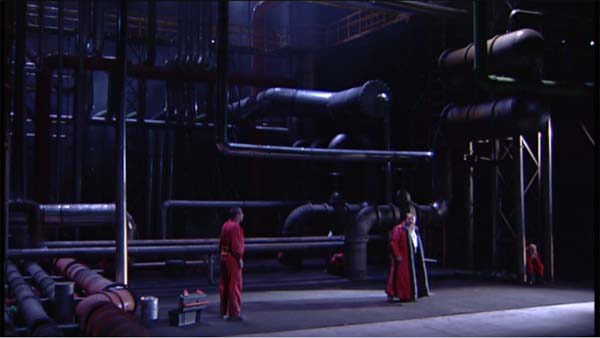
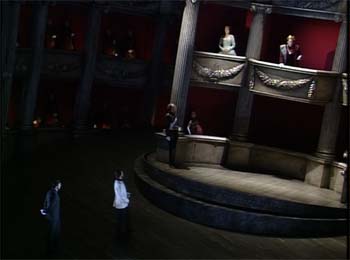
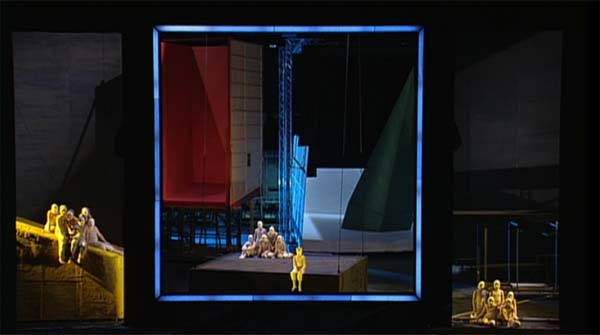
Some time ago, Shezan from LiveJournal pointed me towards the 2003 Salzburg Festival production of Mozart’s La Clemenza di Tito. This is not a work I know at all well and previous efforts to watch it without sub-titles failed miserably. Now I’ve had a chance to watch the DVD. I can do the musical part of the review very quickly. It’s virtually flawless. All six principals (Michael Schade – Tito, Dorothea Roschmann – Vitellia, Vesselina Kasarova – Sesto, Elina Garanca – Annio, Barbara Bonney – Servilia, Luca Pisaroni – Publio) sing exceedingly well and Nikolaus Harnoncourt in the pit coaxes a thoroughly satisfying performance out of the orchestra. What I’m less sure of is what to make of Martin Kusej’s production. He uses the arches of the Felsenreitschule to create a three level heavily compartmentalized area which frames centre stage. Sometimes the compartments are used effectively for the various plotting and overhearing bits of the drama; fair enough. At others they are used to frame tableau that no doubt mean something to Kusej but which escaped me. For example, during the overture, Tito rushes around the set making the odd phone call while very young boys in underpants stand to attention in the various archways. Similarly in the final scene the active stage area is surrounded by a repeated motif of a man and a woman in formal dress with a table with a young boy (again in underpants) draped across it as if for a human sacrifice. I had similar problems with some of the Personenregie. Is Tito supposed to be mad? Certainly many of his arm and facial gestures suggest so and they contrast oddly with his classically stylish singing. My guess is that much more of this kind of thing was going on but Brian Large’s (who else?) direction for video was almost all in close up, often super close up. Maybe he couldn’t figure out what was going on either so decided to ignore it. This was one DVD release that could have used an interview with the director or at least some documentation.

Technically, this TDK release is very good. It’s spread across two disks and has a very good 16:9 picture and choice of LPCM stereo, Dolby 5.1 or DTS sound. The sound balance has the voices fairly far forward but not annoyingly so. The second disk has (at least my copy has) trailers for other TDK Salzburg releases including a 1962 Ariadne and a really freaky Turandot. Definitely worth a quick look!


Freedom for the Rich

Brecht and Weill’s Rise and Fall of the City of Mahagonny might seem a peculiar choice for the Salzburg Festival but it was performed there in 1998 and was broadcast by ORF and subsequently issued as a DVD on Kultur in North America and Euroarts in Europe.

The musical style is pretty similar to most other pre USA Weill works; it sounds more like cabaret than grand opera and feels as if it would benefit from a more intimate setting than the Grosses Festspielhaus. One also feels that the director (Peter Zadek) is trying a bit too hard to fill up the space; There’s lots of “stuff” and busy action that doesn’t seem to add any meaning. It’s a problem I’ve also noticed with the Met HD broadcasts. A bigger problem though lies in the casting. Voices that can fill a huge theatre are maybe not the most idiomatic for this music. The problem really comes over with the women. Dame Gwyneth Jones as the widow Begbick is truly a piece of WTF casting. Catherine Malfitano as Jenny (a role created by Lotte Lenya) is better but still a bit overly operatic. She does act very well though. The one clear success is Jerry Hadley as Jim Mahoney who seems to manage to be idiomatic and to project enough sound. His is a great performance. Among the other characters I thought Wilbur Pauley as a lean, even cadaverous, Trinity Moses really stood out. The orchestral playing is precise and jazzy at the same time. Dennis Russell Davies gets some really good playing from the Vienna Radio Symphony Orchestra.

The staging is eclectic and inevitably didactic. Brecht leaves no Marxist cliche unemployed and the staging and direction follows suit. The best examples are early in the second act where Jacob Schmidt is eating himself to death in a scene reminiscent of The Meaning of Life closely followed by a good deal of nudity and more; it seems to be veering towards anal fisting at one point, to underscore the commoditised nature of sex in capitalist society. During this extended indictment of commercialism, Mahoney moves through the orchestra into the audience and we get the irony of him singing surrounded by the Salzbourgeoisie in their finery. Subtle? Not so much. There’s also lots of weird symbolism in the sets; disembodied Statue of Liberty, elephant statues etc, that I just don’t get. All in all, this isn’t a bad production but it’s not one I can imagine watching very often and I feel like I want to see the more recent LA version to see if it’s more successful.

Technically, the DVD is of its era. The picture is 16:9. The only sound option is Dolby Digital 2.0. There are English subtitles only (This production is sung, mostly, in German). Brian Large (surprise!) directed for TV. For once, I don’t mind that he used a lot of close ups as much of the action cropped seemed to serve little purpose but to fill up space.

And in today’s “only connect” trivia moment I can point out that the premiere of Mahagonny was conducted by Alexander Zemlinsky whose Florentine Tragedy will be directed in Toronto this season by one Catherine Malfitano.

Here’s a link to the “Loving” scene from Act 2. Don’t play this at work!

Salome – DVD of 2008 ROH production

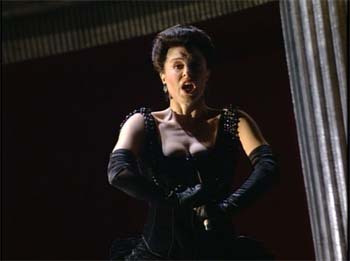
Strauss’ Salome is not for the faint hearted. It contains perversions including, but not limited to, necrophilia, paedophilia and incest. I think this makes David McVicar an obvious choice as director. In fact, by McVicar standards, this 2008 Covent Garden production is fairly restrained and straightforward. McVicar gves the work a 1930s setting which works just fine. The action evolves on a rather elegant two level set; upstairs is Herod’s banquet and downstairs is a sort of guardroom including Jokanaan’s cistern. It’s all quite elegant in light blues and greys and essentially all the action takes place downstairs. There are a few supers including a naked woman and another not far off floating around for no apparent reason except perhaps to suggest that the Judean army is not the Brigade of Guards.

1.beginning

Continue reading

Roberto Devereux

Donizetti’s Roberto Devereux is based (even more loosely than most Donizetti historical operas) on the relationship between Elizabeth the First and the Earl of Essex. Unfortunately for Liz, Essex is in love with the wife of the queen’s bestie; the entirely fictional Sarah, Duchess of Nottingham, whose ducal husband is also Essex’ bestie. Got that? As the opera opens, Essex has been recalled from Ireland to face treason charges but is vigorously defended by Nottingham. Eventually the queen rumbles Essex and agrees to sign his death warrant. By now Nottingham has also figured out what is going on and ties up his wife to stop her delivering the token ring to Elizabeth that will force her to pardon Essex. Essex is executed and the queen goes mad, abdicating in favour of James VI and I (who has been hanging around all along) and then dropping dead from grief. Pretty much par for the Donizetti course really.

1.papers

Continue reading

Orphée et Eurydice – Gardiner DVD

John Eliot Gardiner chose to videorecord the French version of Gluck’s Orphée et Eurydice at the Théâtre Musical de Paris – Châtelet. Choosing the French version is consistent with Gardiner’s other Gluck recordings. The Paris cast is a bit less starry than his Lyon CD version but more than adequate. Orphée is sung by mezzo Magdalena Kozena, Eurydice by Madeline Bender and Amour by Patricia Petitbon. Gardiner uses his usual forces for chorus and orchestra; the Monteverdi Choir and the Orchestre Révolutionnaire et Romantique. Choreography is by Giuseppe Frigeni, stage direction by Robert Wilson and video direction by Brian Large. The DVD is on EMI, has 16:9 video and Dolby 2.0 sound. It was recorded in 2000.

orphchat1

Continue reading

Svadba-Wedding

Last night was the world premiere of Montreal composer Ana Sokolovic’s Svadba-Wedding performed by Queen of Puddings Music Theatre at the Berkeley Street Theatre. The 400 or so seat theatre was packed and I had the splendid company of lemurcatta and sabotabby.

Svadba is an interesting work. I guess one can call it an opera. It lasts about an hour and is sung a cappella in Serbian by six singers. The seven scenes take place the night before Milica’s wedding as her best friends prepare her. There isn’t really a linear narrative but the scenes do unfold with a certain coherence. Similarly, although all the characters are named, only the bride to be Milica has any definable identity. The other five sing mostly ensemble and to someone who hasn’t seen the score seem essentially interchangeable.

The music draws on Serbian folk motifs but also has a lot of play with pure sound elements. That much it had in common with the other Sokolovic piece I’ve seen which was a short opera about mobile telephones. It’s not the sort of music one comes away humming but it is quite accessible and very interesting

The production, by Dairine Ni Mheadhra and John Hess, was quite spare but effective. Fabric drapes at the back of the stage are lit for various effects, a flexible piece of mirror serves multiple roles , most notably as Milica’s bath, and long strios of translucent material unroll to represent water. On occasion some Klieg lights make an onstage appearance and there is a ladder that serves as a sort of throne for Milica in the final scene. It’s all quite unfussy and interesting.

The highlight of the show though is the performers themselves. We got to see and hear six of Toronto’s best young singers and they were excellent. Jacqueline Woodley sang Milica and was wonderful. She seems to improve every time I hear her sing. The “friends” consisted of sopranos Laura Albino (last seen as Mimi at the Tranzac), Carla Huhtanen and Shannon Mercer with mezzos Andrea Ludwig and Krisztina Szabo. The nature of the piece makes it impossible to single out individual performances. What we got was crisp, rapid fire ensemble work covering some pretty challenging material nicely held together by Dairine Ni Mheadhra who conducted.

All in all, it’s a really good piece beautifully performed. It runs until July 2 and there five more performances.

Against the Grain’s Bohème

Last night we were as far removed from the elegant sophistication of the Four Seasons Centre as one can get. We were in the back room of the Tranzac for Against the Grain Theatre Company’s updated, Toronto version of Puccini’s much played La Bohème. The Tranzac is a club. It’s quite scruffy and for many years the Nomads hung out there. I have spent many a riotous evening there involving beer slides and too much booze. It also hosts music events; mostly folk and jazz. Last night’s show was in the big room at the back which, set up with tables as it was, holds maybe a hundred or so people. The bar was open throughout. The beer selection has improved markedly since I was last at the Tranzac with a good range of products from McAuslan’s and Mill Street.

Against the Grain is a newly formed company of youngish performers. Many of them are products of the COC’s Ensemble Studio. This was not an amateur show! What we got was a somewhat abridged version of La Bohème in a new English translation by Joel Ivany (who also directed) adapted to include the translation in place and time to contemporary Toronto sung with piano accompaniment and staged in and around the audience. The piece opens with Rudolfo and Marcello squatting at the Tranzac where, the libretto informs us, it is “fucking cold”. It rolls on from there in a similar vein and it’s very effective.

The singing was excellent. Adam Luther sang Rudolfo and showed that it was well within his compass, high notes and all. Laura Albino sang a serious Mimi capable of great and beautiful passion in her set pieces. Opera turned cabaret singer Lindsay Sutherland Boal was a thoroughly engaging Musetta. She pretty much stole the show in Act II when she worked the room in black corset and tight pants during her big aria. Christopher Mokrzewski was at the piano throughout and did a fine job.

All in all it was an enjoyable and worthwhile evening without the rather jarring aspect of displaying grinding poverty to the rich in their opera house finery. I really like that alongside the increasingly excellent offerings from the COC Toronto can offer opera in settings like the Tranzac.

There are two more performances; tonight and tomorrow.

The 2010/11 Canadian Opera Company season in review

On paper this looked like the strongest season the COC has ever staged. Every production featured a judicious balance of international stars and local talent. Most of the casting would not have looked shabby in any opera house in the world. In execution it didn’t disappoint. All seven shows were better than competent and the best were very good indeed. The critics were mostly positive though La Cenerentola was less enthusiastically received. Despite all that ticket sales don’t seem to have been all that great. There’s been a fair amount of discounting and definitely more empty seats than one expects at the Four Seasons Centre. The grapevine also tells me worrying things like that the most positive feedback came for a pretty mundane production of The Magic Flute.

So what’s up? I really don’t know but I’d love to see the full stats on ticket sales and see what demographic is growing and which shrinking. I’d hazard a guess that we are seeing a typical Toronto phenomenon; not quite daring to be first rate. The good people of Toronto love to think of themselves as “a world class city” but faced with the awful prospect that they might actually have something that is first class they get scared and, for example, elect a buffoon as mayor. It happened with straight theatre about twenty five years ago. There was a brief flurry of innovative, edgy productions of classic plays but it all sputtered out as audiences couldn’t quite engage and the major theatres were rapidly recolonised by Broadway shows for tourists and straight theatre slunk back into the ghetto of producing plays nobody had heard of in tiny scruffy theatres. Hopefully it’s just a generational thing and a new audience that appreciates what’s on offer will be created. Next season is, if anything, even more exciting than 2010/11 so we will see.

(ETA: There’s also a section of the audience I just don’t understand. More specifically I don’t understand why they are there; they cough, they snore, they whisper, they come in late, they leave the second the curtain falls etc. Why do they come? Do they not realise how rude they are? Is it an entitlement thing?)

So back to the season; the good, the bad and the controversial. Highlights for me were, unexpectedly, Tim Albery’s gritty production of Aida which opened the season. This probably generated more hate mail than any production in COC history but I thought it was bold and effective, though like most bold statements not flawless. Certainly nothing else matched it for raw emotion. Less controversial but just as satisfying was Ariadne auf Naxos. Nothing better exemplified the COC’s ability to blend international stars with local talent (though as three out of five of the international stars were Canadian the categories are not exclusive).

Robert Carsen’s Orpheo was an aesthetic masterpiece entirely in keeping with Gluck’s ideas about simplicity. Beautifully performed, it was enjoyable but in an entirely celebral way. Much the same could be said for Death in Venice; design, direction, singing all beyond criticism but somehow failing to engage at the gut level. The problem lying, I think, with the libretto and its source, rather than anything the COC did to it.

La Cenerentola got a lukewarm reception from the critics who didn’t like the production or the conducting much though all praised the singing. I thought they were harsh. It’s not my favourite opera but I liked the production. The much criticised mice were rather fetching, the production design was a caricature but then so is the work, and the singing was splendid. It would have been a great one to have taken kids to as their introduction to opera.

Nixon in China compared very well with the Met’s version, directed by Sellars and conducted by the composer, which is perhaps all we need to say about it.

That leaves The Magic Flute, apparently the vox populi favourite of the season. Well colour me “blah”. It was OK, even rather good. The production was OK if lacking any real imagination. The singing was extremely stylish but lacked gut punch. Maybe I’d have felt different if it was my first Flute rather than my umpteenth. All in all, I enjoyed the Ensemble Studio performance better. What it lacked in polish it more than made up for in spontaneity.

So, a very high standard over all with a raft of star singers and conductors. Why wasn’t the company playing to packed houses? It’s a mystery.

Next season; more Adrienne Pieczonka, Jane Archibald, Robert Carsen and Sir Andrew Davis plus appearances by Susan Graham, Russell Braun, Christopher Alden, John Relyea, Catherine Malfitano and Alan Held among others.

Ariadne auf Naxos

Last night’s Ariadne auf Naxos at the Four Seasons Centre was a delight. It’s a peculiar opera and clearly a section of the audience hadn’t done their homework and were rather confused. It’s in two parts. In the prologue arrangements are being made for two pieces to be performed at a big party at the home of “The richest man in Vienna”. The first is an opera seria; Ariadne in fact written by a young earnest composer and to be performed by a stereotypically haughty diva and tenor. The second is a buffo piece to be performed by the dancer Zerbinetta and her troop of Harlequins. There is much huffing and puffing by the serious opera crowd, especially the composer, about having to perform in such undignified company but the boss is the boss and money talks. The final indignity is when the Major Domo announces his master’s decision that both pieces must be presented simultaneously. Last night this was played out in modern dress on a set that faithfully, at least as I remember it, recreated the rather drab back stage areas of the Four Seasons Centre. I have no idea how many people got the joke but I thought it was funny. Alice Coote, as the composer, and Richard Stilwell, as his mentor, the music master, were excellent and everyone else contributed as needed to make for a very funny first half. It was almost, but not quite, enough to distract attention from some truly gorgeous orchestral playing by the COC Orchestra under Sir Andrew Davis.

The opera proper is a classical myth based story about Ariadne being abandoned by Theseus and wishing to die on her desert island where she is accompanied only by three nymphs who comment on her condition. Ariadne’s big aria, “Es gibt ein Reich”, is all about longing for solace in death. Adrienne Pieczonka sang gorgeously and was well supported by the three nymphs; Simone Osborne, Teiya Kasahara, Lauren Segal. The orchestral playing just kept hitting the spot. All this was played out in front of a very drab backdrop with holes torn in it through which Zerbinetta and her boys were observing the action. This is where it gets weird again as first the Harlequins appear and try to cheer Ariadne up with a bit of comic singing and dancing. She is unmoved. The boys having failed, Zerbinetta herself appears and explains her views on their shared plight as women and her rather cynical philosophy of love. This happens in a coloratura aria of truly fiendish length and difficulty (“Großmächtige Prinzessin”). Jane Archibald brought it off with aplomb and brought the house down. Then it all gets serious again. Bacchus arrives (raving about having been bewitched by Circe, or not). Bacchus and Ariadne sing at each other heroically and rather at cross purposes until they realise that they have redeemed, transformed or something each other through love. Zerbinetta briefly reappears to remind everyone that “a new God always comes”. Ariadne and Bacchus get even more ecstatic, all sorts of starry things start to appear projected on the stage and backdrops, the orchestra goes nuts, and the curtain falls. It shouldn’t work. It’s Strauss and Hofmannsthal perhaps being too clever for their own good but, miraculously, it does work and the music is fabulous. When the performances are as good as last night it’s all really rather wonderful.

The audience reaction was interesting. A non trivial number of seats were empty after the interval and one couple left rather abruptly half way through the opera proper. Those who stayed were very enthusiastic. Makes me wonder what’s happening with the COC audience. Thoughts on that will form part of a season round up post I think.