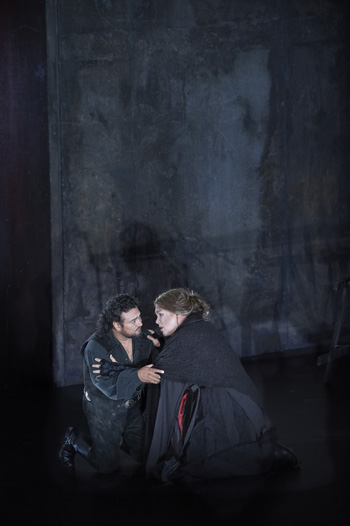
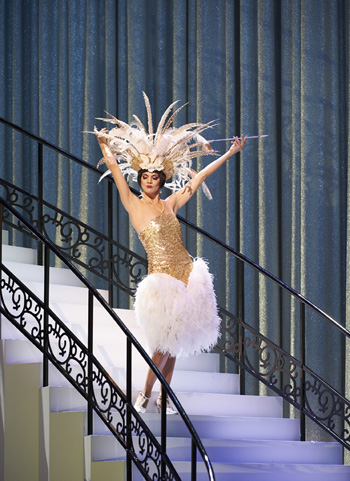
Christopher Alden’s recent productions in Toronto; Rigoletto and Der Fliegender Holländer, were controversial, rather cerebral affairs that delighted his fans but tended to puzzle, and even infuriate, the more conservative critics and opera goers. His Die Fledermaus, which opened last night at the Four Seasons Centre, has something for everybody. There are two main threads uniting the three acts. The first is the piece as an allegory of Austrian bourgeois society from an insecure pre WW1 period through a period of unbridled hedonism in the 1920s to the beginnings of Fascism. The second is a much more explicit depiction of Falke as the ringmaster of the whole circus. He goes from manipulative Freudian psychiatrist in Act 1 to Orlofsky’s confidante in Act 2 to, bat costumed, sitting astride the giant watch that hangs above the stage; the only character aloof from the takeover of the drama by the sinisterly Fascistic Frosch. All this is strung together by prefiguring later elements in earlier scenes. In Act 1 the party goers from Act 2 invade the scene via the fractured wall of Rosalinde’s bedroom as Gabriel imagines the delights to come. A silent but frenetic Frosch appears on stage at various points in the first two acts although his identity isn’t apparent until the coup de theâtre that carries us into Act 3. Additionally Alden does not shy away from bat imagery, including it’s darker overtones. There are bat shadows on the backdrop during the overture, Falke first appears as a Dracula look alike, the ‘ballet’ are batgirls and we close out with Falke, again dressed as a bat, overseeing the denouement. There’s a lot going on and I shall be very happy to see this again and delve deeper (a recurrent theme with Alden productions). Continue reading →


 A couple of weeks ago we recorded another Big COC Podcast. It’s now available on the COC website and from iTunes. This time the panel was myself, Wayne Gooding from Opera Canada magazine and Gianmarco Segato and Gianna Wichelow from the COC.