Unknown's avatar

About operaramblings

Toronto based lover of opera, art song, related music and all forms of theatre.

Artificial and cruel Così

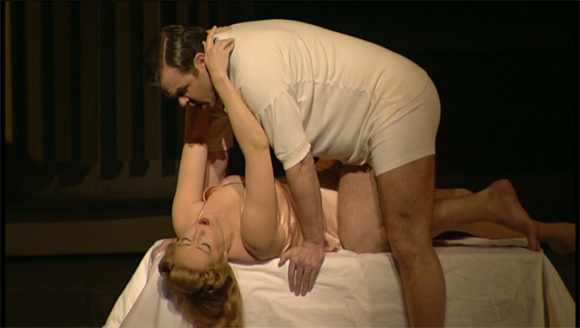
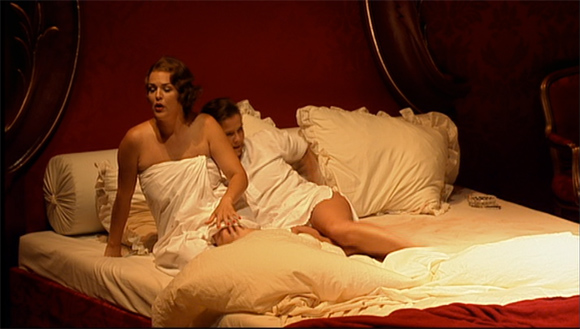
In 1988 Jean-Pierre Ponnelle made the last of his lip synched opera films; Mozart’s Così fan tutte.  It carries Ponnelle’s trademark “artificialityeven further than in other of his films that I have seen.  The sets, the costumes, the acting and the camera work never let us forget that this is a work of the, in the director’s words, “greatest artificiality”.  It also becomes increasingly clear as the piece progresses that Ponnelle has a very clear idea of what “the opera is about”.  Continue reading

Monteverdi’s L’Orfeo at the Liceu

Director Gilbert Deflo was inspired by the Hall of Mirrors in the ducal palace in Mantua, scene of the first performance of Monteverdi’s L’Orfeo, to try and create something similar for the much larger Gran Teatre del Liceu in Barcelona.  The result is an almost extreme HIP approach.  Sets, costumes, acting and singing style are all what we have come to expect from HIP performances of baroque works.  In this case even the conductor and orchestra wear period dress which is quite effective as conductor Jordi Savali looks remarkably like Monteverdi.  For reasons I don’t understand though the lighting plot is one that could never have been realised with baroque forces.  To further advance the “hall of mirrors” idea Deflo makes quite a lot of use of mirrors on stage reflecting the house back on itself which doesn’t really come off on video but I imagine, based on my experience with the COC’s staging of Semele, that it could work well if one was in the right part of the theatre.  There’s also a fair amount of characters entering via the auditorium including a dramatic entrance for Savali as the brass and percussion play the opening toccata from stage boxes.

Continue reading

The Frosch report

Casting for the upcoming COC production of Die Fledermaus, to be directed by Christopher Alden, was announced back in February with one notable exception. There has been no word on who will take the speaking role of the drunken gaoler Frosch in Act 3.  This part is usually played as a buffoon by a second rate comedian(1) so Toronto mayor Rob Ford would seem an obvious choice.  Unfortunately it’s a speaking part so that rules him out.  Now, apparently, we can expect a ‘crisis of capitalism’ Fledermaus but I’m not sure that leaves me any the wiser.

Continue reading

Ponelle’s Cenerentola

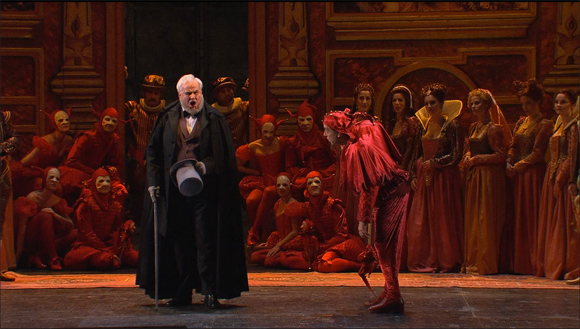
There’s been a fair amount of discussion of Jean-Pierre Ponnelle’s film version of Mozart’s La Clemenza di Tito over at The Earworm so I thought it would be a good time to dig out his La Scala production of Rossini’s La Cenerentola.  They have a lot in common; an obsession with statuary and heavy focus on verticality that makes the picture often seem taller than it is wide are just two.  The Rossini, despite being filmed at La Scala is very filmic.  It’s much more like a movie than a video recording of a staged performance.  Continue reading

Historically informed performance à l’outrance

The works of the French baroque are a rather specialized taste.  Some people love them, some not so much.  There are also strong views on performance style.  Some people favour an essentially modern treatment as in Robert Carsen’s Paris Garnier production of Rameau’s Les Boréades.  Others are fans of the fantasy baroque approach taken by the likes of Opera Atelier.  I’ve seen good examples of both approaches.  What I haven’t seen before is a rigorous attempt to recreate a 17th century staging complete with period appropriate scenery and stage effects.  In 2008 such an attempt was made at the Théâtre de l’Opéra Comique in Paris.  The work involved was the first true opera in French; Lully’s Cadmus et Hermione.  The results are very interesting.

Continue reading

Tcherniakov’s Gambler

So I finally found a way of getting the Kultur release of the 2008 Staatsoper unter den Linden production of Prokofiev’s The Gambler to work, with subtitles and all, though I had to go to my back up DVD player.  As you will read below this is a very interesting and worthwhile DVD but whatever you do, don’t buy the Kultur release which is technically wonky and features sub-standard Dolby 2.0 sound.  For heaven’s sake who is doing Dolby 2.0 on an opera DVD in 2008!  The same recording is available on regionless DVD and Blu-ray from C-Major and in that release it features PCM 5.1 and LPCM stereo choices.  There may even be some useful documentation which, as ever with Kultur, is minimal.  There are also more subtitle choices on the C-Major version.

Continue reading

Maria’s Carmen

In 1989 entrepreneur Harvey Goldsmith followed up his Aida of the previous year with a spectacular production of Bizet’s Carmen in the amphitheatre at Earl’s Court.  This is a sports stadium like venue that seats 19,000 and a cast of 400 or so singers, dancers and supers was employed.  The production was revived in 1999 when It was broadcast by Tyne-Tees Television and has been available on DVD ever since.  Continue reading

For fans of singing competitions

The finals of the International Hans Gabor Belvedere Singing Competition are going to get a live stream this year.  If competitions are your thing there will be a feed live from the Vienna Rathaus starting at 1000 GMT on July 8th at www.belvedere-competition.com

Previous winners have included María Bayo, Stuart Skelton and Rachel Willis-Sorensen.  There are more details here.

Well, grrr

I finally managed to get my hands on a DVD of a Tcherniakov production.  It’s a 2008 Berlin performance of Prokofiev’s The Gambler.  It’s also on the usually appalling Kultur label and, true to form, it’s unwatchable.  The sound is very poor Dolby 2.0, on a 2008 recording, stone the crows etc!  Worse the subtitle encoding (English only) is very weird.  My Blu-ray player won’t show them and nor will Apple’s DVD player.  Vlc will play them but sod it it if I’m going to sit in the computer room for 135 minutes with manky sound and a relatively small screen.  Not acceptable at all.  Grrr!

Ice and Steel

Vladimir Deshenov’s 1929 opera Ice and Steel, based (loosely) on the Kronstadt sailors’ revolt of 1921 isn’t very good but it is of some interest as one of the very first Soviet era works for the operatic stage.  The libretto, by Boris Lavrenjov, is so crude it might be project work for GCSE Stalinist Propaganda.  In the first act black marketeers and sundry other anti-socials are rebuked by sound workers and the political police.  Next we move to grumbling factory workers who are, again, rebuked by the politically sound ones  news of the Kronstadt rising reaches Petrograd and a rather dodgy looking commissar recruits the loyal workers to help put down the rising.  The one character with any real individuality, Musja, a female organizer in a metal works, volunteers to infiltrate the mutineers.  Meanwhile a really motley band of counter-revolutionary elements; SRs, a Mensheik, foreign agents, Tsarist officers, a çi devant aristo vamp and anarchist sailors, argue among themselves in the fortress.  Musja is unmasked and tortured as a spy but as the Soviet infantry launch their famous attack across the ice she manages to blow up the key defensive position and herself.  Cue heroic revolutionary tableau vivant and curtain.

Continue reading