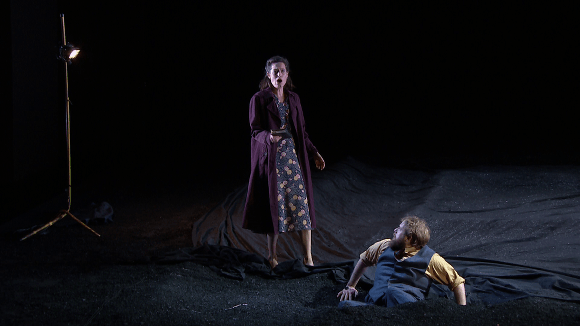
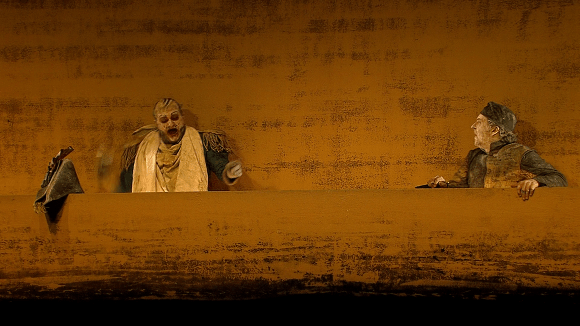
A couple of weeks ago I wrote a preview for Peepshow which opened last night at Campbell House. Summarizing crudely, the idea was to present a show that broke down some of the barriers of formality that make the opera house intimidating and so open up the genre to a different kind of audience. So did Peepshow do that? The answer has to be “to some extent”. There were four shows in four rooms and in an ideal world they would have each played at intervals throughout the evening and people would have been able to drop in and out as they chose. The geography of Campbell House simply doesn’t make that possible. It’s a 19th century house with stairs and corridors and fairly small rooms with mostly “do not touch” furniture. Each room will only hold a dozen, in a couple of cases perhaps twenty people, in comfort levels ranging from OK to excruciating. This means that audience members must be assigned to specific performances, rounded up and herded to their allotted place at the right time; or as close to it as possible as it always takes longer to herd an opera audience than anyone imagines. And no drinks in the performance rooms. Once in, for an admittedly only fifteen minute show, you are as stuck as in a performance of Parsifal at Bayreuth. In other words, rather than a fluid experience it’s a series of chunks of more or less traditional concert hall broken up by some socializing at the bar.
Author Archives: operaramblings
Collaborations
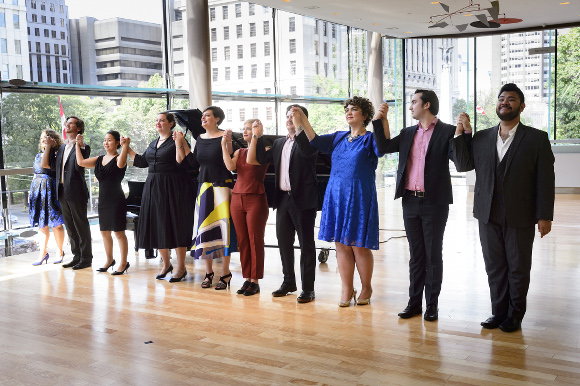
Lunchtime saw the annual concert featuring visiting members of the Atelier lyrique de l’Opéra de Montréal. It turned into something of a Donizettifest. First up was soprano Cécile Muhire with Adina’s aria Prendi, per me sei libero. This was quite competently sung though she seemed very nervous. The nerves seemed to vanish though when she was joined by her Nemorino, Jean-Philippe Fortier-Lazure, for the duet when he tries the elixir. One of the things that has always struck me about the Ensemble Studio is how quickly it teaches singers to have stage presence. J-P was a very funny, rather drunk, Nemorino and his swagger seemed to rub off on Cécile who looked much more at home in this number.

Fruitful and Sacred Ground
Yesterday’s recital in the RBA was given by soprano Simone Osborne and the very busy pianist Stephen Hargreaves. The program began with three Mozart songs that I was not familiar with; Oiseaux, si tous les ans, Dans un bois solitaire and An Chloe. They were unfamiliar to me but Mozartian in a pleasing, intimate way; very much songs rather than concert arias. They got a clean, rather dramatic reading with real feeling from both parties. Next came the Ariettes oubliées of Debussy. Here we have texts by Verlaine of a mostly languorous ecstasy variety with a complex, very impressionistic piano part. Indeed they really do sound like pieces composed by someone who prefers writing for the piano and Stephen brought out their somewhat ethereal qualities nicely. Still the soprano gets to spin some very beautiful languorously ecstatic lines and there’s even one piece; Chevaux de bois, where the mood changes and the singer can have some fun. Which Simone did.

Bryn!
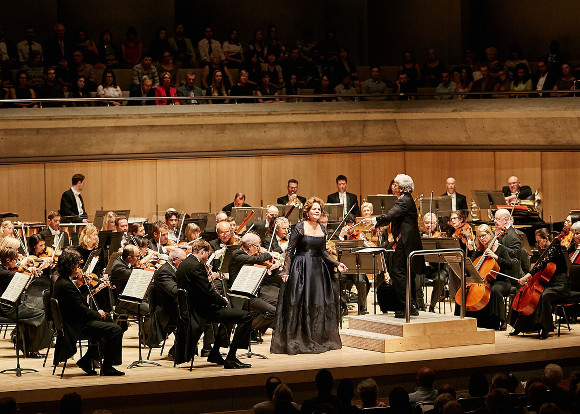
It was my first time seeing Welsh bass-baritone Bryn Terfel live and my expectations were high. They were met, possibly exceeded, but not perhaps in the way I expected.The singing was brilliant across a wide spectrum of moods and genres (I’ll come back to that) but what really stood out was the man’s rapport with the audience which was extraordinary. It’s really hard to describe but let me try with just one example. It’s that thorny issue of people applauding for ages in the middle of sets. The usual approach is to have some functionary come out and announce that “Herr Poffel-Woffel respectfully (huh) asks that the audience not applaud until the end of the set because he believes it spoils the atmosphere”. Bryn’s approach was to wait for the first time it happened, gently shh the audience and announce “I don’t mind at all if you applaud every song but we’ll all get a home a lot earlier if you wait until the end of the set”. There was a lot of that kind of thing and it seemed quite natural and not at all stagey.
Shakespeare 400
Beware of the leopard!
Clémentine Margaine prowled the RBA like an exotic and rather dangerous feline. A total stage animal, she created a stunning series of female personae, from the virginal to the very much not, to bring to life a well curated selection of Spanish and French pieces. She started with the 7 Canciones populares Españoles of de Falla which set the tone as they communicate a wide variety moods and temperaments in a very short space of time. Each little song was fully invested with its own drama. And her eyes. Incredible! Granados’ La maja dolorosa followed. By this point I was really beginning to understand why Ms. Margaine is so sought after. It’s a big, dark, sexy voice. I would probably have realised the sheer size of the voice more on Wednesday if I hadn’t been comparing her to the absolutely enormous sound of Anita Rashvelishvili. It’s a wonderfully expressive instrument perhaps lacking a really strong upward extension but, overall, lovely to listen to.

Russell Thomas in the RBA
American tenor Russell Thomas, currently singing Don José in the COC’s Carmen, gave the lunchtime recital in the RBA yesterday. The main item on the program was Schumann’s Dichterliebe; a setting of sixteen poems by Heinrich Heine and one of the great test pieces of the classic German lieder repertoire. It was a red-blooded, operatic account. Purists might think too much so but I enjoyed the sheer power and beauty of it, even at the expense of the (incredibly wonderful) text not getting the sort of attention it might get from someone like Ian Bostridge. There was plenty of variation of tone and colour, some real virtuosity and even some humour in, for example, Ein Jüngling liebt ein Mädchen but the the most impressive and striking thing was the ability to effortlessly project a lot of rather beautiful sound. Liz Upchurch’s accompaniment was very much in synch emotionally and musically.

Carmen again
We were back at the COC last night for the first performance of Carmen by the alternative cast. (First cast review) As so often seems to be the case with these double cast shows it felt almost like a different production. The biggest differences are produced by the new Don José, David Pomeroy, and the new Carmen, Clémentine Margaine. Pomeroy is a very decent singer but he doesn’t have the ease, power and bloom of Russell Thomas. What he does have is vastly superior acting chops. His Don José is a believably complex human being. We can see his decline from rather boring and provincially stuck up into despair(1). It’s palpable. Margaine’s Carmen is a similar story. Her voice isn’t as big or dark as Anita Rashvelishvili(2) but she’s much more physical on stage. Further, Pomeroy and Margaine are much more credible as a couple. The net result is the drama that was rather missing in the first two acts on Sunday. The price is not hearing two absolutely incredibly beautiful voices.

Livening up
I didn’t do a preview post on Sunday so let’s remedy that with one covering the balance of this week and next week. Carmen continues at the COC with the first chance to see the second cast tomorrow evening. There’s also a slew of lunchtime concerts in the Richard Bradshaw Amphitheatre:
- Russell Thomas, Don José in Carmen, is on Thursday 21st with a program of that includes Schumann’s Dichterliebe.
- The next day, Clementine Margaine, the second cast Carmen, performs French and Spanish love songs.
- On Tuesday 26th, Simone Osborne, the first cast Micaëla, has a program including Debussy’s Ariettes oubliées as well as works by Matthew Emery, Mozart and Cole Porter.
- Thursday 28th sees the annual collaboration between the Ensemble Studio and their counterparts from Montreal.
All of these are at noon and are free.
Carmen in Cuba?
I caught the second performance of the current run of Carmen at the COC this afternoon. It’s a revival of the production previously seen in 2010 but with, we are told, debuting director Joel Ivany being given some freedom to change things up a bit. Obviously he was mostly constrained to use the existing sets and costumes which, for reasons that escape me, transplants the piece to 1940s Cuba which was, as far as I know, markedly short of both gypsies and bull fights but there you go. Actually it matters scarcely at all because both sets and costumes are generic scruffy Hispanic and could be anywhere from Leon to Lima. For the first two acts too the blocking and Personenregie is pretty standard too. It’s all really down to the chemistry between the singers and the quality of the acting and neither is anything to write home about. It says a lot when Frasquita is scene stealing. Fortunately it livens up a lot after the interval. The third act is atmospheric and Micaëla’s aria is deeply touching and for the first time I felt genuine emotion. It gets even better after that with a really effective use of the whole auditorium for the parade which had much of the audience clapping along and a clever stage set up for the crowd during the final confrontation scene. I don’t think it’s a production for the ages but it’s better than merely serviceable and I’ve seen much worse Carmens. And, frankly, it’s simply not realistic to expect one of the season’s cash cows to push the envelope very far.