Unknown's avatar

About operaramblings

Toronto based lover of opera, art song, related music and all forms of theatre.

Golijov at Koerner

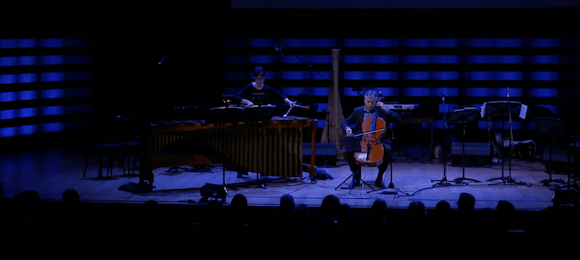
The opening concert of the 21C festival featured an all Osvaldo Golijov programme presented by Against the Grain Theatre.  It was preceded by a very informative conversation between Joel Ivany and the composer.  My main takeaway from that is that Golijov writes for people not instruments.  If the people he has in mind for a piece play a certain combination of instruments that’s what he will write for and if circumstances demand it he will readily make changes.  We saw that last night when cantor Alex Stein was unable to perform in K’vakaret (for cantor and string quartet) and Juan Gabriel Olivares stepped in on clarinet instead.
gk-marimba

Continue reading

Beethoven at the TSO

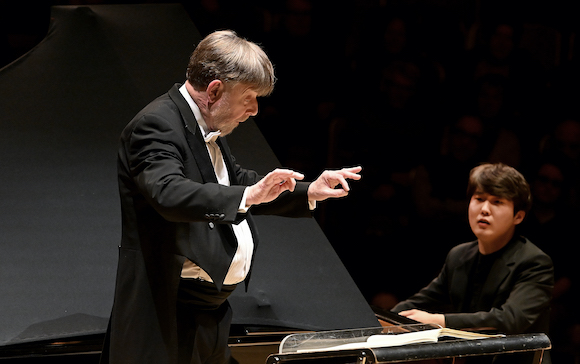
A comparatively rare excursion into purely instrumental music for me last night but the prospect of Sir Andrew Davis conducting Beethoven’s seventh symphony was irresistible.

The “garage piece” was the overture to King Stephen.  Probably the most notable thing about this is that it was composed for a play by von Kotzebue who had just turned down Beethoven’s idea of writing the libretto for an opera on the life of Attila the Hun.  It’s not a fabulous piece but it was efficiently despatched.

JAG_5046

Continue reading

Bits and pieces

A few things from the in box that might interest readers:

Synesthesia-II-in-March-2013-CineCycle-Pic-13So what do you get when you mash up contemporary classical music, experimental electronic music, staging, art installations and other stuff?  That’s what FAWN’s Convergence Theory concerts are about.  There’s one at Victory Social Club on January 25th.  Details are here.  To quote Artistic Director Amanda Smith “As much as Convergence Theory is about exposing more people to new, Canadian classical music, it is also my intention for classical audiences to be introduced to the exciting and plentiful artists of Toronto’s underground experimental electronic music scene. This way we can celebrate the parallels, as well as the individualities of both genres.”

Continue reading

Back half of January

barber-1The second half of January kicks off with the COC’s revival production f Rossini’s Barber of Seville, this time starring Emily D’Angelo as Rosina.  There are eight performances running to February 7th.
.  Sunday 26th at 2pm there’s a concert in the Mazzoleni Songmasters series.  It’s called Sirens and features Leslie Ann Bradley, Allyson McHardy and Rachel Andrist in a suitably watery and alluring program.

Continue reading

Grim Trovatore

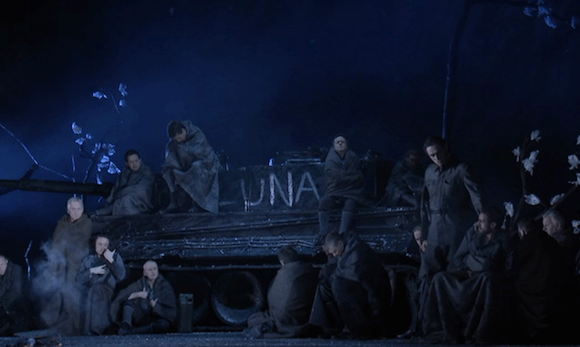
Verdi’s Il Trovatore is always pretty grim.  It’s hard to lighten up an opera with multiple executions, suicide and babies being barbecued.  David Bösch in his Covent Garden production (remounted and recorded in 2017 with Julia Burbach directing), probably wisely, doesn’t even try.  This is as grim as Grimsby on a wet Sunday in February with extra gratuitous violence.  The setting is some roughly contemporary civil war.  The Conte di Luna’s troops are a scruffy lot but they have a pretty cool looking tank.  The gypsies are a bit gayer though Azucena’s caravan is disturbingly plastered with baby dolls reflecting her obsession.  It’s all quite dark.  Really only Leonora (and her maid) stand out as they wear white in contrast to the greys of pretty much everyone else.  The story is told straightforwardly enough and the sets and costumes do provide some kind of moral differentiation between the two camps with Leonora sort of standing above and apart from the violence.

1.soldiers

Continue reading

Tri sestry

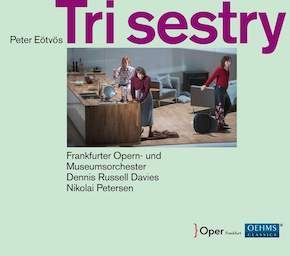
trisestryPeter Eötvös’ 1998 opera Tri sestry is based on the Chekhov play and was recorded live at Oper Frankfurt in 2018. It takes fragments of the original Russian play and recombines them in a non-linear way to create a prologue and three “Sequences” from the points of view of Irina, Andrei and Mascha repectively. The recombination is complex enough for the accompanying booklet to contain a table mapping Chekhov’s scene order to Eötvös’. There’s no libretto in the CD package so even flipping between the (fairly detailed) synopsis and the track listing it’s hard to figure out who is singing or about what. No doubt this was much clearer when watching the stage production.
Matters are not made any easier by giving all the female roles to male singers. The sisters and Natascha are given to counter tenors while the nanny Anfisa is sung by a bass. This is fine except that a non-trivial amount of text is spoken and counter tenors sound just like any other male when speaking which further increases the difficulty of keeping things straight, especially with a cast of thirteen characters! Non-Russian speakers are unlikely to be able to follow much of the text anyway as singers sing over each other for most of the first two Sequences. It does get a bit more open and sparer in the third sequence and someone with a strong knowledge of the language will likely pick up nuances there that I missed.

Continue reading

Elektra trivia

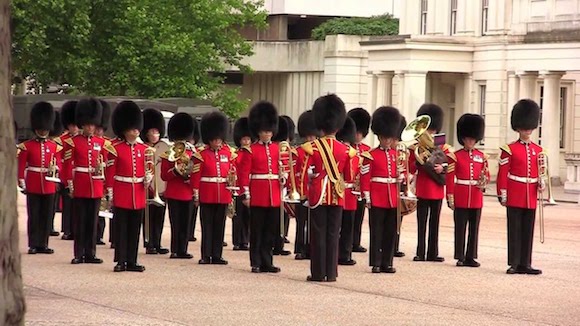
Back in the days when all British regiments had bands it was common for the band to entertain the locals with outdoor concerts in park or seaside bandstands.  As well as the usual martial and patriotic fare, such concerts often featured suites drawn from operettas or operas; both old and new.  Shortly before the First World War the more than averagely enterprising bandmaster of the Grenadier Guards made such a suite from Richard Strauss’ Elektra (premiered 1909).  Rather pleased with it, he decided to insert it into one of those rather dull pauses that happen during Trooping the Colour.  The bandsmen were also rather pleased with themselves for executing such advanced music.  Unfortunately they were soon to be deflated as a liveried flunkie emerged from the palace with a message for the bandmaster… “The King does not know what the music the band just played was but it is never to be played again”.  Sic transit gloria mundi.  Mozart apparently is OK though as the Coldstream’s slow march to this day is Non più andrai.

grenadier guards

Mozart’s Messiah

This year the TSO used the Mozart arrangement for Handel’s Messiah (though, naturally enough, with the original English text).  I have mixed feelings about it.  It’s not hugely different in sound to whichever of Handel’s versions one is used to and it’s definitely not one of those 20th century versions for 100 piece orchestra and massed choirs but I’m hard pressed to see what the point is other than it’s Mozart.

JAG_4231

Continue reading

Best of 2019

Last night marked the last performance I plan on seeing before the holidays so it’s time for the annual “best of” posting.  So what did your scribe enjoy or admire the most in 2019?  Let’s look at it by categories.

Fully staged opera with orchestra

19-20-02-MC-D-855The COC had a decent year but two of their shows stood out for me.  David McVicar’s production of Rusalka in October was perhaps all round the best thing the COC have done in years.  The production was clever in that interrogated the material enough to ask lots of questions for those willing to think about them without doing anything to upset those not so interested.  Musically one really can’t imagine hearing Rusalka sung or played better anywhere in the world.  The other winner was Elektra in January.  The orchestra and the singing was the winner here, especially Christine Goerke, but the production was better than average and we don’t see enough of the great modern classics in the Four Seasons stage.

Continue reading