All change!

The COC announced a bunch of line up changes for the upcoming winter and spring runs this morning.

  • Johannes Debus replaces Jiří Bělohlávek, who has health issues, as conductor for Tristan und Isolde.
  • Daniel Cohen will conduct La clemenza di Tito instaead of Debus.
  • Michael Baba replaces Burkhard Fritz as the ‘B’ cast Tristan.
  • Hanna Schwarz replaces Julia Juon as Herodias in Salome.

No reasons were given for the withdrawals of Fritz and Juon.

Una opera in maschera

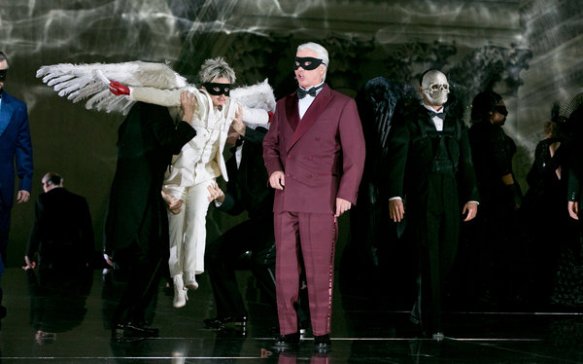
I despair.  I really do.  Yesterday’s MetHD broadcast of Verdi’s Un ballo in maschera had so much going for it.  The singing was brilliant and David Alden’s production seemed to have plenty of interesting ideas.  I say “seemed” because we only got the briefest of brief glimpses of it in between the succession of close ups served up by video director Matthew Diamond.  On the odd occasions we got to see more than a head or a body it was usually from a weird angle.  It’s particularly irritating because the two elements of the production that seemed to be most important were the ones most ruthlessly undermined.  Alden’s movement of chorus, supers and dancers and the contrast between what they do and what the principals do seems to be important but who knows?  Similarly his use of contrasting spaces, especially in Act 3, is obviously important but when the viewer gets only a couple of seconds to establish the context before the camera moves in and loses it the effect is fatally weakened.

ballo Continue reading

The Brothers Grimm hits 500

Dean Burry’s opera for children The Brothers Grimm had its 500th performance last night at the shiny new Ada Slaight Hall at the Daniels Spectrum in the revitalised Regent’s Park neighbourhood.  It’s a work that premiered in 2001 and has been a staple of the COC Ensemble Studio School Tour ever since.  It’s played an important role in developing young Canadian singers as performers as evidenced by the fact that the original cast brothers were Joseph Kaiser and David Pomeroy.  500 performances!

lrc_wolf Continue reading

Full of sound and Furies

When I first encountered Richard Strauss’ Elektra as a teenager I found the music almost unbearably harsh.  The more I listen to it the more erroneous that judgement seems.  It has its “tough” moments to be sure.  How could an opera about Elektra not?  But it is also full of lush romanticism and there are some really quite lovely passages.  In the 2010 Salzburg Festival recording Daniele Gatti explores both sides of the music in a rather thrilling reading of the score aided and abetted by the Wiener Philharmoniker and a pretty much ideal cast.

set Continue reading

Shout out to Washington

Rihab Chaieb and Mireille Asselin

Rihab Chaieb and Mireille Asselin

In February I attended a brilliant lunchtime concert of vocal music by Kaija Saariaho sung by three singers from the COC Ensemble Studio.  I wasn’t the only one who was impressed.  The composer was so taken with the standard of performance that she has arranged for them to perform a slightly different selection of her works in Washington DC in February.

If you aren’t from Toronto or Montreal (or perhaps Paris, Lyon, Dublin or Belgrade) you probably haven’t heard much about Mireille Asselin, Rihab Chaieb or Jacqueline Woodley (except maybe on this blog) but you will!  Strongly recommended both for the music and the singers.

Feeding all the senses

Opera Five’s schtick is that they satisfy all five senses.  In their current show that means matching a food offering with each of the three short operas on display.  It’s a neat idea.  In the current show a palindromic skewer of sausage, pickle and cheese is matched with the palindromic Hindemith work Hin und Zurück, assorted Russian pasty like objects are paired with Rachmaninov’s Aleko and some sort of chocolate on a stick thing with Milton Granger’s 1999 piece Talk Opera.

Continue reading

Grimmfest

virginiaIt’s pretty Grimm in Toronto these days.  Friday will see the 500th performance of Dean Burry’s 1999 opera for children The Brothers Grimm.  Now, 500 performances for any recent opera is pretty remarkable.  500 performances for a Canadian work is extraordinary.  Anyway, in the lead up to Friday there are a number of events scheduled including a concert yesterday lunchtime in the Richard Bradshaw Amphitheatre with a Grimm theme.

Eric Domville introduced the music.  He gave us a disquisition on the Grimm brothers, philology, the Great German Dictionary, folk tales and the oral tradition, his childhood, Romanticism as a reaction to Enlightenment, the plot of several folk tales in their English, French and German incarnations and a potted summary of the cultural, political and religious state of Germany in the mid 19th century.  It was perhaps just a teeny bit more than one resally needed to explain three arias from Hansel and Gretel and one from Königskinder.  Continue reading

Get your tickets now

Photo Credit - Kira Perov 2005

Photo Credit – Kira Perov 2005

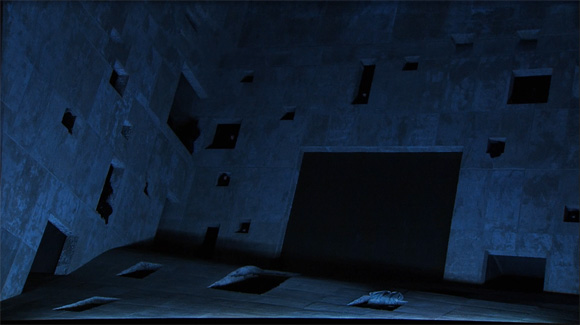
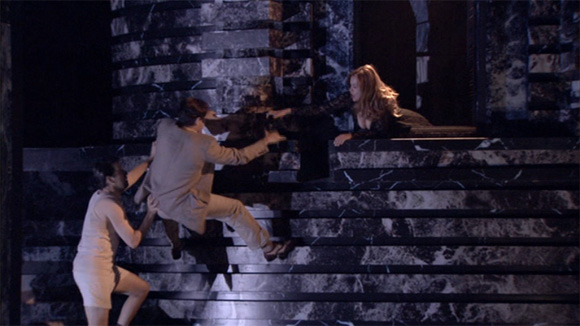
Word on the street is that there are only “a few hundred” tickets left for the COC’s February run of the Peter Sellars/Bill Viola Tristan und Isolde.  It’s a fair bet that most of the available tickets will be for nights when Burkhard Fritz is singing rather than Ben Heppner.  If you want to see Heppner I’d plan on buying now rather than expecting something last minute to turn up.  I’d expect there to be horrific line-ups for the same-day nosebleeds and standing room tickets (and I don’t have the stamina to stand through Tristan!).

tito05Christopher Alden’s production of Mozart’s La Clemenza di Tito apparently isn’t selling so well, despite a stellar cast and a production that got very good reviews in Chicago.  This makes me a sad panda.  Unfashionably, perhaps, I regard Clemenza as one of Mozart’s best operas, perhaps his very best, so the chance to see it with a wonderful cast is one I would not miss.  My current plans call for me to see it twice; with the principal cast and with the Ensemble Studio, but I shall be sorely tempted to get in for an extra look earlier in the run than my current tickets!

Gerry Finley’s Don Giovanni

Jonathan Kent’s 2010 Glyndebourne production of Don Giovanni has a great cast and high ambitions but, ultimately, doesn’t really come off, largely because the relationships between the characters too often fall short of anything interesting.  The concept, as explained in the two short bonus segments, is that Don Giovanni is set in a society in transition and that the title character is a sort of harbinger of the new mores.  The “society in transition” chosen by Kent is a sort of hybrid of Fellini’s La Dolce Vita and the last years of Franco’s regime in Spain.  He might have done better to just pick one as the Fellini elements get pretty much reduced to the costumes and the Franco elements really don’t go anywhere.

window Continue reading