Episode 7 of The Big COC Podcast is up on iTunes and at coc.ca. I’m not involved with this one but Lydia Perovic is holding up an end for us bloggers. There’s discussion of sexing up opera, La Scala’s Lohengrin, the new Meyerbeer at the ROH, the Ensemble Studio competition and singing competitions in general and much more.
Monthly Archives: December 2012
‘Tis the season to speculate
With a month or so to go before the Canadian Opera Company officially announces its 2013/14 season it’s surely time for some uninformed speculation.
There are three big anniversaries in 2013; the bicentenaries of Verdi and Wagner and the centenary of Benjamin Britten. One would think all would be represented but maybe not. We know Verdi will be. Gerald Finley announced at the Rubies that he would make his role debut in the title role in Falstaff at COC in 2013/14 so we can ink that one in. Britten seems probable. There’s a Houston/COC co-pro of Peter Grimes, directed by Neil Armfield that is due to to come to Toronto. I think we can pencil that one in. No idea on casting but I would love to see Stuart Skelton myself. Wagner, I’m not so sure. Maybe February’s run of Tristan und Isolde will be COC’s sole nod to Wagner. Certainly the next most likely candidate; the Lyon/Met/COC Parsifal is, apparently, not expected before 2015.
Incidental Music – finally read
What can one say about a novel that combines opera, the Hungarian uprising, philosophising about urban planning, Toronto, the immigrant experience and lots of steamy lesbian sex? We can say that it’s an interesting combination and not surprisingly it appeals to someone who loves opera, is an immigrant, has a half Hungarian partner and thinks a lot about what makes cities work. The lesbian sex doesn’t do a lot for me but at least it’s well written lesbian sex which beats the heck out of a lot of the other kind in novels.
Reward for effort
Various discussions on and around this post got me thinking about the issue of reward for effort versus instant gratification and what that means for audiences, critics and management. It goes something like this. Opera house schedules are dominated by relatively elderly, often unchallenging repertory. As Philip Hensher says, it’s as if The Second Mrs. Tanqueray was still the most performed piece on the straight stage. In North America these works are usually presented in a way that is unchallenging and familiar to audiences. There isn’t much new work on show and most of what there is is musically fairly undemanding. Even 20th century classics like Lulu or Peter Grimes aren’t much seen except perhaps in the very large centres. In Europe it’s a bit different. The standard works tend to be presented in more challenging productions. The 20th century classics are given more often and new work is often rather more demanding in nature; Riemann and Birtwistle rather than Heggie and Adams.
A very AtG Christmas party

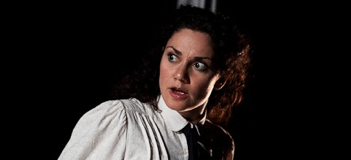
Miriam Khalil as the Governess in last season’s The Turn of the Screw. She was looking sparklier and less spooked last night!
Last night was the Against the Grain Theatre fundraiser at the Norman Felix Gallery. It was definitely billed as a Christmas party but was probably one of the most Jewish Christmas parties since the one in the stable. A fair selection of the great and good of the Toronto opera scene turned out together with an even larger sample of the not so great and good, including the lemur and myself. Topher banged the ivories for a few operatic excerpts and some Christmassy songs. There was carolling, of a rather higher standard than my old parish church, and drinking; though not necessarily in that order. There was a small dog. I think everybody had fun.
Do not expect the form before the ideal
That headline is pretty typical of the English translation of the libretto of Schoenberg’s Aron und Moses. “Holy is genital power” is another gem. The whole thing is basically an extended debate about the nature of God with Moses arguing for an extreme degree of abstraction and Aron championing a more populist version that “the people” can relate to. There are ideas in there that could probably be staged quite spectacularly, such as the Golden Calf scenes and a spot of human sacrifice. There’s even a fairly decent opportunity for an orgy. In their 1975 film Daniele Huillet and Jean-Marie Straub reject any opportunity for visual excess or even representation almost as rigidly as Moses himself.
Can’t get no Atisfaction
Despite also featuring William Christie, Les Arts Florissants and François Roussillon, the 2004 Châtelet production of Rameau’s Les Paladins could hardly be more different from the recording of Lully’s Atys that I reviewed yesterday. The work is based on Orlando Furioso and is an utterly anarchic parody of pretty much everything that Rameau had previously written. It was considered shocking in its day. The production by José Montalvo with choreographic help from Dominique Hervieu is completely mad and tremendous fun.
L’opéra du roi
Lully’s Atys was, apparently, Louis XIV’s favourite opera. It’s not hard to see why. Within the rigid conventions of its time and place it really is rather fine. The plot is classical and convoluted. After an allegorical prologue celebrating Louis’ successful winter campaign in the Low Countries we get the story proper. The hero Atys loves the nymph Sangaride, daughter of the god of the river Sangar, who returns his affection She is betrothed to Celenus, king of the Phrygians. The goddess Cybèle fancies Atys and makes him her high priest. Atys uses his position to nix the wedding which upsets both Cybèle and Celenus. Cybèle blinds Atys who kills himself but is immortalised by being turned into a tree by Cybèle. All of this takes over three hours with lots of ballets and other set pieces. The music is French 17th century court music so it’s a bit unvaried but much of it is very fine indeed.
Notable today
There’s a long and interesting review by Philip Hensher in today’s Guardian of A History of Opera by Carolyn Abbate and Roger Parker. There are more than a few stock clichés but he does have useful things to say about the reason opera might, but shouldn’t, be relegated to a museum piece. In any event, it’s good to see a major daily giving space to a thought piece about opera.
There’s also a related piece by Leslie Barcza over at barczablog. He looks at why we owe it to ourselves to engage with the director’s vision of an opera and should avoid useless and pejorative epithets likes “Eurotrash” and even “Regie”. It’s the best contribution to that endless debate that I’ve seen in a while.
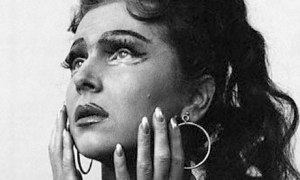
RIP Galina Vishnevskaya
I’ve just read the news of the death of Galina Vishnevskaya. I’m taking it a bit hard because she was an important part of my education in classical music. She, of course, created the soprano solo role in Britten’s War Requiem and was also a notable performer in the premiere of Shostakovich’s 14th Symphony. Both of these works meant a great deal to me as a teenager and still do 40 years later. There’s a good obituary in the Guardian.