I guess it’s a sign that work has attained a certain maturity when it is performed outside it’s own “cultural zone”. Peter Grimes has surely reached that point. A quick look at Operabase suggests fifteen productions worldwide in 2010-12 with only two of those in English speaking countries. That said, four of the five video recordings in the catalogue were recorded in Britain or the United States. The fifth, from Opernhaus Zürich is the subject of this review.
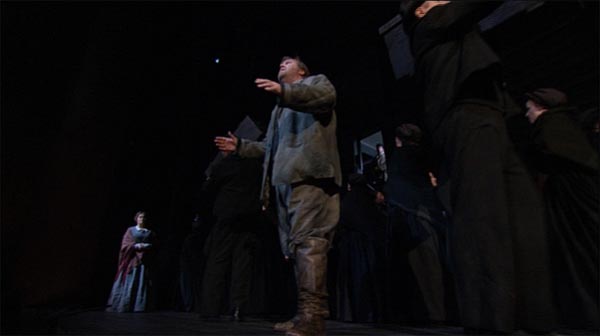
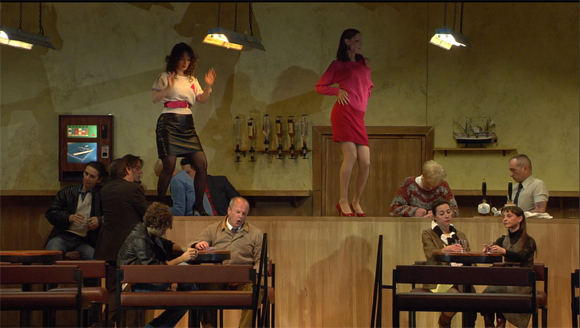
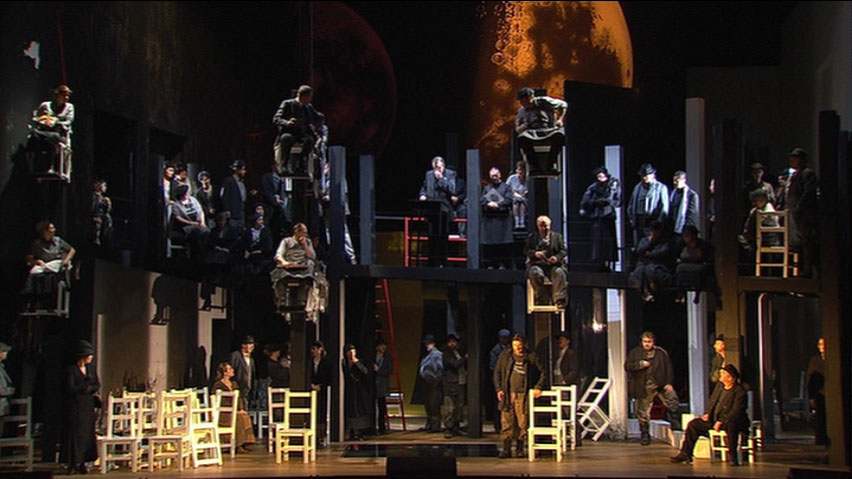
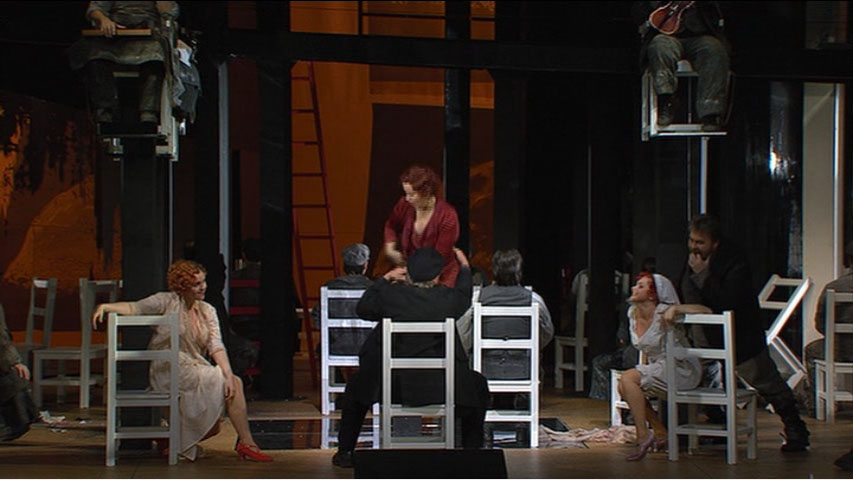
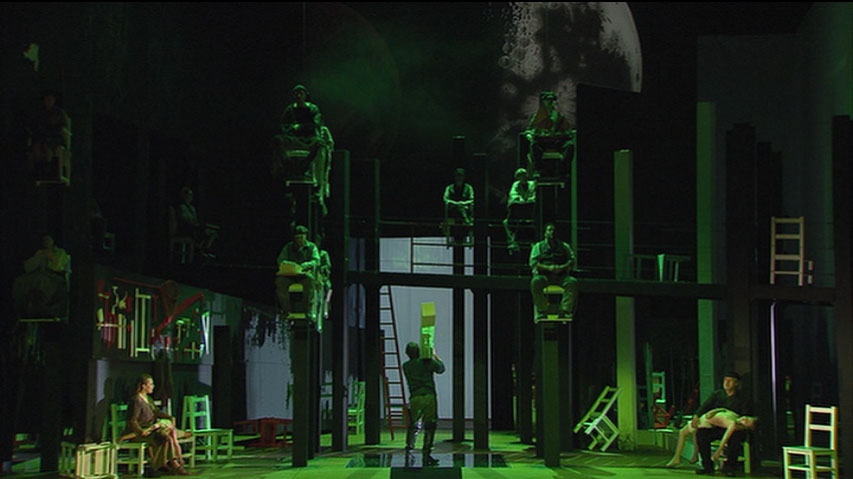
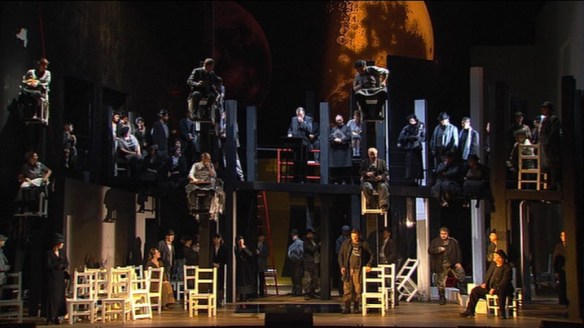 David Pountney’s 2005 production uses a single set, designed by Robert Israel, with gantries at different levels and members of the Borough suspended in chairs above the action. In some ways the concept is similar to the “wall” at the Met but it’s less compartmentalised and not as bleak to look at. It provides a flexible, abstract space which Pountney uses with minor detailing to great effect. Some aspects seem almost Brechtian. The pub scene could be straight out of Mahagonny while “Now is gossip put on trial” takes on quite a militaristic aspect. The set realises it’s potential to greatest impact in the closing scene. Grimes staggers on stage carrying the mast of his boat which he plants on a rocking platform at centre stage. On either side of the stage sit Ellen and Balstrode, each with a dead boy in their lap. As Peter departs to his death, he unships the cruciform mast, shoulders it and walks slowly upstage. It’s stark, beautifully composed and breathtakingly moving.
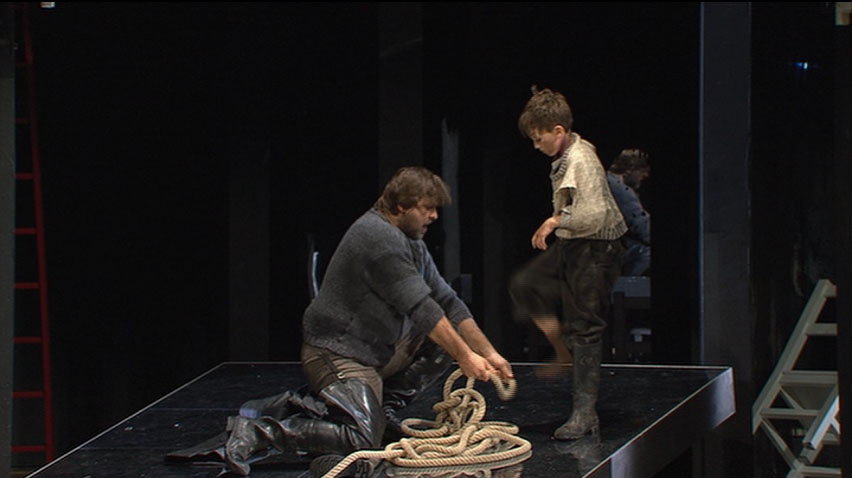
 Pountney is also very careful in his direction of the interpersonal relationships though the Grimes/Balstrode chemistry doesn’t come off as well as in some productions. The Grimes/Ellen relationship is very well delineated. This Ellen is a tough cookie. She stands up to Grimes in the Sunday morning scene and while peter appears desperate and hopeful by turns throughout Act 2 there’s a real finality about Ellen’s “We’ve failed” and it’s followed by a very effective scene with Ellen, Auntie and the Nieces which strongly conveys both “sisters under the skin” and the sense that they, with Grimes, stand outside the tight knit community of the Borough. There are many other deft touches.
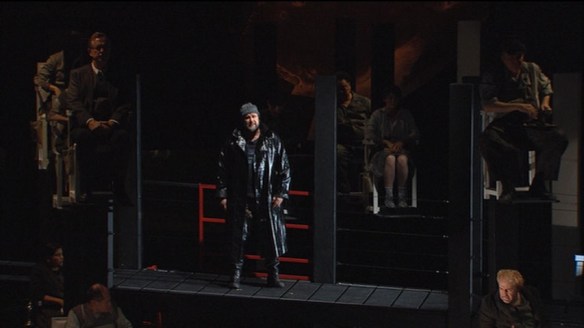
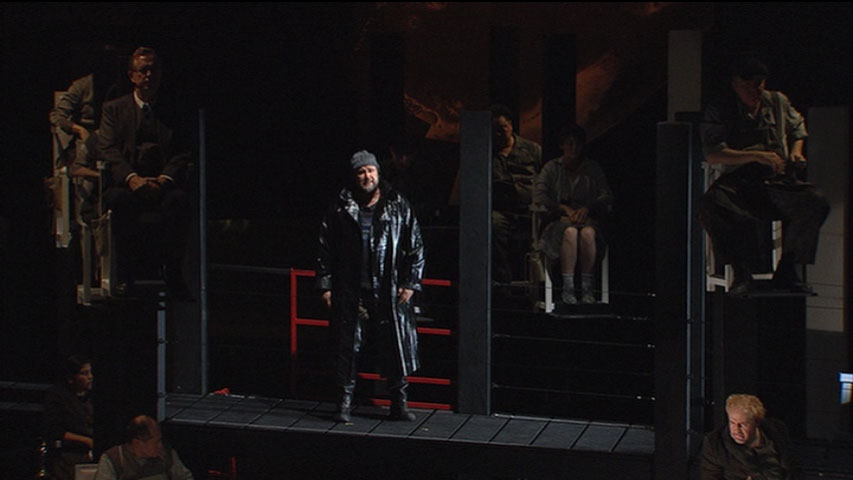
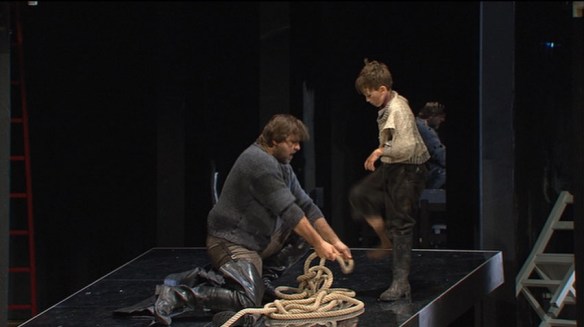 The performances are generally strong. Christopher Ventris’ Grimes is wonderful. He’s a full on Heldentenor who can sing a simply gorgeous pianissimo and he can act. It’s a more subtle performance than Vickers and less ethereal than Pears. He’s a Grimes who just doesn’t really get why the Borough hates him. Even when the lynch mob is heading for his hut at the end of Act 2 he’s more puzzled than angry. We never see him maltreat the boy and he doesn’t really hit Ellen either. He’s magnificent in the final scene. Arguably his is the best Grimes currently available on video.
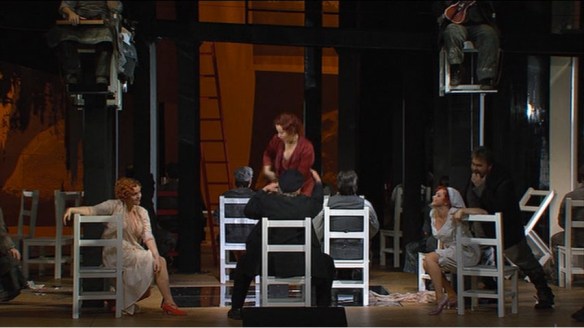 Emily Magee’s Ellen is interesting too. Hers is a more obviously dramatic voice than, say, Heather Harper and not as sweet toned. At times she is a bit squally though at others very lyrical. It fits the interpretation though. As noted above, her Ellen is a tough cookie. I didn’t really care for Alfred Muff’s Balstrode. It’s OK and generally better in the scenes that don’t involve Grimes. He doesn’t achieve the relationship with Grimes though that shines through with Geraint Evans (sadly not recorded) or Anthony Michaels-Moore. Cheyne Davidson makes Ned Keene a more serious and forceful character than his rivals and Richard Angas’ Swallow, is very well characterised indeed, drunk or sober. Liliana Nikiteanu’s Auntie and the Nieces of Liuba Chuchrova and Sandra Trattnigg make a distinctly Continental feeling trio and leave us in little doubt that they are, as the libretto insists, “the chief attractions of the Boar”. Cornelia Kallisch is superb as Mrs. Sedley, maybe even better than Felicity Palmer. She seems to be getting a really creepy sexual pleasure out of her “murder investigation”.
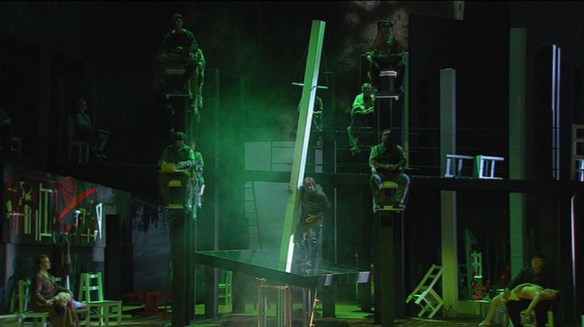 The chorus, orchestra and conductor (Franz Welser-Möst) get absolutely top marks. Welser-Möst directs a consistently incisive, even thrilling, reading of the score and his forces respond magnificently. The chorus is arguably even better than the Met’s and their English diction is almost impeccable.
Video direction is by Felix Breisach and it’s very good indeed. he’s reasonably judicious with his close ups and doesn’t muck about with silly angles. Generally i felt the camera was going pretty much where I would if I were watching in the theatre. In an attempt to do his camerawork justice the screencaps in this post are full sized. Click to get the large version.
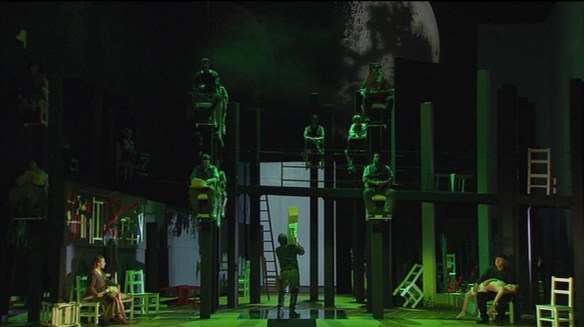 The 16:9 anamorphic picture is first class. The sound options are LPCM stereo, Dolby 5.1 and DTS 5.1. The last is clear, detailed and focussed with excellent dynamic range. It’s markedly better than the options. There are English, German, French, Spanish and Italian subtitles. Extras are restricted to some EMI promos which do include some interesting Maria Callas material. Documentation is limited to a short generic essay about the history of Peter Grimes. It’s a shame really. With two DVD9 discs to play with there’s definitely room for a conductor and/or director interview. A chapter listing would be nice too!
Quibbles about the packaging aside, this is a very fine DVD set. For those interested, David Pountney has a rather interesting blog.

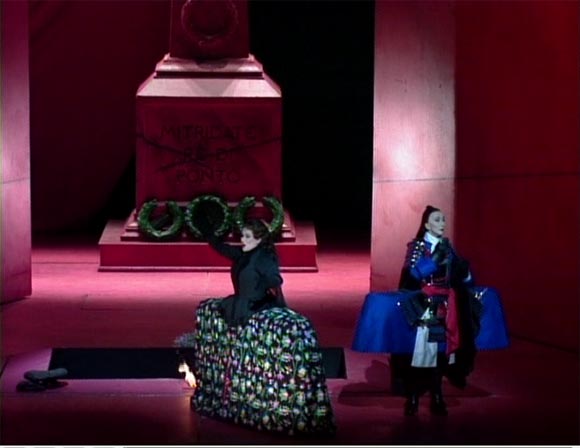 The director – Graham Vick, designer – Paul Brown and choreographer – Ron Howell do a pretty good job of injecting some life into the production with fairly extreme use of colour in the costume design, sets and makeup. The choreography and blocking is also quite striking at times but it still ends up being rather a wash of coloratura. The singers too do a worthy job but after a while it all starts to sound the same. Good work too from conductor, Paul Daniel, and the ROH orchestra but ultimately a bit blah.
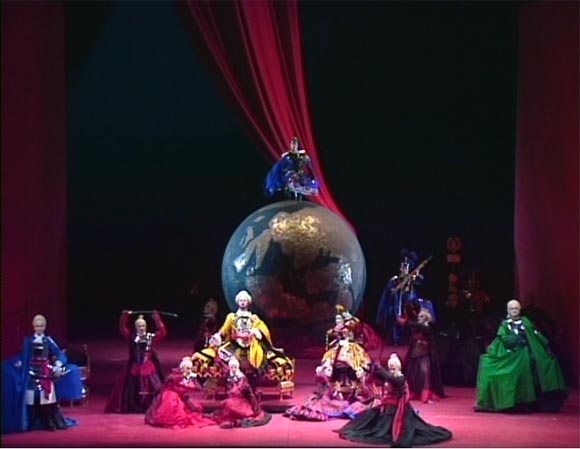 Video director Derek Bailey does a pretty good job for the period. It’s hard to object to closing in on the singer during a da capo aria and he does pull out when there is stage wide action. He’s not helped by pretty average picture quality that lacks the definition needed to make long shots fully effective. Technically it’s a typical Kultur release of the period. The less than brilliant picture is coupled with so-so Dolby 2.0 sound, hard coded English sub-titles and minimum documentation. It’s also a bit quirky in that the overture comes on, with lead in credits, as soon as the disc is inserted. There’s no “set-up” menu.
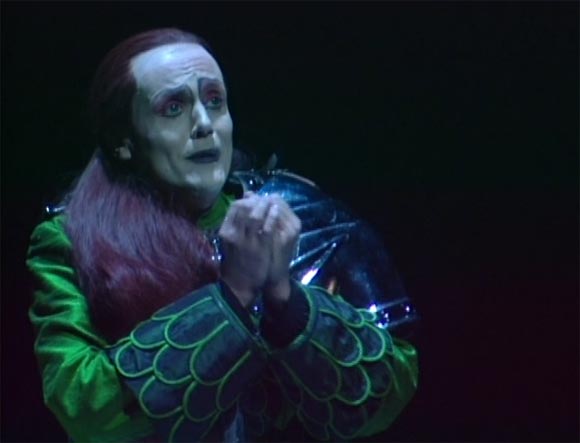 One for the Mozart completist.
 Tickets are now on sale for Against the Grain Theatre’s new show;


 operaramblings