Can Bayreuth really tackle Meistersinger?

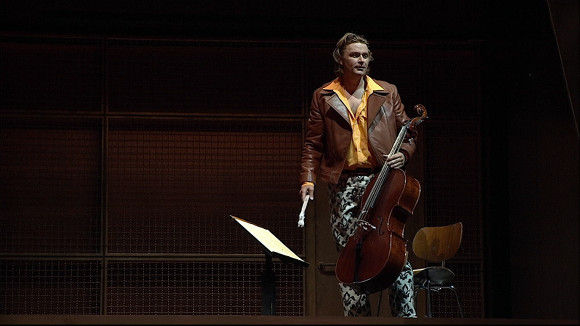
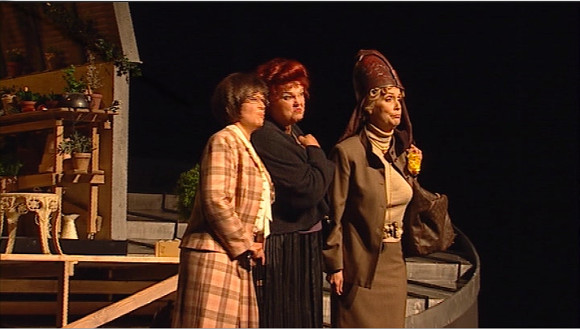
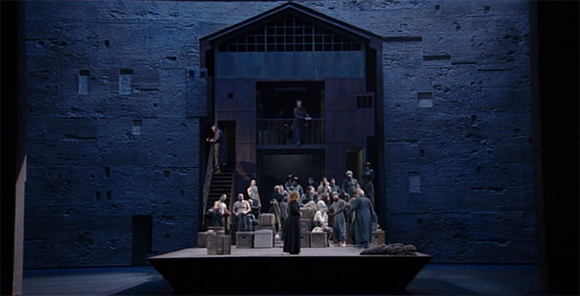
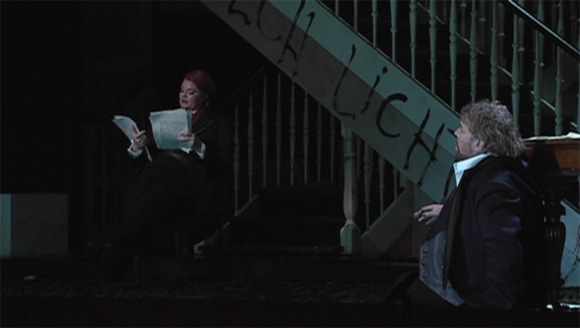
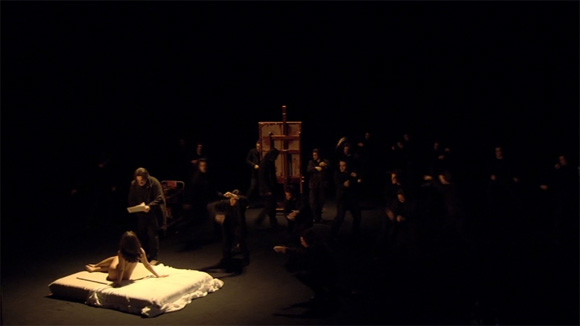
Die Meistersinger is a problematic opera, particularly for Bayreuth.  It has rather disturbing elements of German nationalism and a performance tradition at the festival of those being used for ends that most people would rather be able to forget.  No surprise then that Katharina Wagner’s production, recorded in 2008, tries to deal with both.  It’s a bold effort.  Like Robert Carsen’s Tannhäuser it tries to use visual art as a metaphor for music and art in general.

1.walther Continue reading

Brünnhilde lives

The concluding instalment of Kasper Holten’s Copenhagen Ring really does wrap it up as Brünnhilde’s story.  It’s very effective in so doing too.  Holten states that the central problem in interpreting the Ring is the ending and he points out that Wagner struggled with it for years before resorting to what Holten sees as a cop out; the tired, patriarchal device of wrapping things up by having the heroine sacrifice herself for her man.  Holten rejects this and instead offers us a living Brünnhilde as a symbol of hope and renewal at the end of a century of terrible strife.  I wish I were as optimistic.

1.norns Continue reading

The Copenhagen Ring – Siegfried

So, onto Siegfried.  Now we are in 1968 but it’s a rather laid back Danish 1968.  It doesn’t reference any of the canonical events of that momentous year though there is a bit of a youth vs experience vibe.  Holten doesn’t let us forget that Siegfried is 18 and Stig Anderson, at 60, manages to pull off the look very well.  James Johnson’s Wotan, on the other hand, is shown in decline; the elder statesman who can’t retire gracefully, like a Berlusconi or Murdoch.  Mime is an ageing nobody hunched over his typewriter and still yearning for some “success”.

1.house Continue reading

Musically satisfying Tristan from La Scala

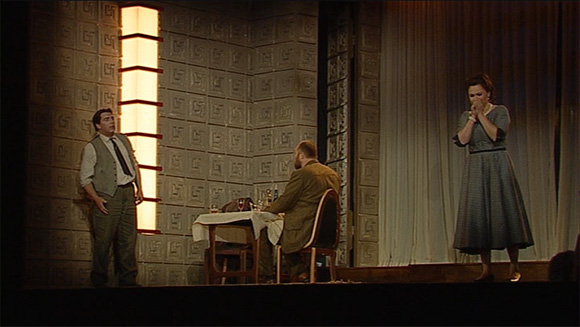
I’ve been looking really hard for a video recording of Tristan und Isolde that I felt I could recommend because, frankly, nothing is worse than a badly executed Tristan as those who suffered through the Met HD broadcast a few years ago will know.  In the 2007 La Scala recording I have found one I feel confident about.  Is it perfect?  No.  A perfect Tristan is probably beyond mere mortals.  I’m never sure whether I find it more astonishing that anyone can sing this music or that a composer might have imagined that he could find people who could.  That said, the La Scala recording is very close to an ideal Gesamtkunstwerk.

1.ship Continue reading

Perplexing Tannhäuser

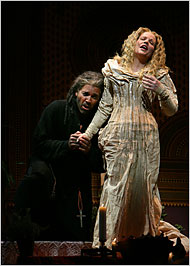
In Kasper Holten’s production, recorded at Royal Danish Opera in 2009, Tannhäuser is a poet torn between family and the conventional world of the Landgraf’s court and his creative processes symbolized by Venus and Venusberg.  There are numerous visual clues that perhaps we are even supposed to identify Tannhäuser with Wagner himself.  Far from being a young man, this Tannhäuser is middle aged, married to Eizabeth and has a son.  He has withdrawn into a psychological world of his own and Venus, his muse, and Venusberg are in his imagination.  Only after death is he recognized as a genius.  Of the rest, how much is supposed to be external and how much internal to Tannhäuser’s imagination is a bit hard to grasp.  If nothing else it goes some way to making the sixty year old Stig Andersen as Tannhäuser and the equally mature Susanne Resmark as Venus almost believable.  The 1900ish setting works quite well for the sexually repressed court of the Landgraf von Thüringen though a chorus of pilgrims returning from Rome in full evening dress is a bit of a jar.  The concept is quite interesting but really probably stretches further than the libretto can accommodate.  This Venus isn’t remotely credible as a goddess of love and the matronly Elisabeth singing about being a pure, young maiden is just odd.

1.heinrich_venus Continue reading

But is it art?

Wagner’s Tannhäuser is the earliest of the canonical works.  In some ways it’s very Wagnerian.  It has screwed up theology with a heavy dose of misogyny and some recognisably Wagnerian music.  On the other hand it is structured more like a French grand opera and some of the music definitely has more than a hint of Meyerbeer to it.The basic plot is that of the hero seduced into sin by the pagan love goddess Venus and then redeemed by the love (and death) of the chaste virgin Elisabeth.

1.venus Continue reading

The Copenhagen Ring – Die Walküre

The Copenhagen Ring has been dubbed the feminist Ring with good reason and we’ll come back to that in looking at the relationship between Wotan and Brünnhilde.  It might also be called the drinkers’ Ring.  There’s an astonishing amount of boozing going on.  It was there in Rheingold with Loge’s hangover and Alberich staggering drunkenly after the Rhinemaidens.  It’s back in Die Walküre.  Hunding and Siegmund knock off the best part of a bottle of Bushmill’s Malt (Add a few cigars and this scene would be perfect for Stuart Skelton and Iain Paterson), Wotan has a flask in his pocket and the Walkyries; Ride is like a sorority party.  Actually it reminds me a lot of Denmark so maybe it just seemed natural.

1.hundingshall Continue reading

Dodgy theology night at the opera

Thais190I seem to be in the middle of a run of operas full of dodgy theology.  First it was the Met’s Parsifal where Wagner à la Girard dished up a puzzling mixture of misogyny, sacred wounds, centuries long curses, bastardization of the Eucharist and weird holy weapons.  There’s a really good conversation about this over at Likely Impossibilities.  Today I was at Opera in Concert’s semi-staged production of Massenet’s Thaïs.  (My review of this should be in the summer edition of Opera Canada).  So today was more misogyny, hairshirts, lots of penance and the idea that the road to sainthood is to be a tart until one’s looks start to go and then torture oneself to death in an appropriately aesthetic manner.  Also, showing empathy for anyone not exactly like oneself leads to doubts, expulsion and damnation.  Coming up soon, Poulenc’s Dialogues des Carmélites, in which salvation is achieved by rejecting anything to do with the Enlightenment and being guillotined.  There’s a Salome in there too somewhere though I’m not sure there’s anything that could be called coherent theology at all in that.

Blessed are the cheesemakers… Really.

The Copenhagen Ring – Das Rheingold

This 2006 Copenhagen production of Wagner’s Ring has been written about a lot.  It’s been dubbed “the feminist Ring” and a lot has been made of the frequent camera cuts and odd angles.  Actually what struck me most about it was the comparative goriness.  The video direction (by Uffe Borgwandt) didn’t strike me as particularly unusual.  I’d say it was better edited than a typical Halvorson Met broadcast but not so terribly different in spirit.  The main difference is that this is very much presented as a film rather than a documentary record of a live performance.  Oddly it begins very much in live performance mode with footage of the Queen of Denmark taking her seat and of the conductor (Michael Schønwandt) complete with miniatures of his decorations on his tail coat going to the pit.  From then on though we get anything but what the audience in the house saw.

1.rhinemaidens Continue reading

Finding the Holy Grail

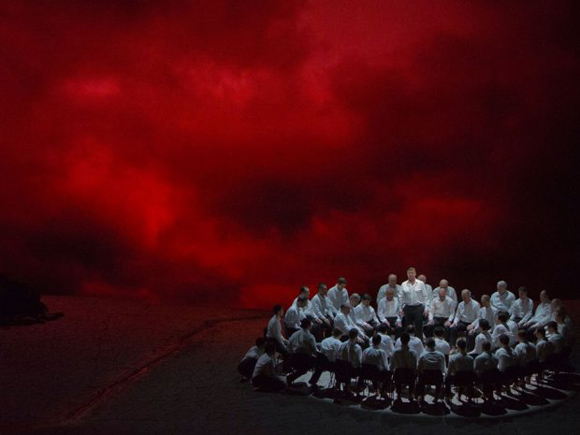
Yesterday’s Met Live in HD broadcast of Parsifal was one of the best I’ve seen.  The production is highly effective, the starry cast lived up to the hype and the video direction was sensitive and true to the staging.  Any reservations I have about the experience are due to the work itself but that may be matter for another day.  It certainly reinforced my belief, consolidated by seeing Tristan und Isolde twice recently that these big Wagner operas are high risk, high reward.  When they come off they are incredible.  When they don’t it’s six hours of one’s life gone missing.

1.act1conclave Continue reading