Old Songs, New Songs

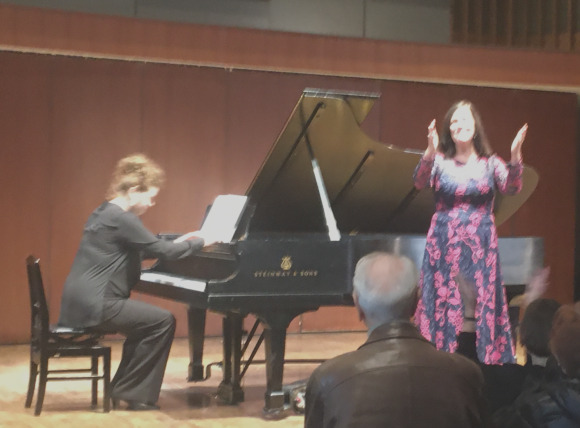
Yesterday Matthew Cairns and Rachel Kerr performed an unusually wide range of songs in the Richard Bradshaw Amphitheatre.  It’s part of Matthew’s prep for his CBC recording session which was part of the prize at last year’s Centre Stage and which will be broadcast in the new year.  They kicked off with a contrasting pair of Duparc song’s.  First came the almost dreamy L’invitation au voyage with it’s arpeggio accompaniment followed by the much more dramatic Le manoir de Rosemonde.  These really set the tone for the recital.  There was power where it was needed but also considerable delicacy from both singer and pianist.

Matthew Cairns Rachel Kerr -5895

Continue reading

The Maiden and the Nightingale

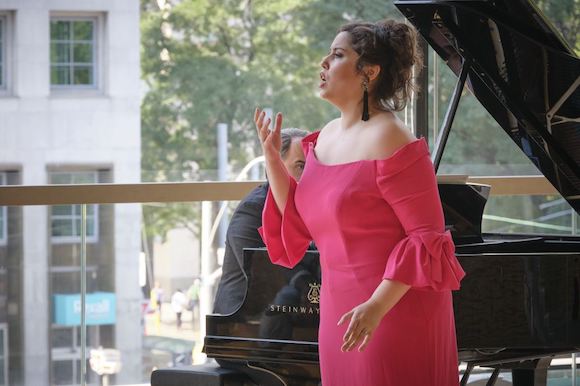
Yesterday’s lunchtime recital in the RBA was given by soprano, Vanessa Vasquez and pianist Miloš Repický.  It was a well constructed programme though there were few surprises.  The first set was three Strauss standards; Ständchen, Breit’ übermein Haupt and Befreit; the last dedicated to Vanessa’s teacher who died recently.  They were all well sung with appropriate emotional emphasis and, best of all, both performers appeared to be enjoying themselves.

2019-10-01-Maiden-_XT37483

Continue reading

An anti-Salome?

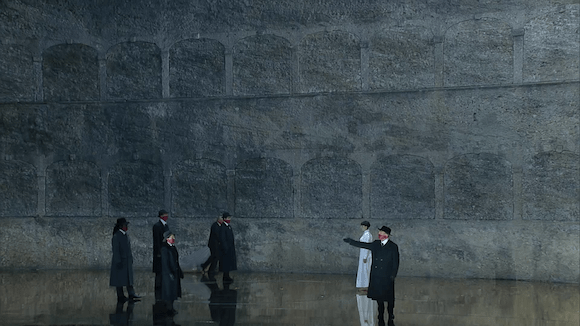
I’ve learned not to dismiss Romeo Castellucci’s work on first watching because it has a nasty habit of starting to make sense on reflection.  His 2018 production of Richard Strauss’ Salome for the Salzburg Festival may be a case in point.  Castellucci seems determined to destroy any preconceptions we have about the work and Franz Welser-Möst in the pit is a willing accomplice.

1.walls

Continue reading

Toronto Summer Music opener

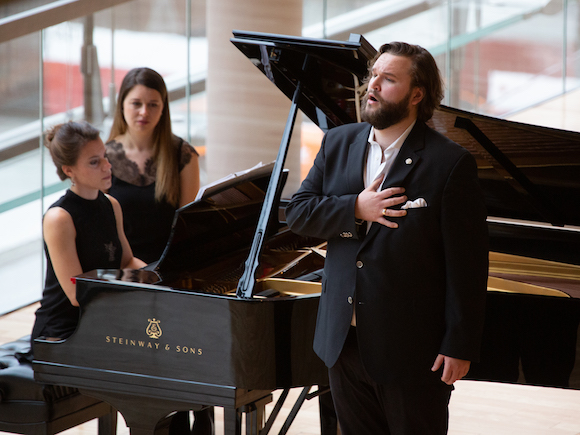
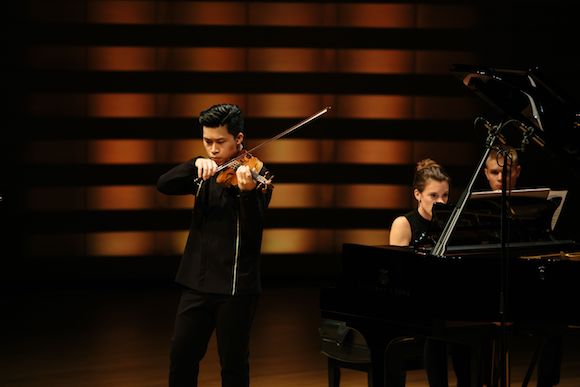
Last night saw the first concert of this year’s Toronto Summer Music Festival.  The theme was “Beyond Borders” with most of the works presented; a mixture of piano, violin and vocal, having been influenced by other cultures/places or written in exile.

bb1

Continue reading

Monica and Judy

Yesterday’s Mazzoleni Songmasters recital featured the relatively unusual combination of soprano Monica Whicher accompanied by Judy Loman on harp.  It was a very well constructed and executed afternoon of song.  Each set had something to offer.Th first set was of English songs of the 16th and 17th centuries including the very lovely O Death Rock Me Asleep attributed, almost certainly inaccurately, to Anne Boleyn.  All very touching and harp seeming very appropriate for songs which were likely intended for lute accompaniment.

judymonica

Continue reading

Terezín

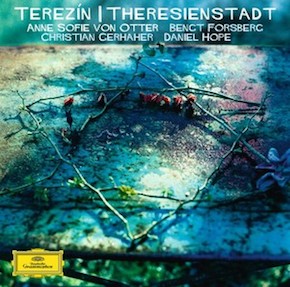
terezinTerezín/Theresienstadt is a CD of music composed in the concentration camp at Terezín in what was then Czechoslovakia.  Virtually the entire Czech intelligentsia; certainly those of Jewish or Communist persuasion, were imprisoned in a kind of “show camp” to demonstrate to the world that the Nazis weren’t as bad as made out.  Nine of the ten composers featured on the disc ended up on a “Polentransport”; a one way ticket to Auschwitz.  No story is more poignant than that of Ilse Weber, a nurse in the hospital.  She chose to accompany the sick children of the camp on their final journey and reportedly sang to them in the gas chamber.

Continue reading

Not Sam

Off I went to the Four Seasons Centre to see Samuel Chan and Stéphane Mayer perform some Schubert.  Sadly Sam was indisposed so what we got was a hastily, but very well, constructed program featuring some of the other singers in the Ensemble Studio.

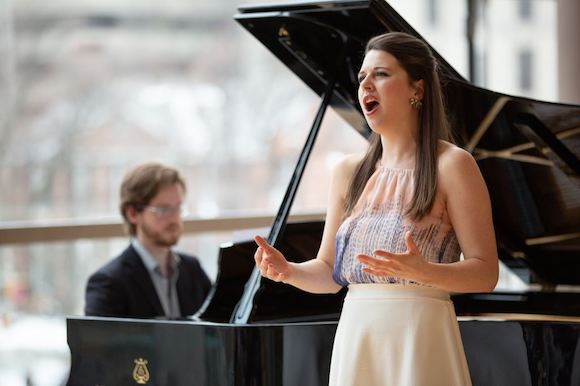
Things kicked off with the increasingly impressive Anne-Sophie Neher in an accomplished rendering of Mozart’s “show off” piece Exsultate jubilate, in which she showed very decent control in the rather fiendish runs.  She was back later with “The Presentation of the Rose” from Der Rosenkavalier which sounded suitably Straussian and sufficiently girlish at the same time.  Nicely done. She made a third appearance with one of Adèles’s arias from Le comte Ory.  This didn’t quite do it for me but it was fun to hear Stéphane playing around with the very Rossiniesque accompaniment.
COC-FCS-20Feb2019-1758

Continue reading

The Three Tenors

Today’s RBA lunchtime concert featured the three tenors; Kammersinger Michael Schade, currently appearing as Aegisth in the COC’s Elektra, Irish tenor Mick O’Schade and Scottish folksinger Michael McSchade.  They were most ably supported by COC Concertmaster Marie Bérard and Sandra Horst at the piano.  The concert was billed as a tribute to John McCormack and Fritz Kreisler but sad events had morphed it into also being a tribute to the CBC’s Neil Crory.  I hope, and believe, that he would have appreciated the combination of whimsy and serious music making.

2019-01-29-homage-9815

Continue reading

Five star Elektra

Richard Strauss’ Elektra opened last night in a revised version of James Robinson’s 2007 production.  The setting is fairly straightforward and a bit drab; vaguely Victorian, or perhaps Gormenghast, which seems about right for the hagridden House of Atreus.  The stage is severely raked; back to front. and stage left to right.  There are a couple of walls with entrances.  There’s a strange little hut which, it turns out, forms a sort of trap door to the palace.  Costumes are either shapeless (ladies) or vaguely reminiscent of evening wear (gentlemen).  In this setting the action plays out convincingly enough with even difficult scenes like Elektra’s “death dance” well handled.  The tricky scenes between Elektra and Klytämnestra and Elektra and Orest have the appropriate degree of tension and suspense.

18-19-03-MC-D-0033

Continue reading

Who knew Frosch could be funny?

Toronto Operetta Theatre opened a run of Strauss’ Die Fledermaus at the St. Lawrence Centre last night.  It’s a will crafted production; basically traditional as to costumes and sets and with a generous amount of more topical jokes added to the dialogue (both dialogue and musical numbers are performed in English).  The one thing about it that is a bit different and much to be praised is that the jailer Frosch, played by director Bill Silva-Marin, is actually funny and sings pretty well for a guy who doesn’t sing a lot anymore.  The schtick is that he is obsessed with singing and insists on singing lessons from Alfred (or here Alfredo) when he appears in the jail in place of Eisenstein.  The singing lessons are kind of a parody with plenty of jokes about vocal production and a fair bit of physical humour.  All this is actually set up from the beginning by making Alfred a rather larger role than usual with a fair amount of interpolated snatches of Verdi and Puccini.  It may not sound that radical but it does liven up the third act which all too often can be pretty dull and anti-climactic.

144

Continue reading