Cartoonish barbiere

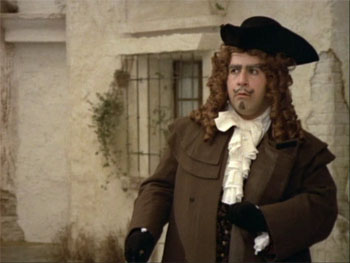
So following on from Jean-Pierre Ponelle’s last film we now turn to one of his earliest, a 1972 version of Rossini’s Il barbieri di Siviglia.  It’s based on his production for La Scala but is, as usual with Ponelle, studio recorded and shot in the studio with lip synching.  It’s not an especially interesting production but it does have a starry cast including Hermann Prey in the title role.  Continue reading

Ponelle’s Cenerentola

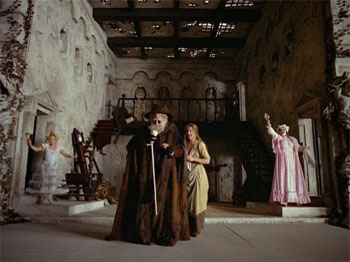
There’s been a fair amount of discussion of Jean-Pierre Ponnelle’s film version of Mozart’s La Clemenza di Tito over at The Earworm so I thought it would be a good time to dig out his La Scala production of Rossini’s La Cenerentola.  They have a lot in common; an obsession with statuary and heavy focus on verticality that makes the picture often seem taller than it is wide are just two.  The Rossini, despite being filmed at La Scala is very filmic.  It’s much more like a movie than a video recording of a staged performance.  Continue reading

Tancredi in Schwetzingen

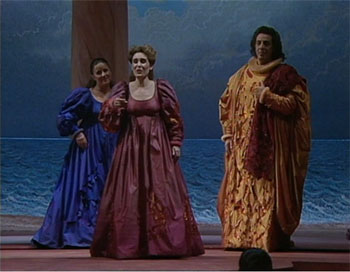
Rossini’s Tancredi isn’t performed particularly often but it was Stendhal’s favourite opera and it’s not hard to see why both these things are true.  It’s got some really lovely music but the plot is pretty thin and it’s hard to cast.  It needs a very versatile low mezzo/contralto for the title role and a crackerjack soprano and tenor too.  I watched it in a well cast 1992 production from the Schwetzingen festival and enjoyed it despite some frustrations with the staging and the implausibly drawn out plot of the second act.  Continue reading

Il Viaggio a Eurovision

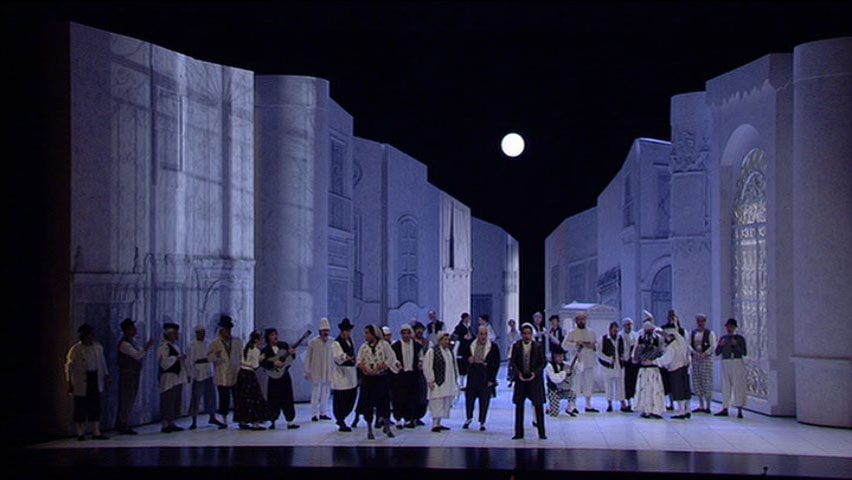
Rossini’s Il Viaggio a Reims is a curious work.  It was written as part of the celebrations for the coronation of Charles X of France, a leading contender in a relatively large field for the title of “most utterly useless king of France”.  It doesn’t really have a plot and, in a sense, is a three hour riff on “An Englishman, a Frenchman and a German go into a bar”.  It also has a huge cast; twenty solo roles of which ten or twelve are quite substantial and require no little virtuosity.  It’s small wonder that it’s not seen all that often.

Continue reading

Cool and refined Barbiere

Emilio Sagi’s 2005 production of Il Barbiere di Siviglia is incredibly elegant and restrained. It looks like something by Robert Carsen.  The sets are all constructed and transformed in full view and just about everything is black and white until the final scene.  There is a lot of background action and commentary from a talented group of dancers who give a very Spanish feel to the piece.  The final scene bursts into vivid, even loud, colour and the finale is just gorgeous to look at. The direction of the actors is well thought out too though they do seem to sing from on top of furniture a lot of the time.

Continue reading

Scintillating Il Turco in Italy from Zurich

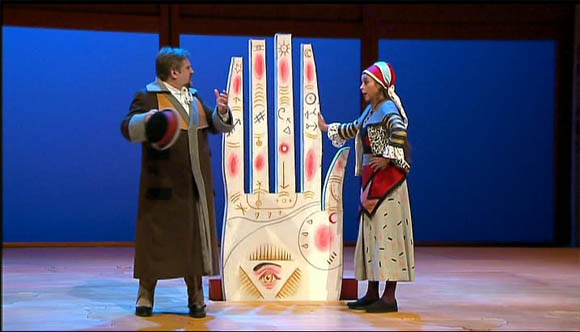
I don’t suppose anybody watches a Rossini comedy for profundity or great insights into human nature but there’s no denying that done well they can be great fun.  This 2002 performance of Il Turco in Italia from the Opernhaus Zürich certainly manages to be that.

The basic plot is predictably silly and full of stock characters; gypsies, flirty young wife, dim older husband, lecherous Turk etc. but wrapped around this is the idea of a poet who is recording what he is seeing as the basis for a new play while, sometimes successfully, sometimes not, trying to influence the action to meet his needs.  It’s quite clever and often very funny.

Continue reading

A fistful of tenors

I put Rossini’s comedies in the category of “guilty pleasures”. They are silly, trivial, lack real human emotion and are musically pretty trite but they are frothy and fun and sometimes even funny. Rossini’s tragedies on the other hand are just that, tragedies. Ermione is no exception. The plot is emotionally beyond credibility, despite being (or perhaps because of) being based on Racine without managing to descend into the unintended humour of, say, Armida. The music is more suited to a comedy and so all that’s left is visual spectacle, vocal virtuosity and a lot of opportunities for the leading lady to chew the scenery. That, ultimately, is probably what it’s about. It was written for Isabella Gilbran. Presumably she coerced Rossini into providing a vehicle for her to display her talents as a tragedienne. Otherwise the whole thing is inexplicable.

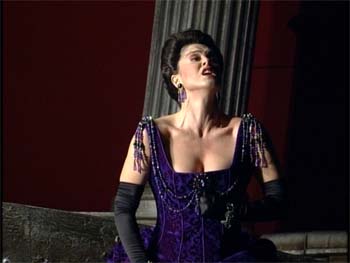
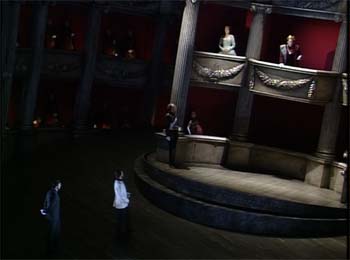
The production given at Glyndebourne in 1995 has a lot going for it. Anna Catarina Antonacci sings the title role, the majestic Diana Montague sings Andromache and Andrew Davis is in the pit. There are also four tenors, which is plenty though not quite in the Armida class. They all seem to be less than about five foot six tall which given that the bass role is sung by the lofty Gwynne Howells looks decidedly odd. Director Graham Vick sets the work in an opera house in the mid 19th century but for reasons obscure everything is tilted at odd angles. It looks like a wedding cake gone badly wrong. Blocking is all very basic, partly at least because Antonacci’s gowns have enough train to seriously inhibit movement. It’s basically park and bark with the odd swoon.

As a musical performance I can’t fault it. Antonacci, Montague, Howells, Jorge Lopez-Yanez (who plays King Pyrrhus) are all near perfect. Antonacci in particular runs through the whole arsenal of Rossinian fireworks with consummate ease. The other roles are never less than competent. Andrew Davis does his level best to breathe some life into the score but there’s really not much he can do about the jolly little tunes that keep popping out of the woodwinds at the least opportune moments.

Humphrey Burton video directs. It was originally filmed for Channel 4 and opens with the obligatory Glyndebourne sheep shots. It is very much a 1995 production for the small screen so lots and lots of close close ups. So many of these are of Antonacci’s cleavage that one wonders whether a dedicated boob cam was employed. Given the original motivation for the opera this may be a case of Historically Informed Videography. The disc package is typically basic Kultur label; 4:3 barely DVD standard picture, Dolby 2.0 sound, no extras. There are subtitles in English, French, German, Italian, Spanish and (oddly) Portuguese. The only documentation is a chapter listing.

One for the Rossini completist only.

La Cenerentola

Last night we saw Rossini’s La Cenerentola at the Four Seasons Centre. It’s not my favourite opera by a long shot and reviews had been pretty mixed so expectations weren’t particularly high. Those expectations were, however, exceeded.

Cenerentola is a version of the Cinderella story and was cobbled together in a hurry for its first performance. It has all the emotional depth of a Disney Princess movie but it does have some reasonable comedy and some very singable music. The director, Joan Font, and designer, Joan Guillén, have taken the work at face value, created sets and costumes that look like something out of a children’s colouring book and upped the comedy, most notably by the introduction of six (non-singing) mice who provide a sort of physical commentary on the action while doubling as handy prop movers. The colour palette is very bright and reinforced by the lighting plot.

Photo gallery

Critics have criticised this approach as lacking emotional depth and character development but, really, is there any to be found in this piece? I rather doubt it. Within the parameters that have been set the blocking and physical acting is remarkably good. There are a couple of places where characters seem to stranded uncomfortably far upstage for too long leading to some audibility problems but nothing grave. The ugly sisters (Rihab Chaieb and Ileana Montalbetti) camped it up better than I might have expected and veteran comedians like Brett Polegato and Donato di Stefano had a field day.

The singing was fine, sometimes very fine. Lawrence Brownlee as Don Ramiro and Elizabeth DeShong in the title role were quite excellent. Both sang beautifully and accurately as befits bel canto. Larry tossed off high notes with ease and Elizabeth’s coloratura was most assured. All the others were well up to their roles. The all male chorus was as good as ever. Anne Larlee accompanied the recitatives on the fortepiano and was her usual sympathetic self. Leonardo Vordoni in the pit took some sections perhaps more slowly than some others but at least that provided a bit of light and shade. There’s enough “breathless Rossini” in this score to sink a battleship.

So, all in all, an enjoyable production of a work that I think is rather over-rated. I don’t care whether I ever see Cenerentola again but I’m glad I went last night.

Should you go see it? Well tickets for the last three shows go as low as $20 (use discount code “RBA”) but the same is true for Ariadne auf Naxos which is also currently in repertoire and is a much more interesting opera. The Ariadne cast is stellar and Sir Andrew Davies is conducting. Hell, for $20 per show you can see both.

Today it’s off to the cinema to see the Met’s Die Walküre followed by sabotabby’s birthday bash at Vegan Valhalla.

Le Comte Ory

Rossini’s Le Comte Ory is a very silly opera about the wicked count and his equally randy page scheming to get into the pants of the virtuous, more or less, Countess Adele while all the local men, including the countess’ brother are off at the crusades. To this end in Act 1 the count appears disguised as a hermit and in Act 2 as a nun. Add to the silliness a fiendishly difficult set of vocal parts and you have a sort of bel canto comedy extreme. To up the ante, today’s Comte, Juan-Diego Florez had been up all night waiting for his wife to pop a pup which she did 35 minutes before curtain.

Continue reading