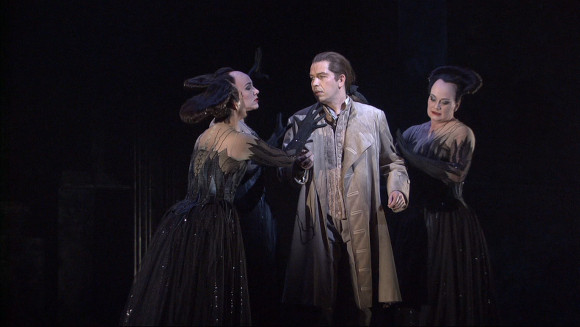
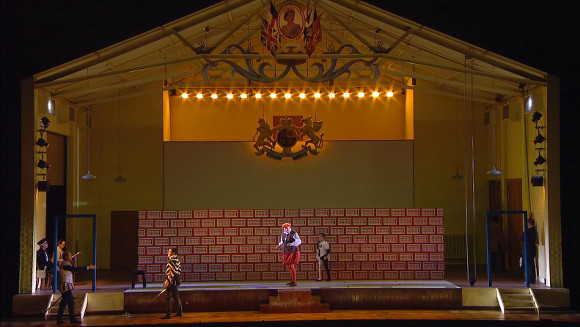
The 2003 Royal Opera House recording of Die Zauberflöte has a terrific cast and it has Sir Colin Davis conducting. The production is by David McVicar and it’s one of those that make one wonder how he ever got a “bad boy” reputation. It’s perfectly straightforward though rather dark (emotionally and physically) and has a vaguely 18th century vibe. In places it seems a bit minimalist, as if the director couldn’t really be bothered with things like the Trials. The interview material rather suggests that McVicar was a bit overawed by doing Mozart with the great Sir Colin and tried very hard to match his rather old fashioned theatrical sensibilities.
Tag Archives: roh
Maria Callas at Covent Garden
There’s not a lot of film footage of Maria Callas performing and most of what there is is of concerts. What makes this disk special is that it contains the whole of Act 2 of Tosca recorded at the Royal Opera House on 9th February 1964. It’s a Zeffirelli production and Tito Gobbi sings Scarpia with Renato Cioni as Cavaradossi. It gives, I think, a pretty good idea of Callas’ appeal as an actress and as a personality. She is fascinating to watch but in many ways quite hard to listen to. My partner, who was in the next room, thought I was listening to an atonal modern piece, which is as much as I’m going to say about accuracy of pitch. I found myself more caught up in thinking about that modern audience segment that wants to go back to “the good old days” because if this is representative I think they are nuts. It’s not about Callas. Well directed I think I’d have enjoyed seeing her. It’s the overly melodramatic, well, everything. OK, I know it’s Tosca but Gobbi’s eye rolling scenery chewing is like three Bryn Terfels without the self deprecating twinkle in the eye. One wants to shout “watch out for the crocodile!” And is he ever loud? At first I just thought it was a recording balance thing but I don’t think so as he sounds way louder than the other singers. It’s hard (and probably unfair) to judge a voice on the basis of a rather ropey recording like this but I wouldn’t pay to hear barking like this.
A Parsifal in three acts
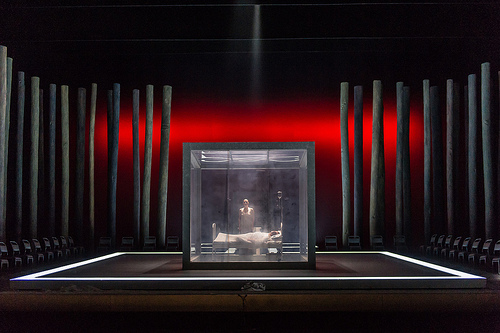
Yesterday, Easter Saturday, I got to see the Royal Opera House production of Wagner’s Parsifal. It was broadcast live to many locations of December 18th last year but hasn’t been seen in Toronto until now. It was very much a three act experience. At the end of the first and longest act I thought we were perhaps seeing greatness in the making. Stephen Langridge’s production concept supported by Alison Chitty’s fairly abstract modern designs were making all kinds of sense to me. At centre stage is a white, semi transparent cube serving as both grail shrine and Amfortas’ hospital room. Within it, various aspects of the back story are shown to us and it comes off as a place of knowledge; perhaps of a much deeper kind than has yet been revealed. This impression is reinforced with the unveiling of the Grail late in the act. It is a young, Christ like boy. The grail ceremony involves Amfortas cutting him to release the blood for the ceremony. There’s a lot of blood letting but it makes sense. We are seeing a very wounded and dysfunctional polity.
Don Giovanni at the cinema
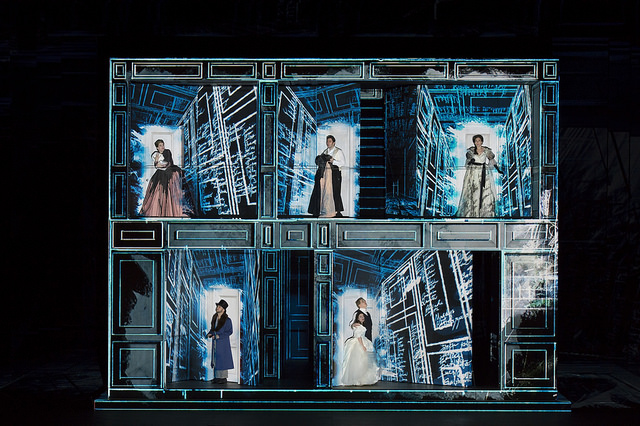
We got to see Kasper Holten’s new Don Giovanni from the Royal Opera House in Toronto yesterday. It wasn’t live but I really don’t think that matters. I’m not going to dwell too much on production or performance because it’s already been extensively reviewed elsewhere. I concur with the general tenor of the reviews that the singing and acting is extremely strong. Certainly Holten got a more intense performance out of Mariusz Kwiecien than Michael Grandage did at the Met and Veronique Gens was a very fine Donna Elvira. There really weren’t any weak links.
Not the Met Live in HD
Finally a cinema in Toronto is screening opera in cinema broadcasts that are not from the Met. Bloor Hot Docs (Bloor and Bathurst) is showing a number of Royal Opera House offerings. They aren’t live and the line up makes even the Met seem adventurous but the theatre is said to have good sound, comfy seats and encourages food and drink. Here’s the screening schedule so far:
| SAT | Feb 15, 2014 | 1:30 PM | ROYAL OPERA HOUSE – DON GIOVANNI | ||
| SAT | March 15, 2014 | 1:30 PM | ROYAL OPERA HOUSE – TURANDOT | ||
| SAT | April 19, 2014 | 12:30 PM | ROYAL OPERA HOUSE – PARSIFAL | ||
| SAT | May 17, 2014 | 1:00 PM | ROYAL OPERA HOUSE – LES VEPRES SICILIENNES | ||
| SAT | June 14, 2014 | 1:00 PM | ROYAL OPERA HOUSE – LA BOHEME | ||
| SAT | July 12, 2014 | 1:00 PM | ROYAL OPERA HOUSE – MANON LESCAUT |
Hat tip to Lydia at Definitely the Opera for the spot.
The Scottish opera
Verdi’s Macbeth is one of those early works where he seems to be trying to grow out of bel canto but not quite making it. There is some splendidly dramatic music and some that just seems completely incongruous given the subject matter. The witches’ chorus at the beginning of Act 3 is a case in point. That said Phyllida Lloyd’s production for the Royal Opera House takes the piece seriously and does a pretty good job of presenting the drama in a straightforward but visually attractive way.
Il Trittico
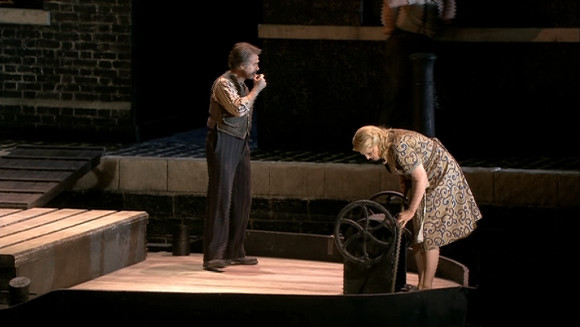
Puccini’s Il Trittico is a collection of three one act operas designed to be performed on a single evening. They rarely are. Perhaps this is because performing all three makes for a rather long evening (and for a huge cast) or maybe it’s because two of the three aren’t all that great. In any event, while most opera goers will likely have seen the comedy Gianni Schicchi, most will likely not have seen the two tragedies that precede it; Il Tabarro and Suor Angelica. However, all three works were performed as a triple bill at the Royal Opera House in 2011. The show was broadcast by the BBC and is available on Blu-ray and DVD. All three pieces were directed by Richard Jones and Anthony Pappano conducted.
Let trumpets blow
A new recording of Britten’s Gloriana is to be welcomed, even when it’s less than perfect. It’s an unusual work for Britten. It’s very grand. The orchestra is large and the music doesn’t seem to be as transparent and detailed as much of his work. This is especially true in Act 1 where I almost wondered whether Britten was sending up “grand opera”. It’s also a grand opera sort of plot. The libretto is based on Lytton Strachey’s Elizabeth and Essex and deals with the late life romance between the queen and the young Robert Devereux, earl of Essex and deputy in Ireland. It has some fine moments; notably the lute songs in Act 2 and the choral dances in Act 2. Act 3 is also dramatically quite effective; dealing with Essex’ abortive rebellion and execution. Curiously, in the final scene, Britten resorts to a lot of spoken dialogue, as he does briefly with Balstrode’s admonition in Peter Grimes. It’s almost as if he has no musical vocabulary for the highest emotional states; a sort of anti-Puccini.
Sex and violets
Cilea’s Adriana Lecouvreur isn’t performed very often and, when it is, it’s usually because some great diva of the day wants to do it. That’s the case with the 2010 Covent Garden production which was created by David McVicar for Angela Gheorghiu. Actually I am a bit surprised it’s not done more often. It’s not a great masterpiece but it’s no worse than a great many commonly done pieces and, if the plot is a bit implausible, it’s not as offensive as half of Puccini’s output. I would have thought it would have great appeal to that opera middle ground to which I don’t belong.
Starry Tosca
Puccini’s Tosca doesn’t seem to lend itself to Regie type treatments. Even quite adventurous directors seem to mostly stick to the very specific time and place of the libretto (even though, as Paul Curran pointed out to me, the plot makes no sense in the Rome of 1800). In the 2012 Royal Opera House recording Jonathan Kent certainly takes very few liberties with the piece; the church is a church, the palace a palace and the castle a castle. There are a few deft design touches. Both Cavaradossi and Tosca wear very bright colours indicative of the new dyes that became available at the period (actually I think this is a slight anachronism – must check with the fashion lemur) whereas Scarpia is more conservatively attired. Generally though it’s pretty straightforward.