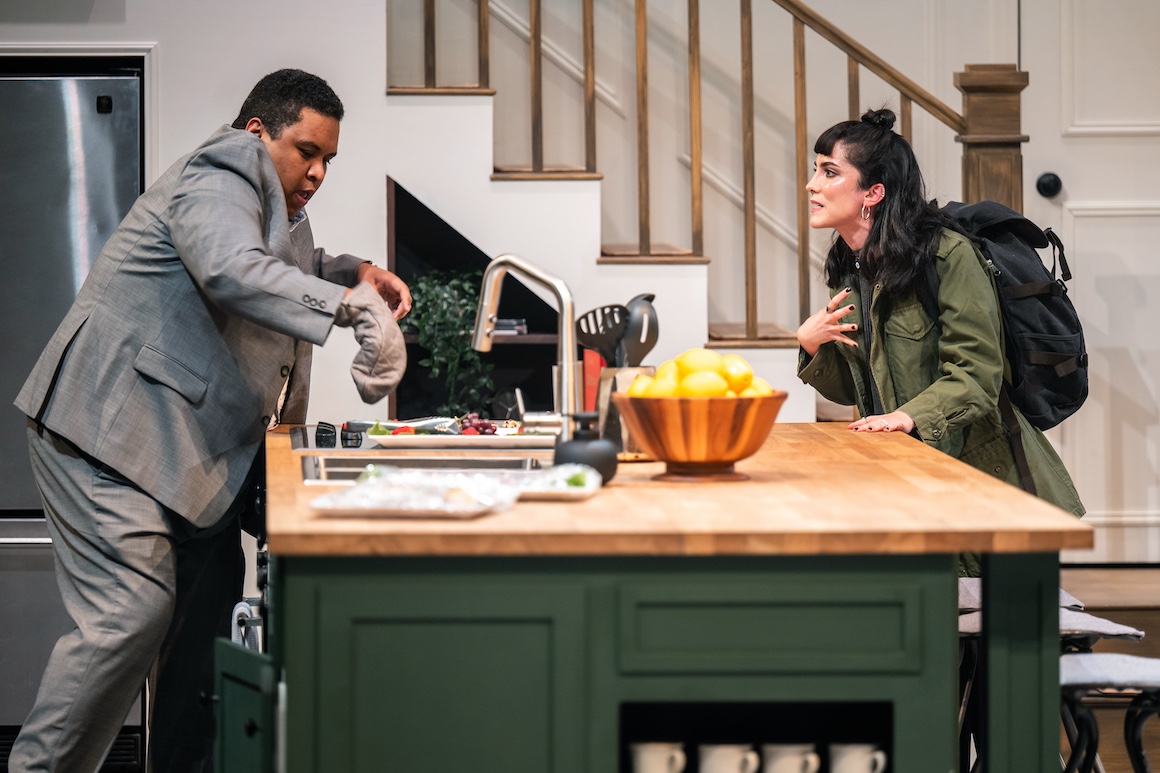
Duncan Macmillan’s play People, Places and Things opened last night at Coal Mine Theatre. It premiered in London in 2015 and has now been adapted to relocate the setting to Toronto and to customize the movement elements to the small, intimate space at Coal Mine. It’s a play about addiction, addiction treatment, theatre and how we construct and cope with “reality” (whatever that is). It’s long, intense, disturbing and, ultimately, very thought provoking.
Tag Archives: reid
The Bidding War
There was a certain amount of anticipatory buzz about Michael Ross Albert’s The Bidding War, directed by Paolo Santalucia, that opened at Crow’s Theatre on Wednesday night. Crow’s has built rather a reputation for punchy, darkly humorous, Toronto-centric plays. This time it’s basically a satire on the Toronto real estate market and the sharp practices of the real estate and property development industries and for the most part it hits the mark.

The Case for the Existence of God
Samuel D. Hunter’s play The Case for the Existence of God, in a production directed by Ted Dykstra, opened at Coal Mine Theatre on Thursday night. It’s a story about the somewhat unlikely friendship between two would be single fathers in a small town in Idaho. It’s mostly pretty sad but with some really funny moments. We can come back to the God thing.

What does Hedda seek?
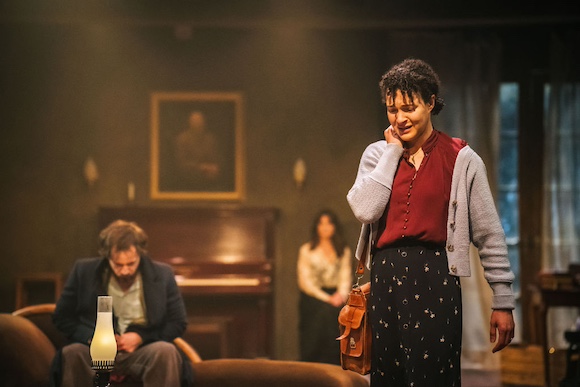
What does Hedda seek? I think that’s the question at the heart of Liisa Ripo-Martelli’s adaptation of Ibsen’s Hedda Gabler that opened at Coal Mine Theatre on Thursday evening. It’s not heavily adapted. It’s still Kristiania in the late 19th century and the environment is as dull, provincial, stuffy and “respectable” as can be. The language is a little more direct than Ibsen especially in the way men speak to women but still more is left unsaid than not. Presented with the audience on three sides of the tiny Coal Mine space it’s intimate to the point of, entirely appropriate, claustrophobia.

It was the best of times…
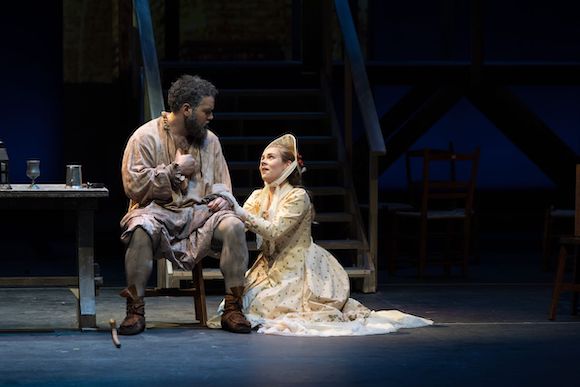
UoT Opera Division’s production of Arthur Benjamin’s A Tale of Two Cities, currently playing at the MacMillan Theatre, is really rather good. Its partly the work itself which surely deserves to be better known. It’s a 1950 work to a libretto by Cedric Cliffe. It was written for the Festival of Britain and was considered a success at the time. It is in many ways typical of mid 20th century English opera (though Benjamin was a peripatetic Australian rather than a Brit). It’s colourful and uses a large orchestra with lots of brass and percussion and combines lyricism with some fairly heavy dissonance. It also includes a few good arias, notably one for Lucie Manette, the romantic female interest.

Dr. Manette (Burak Yaman), Lucie Manette (Emily Rocha)
Mathis der Maler
My guess is that Paul Hindemith’s Mathis der Maler is an opera most opera amateurs have heard of but which comparatively few have actually seen. The video release of a 2012 production at Theater an der Wien directed by Keith Warner is therefore very welcome.

Mahler; arr. Schoenberg
This review first appeared in the print edition of Opera Canada.
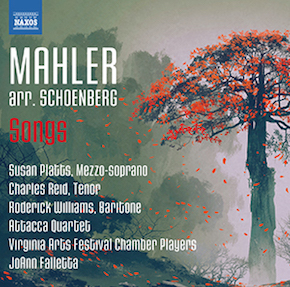
Schoenberg’s reductions of Mahler’s two great orchestral song cycles; Lieder eines fahrenden Gesellen and Das Lied von der Erde, were made for his “Society for Private Musical Performance” which flourished briefly in post WW1 Vienna. Essentially the orchestral score is reduced to one instrument per part with a few other minor changes. The results are intriguing. Unquestionably some of the grandeur of Mahler’s massive orchestration is lost. This is especially noticeable in Das Lied von der Erde. On the other hand the instrumental textures are greatly clarified and there is much less sense of the singers straining to make themselves heard against a large orchestra. There are still fifteen instrumentalists so the singers are pushed well beyond lieder singing but it does allow for a somewhat more nuanced approach to the text.
Wonky androids
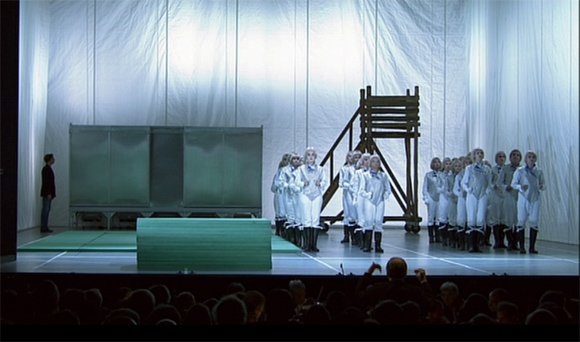
I’m a pretty Regie friendly guy but I confess to being quite bemused by the 2006 Salzburg production of Mozart’s Ascanio in Alba. Some of the production concept I totally get. Removing the unaccompanied recits and replacing them with two actors speaking a summary (in German) makes all kinds of sense. It reduces a sprawling pastorale with minimal plot to something half the length while keeping all the good music. The wonky android chorus, the hero apparently with severe motor neuron disease and Aceste shunting Silvia about in a wheelbarrow I had more problems with. The Gumbie chorus seemed particularly odd and the costumes, well see for yourself.
Chuck’s back
Earlier this week I fired up iTunes in search of the latest Melvin Bragg “In Our Time” episode and noticed that two podcasts were downloading. The other one turned out to be a new episode of Charles Reid’s “This Opera Life”. Now, Charles’ podcast had been on hiatus for months and I really missed it so I was delighted at this turn of events. I didn’t get a chance to listen to it until I was heading to the market at stupid o’clock this morning. Anyway, to cut to the chase, after an explanation of the hiatus, Charles goes on to say nice things about this blog and the Big COC Podcast. Which is awfully kind of him. Charles’ podcasts are mostly interviews with the ordinary working stiffs of the opera world. Occasionally he hooks a “big name” but mostly not and it’s all the more interesting because of it. I think his archive now has 59 episodes, curiously numbered two to sixty! The latest features director Jonathon Loy. I recommend it highly.
You can find Charles Reid’s podcasts at http://thisoperalife.charles-reid.com/ or on iTunes.