Victor Davies’ Rita Joe

Victor Davies’ The Ecstasy of Rita Joe opened last night in a production by Guillermo Silva-Marin at the Jane Mallett Theatre.  It’s based on the play by George Ryga that caused a stir when it opened in Vancouver in 1967.  The play was described as indirect and allusive with no clear narrative thread by the critics back then and was praised perhaps more for tackling the subject than for its intrinsic merits which were far from universally appreciated.  Interestingly, as is so often the case in Canada, although rarely performed it has attained “classic” status.  One word Victor Davies uses to describe the play is “expressionistic” but curiously rather than taking that as a jumping off point for the music (as Strauss and Berg did) he decides it’s an inappropriate idiom for “the lyric approach needed for the melody to unfold”.  Why one needs “melody to unfold” in a disturbing tale of a young native woman’s descent into a hell of sexual abuse, alcohol, drugs, prison and, ultimately, her murder and why that melody should be couched in 1940s jazz/swing terms wasn’t obvious to me.

Marion Newman and Michelle Lafferty

Continue reading

Reconciliation

Yesterday’s free concert in the RBA featured mezzo Marion Newman with pianist Adam Sherkin and violinist Kathleen Kajioka in a programme of contemporary Canadian works (all the composers were in the room!) mostly connected in some way with Canada’s First Nations and Inuit peoples.  First up was Ian Cusson’s setting of E. Pauline Johnson‘s A Cry from an Indian Wife.  It’s a long, highly emotional but not, I think, especially well crafted, text about an Indian woman sending her husband off to war (the language reflects the usage of its day) and the words are not easy to set or sing.  Cusson’s setting is appropriately intense with a blistering piano part and a tough vocal line.  It’s deeply affecting but hardly comfortable especially when sung in a manner that clearly (and rightly) privileged text and emotion over beauty of sound.

newman1

Continue reading

Ringing in the New

marion_portrait_2015_1pWell the holidays are over and the music scene is coming back to life from its seasonal diet of musical plum pudding.  There’s not a lot on this week but there is the first vocal concert of the year in the Richard Bradshaw Amphitheatre.  Mezzo-soprano Marion Newman will be joined by Kathleen Kajioka (violin) and Adam Sherkin (piano)in a programme of Canadian works exploring First Nations themes.  It includes Dustin Peters’ song cycle, Echo|Sap’a, which explores the journey of The Echo (or Sap’a in Kwakwala), a para-natural entity that mimics the sounds and movements she encounters throughout the woods and waters, as well as Kinanu, a lullaby composed by Newman for her baby sister.  Noon, of course, and free.

Later on Thursday, at 9pm to be precise, there’s AtG’s first Opera Pub Night of the year featuring beer, singers and a Craig’s list piano.  It’s at the Amsterdam Bicycle Club on the Esplanade and I strongly recommend arriving early.

The Lesson of Da Ji

dajiThis review first appeared in the print edition of Opera Canada.

Alice Ping Yee Ho’s The Lesson of Da Ji, to an English libretto by Marjorie Chan, is an ambitious piece. It tells the story of the concubine Da Ji who is having an affair with the son of a local lord, Bo Yi, who is masquerading as her music teacher. The king covets the young man’s father’s land and finds out about the affair when Da Ji’s maid betrays her. He invites Bo Yi and his parents to dine. Bo Yi doesn’t show because he’s been intercepted and killed by the king’s agents. The king, painted as a rather cartoonish villain, serves the boy up as a stew to Da Ji and his parents before killing them and presenting Da Ji with the boy’s heart. Thus is order restored and betrayal punished!

Continue reading

A flautist walks into a bar

magic-flutes_featured3Last night’s Soundstreams Koerner Hall presentation; Magic Flutes was an interesting experience.  Aside from interesting (mostly) contemporary flute pieces it was very much an experiment in different ways of staging a concert.  I’m all for breaking down the conventions of Mahlerian solemnity and I think experimentation is great.  It’s in the nature of taking risks though that some things don’t quite work.

Continue reading

This in my picture, I would fain convey – Turner at the AGO

tombThe AGO has a new initiative; AGO Friday Nights.  For the price of admission to the gallery one also gets to hear a one hour concert of music programmed by Tapestry’s Michael Mori to reflect something going on at the the gallery.  Right now the big exhibition is JMW Turner: Painting Set Free.  It’s a decent sized exhibition of works mainly drawn from the later stages of Turner’s career and it’s well worth seeing.  The music; half piano, half works for mezzo and piano reflects aspects of the exhibition.

Continue reading

Music at the AGO

London National Gallery Top 20 13 JMW Turner - The fighting TemeraireThe Art Gallery of Ontario is starting a new Friday night music initiative.  Each Friday night in November (6th, 13th, 20th, 27th), the inaugural month of AGO Friday Nights, will celebrate the opening of J.M.W. Turner: Painting Set Free, a major exhibition featuring the works of Joseph Mallord William Turner. The AGO is partnering with Tapestry to present Music Set Free, a special performance featuring pianist/composer Adam Sherkin and mezzo-soprano Marion Newman.  Capturing a selection of music from Turner’s time in addition to pieces inspired by his influences, subjects and artistic practice, the concert will feature works ranging from Beethoven to Britten, as well as a special world premiere of an original work by Adam Sherkin, commissioned by Tapestry for the occasion. Music Set Free is curated by Michael Mori, Artistic Director of Tapestry Opera.  The performances will be from 7.30pm to 8.30 pm and are included in the admission price to the exhibition.  There will be a bar and food and stuff too.

The Lessons of Love

Last night Toronto Masque Theatre presented a double bill entitled The Lessons of Love.  First up was John Blow’s 1683 masque Venus and Adonis and it was followed by the premier of The Lesson of Da Ji; a fusion of Western and traditional Chinese elements by composer Alice Ping Yee Ho and librettist Marjorie Chan.

Continue reading

Farewell Queen of Puddings

Lorca-horizontalChris Paul Harman’s La selva de los relojes (The Forest of Clocks) had its premier at the Four Seasons Centre at lunchtime today.  It’s a setting of some very beautiful texts from Lorca’s Suites scored for mezzo, harp, piano/celeste, flute, clarinet, cello, percussion and tape.  The tape consists of sections of the texts read by Martha de Francisco.  Sometimes the text comes from the tape, sometimes it’s sung by mezzo, sometimes it’s spoken by the mezzo and at other times they overlap.  The accompaniment is mostly very spare but occasionally becomes surprisingly dense with lots of work for tuned percussion.  There are also some unconventional roles for the instruments, especially the flute, and there is a whistled passage for the singer near the end.  All in all it’s very 21st century; decidedly modern but quite approachable.  And did I say the texts are gorgeous?  Continue reading

The Enslavement and Liberation of Oksana G.

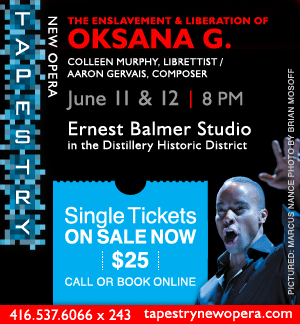
Last night saw the first of two workshop performances of Act 2 of The Enslavement and Liberation of Oksana G., a new full scale opera with music by Aaron Gervais and libretto by Colleen Murphy.  Act 1 was similarly workshopped last year.  It’s being produced by Tapestry New Opera in the Ernest Balmer Studio at The Distillery.  The second performance is tonight.

The piece is about sex trafficking.  Oksana is a Ukrainian girl tricked, raped and forced into an Italian  brothel controlled by Russian organized crime.  At the beginning of Act 2 she has escaped and is living at a refugee shelter run by a Canadian priest in Brindisi.  The story concerns her relationship with the priest, her desire to return to her family and her pimp’s determination to get his hands on her again.  It’s dramatic, emotionally charged and ends badly.  It’s neither overly melodramatic nor crushingly intellectual and it works very well as an opera libretto.  Somewhat oddly it’s written in four languages; English, Italian, Russian and Ukrainian, apparently for essentially “naturalistic” reasons.  I think the logic is off but it didn’t reduce my enjoyment of the piece. Continue reading