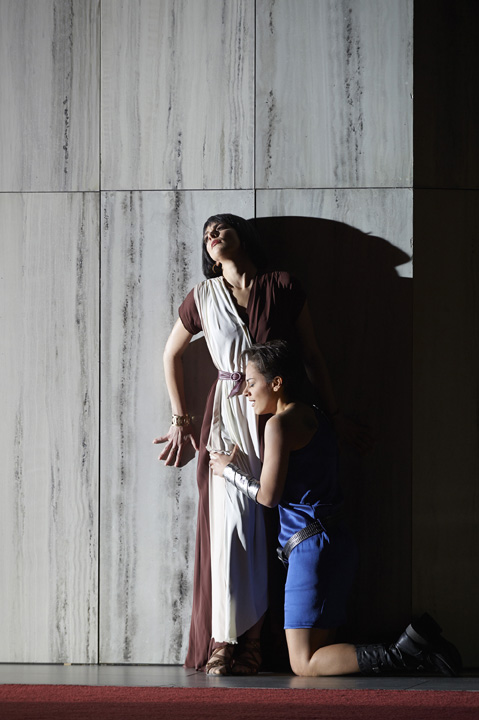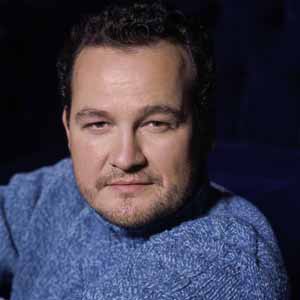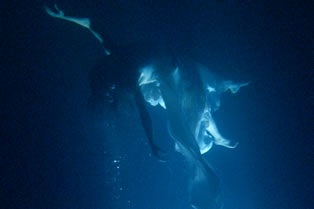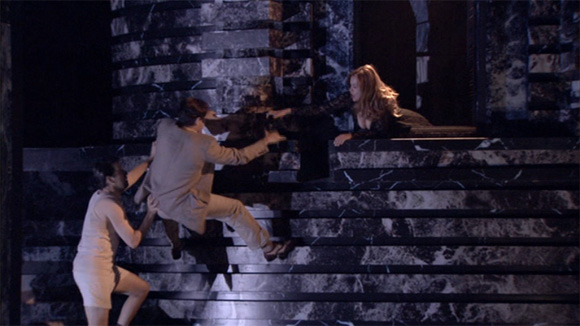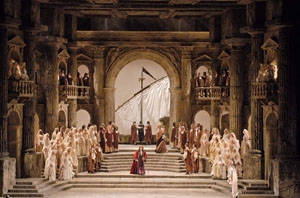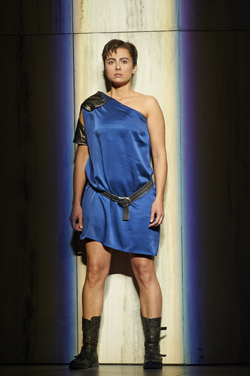
Last night saw the final performance of the COC’s run of La clemenza di Tito. I had seen the Ensemble Studio performance a couple of weeks ago and really enjoyed it but had some questions and reservations about the production. Last night many of those issues were resolved. It seemed more closely directed and the characterizations were more fully rehearsed. A good example of this would be Michael Schade’s intensely neurotic Tito which was central to the concept. Many things make sense if one sees Tito as being in love with an idea of himself. In this context his betrayal by Sesto is particularly hurtful because it implies that his closest confidante isn’t buying it and his “clemency” is necessary to restore his faith in his own self-projection. This Tito gives Robert Gleadow’s Publio space and reason to be more than the dutiful, rather thick plod. He’s the one who has seen through Tito but must “play the game”. His final, rather sharp, exchanges with Vitellia suggest a genuine capacity for malevolence. This is, after all, an Imperial Court, where by definition life is dangerous and nothing what it seems.
Tag Archives: mozart
Sic Semper Tyrannis
Last night saw the COC Ensemble Studio’s annual main stage performance. This year it was Mozart’s La Clemenza di Tito in a Christopher Alden production. It’s a somewhat quirky production that I haven’t fully digested yet and may need to wait until after seeing the main cast on the 22nd to come to a more considered view. My initial reaction is that it has a lot of interesting ideas, maybe one or two misguided ones and that the whole thing, while interesting, isn’t completely coherent. That said, Alden productions often seem more coherent second time around. And whatever I might think of the production, it didn’t distract from some very fine performances.
Fifty shades of Braun
This afternoon’s Off Centre concert at the Glenn Gould Studio was structured around three pairs of composer friends; Mozart/Haydn, Schumann/Brahms and Wolf/Mahler. It was a mix of lieder, opera excerpts and piano pieces and was pleasantly varied.
Things kicked off with Russell Braun singing a number of songs from Schumann’s Liederkreis accompanied by his partner, Carolyn Maule on the piano. This was maybe the third time that I’ve heard Russell in recital and he really is impressive. He has a really good command of a wide range of dynamics and tone colour and lovely floaty high notes. If I was being hyper critical I’d say I think there’s a point in the middle voice though that can’t quite sustain the volume he sometimes tries to get. He has quite an operatic approach to lieder (compared to, say, DFD) but that’s quite fun in its own way.
Wonky androids
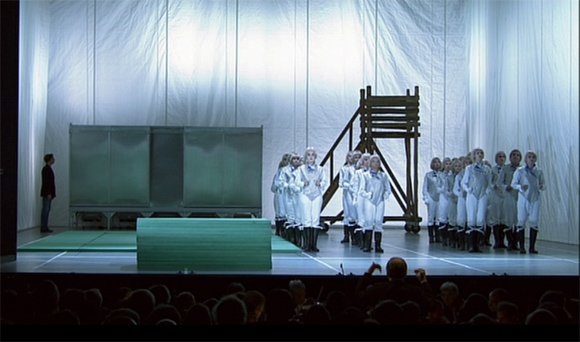
I’m a pretty Regie friendly guy but I confess to being quite bemused by the 2006 Salzburg production of Mozart’s Ascanio in Alba. Some of the production concept I totally get. Removing the unaccompanied recits and replacing them with two actors speaking a summary (in German) makes all kinds of sense. It reduces a sprawling pastorale with minimal plot to something half the length while keeping all the good music. The wonky android chorus, the hero apparently with severe motor neuron disease and Aceste shunting Silvia about in a wheelbarrow I had more problems with. The Gumbie chorus seemed particularly odd and the costumes, well see for yourself.
First of the year
Yesterday saw the first free lunchtime concert of 2013 at the Four Seasons Centre. Five singers from the COC’s Ensemble Studio gave us a programme of works by Mozart and Salieri, mostly comparative rarities. I enjoy hearing the singers of the Ensemble Studio because it’s not just a chance to hear some good singing but also to see how voices are developing and make some guesses about whether one is seeing a future star.
Into the woods
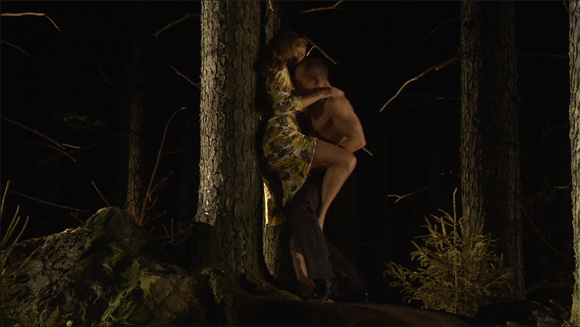
Claus Guth’s 2008 Salzburg production of Don Giovanni divided the critics along entirely predictable lines. It’s a very unusual treatment of Don Giovanni but the concept is stuck to with real consistency and it works to create a compelling piece of music theatre. The treatment on video too is not straightforward and, in a sense, the DVD/Blu-ray version is as much the work of Brian Large as it is of Claus Guth.
‘Tis the season to speculate
With a month or so to go before the Canadian Opera Company officially announces its 2013/14 season it’s surely time for some uninformed speculation.
There are three big anniversaries in 2013; the bicentenaries of Verdi and Wagner and the centenary of Benjamin Britten. One would think all would be represented but maybe not. We know Verdi will be. Gerald Finley announced at the Rubies that he would make his role debut in the title role in Falstaff at COC in 2013/14 so we can ink that one in. Britten seems probable. There’s a Houston/COC co-pro of Peter Grimes, directed by Neil Armfield that is due to to come to Toronto. I think we can pencil that one in. No idea on casting but I would love to see Stuart Skelton myself. Wagner, I’m not so sure. Maybe February’s run of Tristan und Isolde will be COC’s sole nod to Wagner. Certainly the next most likely candidate; the Lyon/Met/COC Parsifal is, apparently, not expected before 2015.
Get your tickets now
Word on the street is that there are only “a few hundred” tickets left for the COC’s February run of the Peter Sellars/Bill Viola Tristan und Isolde. It’s a fair bet that most of the available tickets will be for nights when Burkhard Fritz is singing rather than Ben Heppner. If you want to see Heppner I’d plan on buying now rather than expecting something last minute to turn up. I’d expect there to be horrific line-ups for the same-day nosebleeds and standing room tickets (and I don’t have the stamina to stand through Tristan!).
Christopher Alden’s production of Mozart’s La Clemenza di Tito apparently isn’t selling so well, despite a stellar cast and a production that got very good reviews in Chicago. This makes me a sad panda. Unfashionably, perhaps, I regard Clemenza as one of Mozart’s best operas, perhaps his very best, so the chance to see it with a wonderful cast is one I would not miss. My current plans call for me to see it twice; with the principal cast and with the Ensemble Studio, but I shall be sorely tempted to get in for an extra look earlier in the run than my current tickets!
Gerry Finley’s Don Giovanni
Jonathan Kent’s 2010 Glyndebourne production of Don Giovanni has a great cast and high ambitions but, ultimately, doesn’t really come off, largely because the relationships between the characters too often fall short of anything interesting. The concept, as explained in the two short bonus segments, is that Don Giovanni is set in a society in transition and that the title character is a sort of harbinger of the new mores. The “society in transition” chosen by Kent is a sort of hybrid of Fellini’s La Dolce Vita and the last years of Franco’s regime in Spain. He might have done better to just pick one as the Fellini elements get pretty much reduced to the costumes and the Franco elements really don’t go anywhere.
Not a potato in sight
Today’s MetHD broadcast was Mozart’s last, and arguably best, opera La Clemenza di Tito. J-P Ponnelle’s production has been around for a while and offers nothing to offend traditionalists. There’s not a baked potato, muscle suit or child sacrifice in sight. The set, maybe more Italian Renaissance than Imperial Rome is elegant, undistracting and very singer friendly. The costumes are a rather eclectic mix of late 17th century and Republican Rome with a bit of Lady Capulet thrown in but only the black number with the big panniers that Vitellia gets in Act 2 would excite much comment. Direction then focuses rather on the characters and their relationships.