Soundstreams’ opening concert of the season at Trinity St. Paul’s on Saturday evening featured Sarah Kirkland Snider’s Mass for the Endangered and an intriguing selection of 20th and 21st century music on related ecological themes.
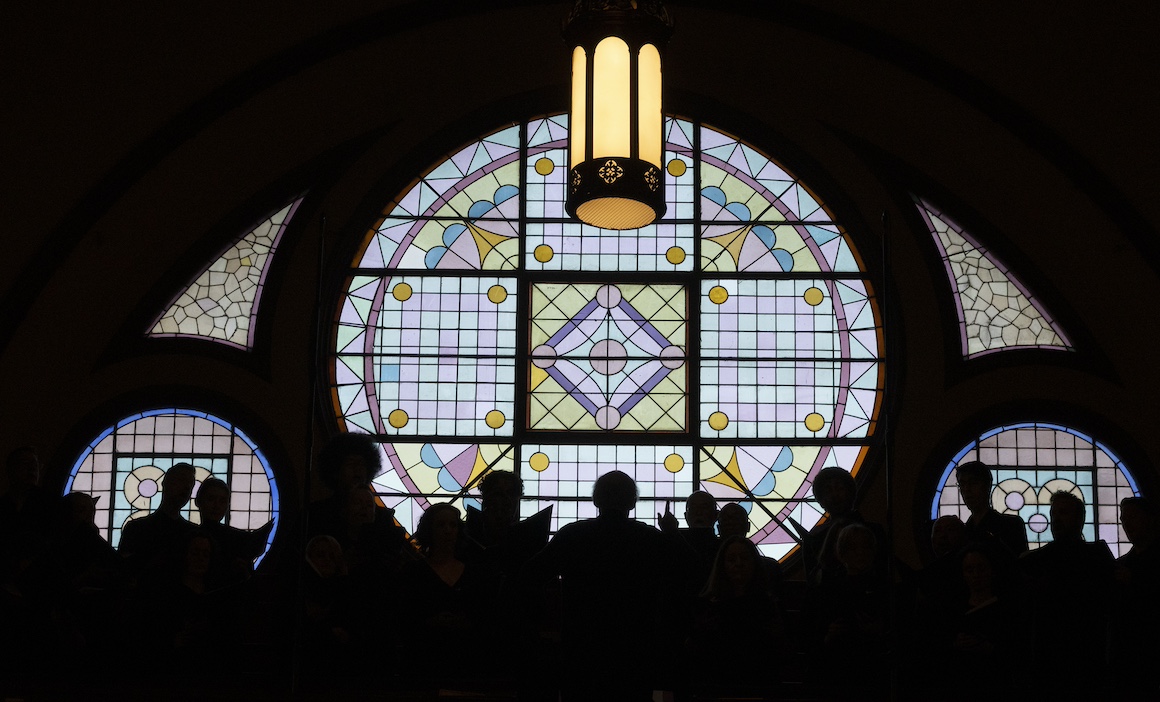

Soundstreams’ opening concert of the season at Trinity St. Paul’s on Saturday evening featured Sarah Kirkland Snider’s Mass for the Endangered and an intriguing selection of 20th and 21st century music on related ecological themes.
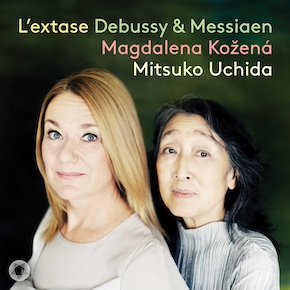 L’extase: Debussy and Messiaen is a new CD from mezzo-soprano Magdalena Kožená and pianist Mitsuko Uchida. There are four sets of songs; three by Debussy and one by Messiaen. The Debussy sets are Trois Chansons de Bilitis which set texts by Pierre Louÿs, Cinq poèmes de Charles Baudelaire and Ariettes oubliées to tests by Paul Verlaine.
To my ear all these cycles inhabit a similar sound world. It’s very beautiful and languorous for the most part with something just not quite wholesome about it. We are clearly looking forward to the language of Pelléas et Mélisande. Only occasionally does something a bit more dynamic happen as in the quite dramatic “La tombeau des Naiades” from the first set and the lively “Chevaux des bois” from the Verlaine settings. Continue reading
Wednesday’s lunchtime recital in the RBA was given by Wirth Vocal Prize winner Sara Schabas and pianist Alexey Shafirov. It was a varied and virtuosic programme. Five composers and five languages were involved and the works performed ranged in date from the 1815 to 2000.

Thursday evening saw one of Barbara Hannigan’s comparatively rare Toronto appearances. This time it was part of a ten city tour with pianist Bertrand Chamayou. It was a three part programme with no intermission. First up was Olivier Messiaen Chants de terre et ciel. Like the better known Poèmes pour Mi these are reflections on family and religion.

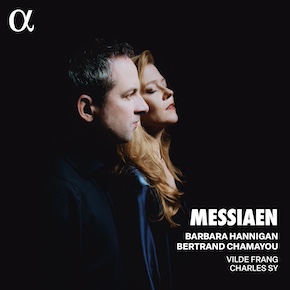 Barbara Hannigan’s latest recording project is a CD of Messiaen’s vocal music with pianist Bertrand Chamayou. It’s very much an equal partnership with some superb musicianship on display. It starts off with two cycles written for/inspired by Messiaen’s first wife. Chants de Terre et de Ciel celebrates the marriage and the birth of their young son. There’s some very dramatic singing here but what really stood out for me was Hannigan’s ability to float a note with perfect control and apparent ease. It works beautifully with the more delicate parts of the piano part.
 The Happenstancers latest concert We’re Late! happenstanced on Saturday evening at Redeemer Lutheran. It was a typical Happenstancers sort of event with chamber music works for various forces split up into their movements with the components then rearranged to make an interesting line up.
Lukas Foss’ Time Cycle provided the opening piece which also provided the title for the concert as a whole. It’s a setting of Auden for soprano and chamber ensemble and begins “Clocks cannot tell our time of day”. Which was pretty much the theme for the evening. This was followed by Toshi Ichiyangi’s Music for Electric Metronomes which had the whole ensemble banging things rhythmically and making stylsed gestures. Then came the first of three parts of rather a good musical joke; John Cage’s 4’33” arranged into three movements for different forces. which as might be expected cropped up at intervals during the show. For the record the movements were scored for piano and percussion, conductor and oboe and percussion.
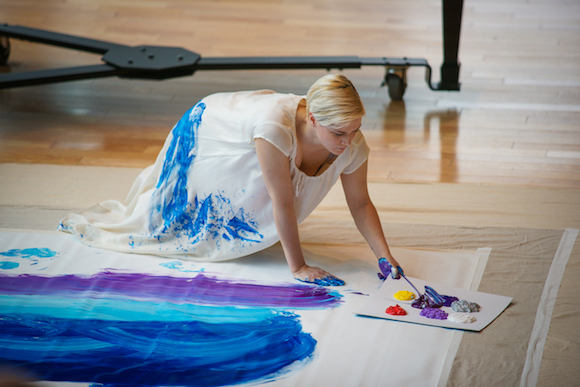
Lauren Eberwein and Rachel Kerr put on a rather different show in the RBA at lunchtime. The musical component consisted of Ravel’s Jeu d’eaux and Messiaen’s Poèmes pour Mi. The surprise was that Lauren painted on a canvas on the floor throughout the performance. She brought on two palettes of acrylics and used her hands and feet to create a large abstract on the broad theme of “water”. Needless to say, she ended up covered in paint.
Yesterday’s concert in the RBA was dedicated to the late Stuart Hamilton, founding director of the COC’s Ensemble Studio. Current members, mezzo Emily D’Angelo and baritone Bruno Roy, each gave us two sets of French songs accompanied respectively by Hyejin Kwon and Stéphane Mayer. Ms. D’Angelo gave us Débussy’s Chansons de Bilitis and the curiously Débussy like Trois Mélodies by Messiaen. Both sets are quite meditative and impressionistic and Ms. D’Angelo’s very beautiful voice suited them well. There’s more there than beauty of tone. She’s showing some interesting, very mezzoish, colours in the voice now and there’s clearly plenty of power in reserve as she showed on a couple of occasions. It’s so easy to forget how young she is when a performance is this accomplished. Ms. Kwon was a sympathetic accompanist.
And so to the boys who gave us Poulenc’s La fraîcheur et le feu and Ravel’s Don Quichotte à Dulcinée. The Poulenc piece rather races along with the piano part, impressively played by Mayer, often much more interesting than the vocal line. Roy was at his best in the more hectic passages where his diction and command of French were at a premium. When the music became more expansive he didn’t quite seem able to expand with it; the voice lacking bloom in both upper and lower registers and with no real sense of some underlying power. This was more of a handicap in the Don Quichotte songs. Roy managed some decent physical and vocal acting, especially in the drinking song, but there just wasn’t enough heft to put in the swagger required in these pieces.
Prior to the performances, the COC’s Janet Stubbs made a short speech in memory of Stuart which managed, in a very brief span, to convey both the impact he had on the Canadian and wider opera scene and a sense of his more endearing eccentricities.
Photos if and when.
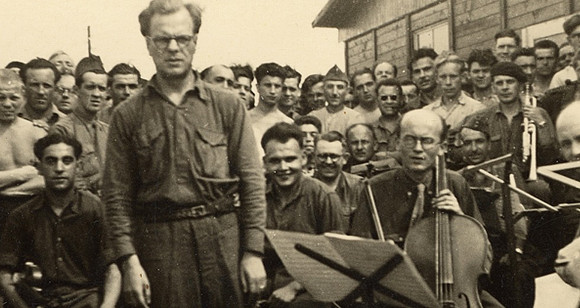
Messiaen’s Quartet for the End of Time is a work of astonishing power and unique provenance. It was written after Messiaen’s capture in June 1940 at the POW camp Stalag VIII-A in Görlitz in what is now Poland. First performed for POWs and guards in 1941 it is, most unusually, scored for piano, clarinet, cello and violin because that’s what the professional musicians among the POWs played. What always strikes me about this work, familiar since my early teens, is how it combines Messiaen’s transcendent and deeply optimistic faith with a kind of passionate statement about the state of the world rooted in Revelations. The contrasts are there throughout the work’s eight movements but nowhere more clearly than at the end when the power and even fury of Danse de la fureur pour les sept trompettes and the Fouillis des arcs-en-ciel, pour l’Ange qui annonce la fin du Temps dissolve into the lyrical serenity of Louange à l’immortalité de Jésus. And, of course, there is birdsong in the haunting clarinet movement Abime des oiseaux.
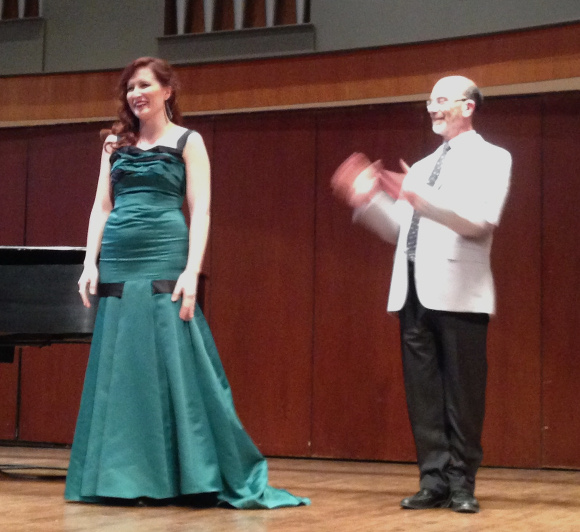
To Mazzoleni Hall yesterday to hear Christina Campsall’s graduating recital. I think over the course of the year she has become my “top tip” for this year’s graduating class at the Conservatory and nothing that happened yesterday did anything to shake that judgement. It was a pretty intense program that was definitely more shade than light but that, I think, rather suits her voice. The opening set, Mahler’s Rückert Lieder, was a case in point. Dark, brooding texts, dark, brooding music and a dark, brooding voice with plenty of power. We have a mezzo here not a second soprano! That said, her high notes are all there and there seems to be plenty of power all through the registers, though to be fait I’ve only seen her once in a large hall and that was in operetta. Very good German too with a distinct northern inflection. All the consonants!
 operaramblings