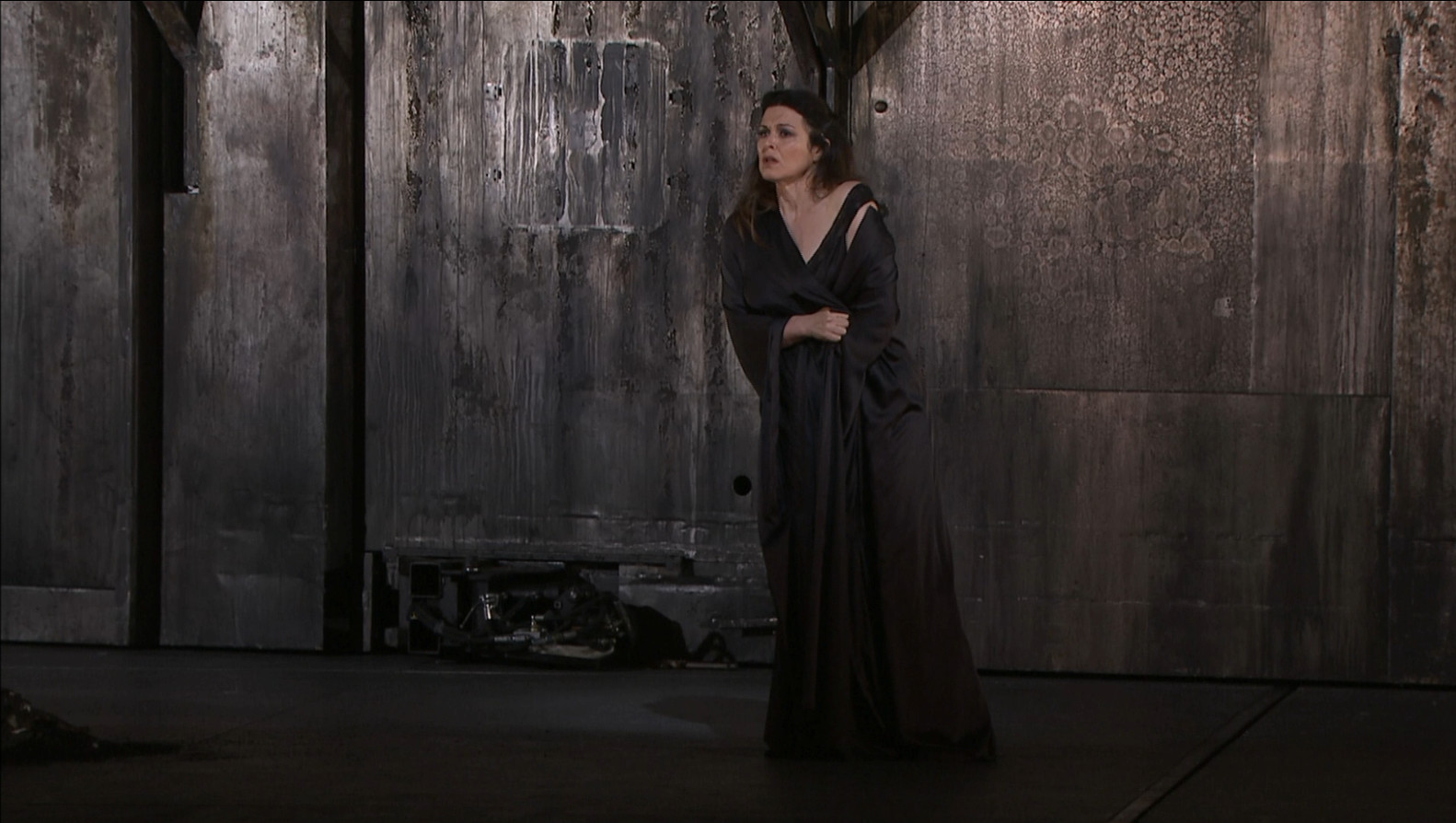
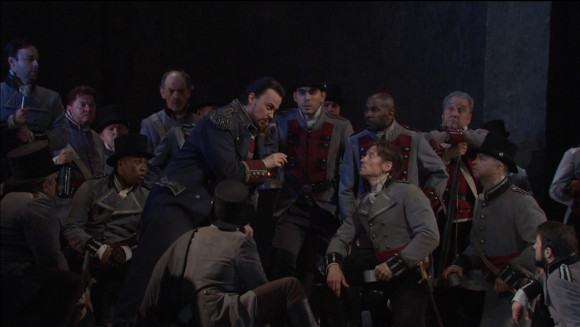
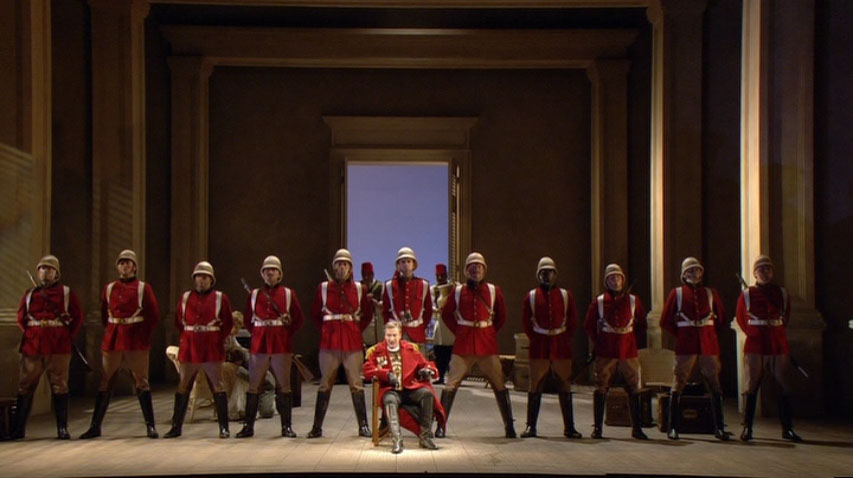
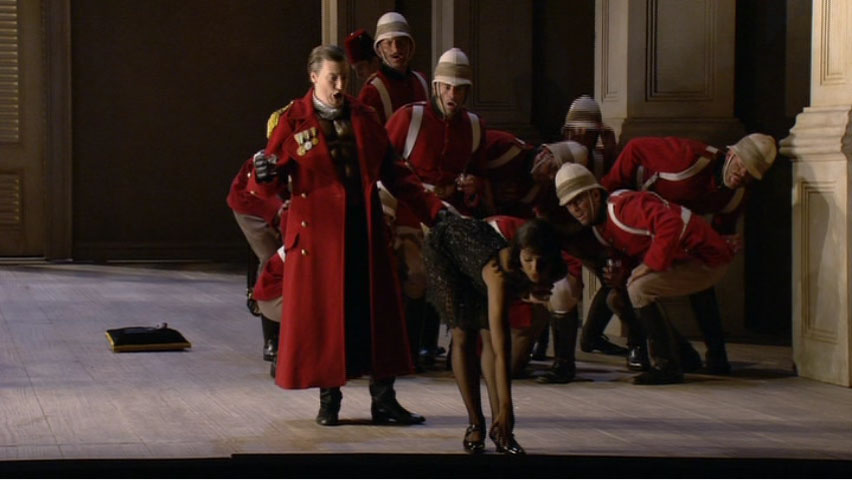
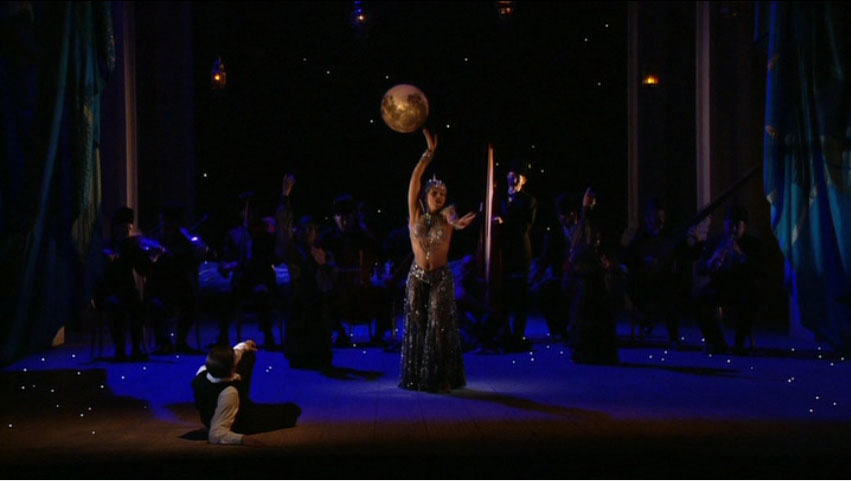
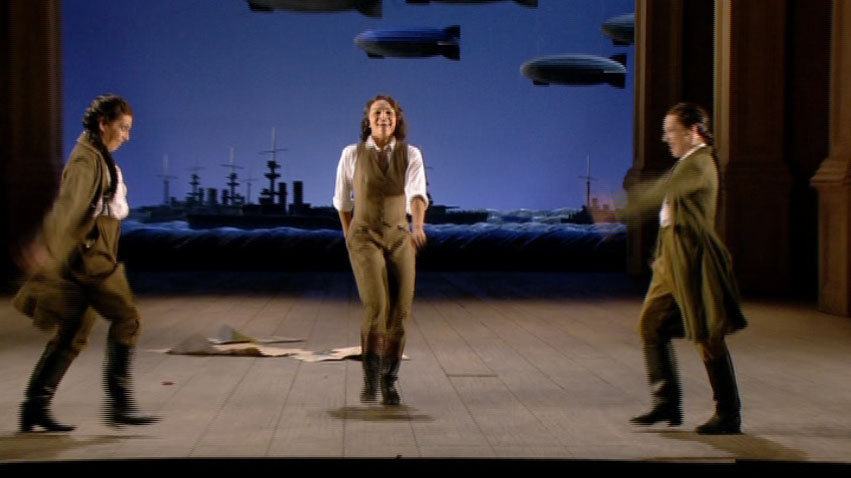
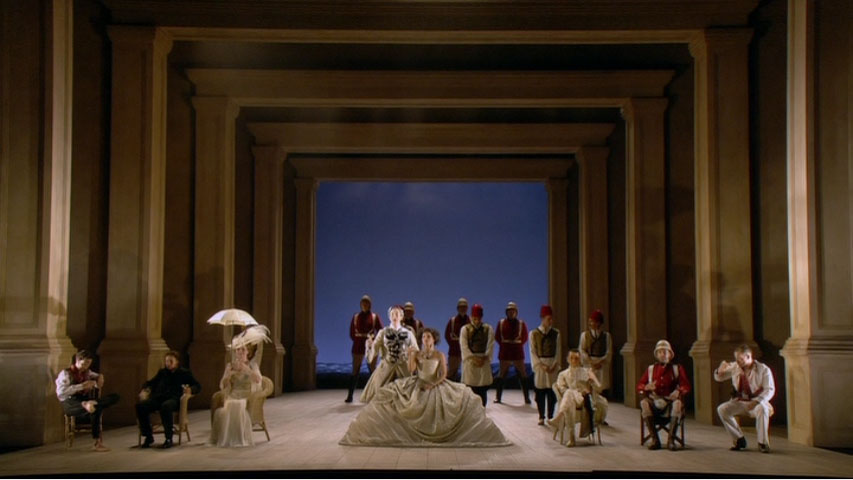
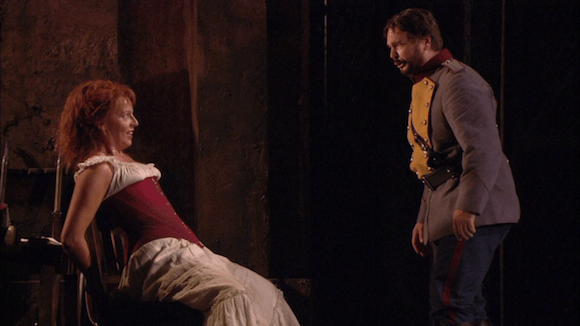
Berlioz’ Les Troyens is one of those pieces that really deserves the descriptor “sprawling epic” and, if anyone can make an epic sprawl it’s David McVicar. This production, recorded at the Royal Opera House in 2012, is typical of McVicar’s more recent work. It’s visually rather splendid and the action is well orchestrated but it’s short on ideas and long on McVicar visual cliches; acrobats, gore and urchins (but mercifully no animals). I don’t want to be too hard on McVicar. This piece is based on the sort of “Ancient History” one used to learn at prep school (British usage) and McVicar pretty much runs with that making no attempt to find deeper meaning, despite superficially translating at least the first two acts to the time of first performance; the era of European colonialism.
Tag Archives: mcvicar
The Rape of Lucretia
Britten’s Rape of Lucretia, which premiered at Glyndebourne in 1946, is an interesting work in a number of ways. Musically it marks a distinct break from Peter Grimes and anticipates the later operas in a number of significant ways. It’s written for much lighter forces than Grimes; string quintet, wind quintet plus harp, percussion and piano and there’s no chorus (in the conventional sense). It’s also not a “numbers” piece. There are no set pieces here. The orchestral writing is spare and somewhat dissonant with that absolute clarity that is so characteristic of Britten. Sometimes this almost distracts from the drama on stage.
David McVicar’s Die Meistersinger
David McVicar chooses to set his production of Die Meistersinger, staged at Glyndebourne in 2011, in the 1820s or thereabouts. It’s an interesting choice as it puts German nationalism in a specifically cultural rather than political context and also rather clearly makes the point that “foreign rule” = “French rule”. That said, he really doesn’t develop any implications from that and what we get is a production typical of recent McVicar efforts. There’s spectacle aplenty and very good character development but he doesn’t seem to have any Big Ideas; for which, no doubt, many people will be grateful. The only place he seems to go a bit overboard is in laying on some fairly heavy German style humour. People who think that slapping waitresses on the bottom is the height of comedic sophistication will probably appreciate it.
Sex and violets
Cilea’s Adriana Lecouvreur isn’t performed very often and, when it is, it’s usually because some great diva of the day wants to do it. That’s the case with the 2010 Covent Garden production which was created by David McVicar for Angela Gheorghiu. Actually I am a bit surprised it’s not done more often. It’s not a great masterpiece but it’s no worse than a great many commonly done pieces and, if the plot is a bit implausible, it’s not as offensive as half of Puccini’s output. I would have thought it would have great appeal to that opera middle ground to which I don’t belong.
Straightforward but effective Il Trovatore
Verdi’s Il Trovatore really is a peculiar piece. It’s a bit of a musical hybrid with huge, rousing choruses interspersed with bel canto arias which I suppose is fairly typical of middle period Verdi. It has a truly silly plot (perhaps based on Blackadder’s lost novel) with gypsies, dead babies and improbable coincidences galore. It’s also notoriously hard to cast with five very demanding roles combining a need for flawless bel canto technique with lots of power. David McVicar’s production at the Metropolitan Opera was broadcast in HD in April 2011 and subsequently released on Blu-ray and DVD. I saw the HD broadcast and enjoyed it enough to buy the Blu-ray.
More Tudor queens
Today’s MetHD broadcast of Donizetti’s Maria Stuarda was a bit of a mixed bag. There were some really good performances. Joyce DiDonato in particular gave what may well have been a truly great performance and I would have loved to have seen it live. David McVicar’s production was much better than his Anna Bolena; visually interesting and with some strong dramatic ideas. However the good was pretty seriously undermined by another really awful piece of video directing by Gary Halvorson. I guessed it was him after about ten minutes. The incessant use of the nose cam and the incredibly irritating low level tracking shots were a dead give away. It was a big disappointment since the last two shows I saw, La Clemenza di Tito and Les Troyens, were filmed by Barbara Willis-Sweete and had given me some faint hope that the Met was capable of self analysis and improvement in this area. Hope that was, alas, sadly dashed today.
I came, I saw, I picnicked
The DVD of the 2005 Glyndebourne Festival production of Handel’s Giulio Cesare in Egitto is one of the most satisfying that I have ever got my hands on. David McVicar’s production is a delight. The cast is consistently excellent with stand out performances from Sarah Connolly as Caesar and Danni de Niese as Cleopatra. William Christie gets wonderful playing from the Orchestra of the Age of Enlightenment. The production for DVD/Blu-ray is exceptional in every way. There’s even over an hour of worthwhile extras giving a total of over five hours of material.
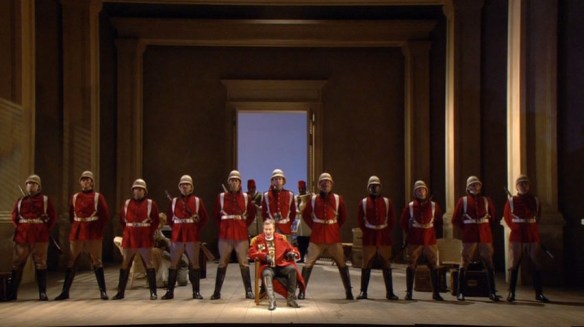
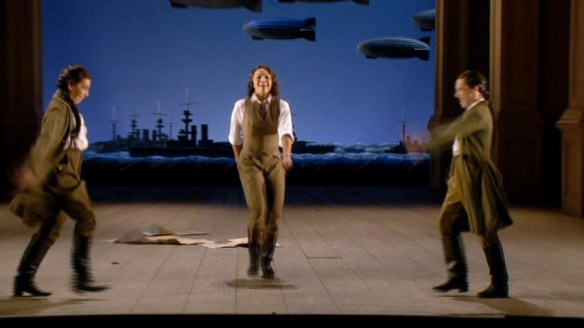
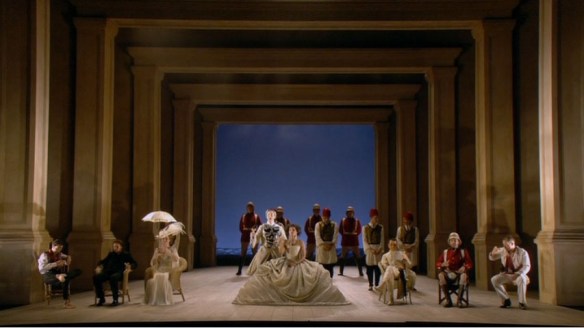
Let’s start with the production. McVicar and his design team have placed the action firmly in Egypt but moved the time period to the late 19th century with the Romans being portrayed in the manner of the British who effectively ruled Egypt at the time. There are a number of elements taken from Bollywood musicals which seems to have led some reviewers to dismiss it as not being “serious” enough to be a proper Handel production. I think this is misguided. The Bollywood elements are well integrated dramatically and musically and serve a dramatic purpose. They point up the cultural rift between the Romans and the Egyptians without getting into a crude and heavy critique of colonialism. There are a few places where Andrew George’s choreography is a bit over the top but mostly it works and, if nothing else, it’s tremendous fun. McVicar has obviously worked really hard on the and all the main characters and their interactions are clearly defined. The gulf between Romans and Egyptians emerges through these relationships though perhaps the rather overwrought Sesto of Angelika Kirchschlager somewhat undermines the chilly memsahib Cornelia of Patricia Bardon. Throughout there are neat little touches like Cleopatra ditching her cigarette in the urn containing Pompey’s ashes or the Roman/British warships sailing into Alexandria harbour with airship cover during Da tempeste il legno infranto. At the very end, Achilla and Tolomeo, blood soaked, (both are dead at this point) reappear and flank the line of seated dignitaries sipping champagne. It’s weird but works. Notably the production team got one of the biggest ovations of the night when they appeared for a curtain call.
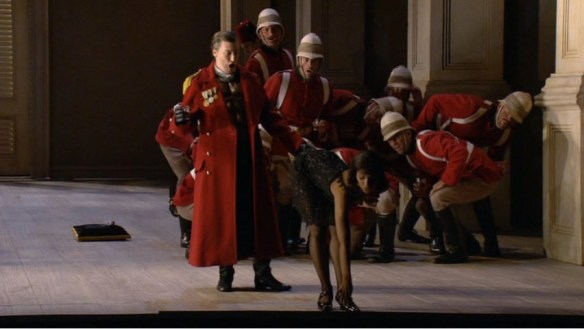
The individual performances range from very good indeed to spectacular. Musically the star is Sarah Connolly. She’s utterly brilliant with completely secure coloratura and ornaments that are far more than just decorative. Right from Empio, dirò, tu sei where she manages to spit out her disgust while maintaining 100% musicality, to the very end she’s note perfect. Her acting is also really good. She covers a wide range of emotions and her physical acting is genuinely masculine. She really does not look or move like a woman in drag. Then there’s Danielle de Niese! Musically there may be subtler or more refined exponents of the art of Handelian singing but I doubt whether there are any who could handle the role Danni is handed here. (Jane Archibald maybe, just maybe). She sings very well in fact. Some of her big numbers are very well done indeed and Piangerò la sorte mia is very fine and she’s very clever vocally in Da tempeste il legno infranto here she works some ornamentation in to accompany miming firing a sub-machine gun. But singing is only a fraction of the work she gets through. She has a lot of physical acting and several major dance numbers. She’s a very good dancer and, of course, she really looks the part. It’s really quite a performance!
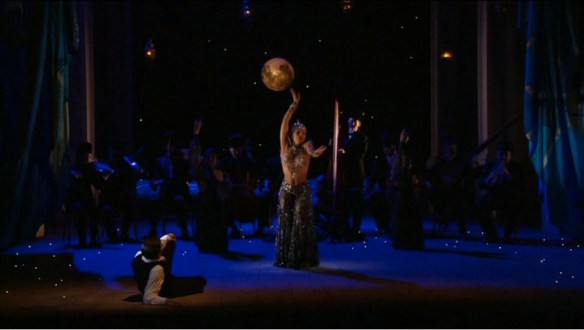
Patricia Bardon acts well in a chilly way and sings beautifully. Priva son d’ogni confortois a real tear jerker. Kirchschlager sings very well but is a bit overwrought in the acting department and doesn’t really come across as a young man set on revenge. Rachid Ben Abdeslam is wonderful as Nireno. He gets the basically scaredy cat (and somewhat effeminate) functionary spot on. Chris Maltman is an appropriately brutal and coarse Achilla without letting the coarseness affect his singing. Alexander Ashworth in a kilt, is a solid, if unexciting, Curio but that’s the role. Christophe Dumaux is brilliant as Tolomeo. He looks like Captain Darling from Blackadder Goes Forth and is similarly petty and petulant. He’s also a vicious, spoiled bully and narcissist. Dumaux brings out all these aspects while singing at the highest level. It’s almost up there with de Niese and Connolly. The musical direction and orchestral playing is of the highest order.
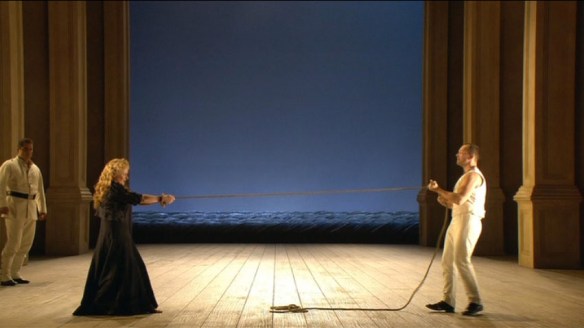
Glyndebourne has been really well treated on video in recent years and this Opus Arte release is no exception. The production for DVD is both excellent and opulent. The DVD version is spread across three disks (the Blu-ray gets two which is remarkable!). The video direction, by Robin Lough, is sympathetic and unobtrusive. The production was filmed in 1080i (which is what one gets on the Blu-ray) and the DVD rendering of the picture is about as good as DVD gets. The audio choices on DVD are LPCM stereo and DTS 5.0 with the latter being superior. In fact it’s superb; maybe the best sound I’ve come across on DVD. The fidelity with which the brass and woodwinds are captured is exceptional. The Sinfonia just before the final scene is thrilling to listen to. I’d really like to hear what the PCM 5.0 track on the Blu-ray sounds like. There are English, French, German, Italian and Spanish subtitles. Besides a synopsis and cast gallery there are two documentaries incluced. There’s a “making of” called, appropriately “Entertainment is not a dirty word” and a feature on “Danielle de Niese and the Glyndebourne experience”. It’s rather touching as Danni gushes over what an amazing place Glyndebourne is and interviews Gus Christie about what it’s like to live there. I’d like to see the follow up with Mrs Gus Christie, chatelaine!
This really should be watched by anyone who thinks baroque opera is difficult and boring and needs to be dumbed down for the average audience. But I don’t suppose he’s listening.
Anna Bolena – MetHD broadcast
Today’s Metropolitan Opera “Live in HD” broadcast was Donizetti’s Anna Bolena. I was not overly impressed although whether this was a result of issues associated with the broadcast or what was happening in the house I’m not entirely sure. One issue was that, again, the cinema was forcing its sound system well past the point at which it could consistently and accurately reproduce music. It may be OK for car chases and explosions but they need to throttle the volume back for the opera broadcasts. I’m guessing that they could drop the sound 6dB and still be louder than it would sound in the house. Driving the speakers and amps at 25% of the pressure level they are currently flogging them at would surely reduce the harmonic distortion. This was particularly an issue because this was very “heavy” Donizetti. I don’t know the work well enough to know whether it has to be done this way but the Met cast large voices in almost all the major roles and Marco Amiliato in the pit seemed to be demanding a very loud and strident sound from the orchestra. It was quite dramatic but emphatically not bel canto; more like forte shouto really. The only singer who sounded idiomatic to me was Tamara Mumford as the page, Smeaton. It did get better after the interval and the big duet between Anna (Anna Netrebko) and Giovanna Seymour (Ekaterina Gubanova) was really quite affecting. Also as far as I could tell Netrebko was singing really well in the “mad scene” (which really isn’t all that mad as these things go) but unfortunately the person in the seat behind me was having extremely audible “gastric distress” and both the lemur and I were having the hardest time not dissolving into giggles during perhaps the most solemn part of the opera. And I thought the coughing at the Four Seasons Centre was bad.
Yet another Carmen
This time it’s the 2002 Glyndebourne production directed by David McVicar. Anne Sofie von Otter sings the title role with Marcus Haddock as Don José. The production is quite restrained by McVicar standards of this period, perhaps an indication of the tamer Met productions to come, though the final scene is gruesome enough and Carmen and Don José make out more enthusiastically than in some other productions. It’s in appropriate period costumes and is pretty enough to look at without being ‘different’ in any significant way.