Cecilia and Bryn

Cecilia and Bryn at Glyndebourne is the DVD recording of a concert from 1999 featuring two of those singers who prove you don’t have to be dead skinny to be a great singer and have a commanding stage presence.  It’s great fun, focussing on the lighter end of the repertoire for the most part.  It’s mostly Mozart with some Rossini, Donizetti, Haydn and Handel thrown in.  There are a couple of overtures and a few arias but the greatest pleasure comes in the duets.  For the second time in a week I got to see Lá ci darem la mano sung by singers of extremely contrasting heights and where else is one going to see Mr. Terfel and Ms. Bartoli sing the Pa-pa-pa-pa duet from Die Zauberflöte.  As ever Ceci’s coloratura is a thing of wonder and Bryn is no slouch.  The accompaniment is ably provided by Myung-Whun Chung and the London Philharmonic.  It’s the perfect antidote to a week of watching Wozzeck.

1.hat Continue reading

The ceremony of Innocence is drowned

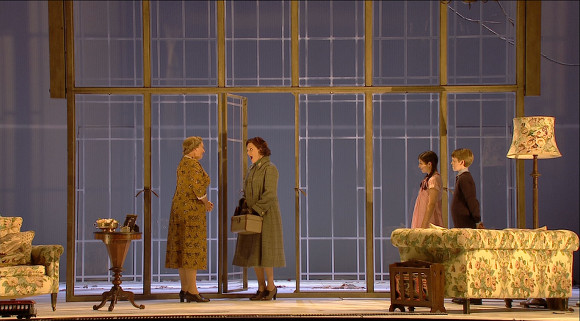
Jonathan Kent sets his 2011 Glyndebourne production of The Turn of the Screw in the 1950s.  It’s effective enough especially when combined with Paul Brown’s beautiful and ingenious set and Mark Henderson’s evocative lighting.  The set centres on a glass panel which appears in different places and different angles but always suggesting a semi-permeable membrane.  Between reality and imagination?  Knowledge and innocence?  Good and evil?  All are hinted at.  A rotating platform allows other set elements to be rapidly and effectively deployed.  There’s also a very clever treatment of the prologue involving 8mm home video.

1.arrival Continue reading

Albert Herring

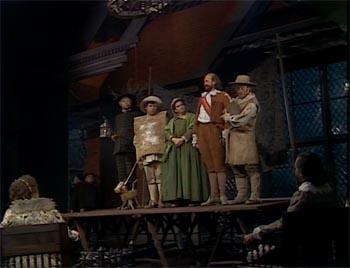
Britten’s Albert Herring is mysteriously under represented in the DVD catalogue.  The work is performed quite often being relatively inexpensive to mount and suitable for smaller venues but the many productions haven’t led to many recordings.  I have only been able to find one and that dates back to 1985 when it was recorded at Glyndebourne.  That’s appropriate enough as that’s the house the piece premiered in in 1947.  At least it’s a  fair and effective representation of the work.  Peter Hall’s production takes few liberties with the libretto and is a rather literal and effective, if necessarily somewhat caricatured,  representation of life in a Suffolk village.  The sets and costumes are evocative; especially the hall of Lady Billows’ house which really evokes a 17th century Great Hall and, as the view through the window tells us, is set in or close to the village, not in an isolated park.  There’s quite a lot of that kind of attention to detail in this production.

1.window Continue reading

Chacun à son goût

There’s lots to like in the 2003 Glyndebourne recording of Die Fledermaus.  Let’s start with Stephen Lawless’ production.  It’s attractively designed, quite slick and has a few good new gags without going overboard.  The sets are designed with striking diagonals and staircases and gantries.  Rotation is used both as a device to change the setting and as an element in the scene composition.  The overall effect is that the scene changes from drawing room to a sort of “gilded cage” for Orlofsky’s party – which opens out to create space for the action – to a prison with minimum disruption to us or the action.  Spots are used to create stagey effects and at one point Jurowski in the pit ostentatiously upstages the actors on stage.  Lawless never lets us forget this is a “show”.  Continue reading

La cosa vostra?

If you are a fan of bel canto comedies you will probably enjoy the 2009 Glyndeboure production of Donizetti’s L’Elisir d’Amore quite a lot.

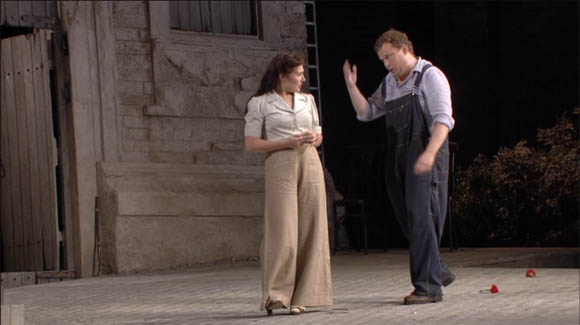
Director Annabel Arden sets this bucolic comedy in the Italian countryside of the 1950s (though some of the iconography is more appropriate to the Mussolini period).  It has some of the look, but little of the edge of Italian neo-realist cinema.  It does though take the work fairly seriously with a Dulcamara who is isn’t the obvious quack we usually see but just hints at having real powers.  Dulcemara also acquires a rather bizarre mute assistant.  Beyond that it’s all carefully staged with the chorus action well directed and performed. Continue reading

Patchy Figaro

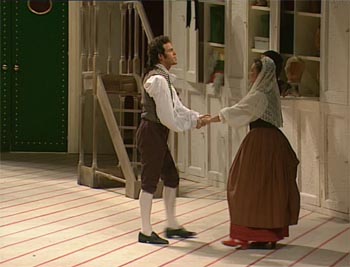
There are, I think, eighteen DVD versions of Mozart’s Le Nozze di Figaro currently available so there needs to be something very special about a recording for it to stand out. Unfortunately Stephen Medcalf’s 1994 Glyndebourne production doesn’t really despite having a strong looking cast. It’s a pretty traditional looking production with breeches and crinolines and sets which look a bit like a giant doll’s house. The Personenregie is well thought out and the stage picture often artfully composed. The acting is almost uniformly excellent. It’s a good solid production but with nothing original in the least about it. Continue reading

Fidelio at Glyndebourne 1979

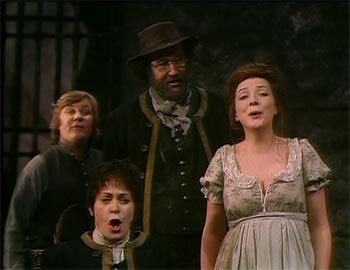
Southern Television’s 1979 Glyndebourne broadcast was Beethoven’s Fidelio. The production by Peter Hall with designs by John Bury is conventional enough though tendencies to exaggerate are clearly creeping in. The chorus of prisoners is almost zombie like and Florestan looks disconcertingly like the legless sea captain from Blackadder II. Apart from that it’s a conventional 1800ish setting where the prison’s a prison, the dungeon’s a dungeon etc. It’s also very literal in that the dungeon is so dark it’s almost impossible to see anything.  Continue reading

Baldrick, you’ld laugh at a Shakespeare comedy

Peter Hall’s 1981 Glyndebourne production of Britten’s A Midsummer Night’s Dream was quite celebrated in its day. How does it wear, thirty years later? The bottom line is it looks and sounds a bit tired.
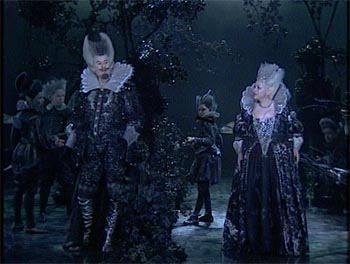
The production was innovative in its day. The scenery in the forest is inhabited by supers who make it, in a sense, “enchanted” and the lighting is interesting (at least so far as one can tell on the DVD). The problem is it never manages to generate any sense of menace from the world of the Fairies without which, to me at least, Dream (Britten’s version or Shakespeare’s) is insipid. Part of this lies in the old fashioned counter tenor sound of James Bowman and part in the very childlike fairies. As a result the first act starts very slowly and the Hermia (Cynthia Buchan) and Lysander (Ryland Davies) scene fails to spark. The “I swear to thee” duet is really slow and a bit lack lustre. Things do liven up a bit with the entry of Demetrius (Dale Duesing) and Helena (Felicity Lott). All in all Act One is a bit of a snooze.
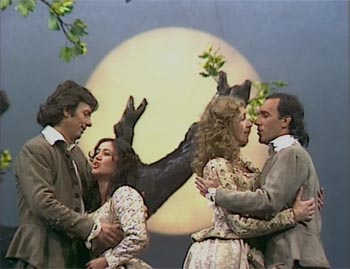
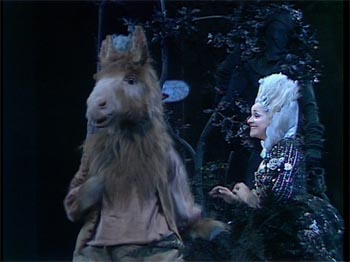
Act Two is better and the cat fight between Hermia and Helena is funny but there is still little element of menace. Oberon can’t even make “This is thy negligence” threatening and even the scenes with Bottom having an ass’ head don’t really have any bite. The Act Three lovers’ quartet is lively but Act Three really turns on whether the Rude Mechanicals are actually funny. That takes close to a miracle from both director and singers and a miracle just doesn’t happen here. Both Bottom (Curt Applegren) and Flute (Patrick Power) have their moments but it never gels. Throughout it’s fairly static with only Damien Nash’s “cheeky chappy” Puck creating much movement. So, lack of both menace and humour rather undermines some interesting design elements.
Musically this is pretty mixed too. Especially in the first act the orchestral playing seems oddly unfocussed. It’s partly a matter of tempi. Bernard Haitink is eight minutes slower overall compared to the composer’s studio recording for Decca. He also fails to get the rhythmic attack and dynamic range out of the LPO that Britten gets from the LSO. (Part of the problem here may be the soft recorded sound versus John Culshaw’s excellent Decca recording). The overall effect is a bit insipid. The singing is OK but really only Duesing and Lott stand out vocally. Ileana Cotrubas as Tytania is oddly anonymous.
Dave Heather directed for TV and video and it’s a typical early 1980s directed for TV effort. I don’t think the whole stage (and this is the old, small Glyndebourne stage) is visible even once. The picture is 1981 quality too. It’s soft by DVD standards. There is flickering on the subtitles. Don’t watch from too close on a modern TV. The Dolby 2.0 sound is barely average. There’s no real depth and at times the orchestra seems to be muffled. It’s not remotely as good as the sound on the 1966 studio recording. There are English, French and Spanish subtitles, no extras and minimal documentation.

I haven’t seen the only other Dream currently available but it’s a recent Robert Carsen production from Barcelona with Harry Bicket in the pit and David Daniels as Oberon plus video direction is by the excellent Francois Roussillon. I’d certainly advise taking a look at that before buying this one.

A Knight to remember

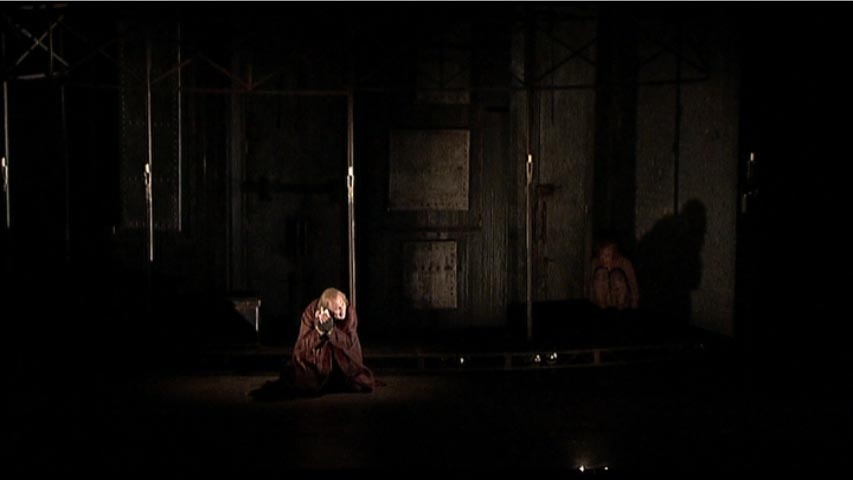
Rachmaninov’s The Miserly Knight is a very strange one act opera and it isn’t often performed. A production by as cerebral a creative team as Vladimir Jurowski and Annabel Arden looks like a very promising idea so I was very intrigued to see what they made of it in this 2004 Glyndebourne recording.

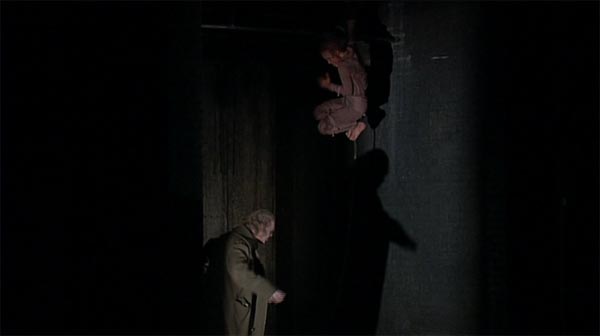
This work lasts only a little over an hour and is split into three scenes which scarcely relate to each other. In Scene 1 a young knight laments that he can’t keep up his social position on his meagre allowance. A Jewish moneylender refuses to extend further credit but suggests that he can provide the knight with poison if he wants to do his old man in. The knight refuses. Act 2 consists of a monologue in which the father, the Miserly Knight of the title, rhapsodizes over his six chests of gold in a fairly overtly sexual way for twenty five minutes. In Scene 3 the Duke orders the father to make an appropriate allowance to his son. The father refuses ultimately claiming, ironically, that his son is trying to poison him. The son rushes in and denounces his father. They have a row and the father drops dead. End of story. All this takes place to an incredibly complex score full of leitmotivs. In a real sense the orchestra is the main character, functioning as Chorus in the original Greek sense. How to bring some sense of the dramatic to this is no mean problem. Arden’s solution is to embody Greed in the form of an aerialist who is present whenever the father is present. This seems like a great idea and on the odd occasion the video director lets the DVD audience see the interaction between Greed and the father it seems to work. Unfortunately the video director, Franceska Kemp, is even more wedded than most of her ilk to superfluous close-ups and so most of Arden’s intelligent work is lost on us.

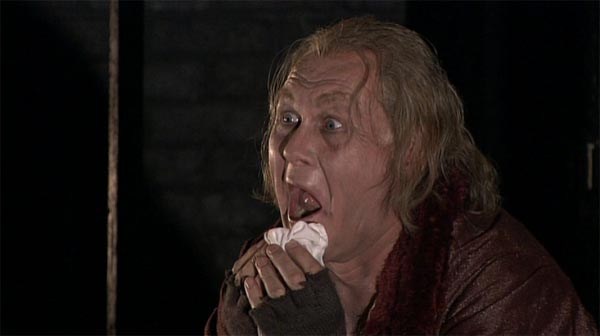
Musically this is pretty impressive. The music is not typical Rachmaninov. There are no big tunes and it looks forward to the musical language of early Schoenberg or Bartok as much as it looks back to Wagner and Tchaikovsky. In other words it’s an uncompromising early 20th century score. Jurowski gets this and conjures up superbly detailed and incisive playing playing from the London Philharmonic. He’s backed up by an excellent cast of singing actors. The star, clearly, is Sergei Leiferkus as the father. He manages a part that is usually cast for a bass but goes uncomfortably high for most basses. He can sing the music and he brings an absolutely revolting quality to his quasi sexual monologue about money and power. He’s amazing. The rest of the cast are more than adequate. I particularly liked Albert Schagidullin’s powerful baritone as the Duke. Richard Berkeley-Steele, Maxim Mikhailov and Vyacheslav Voynarovsky are solid as the young knight, the servant and the moneylender. Matilda Leyser is the aerialist portraying Greed. What little we see of her is impressive but I really would like to see much more.

Video direction aside this is pretty impressive as a DVD package. The DTS 5.1 soundtrack is superb (LPCM stereo also available). The picture is also excellent. There are French, German, English, Italian and Spanish subtitles. The extras on the disk include very useful interviews with Jurowski, Arden and Leiferkus as well as a quick look at the Gianni Schicchi with which it was paired at Glyndebourne. The documentation also includes a couple of essays that are worth reading. There’s also a Blu-ray release that includes both The Miserly Knight and Gianni Schicchi.

This is the only currently available video recording of The Miserly Knight so I think it’s worth a look despite the dreadful video direction. If that had been done properly I think this would likely have been really impressive.

Searing Kat’a Kabanová

The searing intensity of this 1988 Glyndebourne recording of Janáček’s Kat’a Kabanová overcomes a rather indifferent DVD transfer to great effect.

The production by Nikolaus Lehnhoff focuses on the inner emotions, or lack of them, of the principal characters especially Kat’a and the Kabanovicka. This focus is greatly aided by the simple but colourful semi-abstract sets that bring to mind Chagall or Kandinsky in their bold use of colour. The execution of the concept is first class. Nancy Gustavson, in the title role, gives a quite breathtaking portrayal of a mental breakdown, especially intense in the confession scene. She also sings quite superbly. Felicity Palmer as her mother in law is as chilling as one could possibly wish, nowhere more so than in the final scene as she walks away from Kat’a’s body. The Varvara, Louise Winter, the facilitator of Kat’a’s fatal affair, brings some real charm to what would otherwise be pretty unrelentingly grim.

The men have less to do and the only real stand out is bass Donald Adams as Dikoj. His scene with Palmer is oddly compelling in a revolting sort of way. The other men are perfectly adequate but it’s the women who carry the show here. The other real star is the LPO under Andrew Davis. This is a hell of a score and Davis, wonderfully supported by his players, makes the most of it. I just wish the sound quality had been better.

The production for DVD is adequate. Helped by the small stage of the old theatre at Glyndebourne video director Derek Bailey lets us see what is happening and only in Act 3 does he get a bit close up happy. All in all it’s not a bad job for a 1988 TV broadcast. The picture is tolerable. It’s 4:3 with hard English subtitles. As all 100 minutes of the opera are crammed onto one DVD5 it’s perhaps surprising it’s as good as it is. Sound is Dolby 2.0 and again “adequate” is as good as it gets. There are no extras or documentation beyond a chapter listing. The european release on a different label may be a little less Spartan.

Technical reservations aside, this is well worth seeing.