Chéreau Ring – Die Walküre

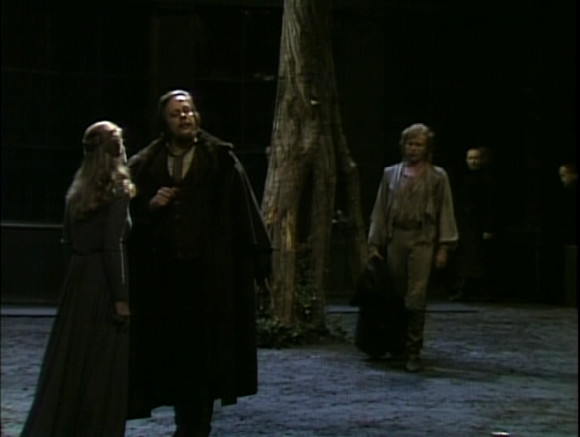
The second instalment of Patrice Chéreau’s 1980 Bayreuth Ring cycle is set, like Das Rheingold, in a sort of industrial bourgeois late 19th century.  One would almost say steampunk if that were not an anachronism.  Actually the “industrial” side is much less evident than in the earlier work.  There’s a sort of astrolabe/pendulum thing in Valhalla but that’s about it.  Setting aside, the story telling is very straightforward; so much so that it takes a real effort of the imagination to get into a mindset where this production could ever have been considered controversial.  It’s quite literal; Brünnhilde has a helmet and breast and back plates (worn over a rather severe grey dress), Wotan has a spear, Siegmund has a sword.  There’s not an assault rifle or light sabre to be seen.  It is though dramatically effective.

1.hundinghall Continue reading

Another classic re-release

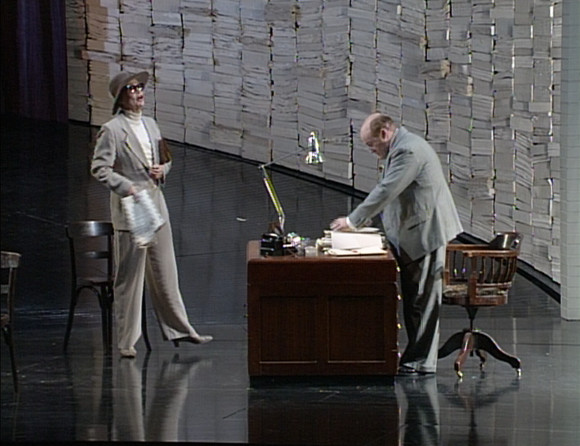
For the longest time the classic 1995 Glyndebourne recording of Janáček’s Věk Makropulos was the only video option.  It’s now been re-released on DVD and Blu-ray in a completely remastered version.  I watched the Blu-ray and it’s as well restored as the companion recording of Peter Sellars’ equally classic Theodora.  As it’s drawn from a Channel 4 broadcast the picture is 4:3 and it’s presented here formatted for wide screens in what is, apparently, called “pillarbox” mode in the UK.  At any event, the picture is excellent; certainly the equal of many more recent recordings, if not quite of the best HD quality.  The sound, stereo only, is decent but  a bit “boxed in” and the voices often seem to balanced a long way back.

1.office Continue reading

Dessay is a spectacular Zerbinetta

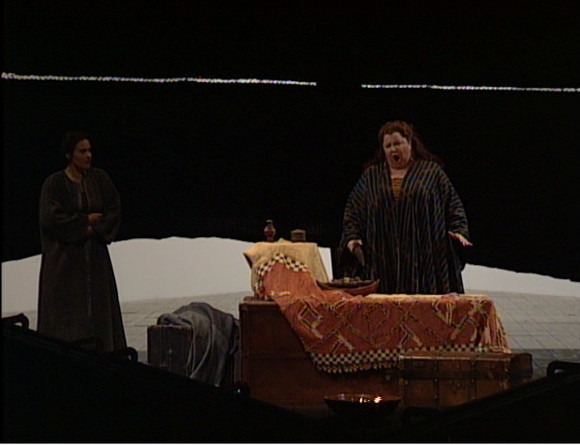
A recording featuring Deb Voigt and Natalie Dessay, both high on my list of singers I’d like to party with, obviously has to be seen.  They feature in a 2003 recording of Ariadne auf Naxos from the Met.  It’s a Moshinsky production, directed for this run by Laurie Feldman.  It’s pretty traditional in most respects though there are some interesting touches in the second act.  We are squarely in the house of the richest man in Vienna c. 1750.  No Konzept here.  In fact, the first act is traditional too in that the acting is broad, going on coarse grained.  Dessay brings a touch of distinction, managing to effectively portray the more vulnerable side of Zerbinetta.  Voigt too is very fine, and very much with the overall mood, as a completely over the top stroppy diva.  She’s definitely playing for laughs.  Susanne Mentzner’s Composer and Wolgang Brendel’s Music Master are both quite competent but suffer a bit from the pantomime acting the director appears to want.

1.house Continue reading

Midnight Marschallin

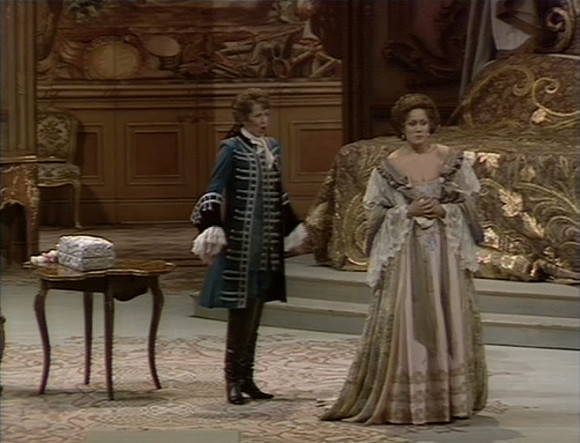
In 1985 the Royal Opera House staged film director john Schlesinger’s production of Der Rosenkavalier to mark the 25th anniversary of Sir Georg Solti’s house debut.  It’s an essentially traditional production.  We are in 1740s Vienna and both costumes and set are highly elaborate.  The opening scene stars one of the largest beds ever seen on an opera stage.  That said, it’s well put together.  The chemistry between the principals is good and the nonsense at the beginning of Act 3 is deftly handled.  There are a number of small touches that help set the tone too.  For example, at the beginning of Act 2 fake books are being installed in the Faninal “library”.

1.marschallin and octavian Continue reading

Gluck à l’outrance

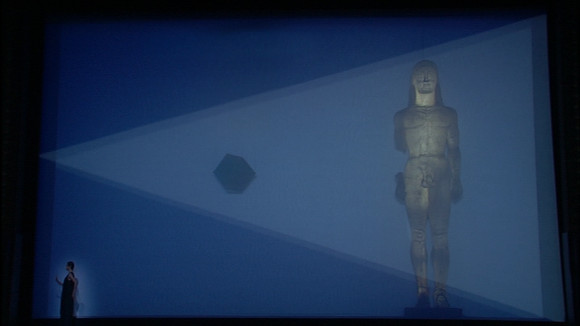
Gluck’s Alceste is not as well known as Orfeo ed Eurydice or the Iphigénie operas but in some ways it’s an even better example of what Gluck meant by “reform”.  It’s simple, restrained and elegant.  The plot has some similarities with Orfeo.  The good king of Thessaly, Admète, is doomed to die unless someone else volunteers in his place.  Naturally enough, this being opera, his wife Alceste volunteers.  There is much dignified lamenting.  She descends to Hades.  Husband and wife reproach each other for their selfishness in being the one to die.  Hercules shows up and, in gratitude for earlier hospitality, saves the day.  There is (dignified) rejoicing.  It;s an easy score to listen to with plenty of good tunes but no blockbuster, memorable, numbers.

1.statue Continue reading

Quirky Idomeneo

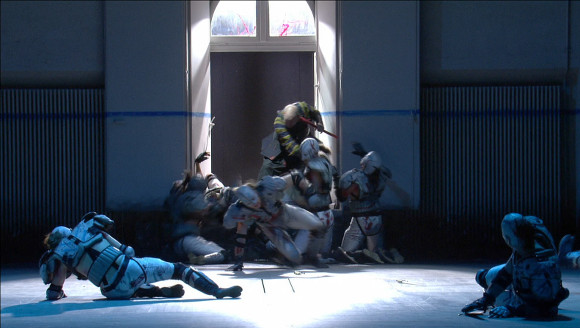
Dieter Dorn’s production of Idomeneo, filmed at the Bayerisches Staatsoper in 2008 has some interesting ideas and some arresting images but ultimately it’s hard to figure out where he is trying to go.  There’s a lot to like.  He clearly places Elettra as a member of the House of Atreus which makes her more believable.  He also creates credible personalities for Ilea, Idamante, idomeneo and Arbace.  No mean feat.  Some of the images are quite arresting too.  There is lots of blood and plenty of stage action.  The sets are chaotic piles of stuff.  Idamante gets a killer sea monster hunting rig.  Then there is the ending.  Instead of finishing on the “final chorus” the chorus drape the set with white sheets and for ten minutes the orchestra play what is listed in the booklet as a ballet but there is noone on stage and nothing is happening.  Going out on ten minutes of the most boring music in the opera is just bizarre.

1.spaceninjas Continue reading

Die tote Stadt

My acquaintance with Korngold’s Die tote Stadt has been pretty much limited to recital and competition performances of Glück, das mir verlieb, better known as Marietta’s Lied and, apparently, the last opera aria to become a hit single and Fritz’ act 2 piece Mein Sehnen, mein Wähnen.  So, I was quite glad to get my hands on a complete recording of this lushly lyrical and rather weird piece.  The “dead city” of the title is Brugge and the story concerns a wealthy man, Paul, who has turned his house, and his life, into a shrine to his dead wife Marie.  He encounters a dancer, Marietta, who very closely resembles his late wife.  What follows is wild and chaotic and is, ultimately, revealed to be a dream.  Paul realises that only in the next world can he be reunited with Marie.

1.room Continue reading

A static Tristan

Dieter Dorn’s production of Tristan und Isolde for the Metropolitan Opera is one of the most interesting from a design point of view that I have seen from the Met.  If only the direction of and acting of the principals in this recording (made in either 1999 or 2001; sources differ) was up to the same standard!

1.isolde_brangane Continue reading

Petitbon’s Lulu

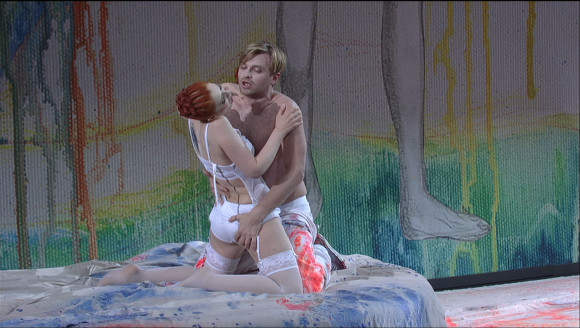
Vera Nemirova’s production of Berg’s Lulu was recorded in the Haus für Mozart at Salzburg in 2010.  It’s presented in the now conventional three act version completed by Friedrich Cerha.  The sets are painterly, including in Act 1 a giant painting of the title character.  Lighting is used to create a very distinct palette for each scene and the detailed direction of the actors is careful and effective.  I didn’t see any big ideas but then on this video recording, if there had been any, they would likely have been lost in the incessant close ups and strange camera angles.  One “trick” perhaps is that much of the action in Act 3 Scene 1 takes place in the auditorium with a fair bit of confusion as the actors hand out fake cash to the punters.  This is, of course, the scene where the glitterati go broke so perhaps some irony is intended.

1.ass Continue reading

Meyerbeer in the museum

Meyerbeer’s L’Africaine was a huge hit in Paris, London and New York when it premiered in 1865.  I’m not sure why.  It has all of the things that make Meyerbeer seem very dated and not as much of the good stuff as Les Huguenots, or even Dinorah.  It’s ostensibly about Vasco de Gama but that’s just a peg to pin a love triangle and a bunch of exoticism on.  Are we actually supposed to believe that the Portugese wanted to find a way around the Cape to find out what was there?  It would have been a lot easier to get hold of a copy of Herodotus.  It’s also long.  Even with cuts it runs well over three hours in the version recorded at San Francisco Opera in 1988.

1.room Continue reading