
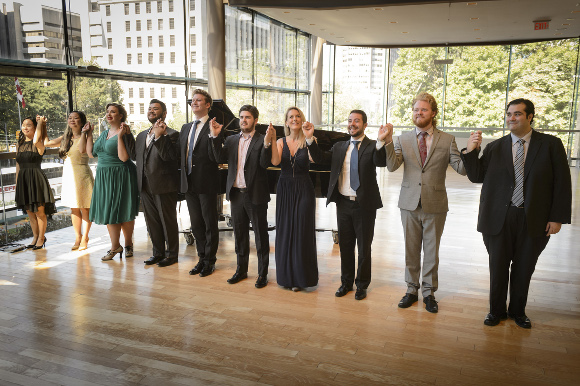
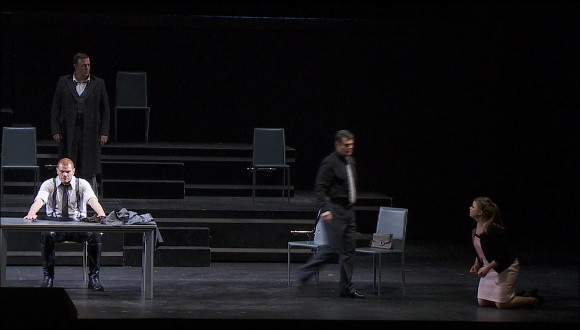
Today’s lunchtime concert in the RBA involved members of the cast of the Ensemble Studio performance of Marriage of Figaro in a semi-staged series of excerpts from the opera. The Ensemble Studio annual stage performance is always worth seeing and this year I think it’s going to be a real treat. Highlights today included Gordon Bintner’s Count. The guy can sing but here there was a swagger that should be just perfect for the Guth production. Jacquie Woodley’s Cherubino was utterly brilliant. Aviva Fortunata nailed Porgi amor, so often a disappointment I find. And I really liked Karine Boucher’s Susanna. She’s not always been a favourite of mine but her slightly dark for a soprano tone seemed really well suited to this music and blended especially well with Aviva. Ian MacNeil impressed too as Figaro, though it’s a role that’s a bit downplayed by this production, and I shall be curious to see what he does with it in the full version. Megan Latham, Jean-Philippe Fortier-Lazure and Aaron Sheppard rounded out today’s cast with the indefatigable Hyejin Kwon on piano. If you don’t yet have tickets for the performance on the 22nd I strongly suggest getting some. They are only $22 or $55 for the best seats. As Claire Morley said in her introduction this could be an event that’s talked of for years to come.
Marriage of Figaro preview
Reply
 operaramblings