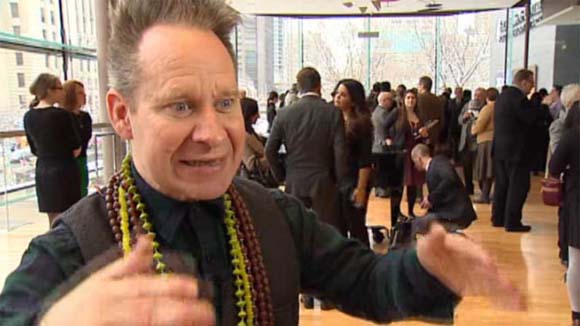
Last night Peter Sellars, in town directing Tristan und Isolde at the COC, made an appearance at the Toronto Reference Library. It was billed as an interview with The Star‘s Richard Ouzounian but bar a couple of questions at the end and a brief set up by Ouzounian it was pretty much a 75 minute monologue by Sellars. Like the man himself it was fascinating but very hard to pin down.
Tag Archives: handel
Staging Messiah
It’s a rare and valuable experience when a performance makes one reconsider a perhaps overly familiar work. That’s the effect that Claus Guth’s 2009 staging of Handel’s Messiah had on me. I don’t think that there is any piece I’m more familiar with than Messiah. I feel like I’ve known it all my life. I’ve sung it. I own a vocal score (rare indeed for me!). I couldn’t begin to count how many times I’ve heard it. And yet here it came up entirely fresh and had me thinking about it in completely new ways.
‘Tis the season to speculate
With a month or so to go before the Canadian Opera Company officially announces its 2013/14 season it’s surely time for some uninformed speculation.
There are three big anniversaries in 2013; the bicentenaries of Verdi and Wagner and the centenary of Benjamin Britten. One would think all would be represented but maybe not. We know Verdi will be. Gerald Finley announced at the Rubies that he would make his role debut in the title role in Falstaff at COC in 2013/14 so we can ink that one in. Britten seems probable. There’s a Houston/COC co-pro of Peter Grimes, directed by Neil Armfield that is due to to come to Toronto. I think we can pencil that one in. No idea on casting but I would love to see Stuart Skelton myself. Wagner, I’m not so sure. Maybe February’s run of Tristan und Isolde will be COC’s sole nod to Wagner. Certainly the next most likely candidate; the Lyon/Met/COC Parsifal is, apparently, not expected before 2015.
Orlando in Craiglockhart
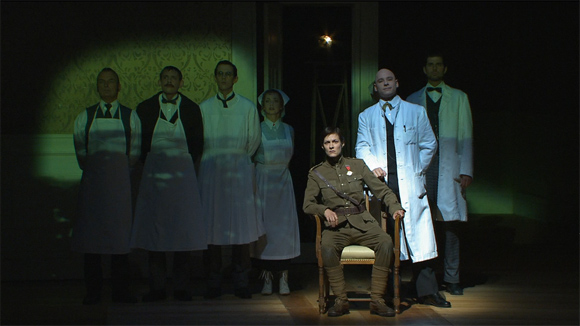
Handel’s Orlando is pretty classic opera seria stuff. It’s based on an episode in Ariosto’s Orlando Furioso. Orlando, a great soldier in Charlemagne’s army has lost his ardour for military glory because he has fallen desperately in love with the pagan princess Angelica, who is in turn in love with another man, Medoro. Orlando cannot accept this and he is driven to madness, prevented from causing absolute carnage only by the magician Zoroastro (who eventually restores his sanity). There’s also a shepherdess, Dorinda, who is also in love with Medoro, but comes to accept her lot. It’s all a bit daft and screams for a strong production concept. In his 2008 Zürich production Jens-Daniel Herzog finds one. He relocates the action to a military psychiatric hospital during, or just after, WW1. Orlando is suffering from battle fatigue or PTSD and Zoroastro is a psychiatrist. Angelica is still a princess but Dorinda has become a nurse. It all works rather well.
Watching DVDs the Handel way
There’s been a bit of jokey banter in comments on posts about various Historically Informed Productions about Historically Informed Audiences. The serious point being that we don’t watch opera in the same way the audience did in Handel’s day and, of course, we don’t perceive it in the same way. There’s nothing one can do about the perception but it did occur to me that the way I watch DVDs is, in some ways, more like Handel’s audience than the way I watch/listen when I am at a live performance. This struck me yesterday as I was watching a rather good production from Zürich of Handel’s Orlando. I’ll be writing more about that later. Continue reading
Time is a funny thing
A series of blog posts discussing time, perceptions of time and historically informed performance (HIP) plus seeing Opera Atelier’s Der Freischütz got me thinking along some curiously convergent lines and arriving at the conclusion that HIP isn’t and can’t be what it is often purported to be; a fairly faithful attempt to reproduce a work as it would have been seen by its first viewers or “as the composer intended” or something like that. Not, of course, that even if it was, we would see and hear it as the original audience did but that perhaps is a topic for another day.
Bartoli’s Semele
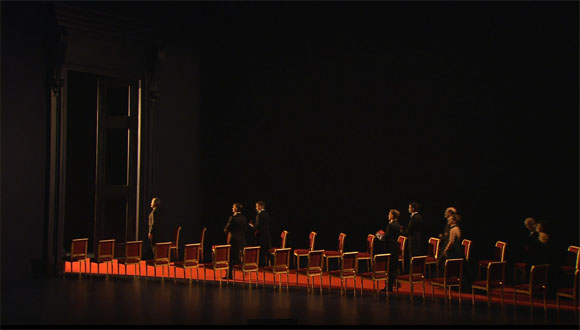
Robert Carsen’s clean, refined production of Handel’s Semele originated in Aix, was recorded in Zürich and eventually made it’s way to Vienna and Chicago. In many ways it is classic Carsen. It’s elegant and uncluttered, is strong on the detailed Personenregie, has a consistent design concept but isn’t really pushing a concept driven agenda. It’s also quite funny without descending to priapic donkeys. Also there are lots of chairs.
Chasing an opera around the Gladstone
Last night we saw the preview of A Synonym for Love at the Gladstone Hotel. The Gladstone has a long and eventful history. Nowadays it’s a boutique “artist” hotel which serves as a performance space and gallery for various indie projects like the one we saw. The work itself is, I suppose, a pastiche. The music is Handel’s long lost cantata Clori, Tirsi e Fileno. It was written when Handel was 21 and isn’t maybe his greatest work but there’s a lot of really good music in it. The libretto is an English text by Deborah Pearson that takes the basic idea of a love triangle and gives it a modern twist. In Ms. Pearson’s story Clori, sung by soprano Traxy Smith Bessette, is a bisexual woman from Calgary in town for a fling with her male lover Phil (countertenor Scott Belluz) at, naturally, the Gladstone. She is followed by her jealous long term partner Theresa (soprano Emily Atkinson). Mayhem ensues. There are also three non-singing roles who act as “guides” to the audience and participate in the drama as hotel employees. Continue reading
Ballet/Opera Fusion
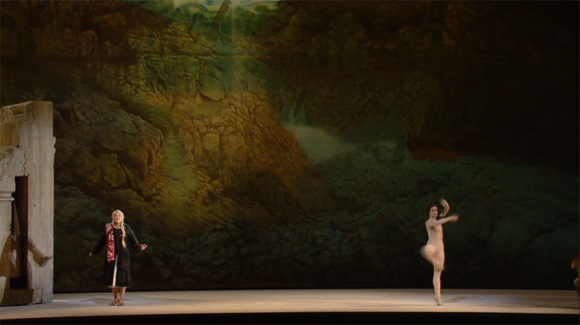
Handel’s Acis and Galatea is a peculiar piece in some ways. It was written to be performed at Cannon’s, the Edgware residence of the then Earl of Caernavon, presumably for his guests. Apparently the performance style was to have the singers sing from music stands in front of a painted backdrop. So, a sort of oratorio with curtains. It’s not uncommon to stage Handel oratorios as opera these days. Theodora is done quite often and even Messiah has been staged so it’s no great surprise that Acis and Galatea should be given a similar treatment. In fact Wayne McGregor’s 2009 Covent Garden production stages it as an opera and a ballet simultaneously combining the resources of the Royal Ballet and the Royal Opera.
An engaging Semele from the COC’s Ensemble Studio
Last night saw the annual main stage performance by the COC’s young artist programme, the Ensemble Studio. This year it was Handel’s Semele in the production which I saw a couple of weeks ago. The main roles were cast from the Ensemble Studio with the the exception of the countertenor role of Athamas which was played by Ryan Belongie, an Adler Fellow. The title role was split with Mireille Asselin singing the first two acts and Ambur Braid coming in for the third act. This seemed like a sensible solution given the size of the role and the two singers’ strengths. Continue reading