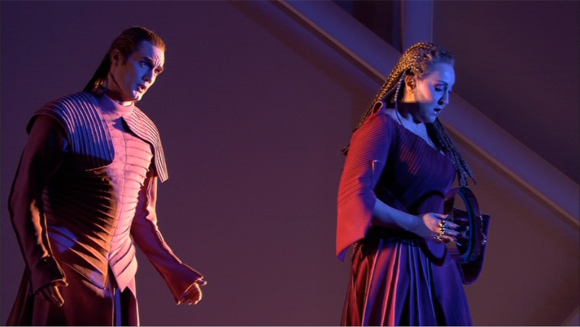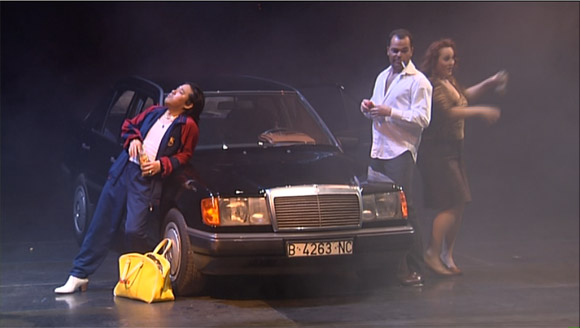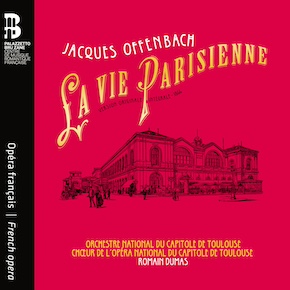
A couple of years ago I took a look at the Bru-Zane reconstruction of the “original”; never performed, five act version of Offenbach’s La vie Parisienne. That version was recorded live on stage in Paris; which was one stop on a multi-city tour. Now it’s got the full Bru-Zane audio recording treatment complete with a 240 page book with much more information about what they did (and why) to create the performing edition used. I won’t duplicate what I said in the review of the video but there are some things I noticed anew on the audio version. Continue reading
Tag Archives: gens
The other Iphigénie
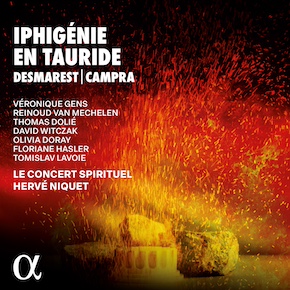
Euripides’ Iphigenia at Tauris formed the basis for an opera almost a century before the more famous one by Gluck. Henri Desmarets; one of the more notable successors to Lully at Versailles/Paris began work on an Iphigenia opera to a libretto by Joseph-François Duché de Vancy in the 1690s but work was interrupted by Desmarets being exiled from France for marrying a minor without her father’s permission. Eventually the Académie Royale de la Musique entrusted the task of completing the opera to André Campra who teamed up with Antoine Danchet as librettist. The end result was a tragédie lyrique in five acts and a prologue that premiered in 1704 to some success. An even more successful revival in 1711 led to multiple productions across France and abroad before it was effectively replaced by the Gluck work in 1779. Continue reading
The other Médée
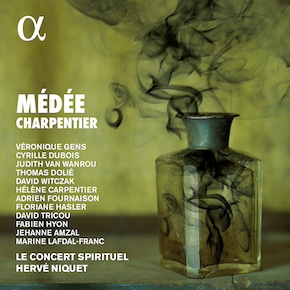
Cherubini’s Médée of 1797 is undergoing something of a revival at the moment albeit in an Italian version. But there’s an earlier and less known version of the same story with a libretto by (as opposed to based on) Corneille. It’s Charpentier’s Médée of 1693. It’s a tragédie lyrique with all the expected elements; an allegorical prologue in praise of Louis XIV, a classical subject, five acts, gods, spirits and demons and lots of spectacular theatrical effects. The Lully formula in fact. Continue reading
Fatal attraction
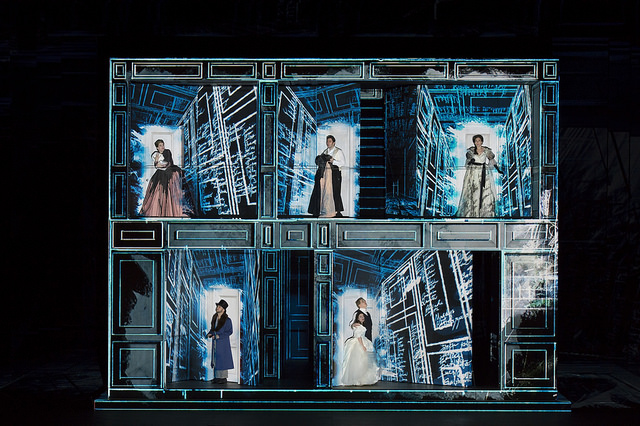
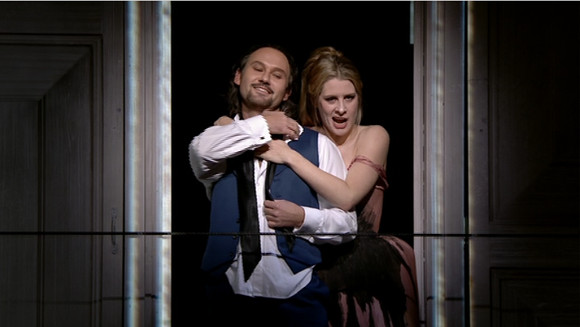
Kasper Holten’s Royal Opera House production of Don Giovanni, seen in cinemas, is now available on DVD and Blu-ray. It’s a visually and dramatically complex production so it’s probably as well that there’s plenty of explanatory material on the disks and in the booklet. Es Devlin’s set is a two storey structure that rotates and serves as a screen for a heavy use of video projections by Luke Halls. These start wth the 2065 names of the women Don Giovanni has seduced and seem to be mostly about what’s going on in Don Giovanni’s head. The sequence during Fin ch’han dal vino calda la testa is particularly spectacular.
All star Carmélites
The 2013 recording of Poulenc’s Dialogues des Carmélites from the Théâtre des Champs Elysées has a cast that reads like a roll call of famous French singers; Petitbon, Piau, Gens and Koch are all there. Throw in Rosalind Plowright and Topi Lehtipuu and one gets some idea of the star power on display.
Don Giovanni at the cinema
We got to see Kasper Holten’s new Don Giovanni from the Royal Opera House in Toronto yesterday. It wasn’t live but I really don’t think that matters. I’m not going to dwell too much on production or performance because it’s already been extensively reviewed elsewhere. I concur with the general tenor of the reviews that the singing and acting is extremely strong. Certainly Holten got a more intense performance out of Mariusz Kwiecien than Michael Grandage did at the Met and Veronique Gens was a very fine Donna Elvira. There really weren’t any weak links.
Iphigénie at last
Gluck’s Iphigénie en Aulide is finally available on Blu-ray and DVD. It was staged and recorded as a double bill with Iphigénie en Tauride at De Nederlandse Opera in September 2011 in productions by Pierre Audi. It’s excellent in just about every respect. The cast is to die for, the production is interesting and so is the staging in the rather challenging space of The Amsterdam Music Theatre, which also poses problems for the video director. Backed up, on Blu-ray, by a 1080i picture and DTS-HD-MA sound it’s a pretty compelling package.
Brotherly love
Rameau’s Castor et Pollux is a tragédie lyrique in five acts. It’s a mythology based libretto which, ultimately, celebrates the fraternal love of the twins who rise to immortality while rather callously discarding the female human love interest. Pierre Audi’s 2008 production for De Nederlandse Opera nods both to the baroque and to the mythological by staging the work in a rather abstract Sci-Fi sort of way but with moving sets and Fx that suggest, rather than reproduce, the stagecraft of the baroque.
Chav Giovanni
Calixto Bieito’s 2002 production of Don Giovanni from Barcelona’s Liceu theatre is a drink and drug fuelled nightmare. The general atmosphere will be familiar enough to anybody who has been around the “entertainment district” of a large city around chucking out time. Besides chemical stimulants and a great deal of enthusiastic bonking there’s also lots of violence, some of it quite disturbing, and buckets of blood but, as far as I could tell, only one rape. It’s bold and never dull but I think it stretches the libretto to its very limits and perhaps beyond.