Agrippina

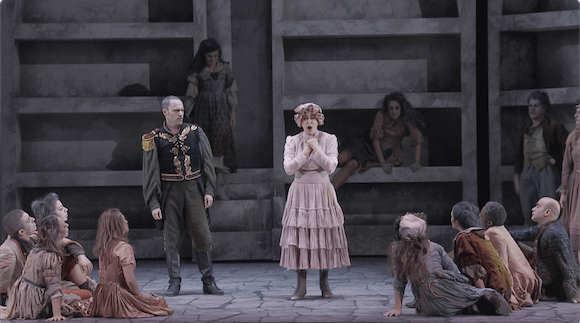
Agrippina is definitely one of the most interesting of Handel’s early operas. It has very good and very varied music including a ravishing love duet in Act 3 which reminds one of Monteverdi; perhaps not surprisingly since Poppea is one of the characters singing it! The libretto, too, has something of L’incoronazione about it. It’s smart, sexy and utterly cynical which I suppose is about par for an 18th century cardinal. It’s said that Grimani based the character of Claudio, here portrayed as an oversexed buffoon (oace Robert Graves), on his arch enemy Clemens XI. s a bonus in Robert Carsen’s version there’s a rather shocking ending in which Nerone, literally, gets the last laugh.

1.desk

Continue reading

Alceste in Munich

I really wonder why Gluck’s Alceste gets as many productions as it does.  The plot is essentially dull (summarised in this review) and I really can’t see an angle that could be used to make it interesting and relevant to today’s audience in the way that one can with such classical stories as Antigone,  Medea or Idomeneo.  The music, bar a handful of numbers, is not very exciting either.

1.people

Continue reading

Cavalli at the court of Louis XIV

Cavalli’s Ercole Amante is an oddity.  It was intended as a wedding present from Cardinal Mazarin to Louis XIV but got hijacked by Lully who inserted a bunch of ballets for the king to dance stretching out the piece to something like six hours.  It wasn’t a great success.  It’s also a very odd story for a piece intended for a royal patron as I explained in reviewing an earlier recording.  It’s also in Italian which may make the only French court work to be performed in that language.

1.allegory

Continue reading

Fidelio 1806

There were, of course, many Beethoven 250 events planned for 2020 and few of them happened.  One, planned for Vienna, was to stage all three versions of Beethoven’s only opera; Leonore (1805), Fidelio (1806) and the final form that modern audiences mostly know, Fidelio (1814).  As far as I know the only one that went ahead was a production of the 1806 version at the Theater an der Wien that was filmed in an empty house and has just got a release on Blu-ray and DVD.  Now, it happens that the 1805 Leonore was staged and recorded by Lafayette Opera in New York the year before.  So we can look at all three versions and the evolution of the piece despite the Vienna cancellations.  For those who want more details on the New York production, it was reviewed by Patrick Dillon in the summer 2020 edition of Opera Canada and there will be a review, by myself, of the recording in a future edition (probably soon).

1.marcellina

Continue reading

La Dori

Pietro Antonio Cesti’s 1657 dramma musicale La Dori is a hoot.  It seems to prefigure every plot device that will ever be used in opera.  A baby sold by bandits who turns out to be a princess.  Pirates. A ghost. Mistaken identities.  Swapped potions. Men pretending to be women.  Women pretending to be men.  Love polygons of fiendish complexity.  I won’t even attempt to explain the plot because it’s very complex and silly and hardly matters.  It took me a half page diagram just to map the relationships between the characters.

1.oronte

Continue reading

Minimalist Lohengrin

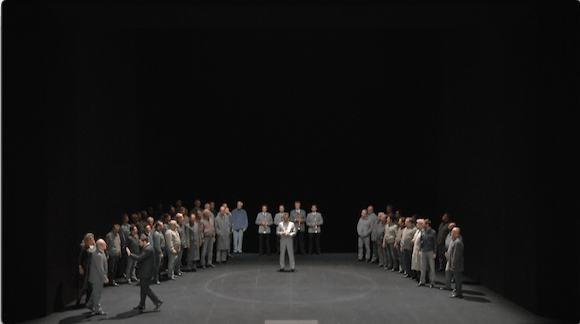
There’s obvious irony in a Hungarian directing Wagner’s Lohengrin; even more so when that director sees in Wagner’s Brabant parallels with Orban’s Hungary.  It’s quite interesting to see how this plays out in Árpád Schilling’s production recorded at Staatsoper Stuttgart in 2018.  The first thing to say is that this is an extremely minimalist production with a circle on stage , a curved back wall and not much else, though a bed appears in Act 3.  It’s very monochrome; the stage and the characters are all more or less in shades of grey until late in the second act when the Vier Edelknaben (here definitely women) and then the chorus appears in colourful but still eclectically modern, casual outfits.  The only real device for telling the story, apart, from the words and music, is the way groups of characters are arranged on stage.

1.Brabantfolk

Continue reading

La nonne sanglante

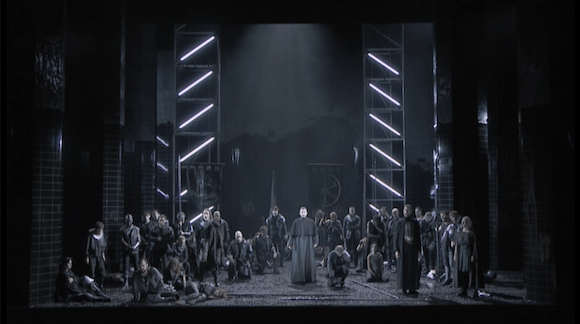
I guess there are two ways one can approach “Gothic Horror”.  Either one takes its conventions at face value as in, say, Bram Stoker’s Dracula or one treats it tongue in cheek; Jane Austen’s Northanger Abbey of the BBC Dracula from earlier this year.  It’s no surprise that in La nonne sanglante Gounod very much takes things at face value and, equally unsurprisingly chucks in a fair amount of Catholic religiosity complete with the unlikeliest characters wandering off to Heaven at the end.

1.feud

Continue reading

The end of all human dignity

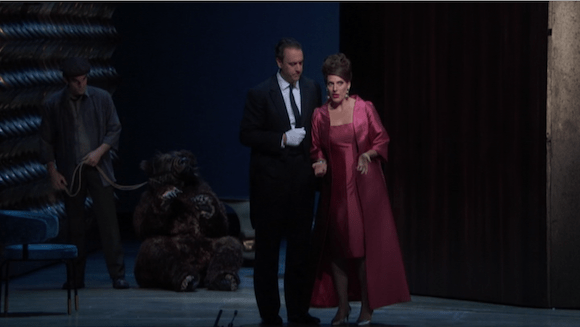
Thomas Adès’ latest opera, The Exterminating Angel, is probably his most ambitious and best to date.  It received its US premiere at the Met in 2017 and was broadcast as part of the Met in HD series, subsequently being released on DVD and Blu-ray.  It’s based on the surrealist 1962 Buñuel film.  It’s a very strange plot.  A group of more or less upper class guests attend a dinner after an opera performance.  All the servants except the butler have (inexplicably) left the house.  The guests seem unable to leave the room they are in nor can anyone from outside enter it.  This goes on for days(??) during which the guests accuse each other of various perversions including incest and paedophilia and turn violent while still expressing delicate aristocratic sensibilities like an inability to stir one’s coffee with a teaspoon.  There’s a suicide pact, a bear and several sheep involved before the “spell” to escape the room is discovered.  What happens afterwards is unclear.  (The opera omits the closing scenes of the film).  It’s very weird and quite unsettling; Huis Clos meets Lord of the Flies?

1.bear

Continue reading

Duelling tenors

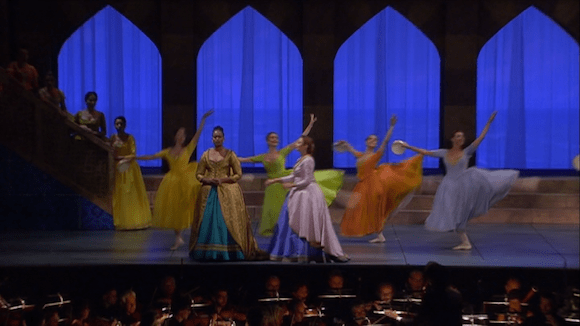
Rossini’s Ricciardo e Zoraide isn’t performed all that often but it has appeared a number of times at the Pesaro Rossini Festival.  In 2018 it got a new production there from the creative team of Opera Atelier with a rather starrier cast than is usual in their Toronto productions followed by a DVD/Blu-ray release.  It’s actually not too hard to see why the piece isn’t done more often despite its many good qualities.  It requires four tenors; at least two of which need to be absolutely top notch Rossinians and a soprano of equal quality.  None of the roles are easy.  It’s also a bit mixed dramatically.  The libretto is a rather convoluted crusader story set in Africa.  Agorante has captured Zoraide and wants to make her no.2 wife.  No.1 wife Zomira is unimpressed.  Ricciardo disguises himself to try and rescue Zoraide.  Zoraide’s father shows up.  Agorante is about to have essentially everyone executed when the crusaders, led by Ernesto, rush in and everybody makes up.  There are some really effective scenes and others that just seem to drag on.  Musically it’s pretty good though.  It’s never less than well crafted and at times; the first half of act 2 especially, there’s some great music including a crackerjack tenor duet, a fantastic display aria for soprano and some really good ensembles.

1.ballet

Continue reading