Orphée et Eurydice – Gardiner DVD

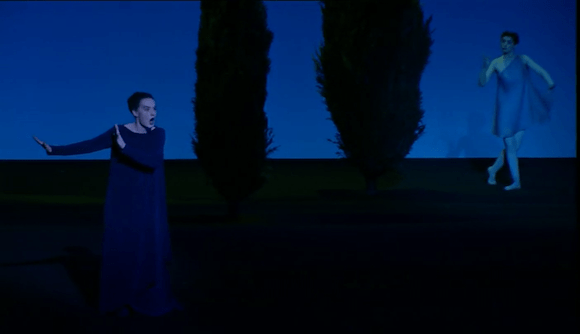
John Eliot Gardiner chose to videorecord the French version of Gluck’s Orphée et Eurydice at the Théâtre Musical de Paris – Châtelet. Choosing the French version is consistent with Gardiner’s other Gluck recordings. The Paris cast is a bit less starry than his Lyon CD version but more than adequate. Orphée is sung by mezzo Magdalena Kozena, Eurydice by Madeline Bender and Amour by Patricia Petitbon. Gardiner uses his usual forces for chorus and orchestra; the Monteverdi Choir and the Orchestre Révolutionnaire et Romantique. Choreography is by Giuseppe Frigeni, stage direction by Robert Wilson and video direction by Brian Large. The DVD is on EMI, has 16:9 video and Dolby 2.0 sound. It was recorded in 2000.

orphchat1

Continue reading

Doctor Atomic revisited

I watched John Adams’ Doctor Atomic again yesterday. Actually this was the first time I’d seen it in its entirety since we left at the interval when it played in the Met “Live in HD” series. This time I was watching a recording of the Nederlandse Opera’s production as broadcast on NPS2 (complete with Dutch subtitles). I think this is the same performance that is available on DVD and Blu Ray; certainly the same cast/production.

I’ve seen and listened to a lot of John Adams’ music since my first exposure to Doctor Atomic including two productions of Nixon in China and a concert compered by the composer so I feel a lot more at home with the style Adams composes in. Also, like many modern works, Doctor Atomic gets easier to grasp musically once heard a couple of times. I found myself liking it quite a lot. I still think the libretto is problematic though I think I see the point of some of the dull bits; the diet scene for example. It seems to be a way of showing how people under great strain behave. I guess it sorta/kinda works. The vocal line can still be a bit dull but the antidote is to let the orchestral accompaniment wash over you. There seems to be a way of listening, not overly analytical, that works for this kind of music.

The Amsterdam (also seen in Chicago and San Francisco) production seemed more dynamic than I remember the Met production being. There’s a lot of use of dance and some pretty garish colour choices. That said, the recording was very heavy on super closeups which made it quite hard to figure out what was going on on stage much of the time. Also, it seemed as if the start and finish had been edited for TV so it wasn’t entirely clear what the audience in the house saw. Needless to say the performances were exemplary as one expects with essentially the cast that created the work and with the very consistent Netherlands Opera Chorus and the Netherlands Philharmonic backing them up.

I guess my revised judgement is that this one of the first significant operas of the century and will likely stay in the repertoire.

So now, an aside. Given that for 300 years Italian and German composers dominated opera composition how come those two countries have produced essentially nothing since 1945? Italy is pretty much batting zero and Germany has a handful of operas by Henze that occasionally get performed. That’s pretty much it. The modern opera stage is dominated by Brits (Britten, Tippett, Maxwell Davies, Weir, Birtwistle, Ades) and Americans (Adams, Glass, Barber, Menotti) with the odd Russian, Frenchman, Argentine and Finn kicking in. The last Italian opera of any consequence premiered in 1926. I think that’s really weird.

Lulu

Berg’s Lulu is a fascinating piece. The plot is unremittingly bleak including (by implication) child abuse, murder, cholera and prostitution culminating in Lulu’s death at the hands of Jack the Ripper. The music is dense and fascinating. Most of it is written using twelve tone technique with a different tone row for each character. It’s not an easy listen. I watched it on a DVD of a 1996 Glyndebourne production directed by Graham Vick, with Andrew Davis conducting and Christine Schafer, then 30, in the title role.

The set for the entire production is a series of contrarotating circles of floor set around a hole in the stage by which characters can enter and exit. Behind this is a high curving wall with a staircase up it and various doors. This allows Vick to use space to explore the relationships between the characters in some interesting ways.

At the heart of this production is Schafer(*) she has the ideal looks and voice for the part. There are only a handful of singers in the world who can throw off the some of the fiendishly high coloratura work and wear the outfits she wears in this piece. The rest of the cast is stellar and the orchestral playing and conducting is about as lyrical as Berg ever could be. It all adds up to a musically and dramatically satisfying package.

Video direction (by Humphrey Burton) is unfussy and undistracting. The DVD is 4:3 and the only audio option is Dolby Digital 2.0.

Here’s the scene with Lulu and Jack the Ripper as a sampler.

*The more I see of Schafer the more impressed I am. She sings a lot of difficult modern music but she also brings real character to a wide range of traditional lyric soprano roles. I’ve seen her as Sophie in Rosenkavalier, as Gretel in Hansel and Gretel and as Cherubino in Il Nozze di Figaro. She really inhabits the characters she plays. As she does in Lulu.

Theodora

Handel’s Theodora was conceived and first performed as an oratorio and it was a flop. closing after three performances. I’m not sure why. It may not be Handel’s best work but it’s got some very good numbers and it’s dramatically very strong.

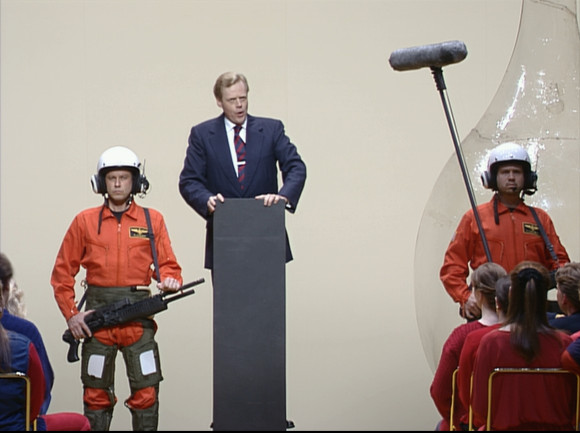
1.valensIn 1996 Glyndebourne staged an operatic version conceived by Peter Sellars. Occasionally Mr. Sellars frustrates me but most of the time I think he’s a genius who stages some of the most thought provoking music theatre out there. This Theodora is pure genius. Sellars sets the piece in contemporary America. The President of Antioch, Valens, (Frode Olsen) is a typical American politician; a nasty mixture of imperialist bluster, bonhomie and crass consumerism and he’s well supported by a brightly clad coke can bearing heathen chorus. The Roman soldiers wear US Navy helicopter pilot uniforms. By contrast the Christians wear combinations of black and white in pretty restrained cuts and combinations. The set is mostly bare but for some giant shattered glass vases and, as needed, a few props such as a lectern, chairs and, most chillingly, the gurneys on which Theodora and Didymus are executed by lethal injection. It all works really well. Although conceived 15 years ago it could have been last week. The idea that one can’t be a “proper Roman/American” if one doesn’t adhere to the state and socially approved approved religion and the chilling, deadly self righteousness of Valens seem especially contemporary in a week that sees an IRA supporter chairing a House investigation into Muslim disloyalty.

Continue reading

Der Rosenkavalier

Back in 1961 Paul Czinner decided to experiment with filming a live opera performance. He chose the 1961 Salzburg Festival production of Richard Strauss’ Der Rosenkavalier. I guess it got a theatrical release in the day then more or less disappeared, popping up up from time to time in a rather poor quality ‘Pan and Scan’ VHS version. Now it’s been digitally restored from a 35mm print and released on DVD and Blu-Ray by Kultur. It’s spectacular. It looks like early 1960s 35mm colour and it sounds like early 1960s analogue stereo. Very impressive. Like watching Il Gattopardo while listening to a recording by John Culshaw or Walter Legge.

1.bedroom Continue reading

Yet another Carmen

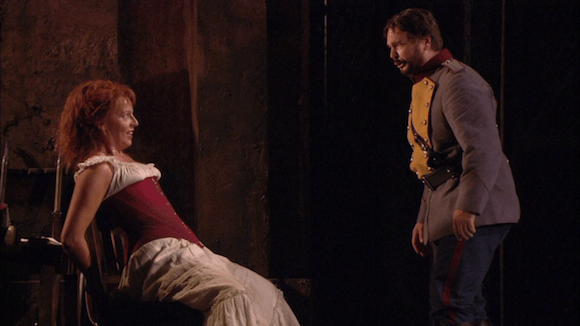
This time it’s the 2002 Glyndebourne production directed by David McVicar. Anne Sofie von Otter sings the title role with Marcus Haddock as Don José. The production is quite restrained by McVicar standards of this period, perhaps an indication of the tamer Met productions to come, though the final scene is gruesome enough and Carmen and Don José make out more enthusiastically than in some other productions. It’s in appropriate period costumes and is pretty enough to look at without being ‘different’ in any significant way.

1.habenera

Continue reading