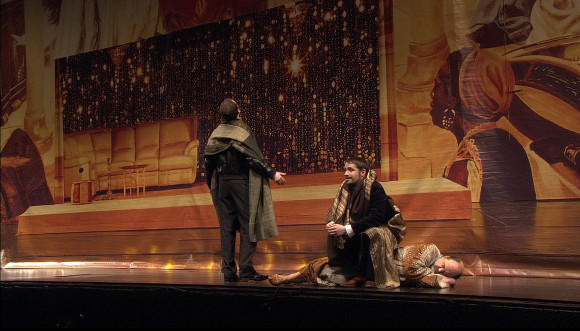
The eternal enemy of righteousness

Michael Grandage’s lack lustre Don Giovanni at the Metropolitan Opera made me very curious to see his very well reviewed 2010 production of Britten’s Billy Budd for Glyndebourne. It is now available on DVD and Blu-ray so I did just that. It’s as good as the Don Giovanni wasn’t.

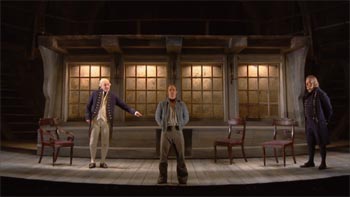
The set design suggests the interior of a warship of the period (1797) which gives scope for galleries around and behind the main stage area. By changing the lighting and sliding panels into place, it easily becomes anywhere desired on the ship. It’s very much an ‘interior’ setting which is appropriate as the sea is as absent in Billy Budd as it is present in Peter Grimes. Having created a working stage arrangement, Grandage focuses on the Personenregie. What’s striking about this production is how the director works the relationship between the characters and the development of the characters as individuals. Claggart is chilling. Vere lacks, in the last analysis, moral courage but his distaste for Claggart and his manifestations is palpable. Billy radiates simplicity and innocence. The lesser parts too are fully developed, not just filler. Dansker really foreshadows what is to come.
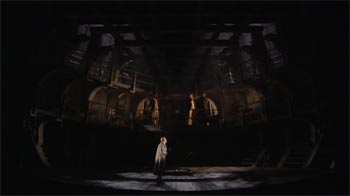
Along with this Grandage contrives some truly striking images. In the prologue “old” Vere appears almost disembodied until the ship materialises around him and the action proper starts. Towards the end of Act1 there”s a striking picture of Billy and Claggart in the centre of the picture; Billy on deck,
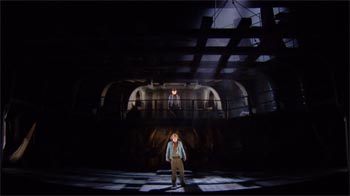
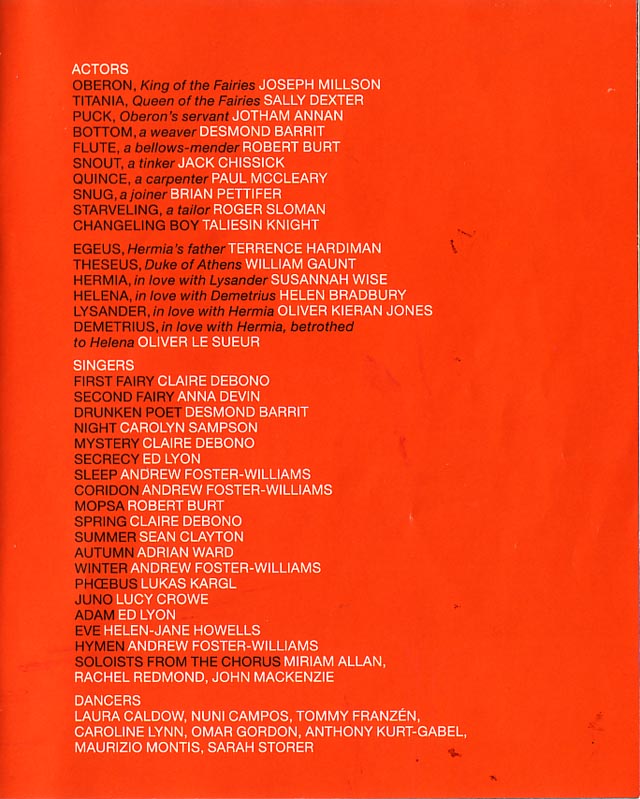
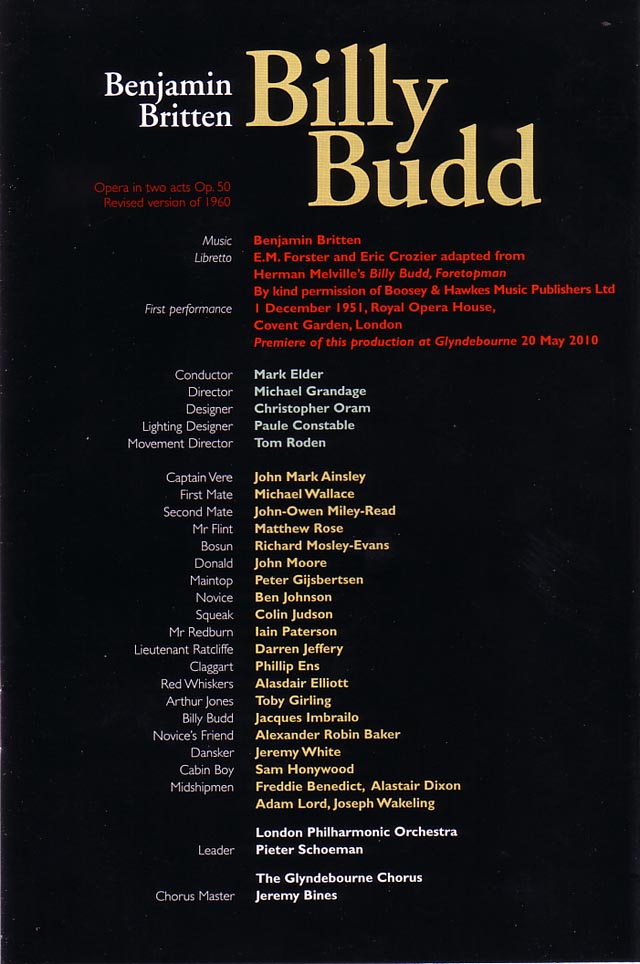
Claggart above him at the quarter deck rail. In the final scene the men hauling on Billy’s rope could be straight out of Rodin. Needless to say it takes considerable acting skill across the company to pull all this off. Grandage gets this from a solid cast of anglophone singers led by John Mark Ainsley as Vere, Jacques Imbrailo as Billy and Phillip Ens as Claggart. There are lots of quite important supporting roles so here’s the full cast:
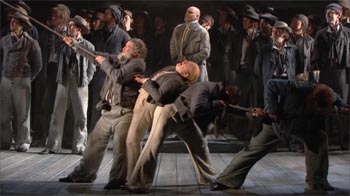
Musically too, this is a treat. The real stars here are the London Philharmonic and conductor Mark Elder. The orchestral playing is taut and incisive and shows off a really good score to fine advantage. The singing is glorious too. Clearly this is a work where the needs of the drama trump pretty singing but in the places where beauty is possible we get it. In the prologue one could easily mistake Ainsley for Pears as he floats the high notes. Imbrailo has a gorgeous voice and there’s some fine singing from many others.
The technical team for this production is essentially the same as for The Fairy Queen and the results are equally good. François Roussillon lets us see the stage and only goes close up where it makes sense. This time I watched the DVD rather than the Blu-ray presentation (two DVD9 discs). It’s not quite as good as Blu-ray. The 16:9 anamorphic picture is very good but even on my less than state of the art TV it’s not quite as good as the 1080i Blu-ray. The sound difference is even more marked. The DVD sound is DTS 5.1 and is clear and well balanced but it comes up short on spatial depth compared to DTS-HD Master Audio. (There’s also LPCM stereo). There are English, French, German and Spanish subtitles, decent documentation and a few short extras on the first disc.

I recommended this unreservedly for both die hard Britten fans and those willing to explore but get the Blu-ray version if you can.
Exemplary Blu-ray transfer for Glyndebourne’s Fairy Queen

I’ve reviewed two DVDs of Purcell’s semi-opera King Arthur on this blog. One was excellent and one was terrible and between them they went a long way to showing how difficult these semi-operas are to stage well but how rewarding when they succeed.

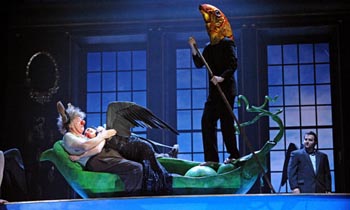
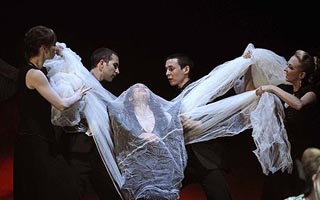
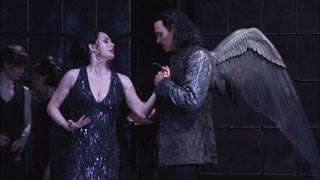
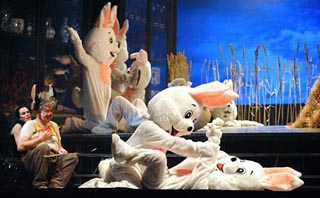
In 2009 Jonathan Kent and William Christie combined to produce a version of The Fairy Queen for Glyndebourne. It’s quite different in style from the successful Salzburg King Arthur but it works splendidly on its own terms. The Fairy Queen combines a libretto based on A Midsummer Night’s Dream with songs, masques and dances of a largely allegorical nature. Like the play itself they range from high flown allegory with classical elements to bawdy humour. It is very English. It almost epitomises what separates the English baroque from the French. Kent and Christie tackle this with a robust English sensibility, There are some changes to the dialogue and to the order of the numbers but it all makes sense (so far as this piece can). The allegorical elements are gorgeously and wittily staged making good use of a large circular lift at centre stage that allows fully formed tableaux to rise into our sight. The bawdy elements are tackled head on with a robustly TV Mopsa (Robert Burt) in the “Dialogue of Corydon and Mopsa” and the, by now, notorious bonking bunnies in the “Dance for the Haymakers”. The audience is totally engaged and one hears plenty of that commodity, rather rare in the opera house, uninhibited laughter. The team of designer Paul Brown and lighting designer Mark Henderson make all of this look quite spectacular. The dramatic action is played out in fairly long segments and the parts are taken by actors rather than singers. The fairies are appropriately sinister with wings that look inspired by contemporary prints of fallen angels. The Rude Mechanicals are rude and not too mechanical.  The “humans” are credibly 17th century in manner though dress gets less formal as the action proceeds.  The disparate elements are integrated very well.  There’s plenty of dance and it’s choreographed by Kim Brandstrup in a style that is robustly muscular but solidly in the classical ballet tradition.

The cast of actors, singers and dancers is huge and consistently excellent.

I was particularly impressed with Sally Dexter’s Titania and Desmond Barrit’s Welsh accented Bottom among the actors.  Barrit even got to do some singing with a not too over the top version of the “Song of the Drunken Poet”.  The singing stars were the wonderful, sweet toned Lucy Crowe; her “if love’s a sweet passion” was a delight, and the robust bass-baritone Andrew Foster-Williams who, among other sings, sang a truly chilling Winter.  Singling out individual performances isn’t the point though.  This is very much an ensemble performance.  Christie directs the Orchestra of the Age of Enlightenment from the harpsichord and is as idiomatic as one could possibly hope for.

So, how well does the stage production transfer to disc?  Extremely well!  The video director is François Roussillon.  Unlike most of his peers he appears to have realised that opera lovers are not, for the most part, watching on tiny screens anymore.  He makes sure we can see what the designer and director intended.  Sure, there are close ups but never at the expense of the bigger picture.  The technical quality is of a very high order.  There are two formats available; a two DVD set and Blu-Ray.  I watched the latter but I doubt most people would see a huge difference.  It was filmed in 1080i HD and the picture is clearly better than my first generation HD TV can fully do justice to.  The sound is incredibly good.  On Blu-Ray it’s DTS-HD Master Audio (DTS 5.1 on DVD).  The quality is apparent even as Christie is walking to the pit.  The applause simply sounds as if one is in the house rather than the usual muffled fluttering noise.  The balance, clarity and spatial depth are exemplary throughout.  Both formats also have LPCM stereo.  There are English, French, German and Spanish subtitles.  There are useful extras.  The disc includes interviews with Kent and Christie which are well worth watching and the booklet includes an informative essay by Kent as well as a track listing and synopsis.

All in all this is an excellent production given an exemplary transfer to disc.  Here’s the official trailer, unfortunately in less than exemplary Youtube quality:

A girl called Maria

Maria Ewing has always been a bit of an enigma to me. It’s the range of roles I’ve heard her in; Salome, Dido, Carmen, Rosina. Soprano to mezzo and bel canto to dramatic.  In the recording under consideration here she sings Rosina in Rossini’s Il Barbiere di Siviglia. It was recorded at Glyndebourne in 1982 when she was 32. Her performance is typical Ewing. She acts really well, looks great (if her unusual looks work for you – they do for me!)  and sings really well without ever really sounding beautiful and occasionally giving one the feeling one gets watching somebody corner a little too fast on a large motorbike. I find watching her fascinating.

The production is as traditional as one could get and makes the small, old Glyndebourne stage look even smaller. Costumes too are absolutely generic 19th century comic opera. Blocking is basic. Mostly it’s very straightforward “park and bark”. All in all it’s the sort of thing you simply wouldn’t see in a modern opera house (except maybe the Met) and I’m sure it would please the investment banker’s wife in the Salzburg King Arthur. The singing and acting, Ewing aside, backs the production up.

John Rawnsley is a very broad Figaro with winks and big gestures and little mincing footsteps. He sings very well indeed but he has a voice that seems two sizes too loud for the production and tends to dominate ensembles. Max-René Cosotti is the Count. He has an old fashioned Italian tenor voice that works really well in this context. The rest of the cast is perfectly OK too and there’s a bit of a bonus in that Basilio is sung by a 33 year old newcomer called Ferrucio Furlanetto. We are a million miles away from Phillip II here! The London Philharmonic are in the pit under Sylvain Cambreling. They are balanced well back from the voices but seem OK to me. All in all, this is musically quite fine, if rather old fashioned, but dramatically it’s rather like watching superior panto for adults.

Technically this disc is about what one might expect. It’s taken from an ITV broadcast and is very much video directed for small screen. The picture is barely DVD quality 4:3 and the sound is Dolby 2.0. It isn’t particularly good either being slightly muffled and with quite unrealistic balance. Subtitles are available in English, French, German and Spanish. There are no extras and minimal documentation. All in all I think one has to treat this like a dodgy mono sound recording from the 1950s. It’s worth having if one wants a record of these singers but otherwise one is better off looking for something more recent. Certainly Dario Fo’s Amsterdam production is much more fun to watch.

Will the Met’s Live in HD series significantly affect live opera?

I’ve been giving far too much thought to a range of issues surrounding the Metropolitan Opera’s Live in HD broadcasts to cinemas. They have attracted a wide audience and are much talked about, both as performances and as to their impact on live opera; the so-called HD Generation. That said, I’ve seen little analysis of what the broadcasts really are or of their audience or of how and why the HD audience reacts to them the way it does. I want to explore those questions and then go on to look at whether and how the HD broadcasts might influence the practice of live opera. Some of this will be speculative as I am certainly not privy to the kind of data about the audience and its reaction that I would need to do what I want to do well. Some of it will be coloured, perhaps highly coloured, by my own experiences with live music, electronically reproduced music and the tricky relationship between them.

Continue reading

Burnt Toast

So this has to be the weirdest opera related thing I’ve seen in a while. It’s a 2005 CBC production of eight very short comic operas (the whole thing only lasts an hour) going through the stages of a relationship from Attraction to Starting Over via Marriage and Murder. The characters are mostly played by actors lip-synching while someone else sings. The music is by Alexina Louie and the libretto by Canadian comic, Dan Redican. Each piece is introduced by Redican as a mad toast scientist and the cast includes some of the best known names in Canadian theatre and opera including Colm Fiore, Isabel Bayrakdarian and Russell Braun. It sounds like a great idea but unfortunately it’s pretty ordinary. The music is mostly dull but it livens up a bit when it’s more obviously pastiche. The humour is a bit lame though the piece about a woman slicing her husband’s head off then disembowelling and liquidizing him for leaving the toilet seat up has its moments; especially her acquittal by an all female jury. Also you get to hear Isabel Bayrakdarian sing about kitty litter and Russell Braun do a version of Der Hölle Rache.

All in all, it’s as Canadian as moose jokes and about as funny.

toast

ETA February 1, 2016

So it’s been four years since I last watched this and the funny thing is that in that time I’ve come to know, one way or another, most of the singers involved in this thing who include Michael Colvin, Krisztina Szabó, Shannon Mercer, Peter McGillivray, Barbara Hannigan and Doug McNaughton.  It does make it more fun but I guess that doesn’t really work for a general audience.  It also makes me a bit baffled about who got to be played by an actor and who got to sing and act.  There are some pretty good actors involved here who never get seen.

Let the triumph of love and of beauty be shown

One of the trickiest things about opera productions; baroque opera anyway, is what to do about the dance elements. Time was when opera and ballet were joined at the hip but not so much nowadays beyond sharing premises. In 2009 the Royal Opera House made the bold decision to have choreographer Wayne McGregor direct the combined forces of the Royal Opera and the Royal Ballet in a production of Henry Purcell’s pocket masterpiece Dido and Aeneas. The result was broadcast by the BBC and subsequently released on DVD and Blu-Ray by Opus Arte. It’s a fascinating and rewarding production.

Sets and costumes are very spare. Aeneas and the chorus are in greatcoats and wide trousers. The ladies are in unfussy gowns. The dancers are in singlets and booty shorts (both sexes). Carefully detailed direction of the singers and their gestures, bold choreography and imaginative lighting carry the visual side of the production. The use of top quality dancers and a top notch choreographer allows the dance elements to realise their full potential (and not a castanet in sight!). The result is visually stunning.

Now add a superb singing cast. Lucy Crowe almost steals the show as Belinda. She’s fresh and vivacious and her clean sound is just right for Purcell. But it is “almost” because we have Sarah Connolly’s monumental Dido to set against it.(1) She is one of the great Didos. I have heard Kirkby, Te Kanawa, Ewing and Baker in the role and even Flagstad but none exceed the combination of searing intensity and pathos that Connolly brings to the role. She is superb. Other elements of the singing are also admirable. Lucas Meachem is a hunky Aeneas and manages the tricky low notes better than most. The sorceress and witches; Sara Fulgoni with Eri Nakamura and Pumeza Matshikiza playing Siamese twins, don’t do the camped up distorted thing that is so often inflicted on the role. Fulgoni sings with quite a lot of vibrato which is sufficient to create some musical distance between her and the non infernal characters. The minor roles are all pretty good too. The regular Covent Garden orchestra is replaced by the Orchestra of the Age of Enlightenment under Christopher Hogwood. This is a move that other large houses might think about for earlier repertoire.

All this goodness builds to a searing climax in which Dido slits her wrists with the “tushes far exceeding those that Venus’ huntsman slew” and dies while a haunting projection of a horse plays back of stage. All in all it’s an hour of magic.

Video direction is much better than average. Close ups are minimised and we get to see the choreography in its broadest sense. The picture is superb 16:9 anamorphic (1080i on the Blu-Ray) and sound options are PCM stereo and DTS 5.1 (PCM 2.0 and PCM 5.1 on Blu-Ray). There are English, French, Spanish, German and Italian subtitle options.

Highly recommended.

(1) I do think the balance of voice types between Belinda and Dido is important. It’s like Carmen and Micaëla. If the voices are too similar much texture is lost. Crowe and Connolly are an ideal combination.

Kinky boots and all

Die Entführung aus dem Serail is probably the major Mozart opera I know least well so I don’t have too many comparators for this performance from Amsterdam by De Nederlandse Opera from 2008. So I can’t say that this is better or worse than other available productions but I can say I enjoyed this one immensely.

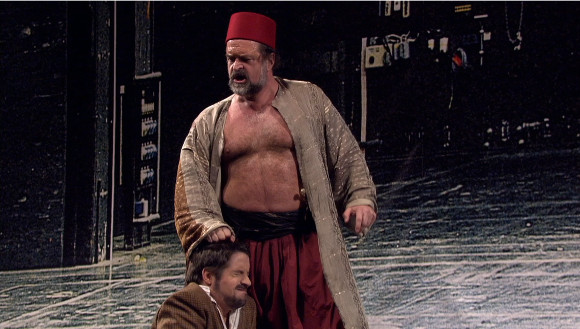
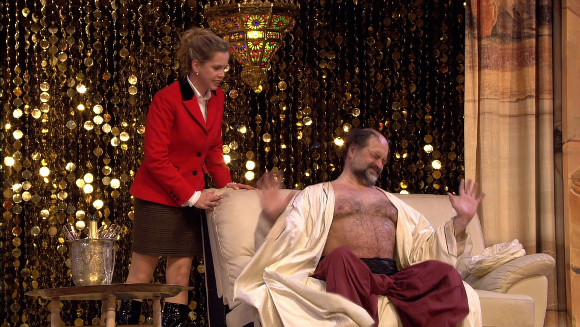
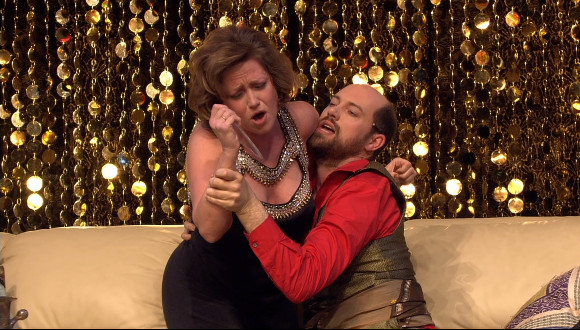
1.osminThe production, directed by Johan Simons, uses fairly uncluttered sets and costumes that switch between pantomime Aladdin and, most of the time, modern dress. The take on the characters is interesting. Osmin is pretty much the classic infatuated old Turk, played brilliantly by Kurt Rydl, but the infatuation is reflected by the distinctly dominatrix like Blonde played by the rather lovely Mojca Erdmann in kinky boots, a tight short skirt and a belt that she’s quite prepared to use on the men in her life. At least in the first two acts there’s plenty of ambiguity in Laura Aikin’s Konstanze. Is she actually at least a little bit in love with Bassa Selim, played very well by Martin van Westmeulen. Certainly she has him twisted around her little finger and in Martern aller Arten seems to be very much “topping from the bottom”. To round the cast out, Michael Smallwood is a cheeky chappy Pedrillo, very much under Blonde’s thumb and Edgaras Montvidas is a suitably sappy Belmonte. It’s mostly fast paced good fun but does strike a more serious note in the final scenes. Funny how that always seems to happen with Mozart “comedies”.

2.bootsMusically it’s pretty good too. Constantinos Carydis conducts a fast paced and nimble reading from the Netherlands Chamber Orchestra. The vocal star is clearly Laura Aikin who has the difficult coloratura parts of Konstanze’s music nailed. This is particularly praiseworthy as she does it while doing some pretty intense physical acting. It can’t be easy to nail Martern aller Arten with Bassa Selim firmly lodged in your cleavage. The men are perfectly adequate. I thought Michael Smallwood was particularly sweet toned. The one weakness, and I hate to say this, was Mojca Erdmann. Her upper register is a bit harsh and shrill. This is surprising as most reviews of Ms. Erdmann praise her beauty of tone. Maybe she was just pushing a little too hard in this performance. The ensemble work was generally first class.

3.maaThe recording is available from Opus Arte on DVD and Blu-Ray. I watched the latter using the Dolby TrueHD 5.0 soundtrack. The picture is 1080i HD 16:9. It looks and sounds great on my system and would doubtless look even better on a more modern TV. Definitely worth a look.

4.boys

A blast from the past

One of the first opera DVDs I bought was John Eliot Gardiner’s Le Nozze di Figaro recorded at the Chatelet Theatre in Paris in 1993. This is a pretty early example of period performance of Mozart. Gardiner was in the middle of his run of recordings for DG Archiv and it was only two years after Opera Atelier’s breakthrough Magic Flute which I saw only because one of my clients was sponsoring it and couldn’t shift the free tickets. This Figaro is pretty traditional in design and features “original instruments” and period singing style without going the whole Opera Atelier style baroque route (there are no castanets). Sets are flats plus bits of furniture. Costumes are breeches, crinolines and wigs. Olivier Mille directed but I’m not sure anybody noticed. At one point the Count looks exactly like Prince George in Blackadder the Third. The buffo characters are over made up and over the top. Regie has no place here.

The cast is excellent. 28 year old Bryn Terfel plays Figaro and already sounds on the big side for a period performance of Mozart. Susanna is the sadly under-recorded Alison Hagley; an ideal Susanna both as singer and actor. Rodney Gilfry plays the Count with a perpetual sneer and other Gardiner regulars such as Hillevi Martinpelto, as the Contessa, are prominent. In the future star department we get Sarah Connolly as one of the contadine. Pacing is a bit breath taking. Terfel in particular takes his recitatives so fast it’s hard to tell if he is actually singing. Despite looking rather old fashioned and having a bit of a feel of period performance for the sake of it, the production does come off really well.

The production for DVD is a bit odd. The opera was filmed as 16:9 but it’s hard coded to disk as 4:3 so if you watch it on a widescreen TV it’s letterboxed both ways. The picture is adequate DVD quality. The only sound option is LPCM stereo and there are IT/EN/DE/FR/ES/CHI subtitle options. The documentation includes a long essay on how they decided to order some of the numbers differently from the autograph score. All in all, an interesting artefact as a very early DVD capturing a very decent performance.

This Youtube clip is of abysmal video quality but it does give a fair idea of the production.

Fidelio – Metropolitan Opera 2000

Apparently the 2000 production of Beethoven’s Fidelio at the Met was controversial. It’s very hard to see why. Although Jürgen Flimm has moved the setting to the mid 20th century and some unspecified country that looks vaguely Germanic the storyline is followed to the letter, bar a few changes to dialogue, and there is no risk at all of any dangerous ideas surfacing. It’s actually a very good example of what the Met does when it’s on form; assemble an all star cast, stick them in an inoffensive production and let the music do its thing. Here we have an enviable cast. Leonora/Fidelio is sung by Karita Matila who looks and sounds spectacular (although maybe the fact that she’s the only “male” among the principals with no facial hair should have triggered a little cluefulness). Vocally she is most assured and never seems under any strain at all. She acts well too. Ben Heppner, as Florestan, is also vocally solid and even quite lyrical in the big trio “Euch werde Lohn in besseren Welten”. The acting though is best passed over in discrete silence. René Pape is fascinating as Rocco, the gaoler. I’m used to seeing Pape playing magisterial roles like Boris Gudonov or Sarastro. Here, the big voice is coupled with almost bumbling acting as he plays a morally weak character. It’s most interesting. A young Matthew Polenzani, one of my favourite tenors, sings Jacquino and he sings quite beautifully. Marzellini is Jennifer Welch-Babidge who I had never heard before but was sufficiently impressed to go look her up. It seems she’s busy with four kids in Utah and doesn’t spend much time at all in opera houses these days. It’s rather a pity. Falk Struckmann’s Don Pizarro is appropriately villainish and musically solid like everyone else. James Levine conducts and right from the overture launches us into a very intense, muscular reading of the score backed up by a very high standard orchestra. Musically and dramatically this is very satisfying albeit in a thoroughly conservative way.

The production was recorded for TV broadcast and it shows. The sets are already pretty claustrophobic but Brian Large’s video direction amplifies that. One gets the feeling that this is being directed for a 27 inch screen and it looks a bit lost on anything much larger. That said, the picture is more than decent and the DTS 5.1 soundtrack is top notch (Dolby 5.1 and LPCM stereo are also offered). The English subtitles are a bit odd. For some reason “Gouverneur” is translated as “Colonel” and “König” as “President”. I didn’t check the French, German, Spanish or Chinese subs for similar oddness. Bonus material is minimal but the documentation is fairly decent. All in all it’s a typical Deutsche Grammophon release of its period.

This excerpt from Act 1 (Gut, Söhnchen, gut) is pretty typical.

Stylish gender bending

I guess Serse gets performed as often as any Handel opera but there only appears to be one DVD version in the original Italian available. It’s a 2000 production from the Dresdner Musikfestspiele. Michael Hampe directs a cast of, then, fairly young singers, few of them familiar to me. Christophe Rousset conducts Les Talens Lyriques and the Ludwigshafener Theaterchor. It’s a really good DVD. The costumes and sets, by Carlo Tommasi, are a sort of mid 19th century European with “exotic” touches. There’s a consistent palette of black, white, grey and silver with a little deep blue and cream intruding. It’s all very elegant. The direction is more than competent. The relationships between characters are explored and Sandrine Piau, as Atalanta gets to exploit her considerable comic talents. To cap it all off we get a few, very apt, pyrotechnic surprises right at the end.

The singing is uniformly excellent. Paula Rasmussen, a mezzo, is cast in the castrato title role. It’s a role where personally I’d prefer a David Daniels or a Lawrence Zazzo but she manages to look and sound masculine enough. The same is true for Ann Hallenberg as “his” brother Arsamene; a genuine mezzo role. Patricia Bardon sings Amastre, Serse’s discarded lover who spends 9/10 of the opera disguised as a man. Ms Bardon manages the difficult feat of acting a woman pretending to be a man convincingly which is obviously quite different from a woman acting a man. I won’t try and describe the singing performances individually because I would just end up using “stylish” way too much. These are all thoroughly idiomatic Handel performances with tasteful decoration, lovely legato and accurate coloratura. The two sisters Romilda and Atalanta are played by sopranos Isobel Bayrakdarian and Sandrine Piau. It was a real pleasure to be reminded of what a fine Handelian Bayrakdarian was right at the start of her career. Her singing is just gorgeous. Piau is great too. She has great comic timing in a role that really needs it and she also gets the most coloratura fireworks which she handles very well indeed. The guys who play guys are Marcello Lippi as girls’ father, Ariodate, and Matteo Peirone as the servant, Elviro. These are both essentially buffo roles and both men are well up to them. I don’t think I’ve heard M.Rousset and his Les Talens Lyriques before but they are as good a Baroque band as I have come across. The chorus doesn’t have much to do but it does fine with what it does have. All in all, it’s very satisfying musically and dramatically.

Direction for TV/DVD is by Philip Behrens and it’s OK. There aren’t too many intrusive close ups though it’s a 4:3 picture so some of that is a bit inevitable. Picture quality is pretty typical of TV to VD productions. Sound options are PCM stereo or Dolby 5.1. The surround version sounded very good. There are no extras on the disk and the documentation is pretty basic. It’s a Euroarts production.

There’s a ten minute trailer up on Youtube that gives a really pretty good idea of what to expect though it’s a bit short on comedy and there’s no Sandrine Piau. Here it is.

And here’s some Sandrine Piau.