Bel Canto bliss

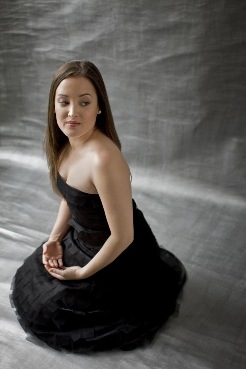
annachristycdarioacostaIt’s one of the nicer things about Toronto that from time to time  a visiting star at the COC will agree to do a free lunchtime recital in the Richard Bradshaw Amphitheatre.  Today was the turn of American coloratura Anna Christy who is currently singing the title role in Lucia di Lammermoor.  It was an exceptionally fun sixty minutes.

I was a little worried when she and accompanist Liz Upchurch just took their places and started.  I need not have been.  We got a set of three bel canto art songs that were full of virtuosity and personality.  The sheer technical skill was obvious but so was the range of tone colour.  Those doomandgloomists who think modern singers can’t act with the voice should listen to Ms. Christy.  It’s all there.  After that opening she did open up and explain the middle part of her set; pieces by Bolcom and Copland that she sees as natural successors to bel canto.  Sung with exquisite attention to the texts one can see her point.  She was also very funny and very human.  I do like modern divas so much more than the one’s who get in a snit because the caviar isn’t the right temperature.

She finished up with arias by Rossini, Handel and Donizetti, all sung stylishly and with tasteful ornamentation.  It was really classy.  And to round things out her parents were there and it was her dad’s seventieth and there are no prizes for guessing how things finished up.

Paedophilia di Lammermoor

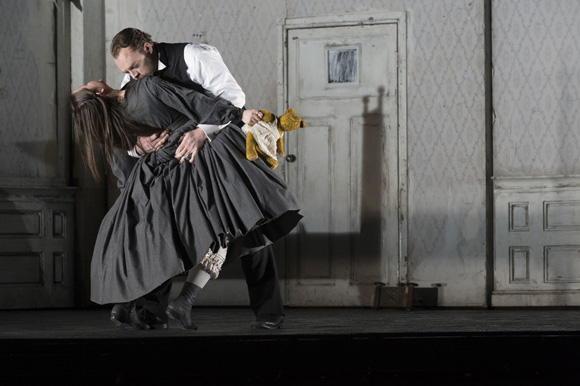
David Alden chooses to set his production of Donizetti’s Lucia di Lammermoor, currently playing at Canadian Opera, in Victorian Scotland in a rather decayed country house.  It’s all set up as classic Gothic schtick.  The angle is that Lucia herself is very young and is being sexually abused by her brother Enrico.  OK, I don’t have a problem with that.  It’s a better solution than the idea that women are all just inherently unstable and liable to go from shrinking violet to shrieking murderess at the drop of a forged letter.  So, it’s an interesting idea but it poses real problems about the nature of her relationship with her “fiance” Edgardo.  If he’s the hero of this thing what is he doing having a clandestine relationship with a girl who’s not yet out of the schoolroom?  (We can tell this by how she’s dressed).  This is a major Victorian taboo.  Respectable men don’t go after girls until they are “out”.  Are we then to see Edgardo as as a big a cad as Enrico?  Maybe.  The trouble with that concept is then why do we care what happens to him?  Edgardo kills himself.  Goodbye paedophile creep.  So what!  So bottom line, I can take the groping and the creepiness that some critics have complained about but I wonder what Alden is really trying to tell us about the piece.

67 – Anna Christy as Lucia and Brian Mulligan as Enrico in the

Photo credit: Chris Hutcheson

Continue reading

More Tudor queens

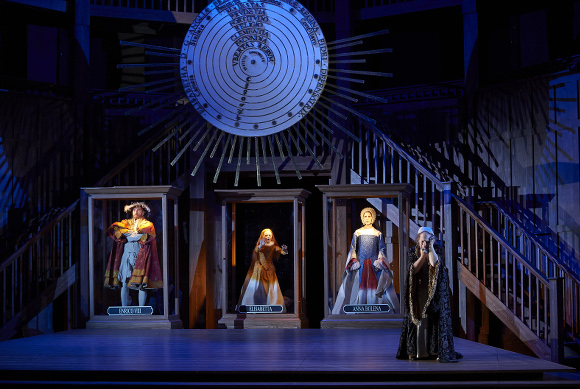
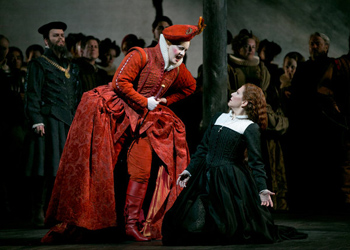
confrontationToday’s MetHD broadcast of Donizetti’s Maria Stuarda was a bit of a mixed bag.  There were some really good performances.  Joyce DiDonato in particular gave what may well have been a truly great performance and I would have loved to have seen it live.  David McVicar’s production was much better than his Anna Bolena; visually interesting and with some strong dramatic ideas.  However the good was pretty seriously undermined by another really awful piece of video directing by Gary Halvorson.  I guessed it was him after about ten minutes. The incessant use of the nose cam and the incredibly irritating low level tracking shots were a dead give away.  It was a big disappointment since the last two shows I saw, La Clemenza di Tito and Les Troyens, were filmed by Barbara Willis-Sweete and had given me some faint hope that the Met was capable of self analysis and improvement in this area.  Hope that was, alas, sadly dashed today.

Continue reading

The silliest opera ever?

Even by the standards of bel canto comedies Donizetti’s Le convenienze ed inconvenienze teatrali is insubstantial fluff.  It’s basically a farce about a no hope opera troupe failing miserably to rehearse an opera in the face of prima donnaish Prima Donna, her overprotective husband, a flaky German tenor and the overbearing mother of the Seconda Donna (played by a man, natch).  Half of the jokes turn on cast members singing badly and the rest on standard opera clichés.  None of them are particularly funny.  The music is a bit non descript too.  The best bits are when the Prima Donna and the tenor inexplicably decide to sing Rossini and Mozart in the middle of a rehearsal.

1.PD_tenor Continue reading

Babes in bodices

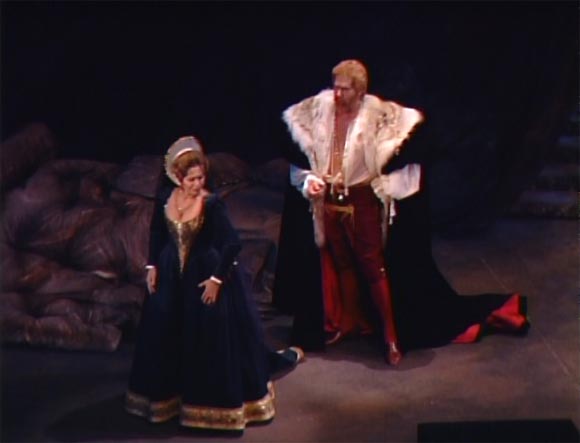
After a less than satisfactory introduction to Donizetti’s Anna Bolena in a MetHD broadcast last year it was with some trepidation that I approached the DVD version recorded at the Wiener Staatsoper and also starring Anna Netrebko.  I need not have worried because it’s very good indeed.  It has a stronger cast, Eric Genovese’s relatively simple production trumps David McVicar’s overstuffed effort and Evelino Pido doesn’t try and make the orchestra sound like it’s playing Wagner.  The sound on the DVD is also way better than it was on that broadcast.

1.anna_giovanna Continue reading

War in opera

As November 11th comes around for the 94th time since the guns were, very temporarily, silenced I thought it might be interesting to look at how war has been seen by librettists and composers over the years. Very early on we get a very gritty take on the subject in Monteverdi’s extremely compact Il combattimento di Tancredi e Clorinda but not so long after the path for the next three centuries is set with Purcell’s broadly comic King Arthur.  As far as I can see from Purcell to 1945, with very minor exceptions, the message is largely “war is fun”.  War is an excuse for a big parade (Aida; unless Tim Albery is directing!), an excuse for a drinking song (Faust), just plain comedic (La Fille du Regiment), a plot device (Cosí fan tutte) or a background event (Tosca, various versions of the Armida story).  The only opera, pre 1945, that I can think of that deals with the horror of war is Les Troyens, and that of course takes place in a distant, mythical, past.

Continue reading

L’Elisir di Steakhouse

Today was the first MetHD broadcast of the season and we got Bartlett Sher’s new production of Donizetti’s L’Elisir d’Amore.  It’s what I would call a “steakhouse production”.  It’s like a meal in a top end steakhouse.  Your steak is a fine piece of meat, they don’t mess it up and ditto your baked potato.  And it’s all served in luxurious surroundings with attentive service.  It’s a terrific steak dinner but it costs the same as the tasting menu at a place with two Michelin stars and it’s still just a steak dinner.

So, a brilliant cast; Netrebko, Polenzani, Kwiecien and Maestri, singing and acting up a storm in a production that was pretty much devoid of ideas beyond a few odd costuming choices.  Since when did Italian peasant girls get to dress like they are attending a ball in a Jane Austen novel?  Still the girl singing Nanetta was cute and had the best dress.  Gary Halvorson’s video direction was about par for the course in terms of virtually incessant close-ups.  Not a bad way to spend a Saturday afternoon but ultimately forgettable.

La cosa vostra?

If you are a fan of bel canto comedies you will probably enjoy the 2009 Glyndeboure production of Donizetti’s L’Elisir d’Amore quite a lot.

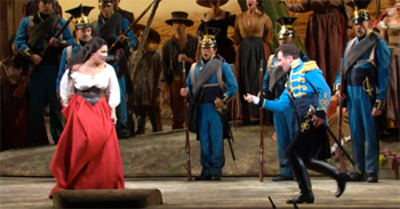
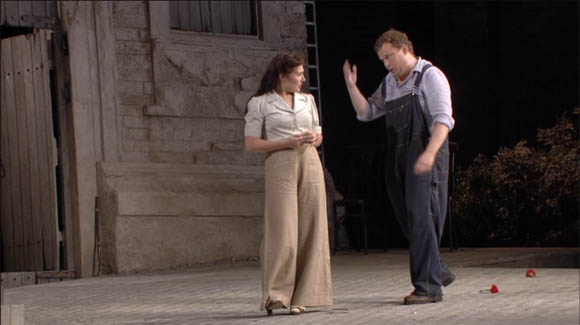
Director Annabel Arden sets this bucolic comedy in the Italian countryside of the 1950s (though some of the iconography is more appropriate to the Mussolini period).  It has some of the look, but little of the edge of Italian neo-realist cinema.  It does though take the work fairly seriously with a Dulcamara who is isn’t the obvious quack we usually see but just hints at having real powers.  Dulcemara also acquires a rather bizarre mute assistant.  Beyond that it’s all carefully staged with the chorus action well directed and performed. Continue reading

Joan Sutherland on form

A while back I reviewed the train wreck that is the CBC recording of Joan Sutherland in Norma. Three years later the Canadian Opera Company and the CBC tried again with a recording of Donizetti’s Anna Bolena. As a recording and a production it has its limitations but it’s not a disaster and is enjoyable in many ways.

Continue reading

La Fille de Laurent Pelly

Laurent Pelly’s 2007 production of Donizetti’s La Fille du Régiment was a coproduction of the Royal Opera House, The Metropolitan Opera and the Wiener Staatsoper which one make expect to produce a stodgy snoozefest.  It’s not.  It’s a fast paced, energetic and funny production.  There’s nothing especially cleverly conceptual about it but its well designed, well directed and well played.  If one were to be hyper critical it would be that the humour in Act 2 is rather laid on with a trowel but it’s not too seriously overdone.  The setting is updated from the wars of the first Napoleon to something vaguely WW1 like.  In some ways this doesn’t make a whole lot of sense but it does provide a visual “Frenchness” that’s probably easier for modern audiences and, anyway, the libretto as originally written is about as historically accurate as the average piece of bel canto fluff.  Best not get into serious military history buff territory and get on and enjoy the show.

Continue reading