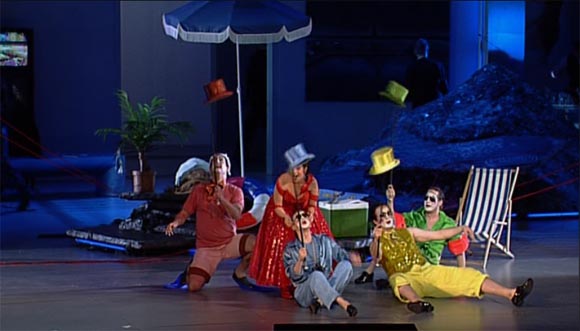
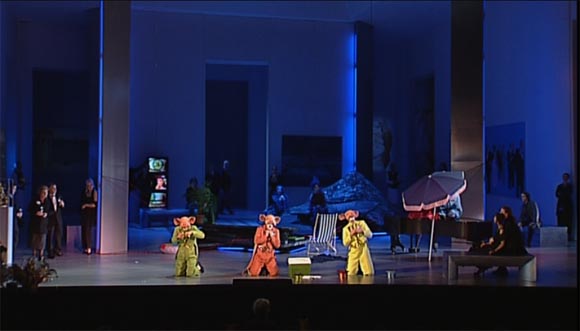
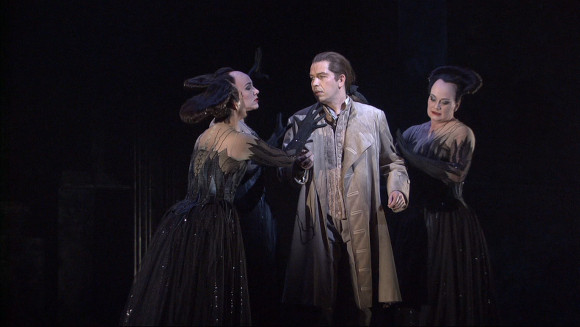
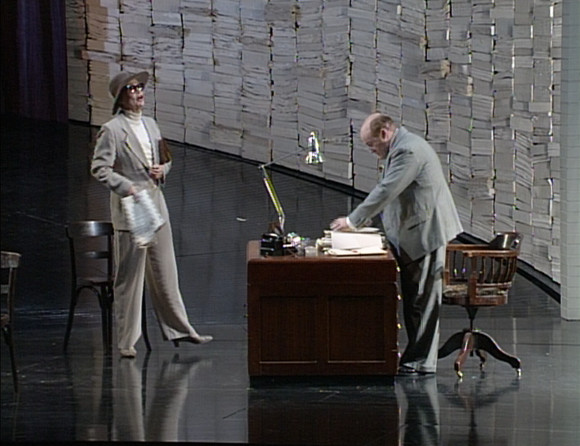
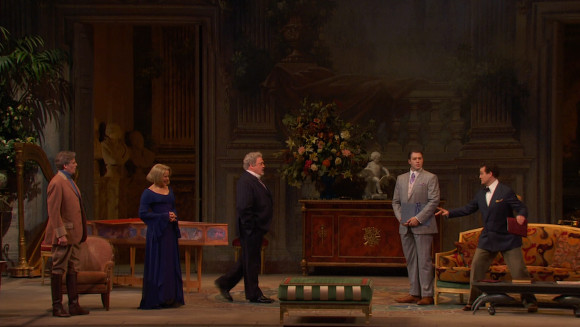
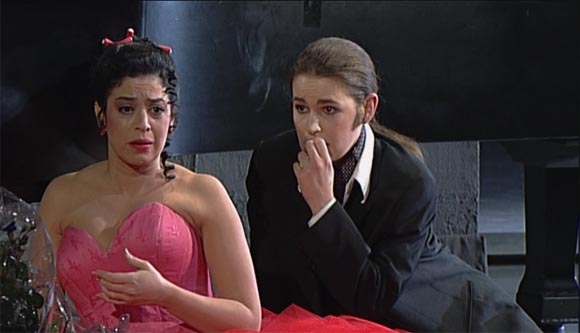
Marco Arturo Marelli’s 2000 production of Richard Strauss’ Ariadne auf Naxos is fascinating and compelling. He sets the work in the present at a very posh, arty party. Throughout there are extras playing party guests all over the place. The “opera” itself takes place in the middle of the main salon where the party is taking place. There are many interesting touches. For example, the Komponist features extensively in Act 2. Obviously smitten with Zerbinetta, he appears to accompany her on piano at the beginning of Groß mächtige Prinzessin and frequently watches from the side of the room as she is drooled over by various male party guests. Only at the end does the staging shift from the party to something that suggests some sort of reality in the relationship between Bacchus and Ariadne before dropping us right back into the party where the guests have completely ignored this piece of transcendence to go and watch the fireworks in the garden. The directorial take on Zerbinetta is interesting too. No flighty airhead here but rather a somewhat cynical and worldly young woman. It works rather well.
 The performances are a bit mixed. The Act 1/Prologue is uniformly strong. Sophie Koch is an excellent Komponist. She sings well and acts very well indeed. Her, non singing, portrayal of the character in the second act as a gauche and geeky young man socially and emotionally out of his depth is really quite funny and touching. Friedrich-Wilhelm Junge is excellent as the Major-Domo. He has just the right touch of disdain. Moving on to the main action it’s a bit of a mixed bag. Iride Martinez’ Zerbinetta is a tour de force. She is completely consistent in her portrayal of the character to the extent of, at times, somewhat suppressing the beauty of the music in favour of dramatic verisimilitude. That’s not to say she sings badly. She sings very well but to a particular purpose. Susan Anthony’s Ariadne didn’t really convince me as much. She’s OK but “OK” isn’t a description I want to use about someone singing Es gibt ein Reich. It should make the hair stand up on the back of one’s neck and Anthony’s doesn’t. To be fair she’s not helped by the recording (see below). Jon Villars’ Bacchus is pretty good and the supporting nymphs and players are more than adequate. The players in particular have a lot of business and they handle it with considerable comic flair. Surprisingly, Sir Colin Davis’ reading of the score seems a bit bland. He doesn’t point the rhythms nearly as incisively as Levine on the Met recording or, even better, as Andrew Davies did in Toronto last year. The orchestra sounds a bit undercooked too. The recording may be a significant part of the problem here too.
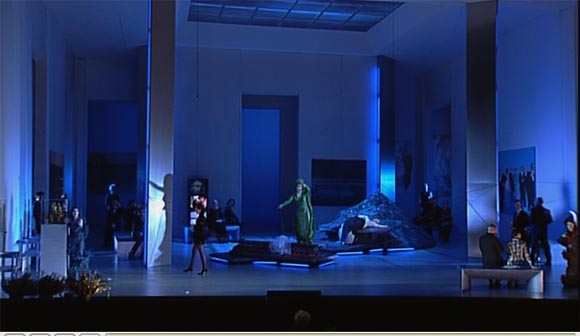 Technically this isn’t too, too bad for a budget Kultur effort. The video direction by Felix Breisach is very good. He shows us the whole stage often enough to appreciate the complexity of the director’s concept and its execution and his close ups aren’t excessively close. It’s a good balance. It’s a pity he’s not better served by the picture quality. It’s fairly good 16:9 (not 4:3 as the box and most on-line references suggest). It works pretty well on close ups but the lack of definition is a bit annoying on the longer shots. This production would definitely have benefitted from being shot in HD. The sound is Dolby 2.0 and it’s at best OK. There’s no real sense of space and it’s a bit dry. It certainly doesn’t do Susan Anthony or the orchestra any favours. Subtitles are English only and documentation is limited to a track listing.
 There aren’t a lot of versions of Ariadne on DVD. There’s a recent Guth production with Emily Magee, which is said to be quite good, an ancient film with Karl Böhm and a 1988 Met version. The Met version is musically far superior to the Dresden offering but features a deadly dull production that looks like it was first given half a century before Ariadne was written. Given that, I think this Dresden version is well worth a look.



 operaramblings