Farewell Ileana

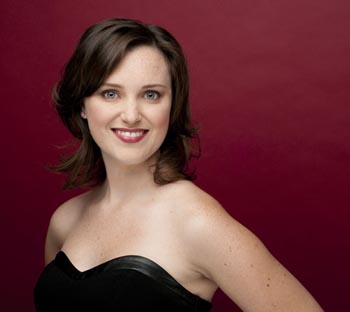
Ileana at the Stella Maris competition

It’s that time of year again. With a few months left in the opera season in Toronto today saw the first “farewell” concert by a departing member of the COC Ensemble Studio. It was a solo recital by dramatic soprano Ileana Montalbetti, quite possibly the best sounding thing ever to come out of Saskatoon. Ileana is the only full on dramatic soprano I’ve seen in the few years I’ve been following the Ensemble Studio and, as ES boss Liz Upchurch pointed out, they are rare so it’s always interesting to see another one come along. Fair to say too, I think, that it’s not the voice type that is treated most kindly by a piano recital in a fairly intimate space. That said, it was a very enjoyable performance.

Ileana kicked off with O Sachs! Mein Freund! from Die Meistersinger. Any reservations I have about dramatic sopranos and piano recitals come redoubled in spades where “big” opera arias are concerned. The kind of volume and tone needed to sing against a large orchestra in a big theatre tends not to sound too lovely when throttled back with only a piano for support and, honestly, I don’t think this piece was a great idea.

Things improved enormously in the next section though. This was the song cycle Ekho Poeta; Pushkin texts set by Benjamin Britten and written for the Rostropoviches. It’s a rarity; a Britten song cycle I don’t recall hearing before, and it’s very good. It was a much better vehicle for Ileana who displayed plenty of power, well controlled vibrato and pleasing and varied tone colours especially in the middle register. Her high end was much sweeter here than in the Wagner too. Where she needed a lot of attack, as in the rather spiteful Epigramma she could certainly produce it. Being Britten, the piano part in these pieces was really quite demanding too so kudos to pianist Rachel Andrist for excellent and sympathetic musicianship.

The second half of the programme was all Strauss. It started with Arabella’s final aria, which I enjoyed more than the Wagner but about which I have similar reservations as a recital piece.  Then we got a selection of songs from Op. 37, Op. 48 and Op. 32 before finishing up with Zueignung from Op. 10. This was all good stuff with more excellent control and very good German diction. The final number was particularly lovely. For an encore we got a spirited rendering of Sweet Polly Oliver in the Britten setting.

I think Ileana is a very considerable talent and I’m sure she’ll do well in the wider operatic world.  Liz Upchurch and the COC certainly seem to think so.  Liz  “leaked” that Ileana will be back in an as yet unannounced major role. Putting two and two together and making something like e^iπ and adding in a dose of wishful thinking I’m wondering if there is any connection between Ileana’s first piece today and the long rumoured Toronto debut of a certain ex-pat Canadian baritone.

Also, à propos not much, it was nice to see a certain world famous dramatic soprano in sneakers and sans make up watching from the standing room section.

Kaija Saariaho’s L’Amour du Loin at Canadian Opera

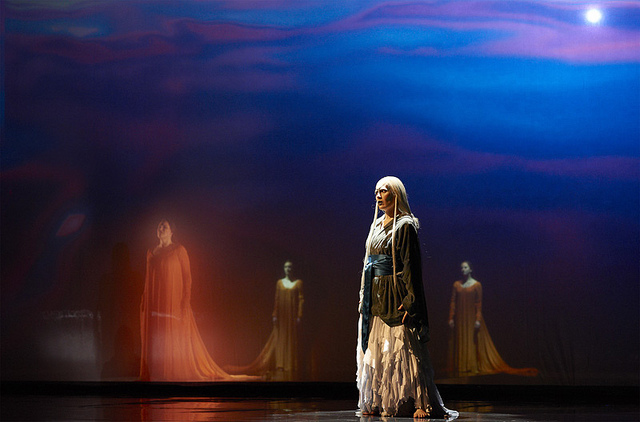
Last night we saw Kaija Saariaho’s L’Amour du Loin at the Four Seasons Centre. It was really, really good. It’s a very unusual piece. There’s not a lot of action in the libretto, despite, or perhaps because of, which Daniele Finzi Pasca devised a most spectacular production (more below). It’s an opera about ideas; love, duty, honour, death, faith, God. The characters spend far more time debating what to do and why than doing it. The plot is very simple. Jaufré Rudel, prince of Blaye, tired of a life of meaningless pleasure, yearns for real love. The Pilgrim tells him of an ideal woman, a countess in Tripoli. devotes Jaufré devotes his life to writing love songs to his “Love from Afar”. The Pilgrim tells Clémence of Jaufré and she falls under his spell. Jaufré decides he must cross the sea and meet Clémence but in doing so falls mortally ill. They meet and throw caution to the winds but Jaufré dies. Clémence decides to take the veil but her attitude to God is ambiguous at best. To who is her finally ecstatically beautiful prayer directed; the deity or her “Love from Afar”? It’s not the easiest piece to engage with. It has something in common with other meditative operas like Dialogues of the Carmélites and Pelléas et Mélisande and it’s rewarding in the same sort of way.
The music really impressed me. It haunted my dreams last night. It is an extraordinary score. In the last couple of weeks I’ve heard quite a few smaller scale works by Saariaho but this was the first time I had heard what she could do with a full orchestra. Her tachnique here seems influenced bu European minimalists like Górecki but the end result is utterly individual. She create waves of sound, often with one section of te orchestra picking a phrase up from another. The effect is almost architectural as textures interplay to create a thing of real beauty. Often, despite the wealth of visuals i found myself wanting to close my eyes and just listen. The solo vocal writing is more straightforward than in some of her chamber works. Each character has a distinct musical signature. The Pilgrim for example has any number of the trills common to medieval vocal music (which I think of as moorish but that’s just my association). The choral writing combines elements of the orchestral and solo vocal styles. It’s all really quite compelling.
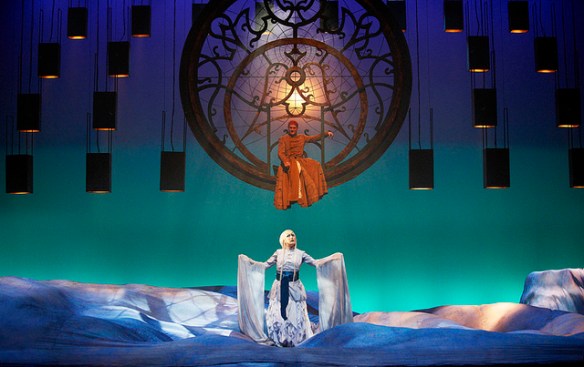
The performances were terrific. All three solo parts are long difficult sings and all three soloists were quite excellent. Russell Braun as Jaufré is on stage for four out of five acts. He was not as smoothly lyrical as he can be but his tougher, more muscular tone suited his line. Kristzina Szabó, as the Pilgrim, also has a lot to do. In many ways her acting must hold the piece together. This she said while sounding very idiomatic in the most ‘medieval’ sounding of the roles. Erin Wall almost stole the show at the end. Much of her part lies cruelly high and includes the sustained f and ff high notes that Saariaho likes to give sopranos. She coped admirably with those to close out the piece with a hauntingly beautiful rendering of the final, despairing prayer. The COC Orchestra and Chorus, were as ever, wonderful and conductor Johannes debus seemed to be right inside the music. Super stuff all round.
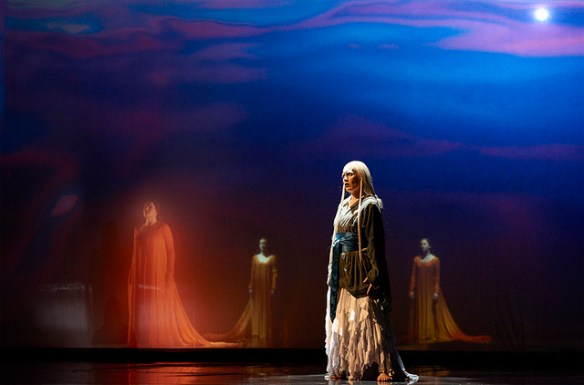
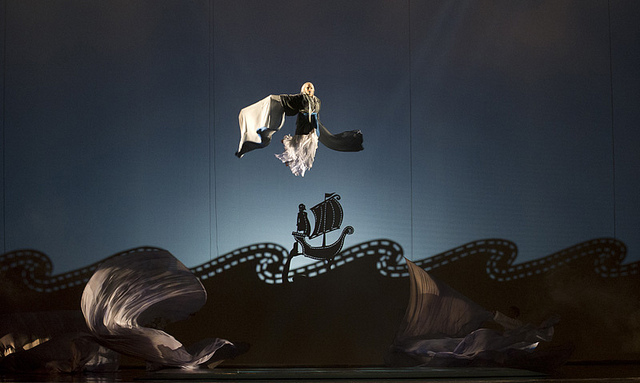
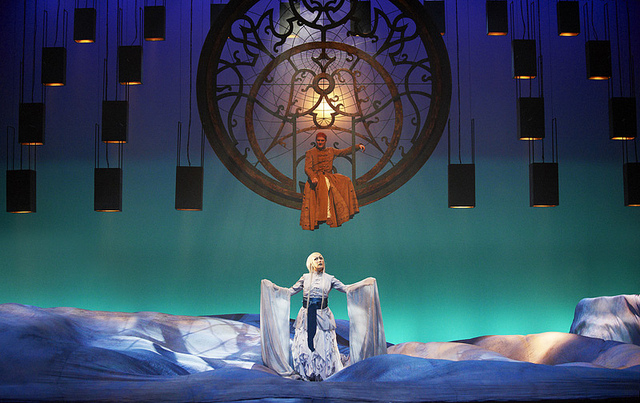
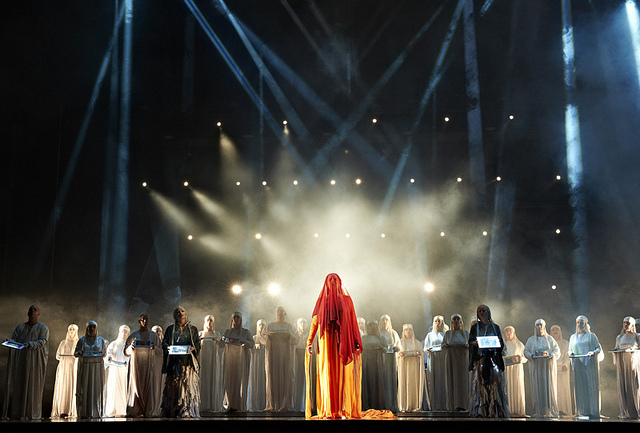
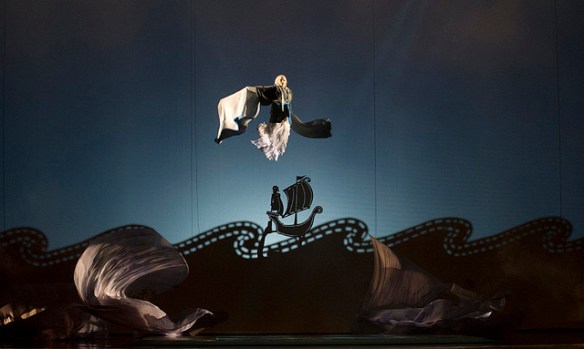
The production is very interesting. Gabriele Finzi pasca and his design team; Jean Rabasse – sets, Kevin Pollard – costumes and especially, Alexis Bowles – lighting and Roberto Vitalini – video, evoke the various settings of the piece extraordinarily vividly using cloth, light and video projections. The evocation of the sea in Act 4 is breathtaking and the ambiguous use of light shone into the auditorium at the beginning and end of the piece ask questions about the stage world and that f the audience. The story telling is embellished with shadow puppets, body doubles, acrobats and aerialists. It’s spectacular in the manner of a rather cerebral Cirque du Soleil performance. It might even be a little over the top to the point of distraction but there’s no denying the beauty of it.
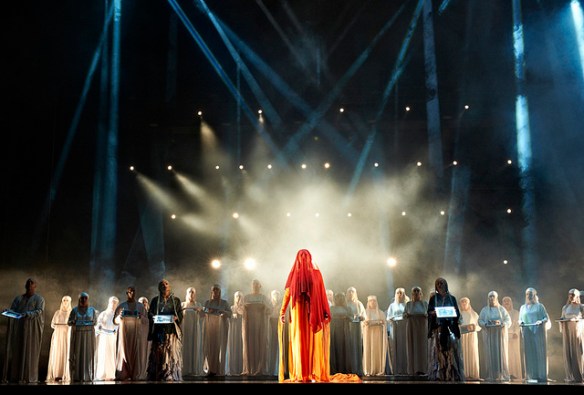
I thought it was a terrific modern opera, beautifully performed and I’d go see this in preference to traditional warhorse productions any time but what I saw last night suggests I may still be a bit unusual in that regard. The house wasn’t full and seats which I’m pretty sure are subscription seats were empty. A significant number of people, young and old, left at the interval. This disturbs me on all sorts of levels. This is quite an accessible piece and it was presented in a production that emphasised that and despite that some people obviously didn’t get it. This worries me far more than people who get offended by blood or nudity in a new production of some over performed Puccini piece. There’s a catch 22 here. A new audience is put off by the idea of opera as a boring museum piece and a section of the traditional audience boycotts anything that isn’t stuffed and mounted. Anyway, if anyone at COC is listening my vote is for innovation, risk and life.

There are four more performances ending on February 22nd.  Go see it!

All photos © All rights reserved by Canadian Opera

Collaborations

Each year the Studio Ensemble at the Canadian Opera Company does an exchange with its counterpart the Atelier Lyrique de’l’Opéra de Montréal. Part of this collaboration is a free concert in the Richard Bradshaw Amphitheatre featuring singers from both companies. Last year I found it quite hard to write about as, frankly, Montreal didn’t bring much to the party. This year, happily, was different.

Philip Kalmanovitch

Two of the Montreal singers really impressed me this time. Philip Kalmanovitch is a tall, slim baritone with an engaging stage manner and a very nice voice indeed. He kicked off the programme with the Largo al factotum from Rossini’s Il barbiere di Siviglia. I would not have thought it possible to overact this piece but Kalmanovitch came close! It was very characterful, well sung and he communicated that he was having fun very effectively. We also got a characterful Là ci darem la mano from Don Giovanni sung with Jacqueline Woodley. Their voices blended very well and the acting was good too. His final piece was the much more romantic Mein Sehnen, mein Wähnen from Korngold’s Die tote Stadt. He didn’t seem quite as at home in this repertoire and he could use some work on shaping his lines but, again, he sang with beautiful tone and the closing pianissimo was very well done.

Emma Parkinson

I was just as impressed by mezzo-soprano Emma Parkinson. She has a lovely smoky voice of some power. In her first number, Come ti piace, imponi from La clemenza di Tito she was singing with the Studio Ensemble’s biggest voice, soprano Ileana Montalbetti. I was worried going in that she’d be blown away (probably literally) but it wasn’t so. They actually worked very well together. Emma and Ileana collaborated again with the addition of baritone Philippe Sly in Soave sia il vento from Cosi fan tutte. This wasn’t so successful. Even when she’s throttling back, Ileana has a distinct ‘slice’ which doesn’t really suit a Mozart number like this and the voices didn’t really blend. I really want to hear what she can do with an orchestra in a genuine spinto role. Also, Philippe sang well enough but it’s going to be a long, long time before he sings Don Alfonso.  Getting back to Emma, she also sang a spirited Parto, parto, agian from La Clemenza di Tito. This was the real deal and raised hairs on the back of my neck. There was power, passion and variation of tone colour. Her coloratura was a bit ragged in places but that will come. Ms. Parkinson is one to watch.

Aidan Ferguson

The Montreal contingent was rounded out by mezzo Aidan Ferguson and tenor Isaiah Bell. Ferguson sang Va! laisse couler mes larmes from Massenet’s Werther, Sein wir wieder gut from Strauss’Ariadne auf Naxos and collaborated with Mireille Asselin in the Presentation of the Rose from Der Rosenkavalier. She and Jacqueline Woodley also sang a very musical version of Belle nuit, ȏ nuit d’amour from Offenbach’s Les contes d’Hoffmann. Ferguson is musical, she’s got plenty of power and was markedly better in the Strauss and Offenbach pieces than in the Massenet where she was a bit wobbly. She just doesn’t sound like a mezzo to me. The voice is very bright and open and I wonder whether she won’t end up as a dramatic soprano.


Bell seems very young. He started out with a very diffident Unis dès la plus tendre l’enfance from Gluck’s Iphigénie en Tauride. He sounded a bit underpowered and undercharacterised. He was better in the duet My Tale Shall be Told from Stravinsky’s The Rake’s Progress (sung with Philippe Sly as a characterful Nick Shadow) where he showed he could convey some real feeling. He finished up with Si, ritrovaria io giuro from Rossini’s La Cenerentola. This really needed more power. he has the notes but he doesn’t have the exciting, ringing top end needed to bring a piece like this to life. He is very young though and with a bit more power and confidence could be quite promising.

The Toronto singers were really in back up roles in this gig but they all performed very well. Mireille Asselin showed she has the classic qualities of a young lyric soprano in her cameo as Sophie and Jacqueline Woodley was excellent in the Offenbach though to be honest I’d much rather hear her singing Weir, Golijov or Saariaho where she truly excels.  Philippe and Ileana I’ve already mentioned.   Accompaniment on the piano was by the Studio Ensemble’s Jenna Douglas and Timothy Cheung who were, as ever, just excellent.

All in all, a very worthwhile effort all round.

Reflections on Tosca

Photo credit: Michael Cooper

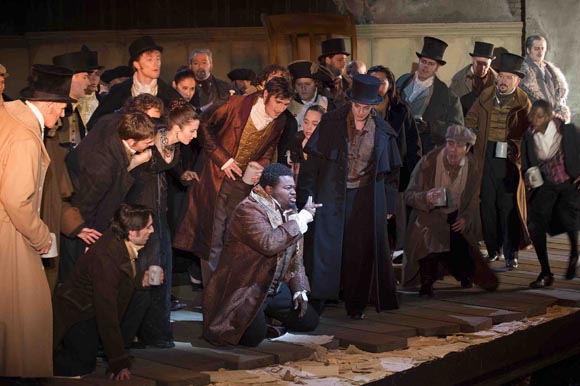
The only known photograph from this production as featured in every other print or internet review I've seen.

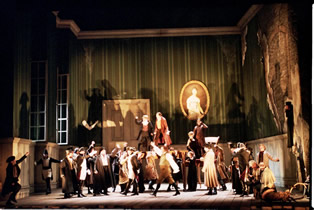
Puccini’s Tosca is on at the Canadian Opera Company right now. It’s this years “bums on seats” production. There are fourteen performances scheduled; compared to eight for most shows. It’s double casted. It’s a conservative friendly, traditionalist production seen before just four years ago and it features hone town diva, Adrienne Pieczonka. We saw it last night and were a bit disappointed. It wasn’t the sort of show one comes out of spluttering “travesty” or “disgrace” but it wasn’t the sort of performance that gets a standing ovation and excited deconstruction on the subway home either. It felt like a revival of a traditional production. It has to be said that my reaction, while more positive than some reviews I’ve read, wasn’t shared by a large chunk of the audience who switched from their customary coughing to an extended standing ovation. From the chatter I could hear in seats around me that was largely the reaction of the “once a year” crowd so, in a very important sense, this production accomplishes what it needs to do.

Still it’s sad to come out of a performance of Tosca relatively unmoved so let me try and dissect why. Paul Curran’s production is very traditional so there’s no gimmickry to either offend or help overcome shortcomings in the singing or acting department and, of course, there’s no sense of novelty. A reasonably seasoned opera goer is, inevitably, comparing it with other Toscas. Mr. Curran’s programme notes are quite explicit about the success criteria for an enterprise of this type.

The joy and challenge of directing Tosca is not only in the glorious music and razor-sharp libretto, but ideally in workingclosely with the talents of the singers playing and fleshing out their roles. As the curtain rises it is the characters and relationships we must believe in. Characters are built bar by bar, phrase by phrase and discussion by discussion. No word is too small that it might not be the trigger for a singer to find a new angle into their character’s life or psyche, and the job of the director, I believe, is in part to help the cast explore and discover just these subtleties.

The trouble is that not much of this happened. The three principals; Adrienne Pieczonka (Floria Tosca), Carlo Ventre (Cavaradossi) and Mark Delavan (Scarpia), are all established ‘A’ list singers and sang as well as one would expect but neither their characters nor the relationships between them came fully alight. I can take my Tosca somewhat overblown but lukewarm doesn’t really cut it. Delavan is a big man with lots of physical presence but here he struck (rather odd) poses and never really exuded any sense of menace. He didn’t even seem to be that into Tosca. His physical encounters with her in Act 2 suggested that their mutual priority was not upsetting the costume shop. You could find steamier scenes in any high school parking lot. This just reinforced the aloofness of Pieczonka’s very “in control” Tosca. Vissi d’arte, though beautifully sung, came out of nowhere. This wasn’t a woman on the edge of breakdown and when she stabs Scarpia our surprise isn’t that she’s done so but that she didn’t rip his balls off with her bare hands ten minutes earlier. The less said about Ventre’s acting the better though he too sang very well indeed and E luceva qualche stella was probably the emotional highlight of the evening.

Besides fine singing there was quite a lot to like in the production. The orchestra under Paolo Carignani sounded great. I really like the atmospheric lighting plot which used light level and tone to create a variety of effects, especially in Act 1 and in Act 3, where it managed to suggest night time without being so dark one couldn’t see. The chorus both adults and children were excellent and curran creates some pleasing visual arrangements in Act 1 (nice touch where Scarpia barges out past the bishop celebrant). Unfortunately none of this really overcomes the emotional hole at the centre of the production.

I’ve heard it said, from various quarters, that the second cast of Julie Makerov in the title role and Brendan Jovanovich as Cavaradossi (Delavan sings Scarpia in all performances) may up the EQ a bit so they may actually be a better bet. Sheer curiosity may even get me to go find out.

I’m sure what I’ve written above sounds really negative. It needs context. Expectations for COC productions have been raised very high by some truly excellent efforts in recent years and so a “pretty adequate” production that would have received rave reviews ten years ago barely cuts it today. That’s the price of success.

Another lunchtime with Kaija Saariaho

Kaija Saariaho

Today’s concert in the RBA consisted of more works by Saariaho performed by members of the COC orchestra and the Studio Ensemble. Both the the composer and General Director, Alexander Neef, were there. The four works performed were most definitely not “easy listening”. To me they seemed firmly in the tradition of modern continental European composition in the same sort of mould as Henze or Berio. The pieces were all very dense with complex tonality and dissonance and placing great demands on the performers.


Jacqueline Woodley - Photo by Helen Tansey

First up was Changing Light described by the composer as a dialogue between soprano and violin. It’s a setting of a text by Rabbi Jules Harlow and was commissioned in the wake of 9/11. It may be a dialogue but the instrument doesn’t support the singer in any way. The violin is in a world of comples slides while the singer has some very tough intervals and the sustained, loud, high notes that characterize much of Saariaho’s vocal writing. That said in some ways this was the most conventional and accessible piece on the program. The performance by soprano Jacqueline Woodley and violinist Marie Bérard was first rate.

Mireille Asselin

Next came Mirage. This a setting for soprano, piano and cello of an English translation of a text from Mazatec healer and shaman Maria Sabina. It’s a rewriting of a piece originally written for soprano, cello and orchestra. The composer described this version as “more intimate”. It’s an uncompromising piece. Much of the piano part is played directly on the strings (rather than the keys) and the keyboard part is furiously virtuosic. The cello part is no easier with complex slides and atonality. The writing for soprano demands some characteristically difficult singing with something akin to Sprechstimme and some phrases that are whispered into the piano, using the piano as a reflector/amplifier. It’s quite a compelling piece. Again the performance was excellent. Jenna Douglas was on piano with Olga Laktionova on cello and Mireille Asselin singing.

The third piece seemed to me even more demanding. Lonh is a longish setting for soprano with electronic tape of fragments of medieval Occitan poetry by Jaufré Rudel. It requires an array of vocal techniques; singing, semi-singing, modulated speech, whispers, the works really. It’s quite haunting and the electronic tape which combines nature noises, bird sounds and fragments of spoken Occitan is very atmospheric. This was another fine performance by Jacqueline Woodley. We were told that this was composed as a “study” during the process of conceiving L’Amour du Loin so I guess it serves as an introduction to that sound universe.

Rihab Chaieb

The final piece was an early work for mezzo and soprano; From the Grammar of Dreams to texts by Sylvia Plath. It was described as “tenser” by the composer and to my ear sounded most influenced by the fashionable idiom of the 1960s and 1970s. It uses just about every vocal technique in the book and interweaves fragments of two different Plath poems; Paralytic and The Bell Jar. The composer tells us that dreams are “non linear” and that’s certainly reflected in the piece. Rihab Chaieb and Mireille Asselin were the singers and I thought their voices blended really well. The mix of Mireille’s very bright soprano with Rihab’s much darker tone was very pleasing.

I was really impressed with everyone on show today. It’s hard to express in words just how difficult this music is to perform. Here we had young singers and, I think, equally young instrumentalists putting on a truly impressive show. In particular, I was intrigued to see how much Mireille has come on. I first heard her sing a couple of Servilia’s arias from La Clemenza di Tito and my impression was of a perfectly competent light lyric soprano but nothing special. The last couple of times I have heard her she seems to have grown quite a bit musically and her performances today were top notch.

Ein Volk, Ein Opera Company, Kein Opera

Forgive the grammar, you get the idea.

So at today’s COC season launch there was an exchange that went roughly like this:

Alexander Neef: Any questions?

Bald academic dude in jacket and tie: I’d like to ask about progress on the two commissions (unannounced) to Margaret Atwood and [somebody else] and more generally when are we going to see a Canadian opera on the Four Seasons stage? makes unflattering comparisons to the SF Opera announcement yesterday.

Clique of Canadian Academic Composers: Here, here, rhubarb etc.

Alexander Neef: That’s become a ritual question so I’ll give you my ritual answer “When we have something concrete to announce we’ll announce it”.

Grumpy female: Claims that there are “many” Canadian composers who could compose something better than L’Amour du Loin (though mentions no names).

More rhubarb etc.

In principle I can see that it’s part of the remit of a national opera company to produce operas by its nationals though to what extent the Canadian Opera Company is a national company is well open to question. It only plays in Toronto. It raises just about all its funding there and it gets next to no support from either the federal government or the hockey channel which masquerades as a national public broadcaster. That said, I doubt one Canadian in a million could name a Canadian opera composer and if they could it would likely be one that no sane opera house would consider working with. So there’s a problem. No company can afford to give a seventh of its season to a guaranteed flop and no-one in Canada is going to pay for a vanity production by an unknown composer even if the libretto is written by Atwood or Ondaatje. I don’t hear solutions. I just hear over-entitled academics demanding that someone else throw away a couple of million bucks.

Rant over. Normal service will now be resumed.

Canadian Opera Company season announcement 2012/13

So this morning I was at the Four Seasons Centre for the press conference to announce the COC’s 2012/13 season.

Board President Philip Deck started off with a strong statement about continuing to improve the quality of the product on the Four Seasons Centre stage and striving for “uncompromising and inspiring” programming with a goal of becoming “one of the world’s great opera houses”. There are crucial words here. If General Director Alexander Neef is to meet these goals he will need a supportive Board. It looks like they are there with him at least for now and that’s very good to hear.

There was a very good “teaser video” with contributions from the many Canadians who will feature next season. I guess this will be available on line at some point. Then we got to the main business with Alexander presenting the line up. It’s pretty exciting so here it is in all its glory and with my commentary.  Continue reading

Opera 101 – Tosca

Opera 101(I) at the Duke of Westminster last night was more interesting than I expected. Besides the usual host, Brent Bambury, we had the director of the current production Paul Curran, Mark Delavan, who is singing Scarpia, and Julie Makerov, one of two Toscas. Delavan and Makerov were engaging and funny if not specially revelatory though both revealed a taste for country music which is a bit disturbing. Most of the interest came from Curran. He’s an intense little Scot who tells it how he sees it. He grew up in the less salubrious parts of Glasgow (I’m reliably informed that there are salubrious bits!) and the first opera he saw was Wozzeck which he describes as the story of his life. I was struck by his emphasis on the role of the music in his directorial process. He described himself as a “musician first” and talked at some length about his role in making sure that the singers can sing to their best ability. He’s also no literalist. I asked him whether the very specific time and place setting of Tosca was constraining or liberating and he went on a bit of a rant which I loved! He listed off the historical inaccuracies with the Tosca libretto with encyclopaedic accuracy peppered with expressions like “complete bullshit” basically ending up at “so I feel I can do pretty much what I like with it”. He’s also not one for the pretties. He told a story about being criticized because Tosca’s dress in Act 2 was inelegant. His response “It’s a rape scene (F word not far away here we feel). I don’t think she’s asking ‘does my bum look big in this?'”. I liked his take on “Vissi d’arte” as a Jewish aria too. He’s alluding to it’s sense of a contractual relationship with God as opposed to Tosca’s over Catholicism (he’s from a very Catholic family). All in all good value.

We had a brief chat afterwards about Britten, ‘difficult’ operas and stuff. I want to see his Peter Grimes but, unfortunately, Santa Fe isn’t exactly next door.

In a couple or three hours it will back to COC for me for the third time in 24 hours. This time for the 2012/13 season announcement.

fn1. Opera 101 is a pub based series of fairly informal talks by members of the creative team for various COC productions.

COC Ensemble Studio – Works by female composers

It feels good to be back listening to live music after a bit of a drought. Today I was at a lunchtime recital in the Richard Bradshaw Amphitheatre given by members of the Canadian Opera Company Studio Ensemble. It was very good indeed. I want to start with the undoubted highlight; Jacqueline Woodley‘s performance of Judith Weir’s piece for unaccompanied soprano, King Harald’s Saga. It’s a complex, fascinating and very difficult piece requiring the singer to switch between voices and to pull off a range of singing styles. Woodley was awesome. I’ve heard her now in quite a few contemporary pieces, though perhaps none as hard as this, and she has always impressed.

Almost as impressive was Ileana Montalbetti’s performance of Libby Larsen’s Donal Oge. It’s a work that requires considerable power from the singer and Ileana, unsurprisingly delivered. She’s got a big voice and she knows how to use it. Neil Craighead gave us two songs by Cecile Chaminade. He sounds a good deal more powerful than last time I heard him. He has a lovely tone and now the power too. He hasn’t quite got the knack of throttling it back yet but that will come I expect. We also got some fiendishly difficult Alma Mahler songs which clearly taxed tenor Chris Enns. They would have taxed anyone I think. Mireille Asselin gave a pleasing unaccompanied performance of a piece from Hildegard von Bingen and the programme was rounded out by two duets by Fanny Hensel sung by Asselin and Craighead and Montalbetti and Enns.

The pianists were the excellent Jenna Douglas and the even more impressive Timothy Cheung. All in all, this was as good a concert as I have heard in the COC’s free lunchtime series.

Joan Sutherland in Toronto

It’s a pet peeve of mine that, alone among state funded TV broadcasters in the industrialised world, CBC doesn’t broadcast opera on TV. There are many other reasons why the CBC is a national embarrassment but this one rankles. That said, there have been a couple of CBC broadcasts over the years and they did make it to DVD. These include a 1981 Canadian Opera Company performance of Bellini’s Norma with Joan Sutherland. It’s a great big pile of steaming whale dreck. The production, by Lotfi Mansouri, looks more like it was done in 1881. The Gauls have helmets with horns on. Sutherland seems to be dressed as the Statue of Liberty and the tenor playing Pollione (Francisco Ortiz) looks like Stephen Fry as the Roman centurion in Black Adder Back and Forth. Add to that it’s pretty much park and bark as far as blocking goes.

Sutherland is on poor form. She has no lower register to speak of and she gets about as much drama out of the music as a doorpost. Whether her powers were in serious decline at this point or she was just having an off night I can’t tell but it’s pretty sad. Ortiz is dreadful. He’s often below the note and seems to be using every trick in the tenor playbook to approximate his music. Bonynge’s conducting is deadly dull. The only part of the music making worthy of note is Tatiana Troyanos as Adalgisa. She’s very good indeed.

Technically the DVD is at least as bad as the performance. It’s recorded in mono (mono, in 1981!) and the sound is muddy and badly balanced. At some points the chorus is completely inaudible. Of course, some of this maybe the lousy O’Keefe Centre acoustics but I think it’s mostly just bad engineering. The picture is very poor quality too. There are hard coded English subtitles. This is one to avoid.

“Thanks” to Lydia at Definitely the Opera for drawing this to my attention!