
Cherubini’s Medea, in the 1909 Italian version being used by the COC, got there by a fairly circuitous route. Euripides 5th century BCE tragedy and Seneca’s 1st century CE play inspired a French verse version of 1635 by Thomas Corneille which was turned into an opera by Marc-Antoine Charpentier in 1693. In 1797 a version with music by Cherubini to a libretto by François-Benoît Hoffman; retaining much of Corneille’s version as spoken dialogue, premiered in Paris. In 1909, for the Italian premiere at La Scala an Italian translation with added recitatives was used and that became, more or less, the standard version for its rare 20th century revivals (most notably in the 1950s with Maria Callas) and that’s the version being given at the COC with Sondra Radvanovsky in the title role. Understandable really. It’s hard enough to find a cast that can do justice to the music. To expect them also to be expert at declaiming Alexandrines en français is probably expecting a bit too much.

 Things are a bit sub fusc at the COC these days. The season reveal isn’t a glitzy gala with a big fight to grab the charcuterie. It isn’t even a 10am doughnuts and coffee presser in the RBA where the ghost of Robert Everett-Green could ask what happened to the promised new Canadian operas . It’s just an email arriving at the prescribed time. There isn’t even an embargoed press only version to let us get our ducks in a row before the broader public get the news. Such is life.
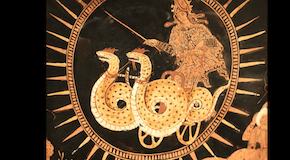 Cherubini’s Médée is a French opéra comique (i.e. with spoken dialogue) which premiered in March 1797. It’s based on Euripides by way of Corneille whose Médée of 1635 was written, as one might expect, in alexandrines. So its roots, and the work itself, are very much in the French classical tradition. The complication is that the work is much better known in its Italian version with sung recitatives (not authorised by Cherubini) and has developed as a “show off” vehicle for star sopranos; notably Maria Callas and, more recently, Sondra Radvanovsky. Along the way it’s lost a lot of its classicism and become almost verismo like. So I was intrigued to see how much Guillermo Silva-Marin, in presenting the work “in concert” at the St. Lawrence Centre, would try, and how much he would succeed, in reclaiming the Cherubini of a Paris tipping from revolution to Bonaparte.
 Here’s what I’m looking forward to in February plus a few gigs I can’t make:
 A couple of years ago I produced a series of “best of” lists for video recordings, which I’ve updated from time to time. One can find them on the
 operaramblings