Gluck’s Orfeo ed Euridice was written in reaction to what the composer saw as the excesses of contemporary opera seria. Out went the glitzy display numbers for star singers and extraneous ballets. In came the idea of telling a strong story simply through words and music. This “stripping down” is emphasised by Robert Carsen’s very spare production, originally created for Lyric Opera of Chicago and currently playing at the Canadian Opera Company.
Carsen gives us a slightly raked stage covered in rubble with the only “feature” being Euridice’s grave. There are no dancers. The three principals and the chorus are dressed in modern black suits or dresses with, where appropriate, white shrouds. In a few scenes pots of fire are used on stage but that’s as near as we get to colour until the very final moment. Despite the lack of dancers there’s plenty of work for the chorus who weave intricate patterns around the principals. Most of this is lit (if anything so dark can be said to be lit) so as to project shadows onto the back of the stage. It’s simple and effective. Only at the very end, as Euridice is redeemed for the second time do we get light. It’s really effective. The stage glows and the houselights come up briefly effectively including us, the audience, in the redemption through love.
Countertenor Lawrence Zazzo sings Orfeo. It’s the crucial role. He’s on stage for virtually the whole 90 minutes and has pretty much all of the famous solos. He was very good last night. He is the ‘modern’ kind of countertenor, sounding more soprano like than say James Bowman or Alfred Deller. That worked very well for this role (though not as well for Oberon two seasons ago when a bit more “otherwordly” would have been welcome). He was very well backed up by Isabel Bayrakdarian as Euridice. It was lovely to hear her sing a role that really suits her current voice; darker and more mature than it was just a few years ago. Amore was sung by Ambur Braid. I think this role suits her voice far better than the Queen of the Night, which is what I last heard her sing on this stage. I think it was quite an inspired bit of casting because, besides the vocal suitability, Ambur is perfect as the gender fluid Amore that Carsen gives us. She looks equally good and equally convincing in a suit as in a dress. So, terrific singing and acting all round.
The chorus is crucial in this piece and didn’t disappoint. It’s a really good chorus and once again did its thing admirably, as did the orchestra The whole thing was musically held together by Harry Bicket in the pit. It’s another excellent choice for this work responds well to his cool, classical style.
So, no histrionics or emotional manipulation here, just an hour and a half of very beautiful and satisfying music theatre that had most of the audience members on their feet for the extended curtain calls. There are three more performances next week and decent tickets still available (surprisingly given the universally stellar reviews). Failing that, Mr. Carsen is back next year to direct Gluck’s Iphigénie en Tauride with Susan Graham and Russell Braun.

 Until very recently one of the few good restaurant options within easy walking distance of the COC offices and the Kitten Kondo (since only a couple of hundred metres separate them) was a pretty decent locavore resto called Veritas. I’ve seen COC General director Alexander Neef in there more than once. Alas Veritas is no more. It has been replaced by what looks to be a hideously trendy and overpriced bar called the Pacific Junction Hotel. What’s a bit disturbing though is that this doubles the number of eateries in the ‘hood with Stiegl on tap (the other being the rather good, but also overly trendy , breakfast/brunch spot Le Petit Dejeuner. Stiegl is, par excellence, the beer of Regie. If beer features in a production by a controversial European director one can pretty much guarantee it will be Stiegl. Is this an omen? The 2012/13 COC season has Atom Egoyan, Peter Sellars, Robert Carsen and the Alden brothers directing 6 of 7 productions (surely enough to induce apoplexy in the National Post‘s Kaptainis). Are the hop leaves predicting a further shift away from the Lotfi Mansouri aesthetic? With this much Stiegl around can Herheim or Bieito be far behind?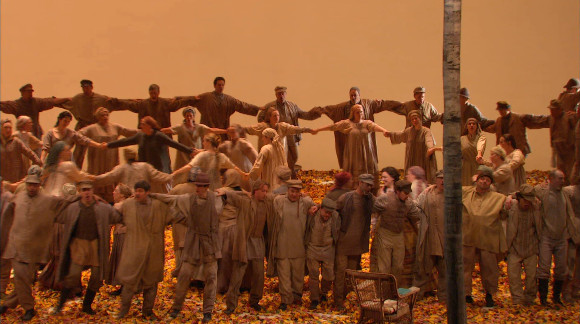


 operaramblings