Song and scrunchions

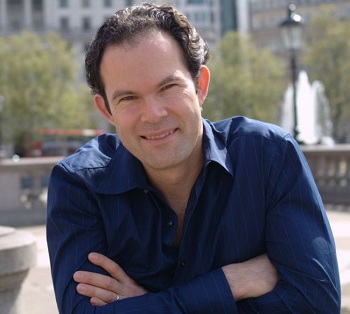
So, apparently Toronto has three opera singers from the otherwise unremarkable town of Corner Brook, Newfoundland.  Today they (Michael and Peter Barrett and Adam Luther) together with Doug Naughton on guitar, Andrew Grimes on bhodran and, the definitely not from Newfoundland, Sandra Horst on piano produced a fun recital of arrangements of more or less traditional songs from Newfoundland and the British Isles together with a few pieces that aren’t actually traditional but people think they are.  And actually, of course, a lot of the time differentiating between a traditional Newfoundland song and a traditional British song is a bit fraught.

Continue reading

Signal boost

It’s not often someone takes the piss out of one of my favourite operas and leaves me laughing like a drain but Chris Gillett has done it with his synopsis of a recently discovered Britten opera Tyco the Vegan.

This may inspire me to go further with describing the late Puccini “masterpiece” Lorenzo d’Arabia featuring belly dancers, dodgy Arabs, stiff upper lipped Brits, sheep’s eyeballs, a trio by Ali, Abdul and Achmet and a touching final scene where the beautiful princess Salima sings desperately of her abandonment by Lorenzo while buried up to the neck in sand.  Of course she dies.  Horribly.

‘Tis the season to speculate

Finley-Gerald-02With a month or so to go before the Canadian Opera Company officially announces its 2013/14 season it’s surely time for some uninformed speculation.

There are three big anniversaries in 2013; the bicentenaries of Verdi and Wagner and the centenary of Benjamin Britten.  One would think all would be represented but maybe not.  We know Verdi will be.  Gerald Finley announced at the Rubies that he would make his role debut in the title role in Falstaff at COC in 2013/14 so we can ink that one in.  Britten seems probable.  There’s a Houston/COC co-pro of Peter Grimes, directed by Neil Armfield that is due to to come to Toronto.  I think we can pencil that one in.  No idea on casting but I would love to see Stuart Skelton myself.  Wagner, I’m not so sure.  Maybe February’s run of Tristan und Isolde will be COC’s sole nod to Wagner.  Certainly the next most likely candidate; the Lyon/Met/COC Parsifal is, apparently, not expected before 2015.

Continue reading

RIP Galina Vishnevskaya

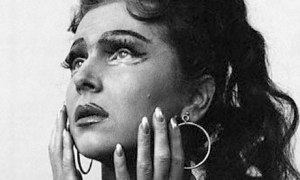
Galina Vishnevskaya in 1962I’ve just read the news of the death of Galina Vishnevskaya.  I’m taking it a bit hard because she was an important part of my education in classical music.  She, of course, created the soprano solo role in Britten’s War Requiem and was also a notable performer in the premiere of Shostakovich’s 14th SymphonyBoth of these works meant a great deal to me as a teenager and still do 40 years later.  There’s a good obituary in the Guardian. 

War in opera

As November 11th comes around for the 94th time since the guns were, very temporarily, silenced I thought it might be interesting to look at how war has been seen by librettists and composers over the years. Very early on we get a very gritty take on the subject in Monteverdi’s extremely compact Il combattimento di Tancredi e Clorinda but not so long after the path for the next three centuries is set with Purcell’s broadly comic King Arthur.  As far as I can see from Purcell to 1945, with very minor exceptions, the message is largely “war is fun”.  War is an excuse for a big parade (Aida; unless Tim Albery is directing!), an excuse for a drinking song (Faust), just plain comedic (La Fille du Regiment), a plot device (Cosí fan tutte) or a background event (Tosca, various versions of the Armida story).  The only opera, pre 1945, that I can think of that deals with the horror of war is Les Troyens, and that of course takes place in a distant, mythical, past.

Continue reading

It is a curious story

Miriam Khalil

Last night was the first night of a four night run for Against the Grain Theatre‘s production of Britten’s The Turn of the Screw.  These are the folks who did La Bohème at the Tranzac and The Seven Deadly Sins in an art gallery.  Last night’s space was only marginally less unconventional.  We were in some upstairs space at the Helen Gardiner Phelan Playhouse reached via the back entrance and lots of stairs.  It was a sort of loft set up so that the performance space was a narrow strip bounded at each end by a door and at the sides by three banked rows of seats.  There was seating for maybe eighty people so it was intimate, even claustrophobic.  Add to the space a few simple props, lights and a fog machine and you have the raw materials for Joel Ivany’s production. Continue reading

Adieu to Jacqueline

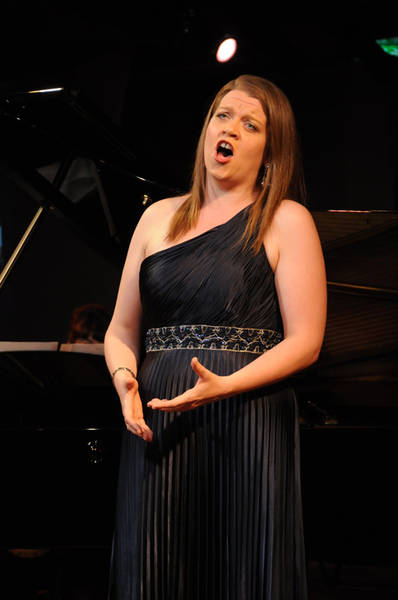
At lunchtime today, in the Richard Bradshaw Amphitheatre, Jacqueline Woodley gave her final recital as a member of the COC Studio Ensemble. In the two years she has been in the programme Jacqueline has given me maybe more pleasure than any other Ensemble Studio singer (stop sniggering at the back). What’s become clear in that time is that she’s an exceptional talent when it comes to interpreting difficult modern and contemporary music. Realistically I doubt we’ll see her sing Verdi at La Scala but few people who do that could do what Jacquie does with works by composers like Golijov, Saariaho and Sokolovic.  Perhaps no surprise then that she chose a recital programme that was 100% art song. Continue reading

Against the Grain’s Seven Deadly Sins

Last night we headed out to that part of the formerly industrial west end much beloved by tiny arts organizations to see a thoroughly eclectic series of performances by Against the Grain Theatre. This is the company that previously brought us a genuinely Bohemian La Bohème at the Tranzac club. Last night’s show cunningly built on that success by using the undoubted crowd pleaser, Lindsay Boa-Sutherland, to headline a performance of Weill’s Die sieben Todsüngen. Since the orchestra was replaced by two superbly virtuosic pianists in Daniel Pesca and AtG music director Christopher Mokrzewski it made sense to include two fiendish pieces for two pianos; Steve Reich’s Piano Phase and John Adams’ Hallelujah Junction. The program was balanced up for “virtue” with Britten’s Abraham and Isaac. So, a thoroughly eclectic but oddly coherent line up.

Continue reading

Farewell Ileana

Ileana at the Stella Maris competition

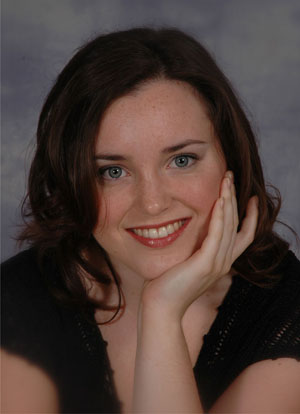
It’s that time of year again. With a few months left in the opera season in Toronto today saw the first “farewell” concert by a departing member of the COC Ensemble Studio. It was a solo recital by dramatic soprano Ileana Montalbetti, quite possibly the best sounding thing ever to come out of Saskatoon. Ileana is the only full on dramatic soprano I’ve seen in the few years I’ve been following the Ensemble Studio and, as ES boss Liz Upchurch pointed out, they are rare so it’s always interesting to see another one come along. Fair to say too, I think, that it’s not the voice type that is treated most kindly by a piano recital in a fairly intimate space. That said, it was a very enjoyable performance.

Ileana kicked off with O Sachs! Mein Freund! from Die Meistersinger. Any reservations I have about dramatic sopranos and piano recitals come redoubled in spades where “big” opera arias are concerned. The kind of volume and tone needed to sing against a large orchestra in a big theatre tends not to sound too lovely when throttled back with only a piano for support and, honestly, I don’t think this piece was a great idea.

Things improved enormously in the next section though. This was the song cycle Ekho Poeta; Pushkin texts set by Benjamin Britten and written for the Rostropoviches. It’s a rarity; a Britten song cycle I don’t recall hearing before, and it’s very good. It was a much better vehicle for Ileana who displayed plenty of power, well controlled vibrato and pleasing and varied tone colours especially in the middle register. Her high end was much sweeter here than in the Wagner too. Where she needed a lot of attack, as in the rather spiteful Epigramma she could certainly produce it. Being Britten, the piano part in these pieces was really quite demanding too so kudos to pianist Rachel Andrist for excellent and sympathetic musicianship.

The second half of the programme was all Strauss. It started with Arabella’s final aria, which I enjoyed more than the Wagner but about which I have similar reservations as a recital piece.  Then we got a selection of songs from Op. 37, Op. 48 and Op. 32 before finishing up with Zueignung from Op. 10. This was all good stuff with more excellent control and very good German diction. The final number was particularly lovely. For an encore we got a spirited rendering of Sweet Polly Oliver in the Britten setting.

I think Ileana is a very considerable talent and I’m sure she’ll do well in the wider operatic world.  Liz Upchurch and the COC certainly seem to think so.  Liz  “leaked” that Ileana will be back in an as yet unannounced major role. Putting two and two together and making something like e^iπ and adding in a dose of wishful thinking I’m wondering if there is any connection between Ileana’s first piece today and the long rumoured Toronto debut of a certain ex-pat Canadian baritone.

Also, à propos not much, it was nice to see a certain world famous dramatic soprano in sneakers and sans make up watching from the standing room section.