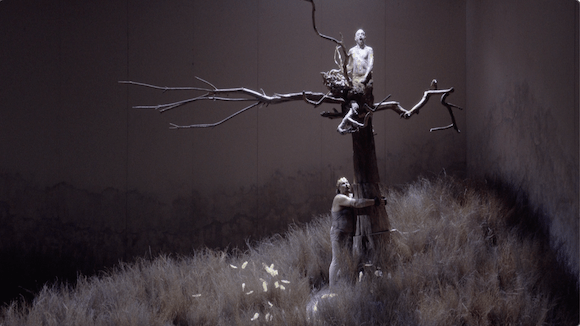
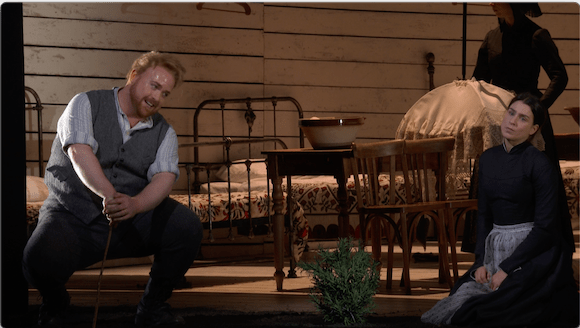
Puccini’s Madama Butterfly is an opera I really have trouble with. Done “straight” it’s just a horrible mixture of cultural appropriation and just plain ick. It does have some good music though and opera companies insist on doing it roughy every five minutes so it would be really nice to find a production that worked dramatically. The lake stage at Bregenz is just about the last place I’d expect to find that so I was pleasantly surprised that Andreas Homoki’s 2022 production is maybe the most interesting I’ve seen.
Tag Archives: blu-ray
Fuoco Sacro
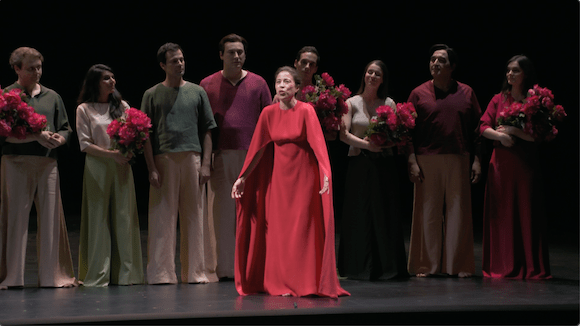
Fuoco Sacro is a film by Jan Schmidt-Garre. It’s subtitled “A Search for the Sacred Fire of Song” and was inspired by Schmidt-Garre’s passion for Italian singing of a slightly earlier era rekindled when he heard Ermonela Jaho on his car radio. This led him to explore how certain singers create something more than “just singing”. In the film he does this by following the lives of three singers; all women (he clearly doesn’t believe that men have this elusive “sacred fire”) and all very different. They are Ermonela Jaho (of course), Barbara Hannigan and Asmik Grigorian. Now these are all singers about whom I have strong opinions and that may colour my view of the film. You have been warned. What follows concentrates on what I think the film tells us about its three principals. The film does this more by show than tell with lots of performance and rehearsal footage as well as interviews.

L’Orfeo in Paris
The last time I reviewed a recording of Monteverdi’s L’Orfeo was ten years ago and it included Jordi Savali with La Capella Real de Catalunya and Le Concert des Nations. Oddly enough they also figure in a recording made last year at the Opéra Comique in Paris. Pauline Bayle’s production though is very different from the very HIP Liceu version.

Giulio Cesare at Grauman’s
The 2021 production, by Keith Warner, of Handel’s Giulio Cesare in Egitto at the Theater an der Wien uses Grauman’s Egyptian Theatre as a framing device. Sometimes the action is clearly the actors, producers, cigarette girls etc involved in the screening of a silent German movie version of “Caesar and Cleopatra”. Other times they are performing the action of the film/opera. Sometimes the cinema screen shows clips from the movie. Other times it shows pictures of the characters on stage. For example, at the beginning of Act 2 Tolomeo, whose other persona is some kind of sleazy mafioso movie exec, is shooting up. There’s a B&W picture of him on the screen that slowly changes to bright colours and then becomes more and more a depiction of a pretty heavy trip.

The Gods look down
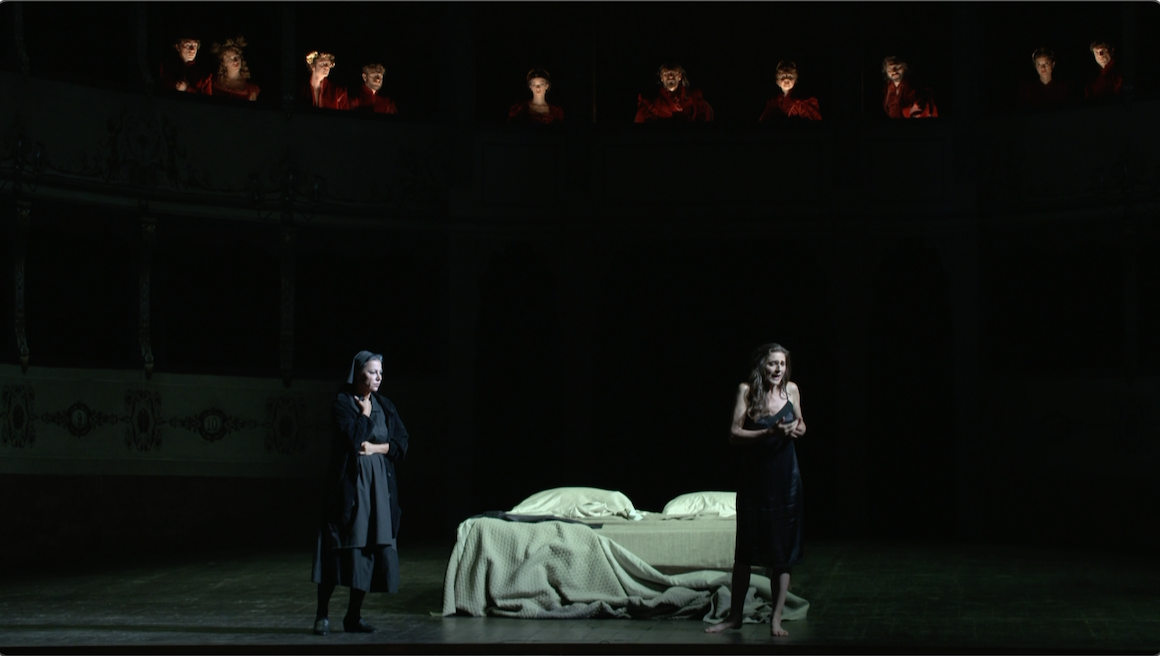
Robert Carsen’s 2021 production of Monteverdi’s Il ritorno di Ulisse in patria was recorded at the Teatro della Pergola during the Maggio Musicale Fiorentino. The theatre, opened in the 1660s and very much a “renaissance theatre”, is very much part of the production; the loge boxes are used during the prologue, entrances are made through the unusual parterre (individual chairs not rows of seats) and the gallery behind the stage is used by the gods to observe the action below. Monteverdi used three distinct styles of music for gods, royals and lesser folk, Carsen mimics this by giving the three orders distinct costume and acting styles. The gods (and there is the full pantheon, not just the ones who appear in the opera, each with his or her distinctive emblem), costumed in opulent crimson 16th century style costumes, act in a stylised manner. The royals get smart modern dress and naturalistic acting while the others are scruffier and act more broadly.

The Golden Cockerel
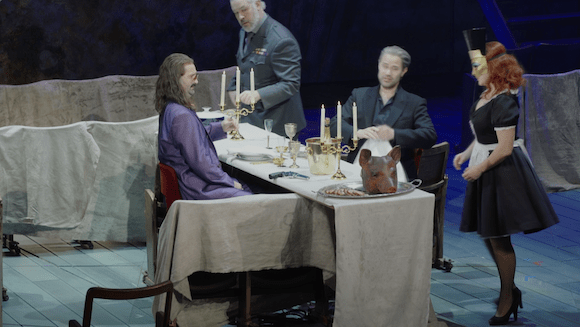
Rimsky-Korsakov’s The Golden Cockerel is a pretty weird opera. It’s a satire on Nicholas II’s performance as tsar written just after the disastrous 1905 war with Japan and due to entirely unsurprising trouble with the censors it wasn’t performed in the composer’s life time. As you may imagine, a production of it by Barrie Kosky doesn’t make it any less weird. Kosky’s production was recorded at Opéra de Lyon in May 2021 and there are still some COVID artefacts. The chorus, for instance, is masked. But mostly it feels like a “normal” production.

Virtue not blood
Scarlatti’s Griselda is based on a story from the Decameron. Gualtiero, king of Sicily, has married Griselda, a shepherdess. The people are upset that the king has married beneath him and are getting stroppy. Gualtiero sets out to prove Griselda a worthy consort by testing her constancy. He repudiates Griselda and sends her back to shepherding while arranging to marry an Apulian princess Constanza, who both he and Corrado, duke of Apulia, know to be his daughter by Griselda. It’s complicated by one Ottone who is infatuated by Griselda and Roberto, son of Corrado, who is in love with Costanza, who returns his feelings. Griselda is put through various humiliating trials in which she repeatedly shows her devotion to Gualtiero. Eventually the people recognise her virtue and all is restored. One notable thing, unlike his predecessor Cavalli, Scarlatti doesn’t inject any incongruous or comic passages into the opera. It’s all deadpan serious.
In this vale of tears
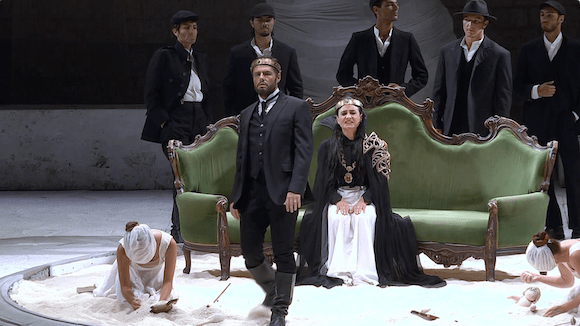
In May of this year I reviewed a recording of Janáček’s Jenůfa from the Staatsoper unter den Linden that impressed me enough to get onto my all time favourites list. I really did not expect to come across another as good for a very long time, let alone one that is, perhaps, even better within a few months but I have. It’s the 2021 recording from the Royal Opera House and it’s really fine.

Tcherniakov’s Holländer
Dmitri Tcherniakov directed Der fliegende Holländer in Bayreuth in 2021 where it was recorded. It’s no surprise given (a)Tcherniakov and (b)Bayreuth that it’s not a straightforward production. I’m not sure I have fully unpacked it and there isn’t anything in the disk package to help (just the usual essay telling the reader what he/she/they already know/s).

Sir John Eliot Gardiner’s Poppea
In 2017 Sir John Eliot Gardiner, the English Baroque Soloists, the Monteverdi Choir and a rather distinguished group of specialist baroque singers toured semi-staged versions of the three main Monteverdi operas, which were also recorded for video. Being a bit skeptical about the idea of videoing semi-staged performances I decided to take a look at L’incoronazione di Poppea (because it’s my favourite of the three) before committing to the trio. Bottom line, despite some stylish singing, good acting and excellent playing I can’t really see the point. There are good fully staged versions of all three operas available on video and, for me, especially watching at home, it’s hard for a semi-staged version to fully engage my attention.