Carmen again

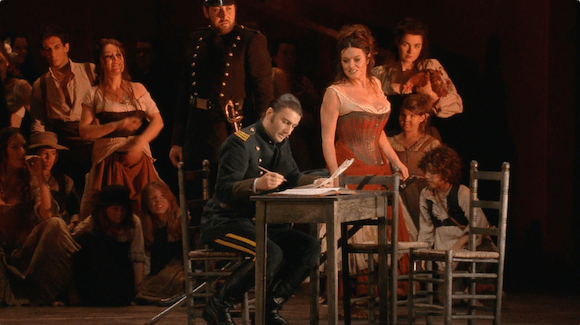
We were back at the COC last night for the first performance of Carmen by the alternative cast.  (First cast review) As so often seems to be the case with these double cast shows it felt almost like a different production.  The biggest differences are produced by the new Don José, David Pomeroy, and the new Carmen, Clémentine Margaine.  Pomeroy is a very decent singer but he doesn’t have the ease, power and bloom of Russell Thomas.  What he does have is vastly superior acting chops.  His Don José is a believably complex human being.  We can see his decline from rather boring and provincially stuck up into despair(1).  It’s palpable.  Margaine’s Carmen is a similar story.  Her voice isn’t as big or dark as Anita Rashvelishvili(2) but she’s much more physical on stage.  Further, Pomeroy and Margaine are much more credible as a couple.  The net result is the drama that was rather missing in the first two acts on Sunday.  The price is not hearing two absolutely incredibly beautiful voices.

Carmen-MC-0189

Continue reading

Carmen in Cuba?

I caught the second performance of the current run of Carmen at the COC this afternoon.  It’s a revival of the production previously seen in 2010 but with, we are told, debuting director Joel Ivany being given some freedom to change things up a bit.  Obviously he was mostly constrained to use the existing sets and costumes which, for reasons that escape me, transplants the piece to 1940s Cuba which was, as far as I know, markedly short of both gypsies and bull fights but there you go.  Actually it matters scarcely at all because both sets and costumes are generic scruffy Hispanic and could be anywhere from Leon to Lima.  For the first two acts too the blocking and Personenregie is pretty standard too.  It’s all really down to the chemistry between the singers and the quality of the acting and neither is anything to write home about.  It says a lot when Frasquita is scene stealing.  Fortunately it livens up a lot after the interval.  The third act is atmospheric and Micaëla’s aria is deeply touching and for the first time I felt genuine emotion.  It gets even better after that with a really effective use of the whole auditorium for the parade which had much of the audience clapping along and a clever stage set up for the crowd during the final confrontation scene.  I don’t think it’s a production for the ages but it’s better than merely serviceable and I’ve seen much worse Carmens.  And, frankly, it’s simply not realistic to expect one of the season’s cash cows to push the envelope very far.

Carmen-MC-4225

Continue reading

Last week of winter?

6The coming week may be the last quiet one before May madness sets in.  This afternoon Off Centre Music Salon have their 21st annual Schubertiad.  Ilana Zarankin and Jeffrey Ollarsarba will sing Die Schöne Müllerin and Der Hirt auf dem Felsen with Boris Zarankin and Ina Perkiss at the piano.  It’s at 3pm at Trinity St. Paul’s.  Apart from that there’s really only (only!) the opening of the COC’s production of Bizet’s Carmen on Tuesday.  That, of course, is at the Four Seasons Centre.


Canadian Opera Company announces rather more than just the 2015/16 season

Last night was the “event” at which the COC brass and guests, with a bit of help from Brent Bambury, announced the upcoming season to a packed house of subscribers and friends.  What struck me was how much news was packed in.  It was far more than the usual schedule presentation with announcements of several major new projects.  But first the season.   Continue reading

Overstuffed Carmen

It’s nearly five years since I saw the MetHD broadcast of Carmen with Alagna and Garanča.  I remember being quite impressed at the time.  Watching it again on Blu-ray I came away with a less favourable impression.  It’s not that it’s bad.  It’s not.  It just feels a bit lacklustre in a very crowded field.  Let’s start with the positives.  Elina Garanča is a very good Carmen.  She sings superbly and grows into the role dramatically as the work progresses.  She’s also a very good dancer and the production exploits that.  In fact dance is used very well throughout with specialist dancers used to stage a sort of prologue to each act as well as the obvious places being reinforced with “real” dancers.  As always, the Met doesn’t stint on this element and the dancers used are first rate.

1.crowd Continue reading

Maria Callas at Covent Garden

There’s not a lot of film footage of Maria Callas performing and most of what there is is of concerts.  What makes this disk special is that it contains the whole of Act 2 of Tosca recorded at the Royal Opera House on 9th February 1964.  It’s a Zeffirelli production and Tito Gobbi sings Scarpia with Renato Cioni as Cavaradossi.  It gives, I think, a pretty good idea of Callas’ appeal as an actress and as a personality.  She is fascinating to watch but in many ways quite hard to listen to.  My partner, who was in the next room, thought I was listening to an atonal modern piece, which is as much as I’m going to say about accuracy of pitch.  I found myself more caught up in thinking about that modern audience segment that wants to go back to “the good old days” because if this is representative I think they are nuts.  It’s not about Callas.  Well directed I think I’d have enjoyed seeing her.  It’s the overly melodramatic, well, everything.  OK, I know it’s Tosca but Gobbi’s eye rolling scenery chewing is like three Bryn Terfels without the self deprecating twinkle in the eye.  One wants to shout “watch out for the crocodile!”  And is he ever loud?  At first I just thought it was a recording balance thing but I don’t think so as he sounds way louder than the other singers.  It’s hard (and probably unfair) to judge a voice on the basis of a rather ropey recording like this but I wouldn’t pay to hear barking like this.

1.Tosca Continue reading

La tragédie de Carmen

warnerLa tragédie de Carmen is a stripped down version of Bizet’s opera originally created by Peter Brook some thirty years ago.  It dispenses with the chorus and most of the minor characters to focus in on the central drama of Carmen, Micaëla, Don José and Escamillo with some support from Zuniga and Lillas Pastia.  In Loose TEA Theatre’s version the action is transferred to New York in the 1920s and given a night club/mob setting which stretches the libretto but allows the rather striking Cassandra Warner to appear in some quite stunning outfits.

The piece is very condensed.  It runs maybe 80 minutes.  Presented in a small space like Buddies in bad times it becomes almost unbearably intense, especially when presented by fine actors as it was here.  Central to the whole thing is Warner’s stunning Carmen.  She is very good looking in a rather angular 1920s sort of way.  She can act and she has a really good voice.  The tone is genuine mezzo but she seems quite comfortable well up into soprano territory.  The overall effect was extremely sexy.

Continue reading

Putting the cars in Carmen

Calixto Bieito has a reputation as one of opera’s “bad boys” but there is nothing particularly shocking about his production of Carmen filmed at Barcelona’s Liceu in 2011.  The action is updated to maybe the 1970s (there’s a phone box and a camera that uses film) and there are lots of cars on stage.  For Bieito, this is a story of people living on the margins where sex is a commodity that women use as a trade currency and where violence, especially toward women, is endemic. It’s enough to disturb, as this piece did its original audience, without being gratuitous.

1.micaela Continue reading

Maria’s Carmen

In 1989 entrepreneur Harvey Goldsmith followed up his Aida of the previous year with a spectacular production of Bizet’s Carmen in the amphitheatre at Earl’s Court.  This is a sports stadium like venue that seats 19,000 and a cast of 400 or so singers, dancers and supers was employed.  The production was revived in 1999 when It was broadcast by Tyne-Tees Television and has been available on DVD ever since.  Continue reading

Zambello’s Carmen

Francesca Zambello’s Carmen for the Royal Opera House has more going for it than is immediately apparent.  On the face of it it’s a very traditional, conservative production; period costumes, literal sets, hordes of kids in Acts 1 and 4, live animals, but a close look reveals rather more.  Zambello reveals her intentions during the overture where we see a manacled, distraught Don José dragged to execution by a masked executioner.  This is going to be Don José’s story rather than one that focuses almost exclusively on the title character.  What we see here is a stark contrast between what Don José really wants; respectability, an obedient wife, conformity with the Church, honour and what key choices, accidents and conflicts drive him to; criminality, liminality, execution and, we may suppose, damnation.  The staging subtly highlights each of the key moments in Don José’s descent; his arrest and demotion in Act1, the fight with Zuniga in Act 2 and the realisation, in Act 3, that Carmen will never be the women he really wants reinforced by Micaëla’s aria that ironically offers him the choice he can no longer make and does so unmistakeably in terms of Catholic eschatology.  There is so much more going on here than a sexy woman and some pretty tunes.

1.carmendonjose

Continue reading