Burnt Toast

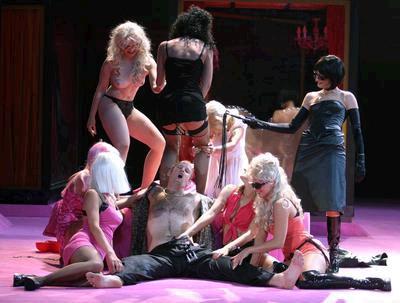
So this has to be the weirdest opera related thing I’ve seen in a while. It’s a 2005 CBC production of eight very short comic operas (the whole thing only lasts an hour) going through the stages of a relationship from Attraction to Starting Over via Marriage and Murder. The characters are mostly played by actors lip-synching while someone else sings. The music is by Alexina Louie and the libretto by Canadian comic, Dan Redican. Each piece is introduced by Redican as a mad toast scientist and the cast includes some of the best known names in Canadian theatre and opera including Colm Fiore, Isabel Bayrakdarian and Russell Braun. It sounds like a great idea but unfortunately it’s pretty ordinary. The music is mostly dull but it livens up a bit when it’s more obviously pastiche. The humour is a bit lame though the piece about a woman slicing her husband’s head off then disembowelling and liquidizing him for leaving the toilet seat up has its moments; especially her acquittal by an all female jury. Also you get to hear Isabel Bayrakdarian sing about kitty litter and Russell Braun do a version of Der Hölle Rache.

All in all, it’s as Canadian as moose jokes and about as funny.

toast

ETA February 1, 2016

So it’s been four years since I last watched this and the funny thing is that in that time I’ve come to know, one way or another, most of the singers involved in this thing who include Michael Colvin, Krisztina Szabó, Shannon Mercer, Peter McGillivray, Barbara Hannigan and Doug McNaughton.  It does make it more fun but I guess that doesn’t really work for a general audience.  It also makes me a bit baffled about who got to be played by an actor and who got to sing and act.  There are some pretty good actors involved here who never get seen.

Dido on film

Long before I got my hands on the Royal Opera House/Royal Ballet Dido and Aeneas, the film version from 1995, directed by Peter Manuira and with Maria Ewing in the title role, was my go to version. How does it stack up today?

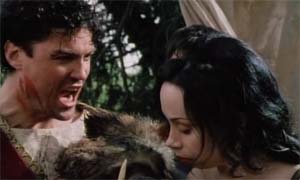
Some things that strike me.  It’s very naturalistic. It seems to be set in and around a Tudor mansion and the costumes are vaguely that way too. The interludes that are normally danced are filled in with “busy” scenes that try to inject some feeling but aren’t nearly as effective as Wayne McGregor’s dancers. The hunt scene has dogs and spears and a real boar’s head (which Aeneas touchingly present to Dido in her bath). There is a lot of fire including a full blown pyre at the end. For all that it doesn’t seem any more “true” than Wayne McGregor’s much sparer vision. It’s also very emotionally restrained. It’s not really until the final confrontation between Aeneas and Dido that any real emotion intrudes and even then it’s quite restrained This is actually very effective and Maria Ewing is truly affecting in the final couple of scenes. Ewing is good throughout both in the singing and acting department and her looks help (OK I know not everyone goes for Ewing but I think she’s gorgeous!). Karl Daymond is fine as Aeneas. We get a sort of composite Belinda/Second Woman set up with some of Belinda’s music given to the Second Woman and them doubling up on other bits. While Rebecca Evans and Patricia Rosario are fine there really isn’t enough musical or emotional contrast between them and Ewing. Richard Hickox conducts the Collegium Musicum and it’s all a bit low key in common with much else. It’s worth watching for Ewing’s performance in the final act but is otherwise a bit of a snooze.

Technically it’s very 1995. The 16:9 picture is hard letterboxed in a 4:3 frame and it’s pretty soft grained. Sound is adequate LPCM stereo. There are English, French and German subtitles.

Let the triumph of love and of beauty be shown

One of the trickiest things about opera productions; baroque opera anyway, is what to do about the dance elements. Time was when opera and ballet were joined at the hip but not so much nowadays beyond sharing premises. In 2009 the Royal Opera House made the bold decision to have choreographer Wayne McGregor direct the combined forces of the Royal Opera and the Royal Ballet in a production of Henry Purcell’s pocket masterpiece Dido and Aeneas. The result was broadcast by the BBC and subsequently released on DVD and Blu-Ray by Opus Arte. It’s a fascinating and rewarding production.

Sets and costumes are very spare. Aeneas and the chorus are in greatcoats and wide trousers. The ladies are in unfussy gowns. The dancers are in singlets and booty shorts (both sexes). Carefully detailed direction of the singers and their gestures, bold choreography and imaginative lighting carry the visual side of the production. The use of top quality dancers and a top notch choreographer allows the dance elements to realise their full potential (and not a castanet in sight!). The result is visually stunning.

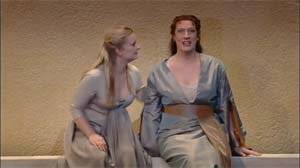
Now add a superb singing cast. Lucy Crowe almost steals the show as Belinda. She’s fresh and vivacious and her clean sound is just right for Purcell. But it is “almost” because we have Sarah Connolly’s monumental Dido to set against it.(1) She is one of the great Didos. I have heard Kirkby, Te Kanawa, Ewing and Baker in the role and even Flagstad but none exceed the combination of searing intensity and pathos that Connolly brings to the role. She is superb. Other elements of the singing are also admirable. Lucas Meachem is a hunky Aeneas and manages the tricky low notes better than most. The sorceress and witches; Sara Fulgoni with Eri Nakamura and Pumeza Matshikiza playing Siamese twins, don’t do the camped up distorted thing that is so often inflicted on the role. Fulgoni sings with quite a lot of vibrato which is sufficient to create some musical distance between her and the non infernal characters. The minor roles are all pretty good too. The regular Covent Garden orchestra is replaced by the Orchestra of the Age of Enlightenment under Christopher Hogwood. This is a move that other large houses might think about for earlier repertoire.

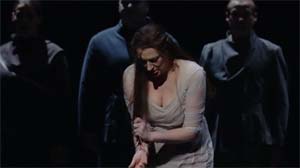
All this goodness builds to a searing climax in which Dido slits her wrists with the “tushes far exceeding those that Venus’ huntsman slew” and dies while a haunting projection of a horse plays back of stage. All in all it’s an hour of magic.

Video direction is much better than average. Close ups are minimised and we get to see the choreography in its broadest sense. The picture is superb 16:9 anamorphic (1080i on the Blu-Ray) and sound options are PCM stereo and DTS 5.1 (PCM 2.0 and PCM 5.1 on Blu-Ray). There are English, French, Spanish, German and Italian subtitle options.

Highly recommended.

(1) I do think the balance of voice types between Belinda and Dido is important. It’s like Carmen and Micaëla. If the voices are too similar much texture is lost. Crowe and Connolly are an ideal combination.

If I ruled the world…

… or at least if I ruled the COC and could design a fantasy season what would I do?

Design parameters:

  • Seven productions (because that’s what COC does).
  • Has to be balanced in the sense that it can’t all be obscurities I want to see.
  • Has to appeal to a reasonably wide audience but I’m not giving in to the sort of people who want to see Zeffirelli direct La Traviata every year.
  • Not constrained by some productions being long and expensive.

Continue reading →

Kupfer’s Der Fliegende Holländer

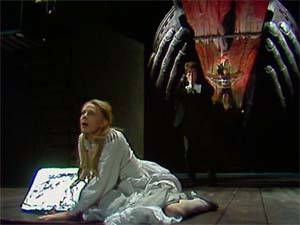
I was really impressed when I first watched the DVD version of Wagner’s Der Fliegende Holländer recorded at Bayreuth in 1985.  It’s been some time since I last watched it so another look seemed in order.  The production, directed by Harry Kupfer debuted in 1978 to both applause and brickbats.  The concept is that the Dutchman exists only in Senta’s imagination.  She is fixated on the Dutchman as her route out of the repressed bourgeois environment she is trapped.  It’s a tormented, even hysterical, version of Senta that finds a fine interpreter in Lisbeth Baltslev.  Kupfer reinforces this idea of Senta by having her on stage all the time.  During the overture she retreats to a sort of cage at the top of a staircase with her precious picture of the Dutchman which she will hang onto throughout the drama.  She will remain in this cage high to one side of the stage watching the action below her throughout the first act.
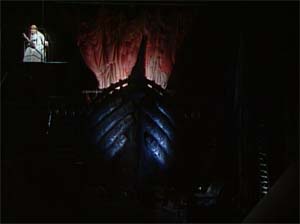
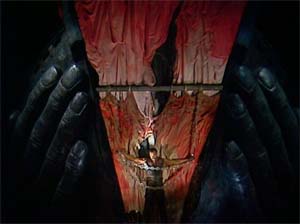
It’s a very strong first act musically and visually  The Dutchman’s ship makes a spectacular entrance and the finger like timbers of the bow open up to show the Dutchman chained in a crucifixion pose.  Simon Estes as the Dutchman is suitably elemental.  His singing and acting have a frightening intensity without ever becoming unmusical.  Matti Salminen’s Dahland is perfectly adequate and conveys the grasping bourgeois rather well.

Act 2, of course, opens in the Spinning Hall.  Anny Schlemm’s Mary exemplifies the dull conventionality of the place.  We are in the world of Strindberg or maybe Babette’s Feast.  The intensity of Balslev’s performance cuts right through this.  Johohoe! Truft ihr das Schiff im Meere an is as eerie as it is powerful.  Against this obsession the rather dull Erik of Robert Schunk is doomed from the start.  Things warm up with the arrival of Dahland and the Dutchman.  Salminen is in very good voice with Mögst du mein Kind, den fremden Mann willkommen heißen.  Senta is pinched looking or frightened almost throughout this scene.  There is great ambiguity while the Dutchman sings Wie aus der Ferne längst versangner Zeiten.  The Dutchman of Senta’s imagination sings from the gorgeous fantasy hold of his ship while the shadowy figure who arrived with Dahland is still on stage.  Senta is slow to buy into what is happening but she finally dissolves into a state that is more madness than delight.
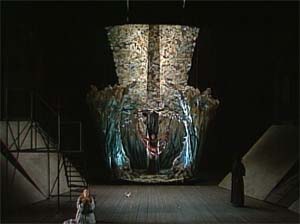
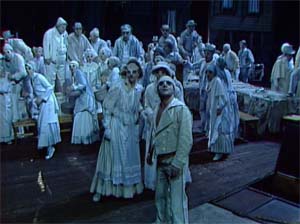
Act 3 opens with Senta watching her own wedding feast from the cage.  The townspeople and Dahland’s crew are almost as unnatural as the Dutchman’s.  It’s quite chilling and sinister all through until the Dutchman’s crew drive everyone off stage leaving Senta alone for her confrontation with Erik.  Then we get the big scene where the Dutchman, chained up again in the infernal version of his ship,  thinks that Senta has betrayed him and leaves her.

This is, obviously, crucial to the plot but it has never really made much sense to me in a normal interpretation.  Here it does.  This obsessed Senta needs to be “faithful unto death” not to have a happy ending.  It’s equally apt that her suicide is just that.  There is no hint of redemption for her or the Dutchman.  It’s the end.  The people turn their backs on her corpse leaving only Erik, in despair, still with her.

So dramatically it works as a piece held together by really intense performances by Balslev and Estes and, lest I forget, Woldemar Nelsson conducts and keeps things moving along briskly.  At times the orchestral playing is quite thrilling and the chorus is excellent too.

A couple of other things about the production are worth pointing out.  Although the booklet sets the scenes out in the conventional three acts it is actually played through (as I understand Wagner intended and as it was played at the COC a couple of years ago).  Scene changes are dynamic and slick.  There’s some real stage craft here.  It’s also very dark, as I recall most 1970s productions being.  This makes on stage detail hard to pick up and, I’m sure, affected the video direction.

This production was directed for video by Brian Large (surprise!) and it seems to have gone straight to video with no TV broadcast.  That said it looks like it was directed for the “small screen” which one might expect in 1985.  This is problematic given the crucial role of the spectating Senta, as most of the time she is out of shot.  Large tries to compensate for this with superpositions, fades and dissolves and is fairly successful.  All in all, I think he gives us as good a picture of what Kupfer put on stage as one could reasonably expect.

Picture quality is a bit soft grained as you might expect for the time and it’s 4:3.  Sound options are PCM stereo or DTS 5.1 which is a post process of the original stereo capture.  It’s very good indeed.  There are English, French, German, Spanish and Chinese subtitle options.  There’s nothing much in the way of bonus material but the booklet has a full track listing and an informative essay by Erich Rappl.

All in all I think this disc can be highly recommended. It’s a landmark production, well executed on stage and captured for DVD remarkably well for its era.

If you want a preview the whole thing is available in ten minute chunks on Youtube but the quality is a bit off putting.

Authentic? Opera Atelier’s Persée on DVD

I’ve been attending performances of Opera Atelier for over twenty years off and on but until viewing this recording of Lully’s Persée I’d never seen them on DVD. I was curious to see how the unique Opera Atelier style would come over on DVD and to what extent watching a recording, which I could compare fairly with other DVD performances, would affect my views of Opera Atelier’s strengths and weaknesses.

Continue reading →

Zodiac Trio

Yesterday’s free concert was given by the Zodiac Trio. They are a young group consisting of Kliment Krylovsky (clarinet) Vanessa Mollard (violin) and Riko Higuma (piano). The programme was titled Music from a Silenced Nation: Soviet Composers and it was presented, appropriately enough, on the greyest, dreariest day of the season so far. They brightened it up considerably. The programme opened with a virtuosic rendering of Stravinsky’s L’Histoire du Soldat followed by the first movement of Denisov’s Sonata for Solo Clarinet. This latter is a very strange work for its time and place. It experiments with quarter tones and is generally the sort of thing that would get one sent to the gulag. Next came the Allegretto from Shostakovich’s Sonata for Violin and Piano, Op 134, composed for David Oistrakh. This piece places huge physical and technical demands on the players which Mollard and Higuma really came through on. The final item on the programme was Galina Ulstvolskaya’s Trio. This I must listen to again. Why is this woman not better known? She was a pupil of Shostakovich and her work has many of the qualities that make her teacher so great. It was played beautifully with special props to Higuma who was required to get a very wide range of effects out of the piano. They encored with an uncredited tango of considerable bravura.

I would say that the Zodiac Trio are exceptionally committed to what they do and show great musicianship and serious musical erudition. Go see them if you get a chance.