Collaborations

Each year the Studio Ensemble at the Canadian Opera Company does an exchange with its counterpart the Atelier Lyrique de’l’Opéra de Montréal. Part of this collaboration is a free concert in the Richard Bradshaw Amphitheatre featuring singers from both companies. Last year I found it quite hard to write about as, frankly, Montreal didn’t bring much to the party. This year, happily, was different.

Philip Kalmanovitch

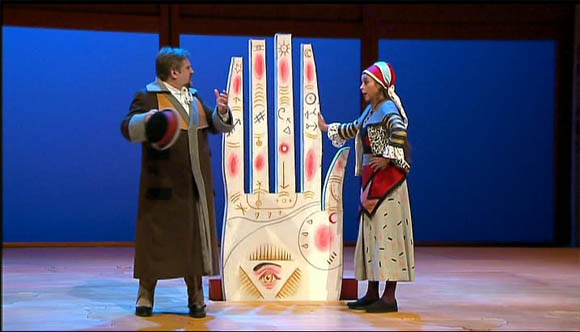
Two of the Montreal singers really impressed me this time. Philip Kalmanovitch is a tall, slim baritone with an engaging stage manner and a very nice voice indeed. He kicked off the programme with the Largo al factotum from Rossini’s Il barbiere di Siviglia. I would not have thought it possible to overact this piece but Kalmanovitch came close! It was very characterful, well sung and he communicated that he was having fun very effectively. We also got a characterful Là ci darem la mano from Don Giovanni sung with Jacqueline Woodley. Their voices blended very well and the acting was good too. His final piece was the much more romantic Mein Sehnen, mein Wähnen from Korngold’s Die tote Stadt. He didn’t seem quite as at home in this repertoire and he could use some work on shaping his lines but, again, he sang with beautiful tone and the closing pianissimo was very well done.

Emma Parkinson

I was just as impressed by mezzo-soprano Emma Parkinson. She has a lovely smoky voice of some power. In her first number, Come ti piace, imponi from La clemenza di Tito she was singing with the Studio Ensemble’s biggest voice, soprano Ileana Montalbetti. I was worried going in that she’d be blown away (probably literally) but it wasn’t so. They actually worked very well together. Emma and Ileana collaborated again with the addition of baritone Philippe Sly in Soave sia il vento from Cosi fan tutte. This wasn’t so successful. Even when she’s throttling back, Ileana has a distinct ‘slice’ which doesn’t really suit a Mozart number like this and the voices didn’t really blend. I really want to hear what she can do with an orchestra in a genuine spinto role. Also, Philippe sang well enough but it’s going to be a long, long time before he sings Don Alfonso.  Getting back to Emma, she also sang a spirited Parto, parto, agian from La Clemenza di Tito. This was the real deal and raised hairs on the back of my neck. There was power, passion and variation of tone colour. Her coloratura was a bit ragged in places but that will come. Ms. Parkinson is one to watch.

Aidan Ferguson

The Montreal contingent was rounded out by mezzo Aidan Ferguson and tenor Isaiah Bell. Ferguson sang Va! laisse couler mes larmes from Massenet’s Werther, Sein wir wieder gut from Strauss’Ariadne auf Naxos and collaborated with Mireille Asselin in the Presentation of the Rose from Der Rosenkavalier. She and Jacqueline Woodley also sang a very musical version of Belle nuit, ȏ nuit d’amour from Offenbach’s Les contes d’Hoffmann. Ferguson is musical, she’s got plenty of power and was markedly better in the Strauss and Offenbach pieces than in the Massenet where she was a bit wobbly. She just doesn’t sound like a mezzo to me. The voice is very bright and open and I wonder whether she won’t end up as a dramatic soprano.


Bell seems very young. He started out with a very diffident Unis dès la plus tendre l’enfance from Gluck’s Iphigénie en Tauride. He sounded a bit underpowered and undercharacterised. He was better in the duet My Tale Shall be Told from Stravinsky’s The Rake’s Progress (sung with Philippe Sly as a characterful Nick Shadow) where he showed he could convey some real feeling. He finished up with Si, ritrovaria io giuro from Rossini’s La Cenerentola. This really needed more power. he has the notes but he doesn’t have the exciting, ringing top end needed to bring a piece like this to life. He is very young though and with a bit more power and confidence could be quite promising.

The Toronto singers were really in back up roles in this gig but they all performed very well. Mireille Asselin showed she has the classic qualities of a young lyric soprano in her cameo as Sophie and Jacqueline Woodley was excellent in the Offenbach though to be honest I’d much rather hear her singing Weir, Golijov or Saariaho where she truly excels.  Philippe and Ileana I’ve already mentioned.   Accompaniment on the piano was by the Studio Ensemble’s Jenna Douglas and Timothy Cheung who were, as ever, just excellent.

All in all, a very worthwhile effort all round.

Dialogues of the Arkelites

Debussy’s Pelléas et Mélisande is not an opera I’m especially familiar with. It’s a strange piece based on a libretto by Maeterlinck. For much of the time it’s wordy without much action. There is a lot of philosophising. When the action does break out; Golaud’s mad jealousy in Act 3, the killing in Act 4, it gets musically and dramatically quite violent. The music is tonal and mostly quite dreamy. It’s almost mood music. All of this reminds me quite strongly of Poulenc’s Dialogues des Carmélites hence the title of this post. Also it’s French. Actually it’s very French.

Laurent Pelly’s 2009 production for Theater an der Wien is also very French; French director, French conductor, almost entirely French cast. In an opera where the words and the relationship between the music and the words matter a lot that’s a distinct advantage. The sets are semi-abstract and placed on a rotating turntable so that scenes can follow on with a minimum of interruption. The forest, the tower, the cave are all suggested rather than made entirely explicit. Even Mélisande’s extra long hair is not depicted explicitly. This fits the indirect nature of both the libretto and the music rather well. The costumes suggest somewhere around 1900 and the colour palette doesn’t stray far from “forest floor”. Lighting is quite dark but evocative. The sense of a gloomy castle in a gloomy (Breton?) forest is quite strong.

With the exception of a few outbursts from Mélisande’s husband, Golaud, and one fairly lyrical love scene between Mélisande and Pélleas the singers have few opportunities for vocal pyrotechnics. They do need to sing stylishly and articulate well though and this cast excels in that department. Natalie Dessay as Mélisande does the fragile Natalie thing which works really well in this role. Perhaps she could create more mystery around her character but her interpretation seems quite valid. Stephane Degout as Pélleas is a good physical actor and is lyrical where he needs to be. I’m not sure that there is much depth to be got out of the character anyway. Perhaps the most interesting role is the insanely jealous Golaud, sung here by the admirable Laurent Naouri. He has a fairly major emotional arc to go through and is strong in the scene of crazy jealousy where he gets his young son, Yniold (well sung and acted by Beate Ritter), to spy on the lovers. It’s a fine all around performance. The part of the old king, Arkel, is sung by Philip Ens. He conveys wisdom, sympathy and a kind of philosophical detachment in an extremely dignified but weary way. It’s a fine job of portraying a very old man without the voice sounding past it. Good supporting performances too from Marie-Nicole Lemieux as Geneviève and Tim Mirfin as the doctor.

Bertrand de Billy is in the pit with the ORF Radio-Symphonieorchester Wien. He seems to be thoroughly at home with the score and gets some lovely, transparent, sound out of the orchestra. The chorus, the Arnold Schoenberg Chor, does what little it has to do perfectly adequately.

The video direction, by Landsmann and Landsmann, is pretty sympathetic. A lot of the time not much is happening and they close in on the singer(s) which is fair enough. When there is a stage to be shown they show it. It’s nowhere annoyingly gimmicky. The picture is top DVD quality 16:9 and the DTS 5.0 sound is mellow rather than punchy which seems appropriate. AV quality is pretty much as good as it gets without going to Blu-ray. There are English, French, German, Spanish and Italian subtitles. Despite being split over two disks there are no extras. The documentation too is limited to credits (there’s not even a track listing). It;s quite a major omission for a work like this. An interview or an article about the director’s reading of the piece and his approach would be very useful.

There’s some stiff competition for this release, notably from Zurich and WNO, so I’ll certainly be trying to get my hands on some alternative versions in an attempt to deepen my understanding of the work as much as anything.

In defence of Robert Lepage

I am getting well pissed off with people taking ill informed shots at Robert Lepage based solely on his Ring cycle at the Metropolitan Opera. For three decades Lepage has been one of the most brilliant minds in the dramatic arts. His oeuvre spans straight theatre, film, circus, opera, multimedia performance art and stuff I don’t even know how to categorize. He acts, he directs, he designs. He also takes risks. In the nature of risk taking, sometimes they don’t come off and, frankly, I don’t think his Ring works. That said I think it shows the height (or depth) of poor taste and ignorance to launch ad hominem attacks on Lepage based on that one production and ignore all the things that have succeeded. The list is long; Elsinore and The Seven Streams of the River Ota would top my list but there have also been award winning opera productions such as Erwartung, Duke Bluebeard’s Castle and The Nightingale and other Short Tales along with a dozen movies, a Cirque du Soleil show that has run for years and an astonishing outdoor multi-media exhibition celebrating the history of Québec. There’s lots more if one cares to look. Even Shakespeare had his off days. Would anybody go on and on and on about how crap Shakespeare was based solely on seeing A Comedy of Errors?

Reflections on Tosca

Photo credit: Michael Cooper

The only known photograph from this production as featured in every other print or internet review I've seen.

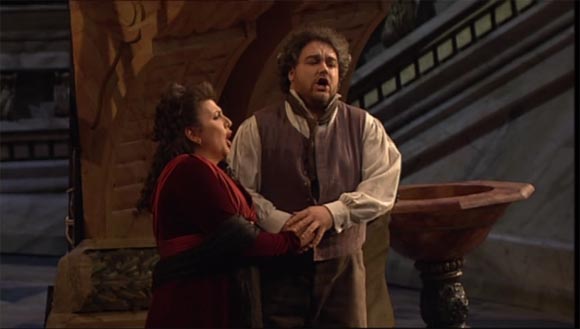
Puccini’s Tosca is on at the Canadian Opera Company right now. It’s this years “bums on seats” production. There are fourteen performances scheduled; compared to eight for most shows. It’s double casted. It’s a conservative friendly, traditionalist production seen before just four years ago and it features hone town diva, Adrienne Pieczonka. We saw it last night and were a bit disappointed. It wasn’t the sort of show one comes out of spluttering “travesty” or “disgrace” but it wasn’t the sort of performance that gets a standing ovation and excited deconstruction on the subway home either. It felt like a revival of a traditional production. It has to be said that my reaction, while more positive than some reviews I’ve read, wasn’t shared by a large chunk of the audience who switched from their customary coughing to an extended standing ovation. From the chatter I could hear in seats around me that was largely the reaction of the “once a year” crowd so, in a very important sense, this production accomplishes what it needs to do.

Still it’s sad to come out of a performance of Tosca relatively unmoved so let me try and dissect why. Paul Curran’s production is very traditional so there’s no gimmickry to either offend or help overcome shortcomings in the singing or acting department and, of course, there’s no sense of novelty. A reasonably seasoned opera goer is, inevitably, comparing it with other Toscas. Mr. Curran’s programme notes are quite explicit about the success criteria for an enterprise of this type.

The joy and challenge of directing Tosca is not only in the glorious music and razor-sharp libretto, but ideally in workingclosely with the talents of the singers playing and fleshing out their roles. As the curtain rises it is the characters and relationships we must believe in. Characters are built bar by bar, phrase by phrase and discussion by discussion. No word is too small that it might not be the trigger for a singer to find a new angle into their character’s life or psyche, and the job of the director, I believe, is in part to help the cast explore and discover just these subtleties.

The trouble is that not much of this happened. The three principals; Adrienne Pieczonka (Floria Tosca), Carlo Ventre (Cavaradossi) and Mark Delavan (Scarpia), are all established ‘A’ list singers and sang as well as one would expect but neither their characters nor the relationships between them came fully alight. I can take my Tosca somewhat overblown but lukewarm doesn’t really cut it. Delavan is a big man with lots of physical presence but here he struck (rather odd) poses and never really exuded any sense of menace. He didn’t even seem to be that into Tosca. His physical encounters with her in Act 2 suggested that their mutual priority was not upsetting the costume shop. You could find steamier scenes in any high school parking lot. This just reinforced the aloofness of Pieczonka’s very “in control” Tosca. Vissi d’arte, though beautifully sung, came out of nowhere. This wasn’t a woman on the edge of breakdown and when she stabs Scarpia our surprise isn’t that she’s done so but that she didn’t rip his balls off with her bare hands ten minutes earlier. The less said about Ventre’s acting the better though he too sang very well indeed and E luceva qualche stella was probably the emotional highlight of the evening.

Besides fine singing there was quite a lot to like in the production. The orchestra under Paolo Carignani sounded great. I really like the atmospheric lighting plot which used light level and tone to create a variety of effects, especially in Act 1 and in Act 3, where it managed to suggest night time without being so dark one couldn’t see. The chorus both adults and children were excellent and curran creates some pleasing visual arrangements in Act 1 (nice touch where Scarpia barges out past the bishop celebrant). Unfortunately none of this really overcomes the emotional hole at the centre of the production.

I’ve heard it said, from various quarters, that the second cast of Julie Makerov in the title role and Brendan Jovanovich as Cavaradossi (Delavan sings Scarpia in all performances) may up the EQ a bit so they may actually be a better bet. Sheer curiosity may even get me to go find out.

I’m sure what I’ve written above sounds really negative. It needs context. Expectations for COC productions have been raised very high by some truly excellent efforts in recent years and so a “pretty adequate” production that would have received rave reviews ten years ago barely cuts it today. That’s the price of success.

Another lunchtime with Kaija Saariaho

Kaija Saariaho

Today’s concert in the RBA consisted of more works by Saariaho performed by members of the COC orchestra and the Studio Ensemble. Both the the composer and General Director, Alexander Neef, were there. The four works performed were most definitely not “easy listening”. To me they seemed firmly in the tradition of modern continental European composition in the same sort of mould as Henze or Berio. The pieces were all very dense with complex tonality and dissonance and placing great demands on the performers.


Jacqueline Woodley - Photo by Helen Tansey

First up was Changing Light described by the composer as a dialogue between soprano and violin. It’s a setting of a text by Rabbi Jules Harlow and was commissioned in the wake of 9/11. It may be a dialogue but the instrument doesn’t support the singer in any way. The violin is in a world of comples slides while the singer has some very tough intervals and the sustained, loud, high notes that characterize much of Saariaho’s vocal writing. That said in some ways this was the most conventional and accessible piece on the program. The performance by soprano Jacqueline Woodley and violinist Marie Bérard was first rate.

Mireille Asselin

Next came Mirage. This a setting for soprano, piano and cello of an English translation of a text from Mazatec healer and shaman Maria Sabina. It’s a rewriting of a piece originally written for soprano, cello and orchestra. The composer described this version as “more intimate”. It’s an uncompromising piece. Much of the piano part is played directly on the strings (rather than the keys) and the keyboard part is furiously virtuosic. The cello part is no easier with complex slides and atonality. The writing for soprano demands some characteristically difficult singing with something akin to Sprechstimme and some phrases that are whispered into the piano, using the piano as a reflector/amplifier. It’s quite a compelling piece. Again the performance was excellent. Jenna Douglas was on piano with Olga Laktionova on cello and Mireille Asselin singing.

The third piece seemed to me even more demanding. Lonh is a longish setting for soprano with electronic tape of fragments of medieval Occitan poetry by Jaufré Rudel. It requires an array of vocal techniques; singing, semi-singing, modulated speech, whispers, the works really. It’s quite haunting and the electronic tape which combines nature noises, bird sounds and fragments of spoken Occitan is very atmospheric. This was another fine performance by Jacqueline Woodley. We were told that this was composed as a “study” during the process of conceiving L’Amour du Loin so I guess it serves as an introduction to that sound universe.

Rihab Chaieb

The final piece was an early work for mezzo and soprano; From the Grammar of Dreams to texts by Sylvia Plath. It was described as “tenser” by the composer and to my ear sounded most influenced by the fashionable idiom of the 1960s and 1970s. It uses just about every vocal technique in the book and interweaves fragments of two different Plath poems; Paralytic and The Bell Jar. The composer tells us that dreams are “non linear” and that’s certainly reflected in the piece. Rihab Chaieb and Mireille Asselin were the singers and I thought their voices blended really well. The mix of Mireille’s very bright soprano with Rihab’s much darker tone was very pleasing.

I was really impressed with everyone on show today. It’s hard to express in words just how difficult this music is to perform. Here we had young singers and, I think, equally young instrumentalists putting on a truly impressive show. In particular, I was intrigued to see how much Mireille has come on. I first heard her sing a couple of Servilia’s arias from La Clemenza di Tito and my impression was of a perfectly competent light lyric soprano but nothing special. The last couple of times I have heard her she seems to have grown quite a bit musically and her performances today were top notch.

And then there were nun

Nest season the Canadian Opera Company is presenting a production of Poulenc’s Dialogues des Carmélites. It’s not a work I’ve had any exposure to and it sounded enough like Catholic snuff porn for me not to have bothered before. However, in the interests of furthering my education I got my paws on the library copy of DVD of a 1999 production from Opéra National du Rhin. I actually ended up quite liking the piece though the libretto might well have been written by Gide in one of his darker moments. The score is so tonal that it could almost have been written a hundred years earlier but it’s pleasant enough in a movie soundtrack sort of way. The production in question, by Marthe Keller, is very restrained. Much of the time it’s quite dark with very little happening. The drama is all in the words and expressions of the singers which must have made it quite hard to appreciate from the cheap seats. It’s also very traditional and period in costume and set design while remaining essentially simple. Given that most of the “action” is a series of dialogues that could have been lifted from a theology text this isn’t a bad set of choices. The final scene is almost impossible to stage literally as it involves the mass guillotining of the nuns. Here it’s handled effectively enough by having the nuns step forward in turn and collapse on stage to the successive sounds of the guillotine falling. The final reconnection of Blanche and Constance is really quite affecting. The cast is huge (full list below) There are a few key roles that have to convince for the piece to work. Foremost among these is Blanche de la Force aka Soeur Blanche de l’Agonie du Christ, here played by Anne Sophie Schmidt. She’s a character of deep religious devotion but also getting on for batshit insane. It’s not an easy role to play. Schmidt is really convincing in what could be a bit of a cardboard cutout role if not handled carefully. She also sings very well though occasionally sounds a bit strained in the upper register. The other young nun is Soeur Constance, a very optimistic young lady, played utterly charmingly by Patricia Petitbon. There are also lots of older nuns. I had to keep looking up who was who because it’s a bit like trying to pick out a suspect in a penguin identity parade. The important one’s are the old prioress (Nadine Denize), who dies in the first act, Blanche’s mentor, Mère Marie (Hedwig Fassbender), and the replacement prioress, also Mère Marie (Valérie Millot). All three ladies play their parts convincingly and sing appropriately for the character. Among the men, the stand out for me was the Aumônier of Léonard Pezzino who has a lovely voice. Really though, Blanche aside, this is an ensemble piece with no real opportunities for vocal fireworks. Here the ensemble worked well and was well supported by Orchestre Philharmonique de Strasbourg under Jan Latham-Koenig. I’m not sure how I feel about Don Kent’s video direction. He starts off with artsy stuff in the title sequence and it’s not entirely clear where the credits end and the piece begins. There is something to be said for showing the conductor going to the pit and starting the show. He stays very close in on the singers most of the time which normally drives me nuts but here seems unavoidable and, to be fair, when there is a stage tableau to be seen we see it. There are also grainy black and white images used during some of the orchestral interludes. It’s not entirely clear whether they are projections in the house or inserts in the video. I think the latter but I can’t be sure. It’s perhaps best to enjoy this as a video and not worry too much about how well it reflects what is going on on stage. Technically this isn’t a bad DVD. The 16:9 picture is quite decent and the LPCM Stereo sound is OK though not in the class of the best recent releases. The only subtitle options are English and Chinese. There is a trilingual (English, French, German) booklet with track listing, synopsis and a brief historical essay. The only real competition for this work on DVD is a much starrier La Scala cast in the Robert Carsen production that will be seen in Toronto so this Strasbourg version is probably worth a look for anyone with a serious interest in the work. There’s also an old (1984) Opera Australia version sung in English still in the catalogue.

Lunchtime with Kaija Saariaho

Today’s lunchtime concert in the Richard Bradshaw Amphitheatre was of a series of works by Finnish composer Kaija Saariaho whose opera L’Amour de Loin opens on Thursday at the Four Seasons Centre. The composer was in attendance and introduced each of the pieces.

First up were four songs for soprano and piano on texts by the Finnish poet Leino. These were performed by Carla Huhtanen and Adam Sherkin. We were told that the texts were essentially untranslatable but the English versions we got were good enough to see how the mood of the music fit the piece, if not to make any real judgement of the relationship between words and music. I found the music evocative and quite complex but not difficult to listen to. It’s certainly well beyond being mere mood music. They are quite intense pieces and place pretty heavy demands on both pianist and singer. In particular the soprano has many loud, sustained high notes to cope with and some awkward intervals. Huhtanen managed this with comfort. I can’t comment on her Finnish though I guess I can say, given that the last time I heard her sing was in Serbian, that odd languages don’t seem to worry her. Sherkin seemed well in control at the keyboard.

Next up were two contrasting piano pieces played by Sherkin. Both demanded some rather athletic playing. The first, Prelude, I found the more meditative of the two. I zoned out at times (but in a good way). The second piece, Ballade, I found myself getting more analytical about. The composer explained that it was a more narratively structured piece and I did get that sense. Sherkin was really good on both pieces.

The final contribution was Tag des Jahrs for choir and electronics. It’s a setting of four poems by Hölderlin on the theme of the seasons. This was performed by the Elmer Iseler Singers who, besides the electronic tape, got “help” from a concrete saw on University Avenue. For me this was the least successful piece. The music was quite evocative but occasionally seemed to be slipping into mood music territory. It probably wasn’t helped by the performance. I thought the German diction was distinctly sub-standard. They might as well have been singing in Finnish.

I’m glad to have heard some of Saariaho’s music ahead of seeing L’Amour de Loin next week and it’s always good to hear the composer’s thoughts on works of this type. There’s another concert of vocal works by Saariaho on Thursday. Here’s the programme. I shall try to be there.

I came, I saw, I picnicked

The DVD of the 2005 Glyndebourne Festival production of Handel’s Giulio Cesare in Egitto is one of the most satisfying that I have ever got my hands on. David McVicar’s production is a delight. The cast is consistently excellent with stand out performances from Sarah Connolly as Caesar and Danni de Niese as Cleopatra. William Christie gets wonderful playing from the Orchestra of the Age of Enlightenment. The production for DVD/Blu-ray is exceptional in every way. There’s even over an hour of worthwhile extras giving a total of over five hours of material.

Let’s start with the production. McVicar and his design team have placed the action firmly in Egypt but moved the time period to the late 19th century with the Romans being portrayed in the manner of the British who effectively ruled Egypt at the time. There are a number of elements taken from Bollywood musicals which seems to have led some reviewers to dismiss it as not being “serious” enough to be a proper Handel production. I think this is misguided. The Bollywood elements are well integrated dramatically and musically and serve a dramatic purpose. They point up the cultural rift between the Romans and the Egyptians without getting into a crude and heavy critique of colonialism. There are a few places where Andrew George’s choreography is a bit over the top but mostly it works and, if nothing else, it’s tremendous fun. McVicar has obviously worked really hard on the and all the main characters and their interactions are clearly defined. The gulf between Romans and Egyptians emerges through these relationships though perhaps the rather overwrought Sesto of Angelika Kirchschlager somewhat undermines the chilly memsahib Cornelia of Patricia Bardon. Throughout there are neat little touches like Cleopatra ditching her cigarette in the urn containing Pompey’s ashes or the Roman/British warships sailing into Alexandria harbour with airship cover during Da tempeste il legno infranto. At the very end, Achilla and Tolomeo, blood soaked, (both are dead at this point) reappear and flank the line of seated dignitaries sipping champagne. It’s weird but works. Notably the production team got one of the biggest ovations of the night when they appeared for a curtain call.

The individual performances range from very good indeed to spectacular. Musically the star is Sarah Connolly. She’s utterly brilliant with completely secure coloratura and ornaments that are far more than just decorative.  Right from Empio, dirò, tu sei where she manages to spit out her disgust while maintaining 100% musicality, to the very end she’s note perfect. Her acting is also really good. She covers a wide range of emotions and her physical acting is genuinely masculine. She really does not look or move like a woman in drag. Then there’s Danielle de Niese! Musically there may be subtler or more refined exponents of the art of Handelian singing but I doubt whether there are any who could handle the role Danni is handed here. (Jane Archibald maybe, just maybe). She sings very well in fact. Some of her big numbers are very well done indeed and Piangerò la sorte mia is very fine and she’s very clever vocally in Da tempeste il legno infranto here she works some ornamentation in to accompany miming firing a sub-machine gun. But singing is only a fraction of the work she gets through. She has a lot of physical acting and several major dance numbers. She’s a very good dancer and, of course, she really looks the part. It’s really quite a performance!

Patricia Bardon acts well in a chilly way and sings beautifully. Priva son d’ogni confortois a real tear jerker. Kirchschlager sings very well but is a bit overwrought in the acting department and doesn’t really come across as a young man set on revenge. Rachid Ben Abdeslam is wonderful as Nireno. He gets the basically scaredy cat (and somewhat effeminate) functionary spot on. Chris Maltman is an appropriately brutal and coarse Achilla without letting the coarseness affect his singing. Alexander Ashworth in a kilt, is a solid, if unexciting, Curio but that’s the role. Christophe Dumaux is brilliant as Tolomeo. He looks like Captain Darling from Blackadder Goes Forth and is similarly petty and petulant. He’s also a vicious, spoiled bully and narcissist. Dumaux brings out all these aspects while singing at the highest level. It’s almost up there with de Niese and Connolly. The musical direction and orchestral playing is of the highest order.

Glyndebourne has been really well treated on video in recent years and this Opus Arte release is no exception.  The production for DVD is both excellent and opulent. The DVD version is spread across three disks (the Blu-ray gets two which is remarkable!). The video direction, by Robin Lough, is sympathetic and unobtrusive. The production was filmed in 1080i (which is what one gets on the Blu-ray) and the DVD rendering of the picture is about as good as DVD gets. The audio choices on DVD are LPCM stereo and DTS 5.0 with the latter being superior. In fact it’s superb; maybe the best sound I’ve come across on DVD. The fidelity with which the brass and woodwinds are captured is exceptional. The Sinfonia just before the final scene is thrilling to listen to. I’d really like to hear what the PCM 5.0 track on the Blu-ray sounds like. There are English, French, German, Italian and Spanish subtitles. Besides a synopsis and cast gallery there are two documentaries incluced. There’s a “making of” called, appropriately “Entertainment is not a dirty word” and a feature on “Danielle de Niese and the Glyndebourne experience”. It’s rather touching as Danni gushes over what an amazing place Glyndebourne is and interviews Gus Christie about what it’s like to live there. I’d like to see the follow up with Mrs Gus Christie, chatelaine!

This really should be watched by anyone who thinks baroque opera is difficult and boring and needs to be dumbed down for the average audience. But I don’t suppose he’s listening.

Search statistics

I’m a bit of a fanatic about numbers so I tend to check the blog stats quite a bit. WordPress has pretty useful statistical tools really. Among other things one can track the search strings used to find one’s site. Here’s a screen cap showing that data from the beginning of this blog:

I’m completely at a loss to explain why “Calixto Bieito” and related terms should be represented thirty times more often than anything else.

Barbarella, Prinzessin von Judea

Götz Friedrich’s 1974 film of Strauss’ Salome is a bit of an oddity. It’s a studio film rather than a video recording of a live performance. This allows the casting of singers who might not be able to manage the role in the opera house. In this case, crucially, the light lyric soprano Teresa Stratas sings the title role which she most certainly never did on stage. Continue reading