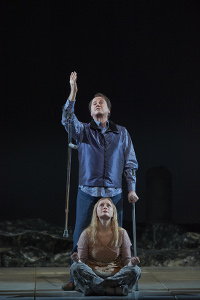
Verdi’s Macbeth is one of those early works where he seems to be trying to grow out of bel canto but not quite making it. There is some splendidly dramatic music and some that just seems completely incongruous given the subject matter. The witches’ chorus at the beginning of Act 3 is a case in point. That said Phyllida Lloyd’s production for the Royal Opera House takes the piece seriously and does a pretty good job of presenting the drama in a straightforward but visually attractive way.
Is this a blogger I see before me
I really struggle with early Verdi. I want to like it. I want to like anything by the guy who wrote Don Carlo and Simon Boccanegra. Also, there’s so much of it about that avoiding it is tedious. But, and it’s a big but, I really struggle with the combination of deadly serious stage action and upbeat, bouncy music. There are all these arias that go something like :
We’re going to murder you,
Rum, tum, tum, tumpty tum.
We’re going to chop you up
Rum, tum, tum, tum.
Cognitive dissonance is killing me and that’s my thought for the day brought to you by Giuseppe Verdi, Francesco Plava and a very puzzled William Shakespeare.
A School for Lovers
Atom Egoyan’s new production of Mozart’s Così fan tutte opened at the Four Seasons Centre last night. It’s a visually appealing production with an interesting concept and some glorious singing and acting. One may question aspects of the concept but nowhere does it do serious violence to da Ponte’s libretto and the end result, coupled with some outstanding performances makes for a most enjoyable evening.
Pricing strategies
Pretty much unremarked in the general houha of the COC’s season announcement is a rather interesting change in pricing strategy. Clearly something had to be done as the switch to a six performance season has consequences. The COC appears to have something over 7000 season subscribers and a further, say, 3500 select subscribers who buy tickets for five performances. The five performance package isn’t offered for 2014/15 so let’s assume that group split 50/50 into six and four package buyers for no net effect on ticket sales. The switch then means a loss of 7000+ ticket sales. The number of performances has only been reduced by 1 so that means the company has 5000 or so more tickets to sell to single ticket buyers or net new subscribers than last year. That is, of course, on top of last year’s unsold capacity of around 12,000 seats. For reference last year’s single seat sales were just shy of 40,000. So, unless subscription sales rise, single ticket sales per show have to rise from 6,500 to 7,500 (more or less) just to stand still. That’s actually a pretty tough ask.
Young artists
The Canadian Opera Company has announced the addition of three singers and a pianist to the Ensemble Studio for next season. The singers, unsurprisingly, are the three prize winners from November’s Centre Stage; Soprano Karine Boucher, tenor Jean-Philippe Fortier-Lazure and bass-baritone Iain MacNeil, The pianist is Jennifer Szeto. The COC also announced the setting up of an orchestral equivalent of the Ensemble Studio in which a number of young musicians will work with Johannes Debus and the COC Orchestra. Names were announced on Wedneday night but I can’t find them in any of the press releases. Continue reading
The COC’s 2014/15 season announced
Yesterday evening saw the announcement of the line up for the COC’s 2014/15 season. The usual rather prosaic press conference was replaced with a glitzy reception and main stage show featuring Brent Bambury of the COC interviewing Alexander Neef, Johannes Debus and others plus piano accompanied performances by Simone Osborne, Russel Braun, Robert Gleadow, Charlotte Burrage and Aviva Fortunata.
There were few surprises, in itself no surprise given the number of official and unofficial “leaks” this time around. There are three productions new to Toronto, all COC copros, and three revivals so it’s an “all COC” season with no rentals or other imports. Here’s what’s coming up:
Le Roi d’Ys
It’s perhaps surprising that Lalo’s Le Roi d’Ys isn’t performed much more often than it is. Most people probably only know it for the tenor aria Vainement, ma bien-aimée which crops up from time to time in recitals and competitions. Sure, it’s not strikingly original. The plot is a love triangle with overlays of revenge and divine retribution and the music is, with the exception of the rather fine overture, a bit on the rumpty tumpty side. But, let’s face it, there are plenty of standard repertoire works with implausible romantic plots and banal, if tuneful, music. I think there’s a large section of the opera audience that would very much enjoy this piece.
Kupfer/Barenboim Ring – 2. Die Walküre
The Kupfer/Barenboim Ring continues very strongly with the second instalment, Die Walküre. It opens in quite a straightforward, more or less realistic way. Hunding’s hall is slightly abstracted with a recognizable tree. It’s quite spare though which creates space for the strong interpersonal dynamics between Siegmund and Sieglinde. Poul Elming is a very physical, almost manic Siegmund and Nadine Secunde’s Sieglinde is almost as physical. It’s all very intense and beautifully sung. Matthias Hölle as Hunding is no slouch either.
The COC’s 2014/15 season
An interview with Sir Thomas Allen
Sir Thomas Allen, noted baritone and Chancellor of Durham University, is in town rehearsing Don Alfonso in the COC’s new production of CosÌ fan tutte. Yesterday evening, between rehearsals, he was kind enough to spend half an hour answering some questions. We talked about his career, about his role as Chancellor of Durham University and about the new production of Così. I’ve detailed some of the highlights below as well as embedding the full interview as a four part audio file at the end.