Maybe this should be titled “The bear and lemur freak show”. Anyway, no surprise to anyone who knows us or reads this blog, the classic 19th century Italian rep is not our sweet spot. Give us Handel or Berg or Britten over Rossini or Verdi (let alone Donizetti) most days. (We’ll make an exception for Don Carlos!). So, last night as the Four Seasons Centre erupted in frenzied applause I couldn’t really share the wild enthusiasm, fine as the performance was, but what startled me was when I heard a smug, female voice to my left say “Well that makes up for Hercules”. I restrained an urge to remonstrate violently (I’ve been taking lessons from Peter Sellars) but I did leave the theatre puzzled and a bit upset; a feeling shared by the lemur and subject of much conversation on the subway home.
Shakespeare vs. Donizetti
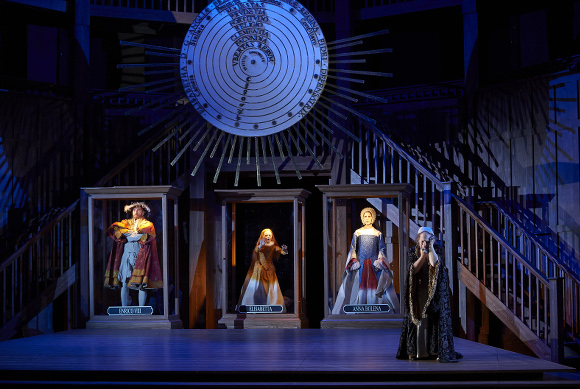
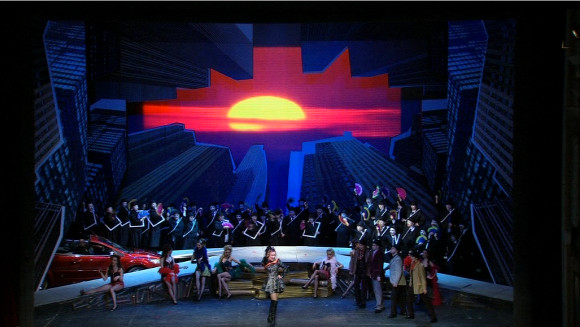
Stephen Lawless’ production of Donizetti’s Roberto Devereux opened last night at the Four Seasons Centre. It’s the last of the so called “Tudor Trilogy” and deals, ostensibly, with the last days of the reign of Elizabeth I. Events are loosely based on history. In this case the queen’s relationship with Robert Devereux, earl of Essex; his failure in Ireland, fall from grace, rebellion and execution for treason(1). Here the drama is turned into a simple story of royal jealousy featuring two fictional characters; The duke of Nottingham, Devereux’ bestie, and his wife Sara, confidante of the queen and in love with Devereux. It’s probably best seen as a logical continuation of the anti Tudor theme of the previous operas. There’s a bombastic, lustful monarch more concerned with his/her love life than affairs of state and there’s a scheming arch-Protestant minister responsible for the death of someone who doesn’t deserve for it for reasons of state (here the younger Cecil). The trouble here is that there is no obvious martyr. However one looks at it Devereux, brings about his own downfall.
Farewell Ben
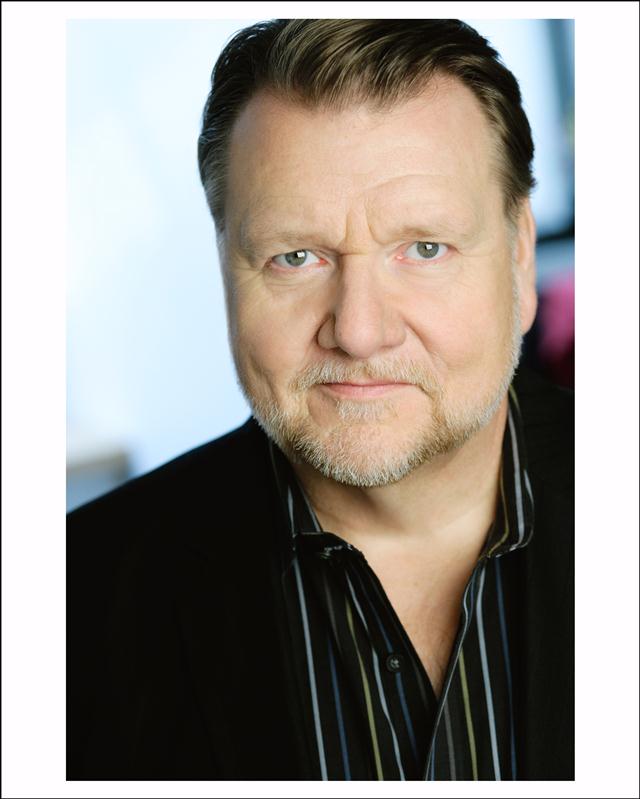
Famed Canadian tenor Ben Heppner has announced his retirement from singing. It’s entirely understandable as he has been struggling with vocal problems for some considerable time. On form, he was magnificent and I was privileged to hear his Tristan when he returned to COC after a long absence in 2013. Unfortunately a run of Peter Grimes later in the year showed the other side of the coin with a cancellation and some pretty rough moments. Ben is a gentleman and a professional and I think he’s doing the right thing by the opera world, for which he’s been such a distinguished servant for so long. He’s already got a radio gig hosting CBC Radio’s Saturday Afternoon at the Opera and I’m sure other interesting opportunities will open up. On to pastures new…
Ok, so how did I miss this?
Saturday (7.30pm) and Sunday (3pm), at Roy Thomson Hall, the TSO has a programme that includes operatic lollipops from Simone Osborne and Wallis Giunta. Joana Carneiro conducts. I had to go all the way to Sudbury to find a picture with wallis and Simone. Anyway, here’s the programme for the concert:
| Mozart: Overture to The Marriage of Figaro | |||
| Mozart: “Letter Duet” from The Marriage of Figaro | |||
| Offenbach: Intermezzo and Barcarolle from The Tales of Hoffmann | |||
| Delibes: “Flower Duet” from Lakmé | |||
| Beethoven: Symphony No. 6 “Pastoral” – Mvt. I | |||
| Glinka: Overture to Ruslan and Lyudmila | |||
| Villa-Lobos: Bachianas brasileiras No. 5 | |||
| Tchaikovsky: Romeo and Juliet Fantasy-Overture |
So three lovely ladies (plus the TSO) at one low (not especially actually) price.
First, the sound quality
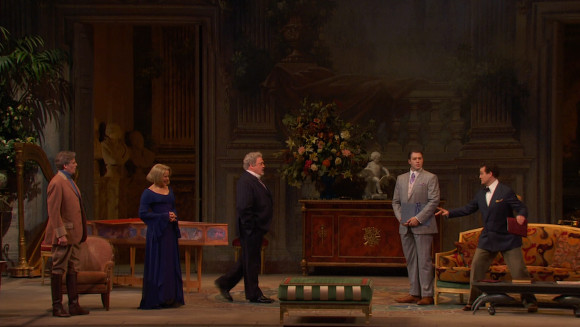
The MetHD broadcast of Strauss’ Capriccio has been issued on Blu-ray. I enjoyed the original broadcast but found watching it again on disk rather unsatisfying. The main problem is the production. It’s a John Cox effort from 1998. The period is updated from ancien régime France to just after WW1, apparently to make the people more contemporary while allowing an opulent, old style Met “all the things” production. Peter McClintock’s direction of the revival emphasizes the most obvious comedy (the ballerina falling over with her legs in the air, for example) while doing little or nothing to bring out the sheer cleverness of this opera, about an opera, within an opera. It all seems very heavy handed, in fact the word that popped into my head several times was “vulgar”.
How can peace come from so much pain?
Making a film of an opera rather than filming an opera involves interesting choices and one of the strengths of the DVD of Penny Woolcock’s film of John Adams’ and Alice Goodman’s The Death of Klinghoffer is that includes 47 minutes of Woolcock, Adams and others discussing just how one takes a rather abstractly staged opera (the original staging was, inevitably, by Peter Sellars) and turn it into an essentially naturalistic film. Of course, naturalism will only go so far with opera but this goes a long way in that direction. The soloists are filmed mainly on location and they sing to the camera. The choruses, mainly backed by documentary footage, and the orchestra were recorded in the studio but the actors sing ‘live’. The one concession to “being operatic” is having a mezzo voice one of the Palestinians though he is played by a male actor.
A Parsifal in three acts
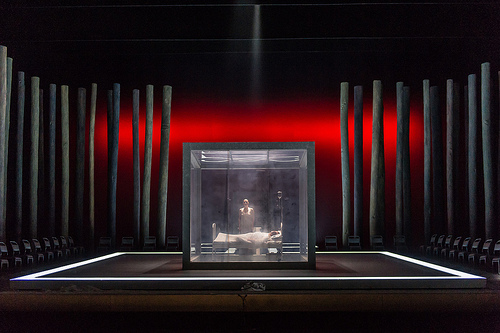
Yesterday, Easter Saturday, I got to see the Royal Opera House production of Wagner’s Parsifal. It was broadcast live to many locations of December 18th last year but hasn’t been seen in Toronto until now. It was very much a three act experience. At the end of the first and longest act I thought we were perhaps seeing greatness in the making. Stephen Langridge’s production concept supported by Alison Chitty’s fairly abstract modern designs were making all kinds of sense to me. At centre stage is a white, semi transparent cube serving as both grail shrine and Amfortas’ hospital room. Within it, various aspects of the back story are shown to us and it comes off as a place of knowledge; perhaps of a much deeper kind than has yet been revealed. This impression is reinforced with the unveiling of the Grail late in the act. It is a young, Christ like boy. The grail ceremony involves Amfortas cutting him to release the blood for the ceremony. There’s a lot of blood letting but it makes sense. We are seeing a very wounded and dysfunctional polity.
Love polygon
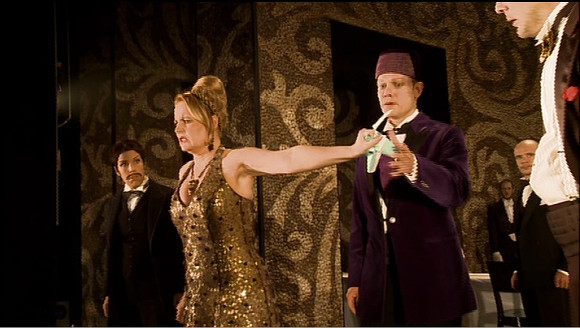
Handel’s Partenope is a bit unusual. It feels lighter than a lot of Handel’s Italian operas and it is basically a romcom, albeit one that still has a vaguely classical setting. Handel also plays with opera seria conventions by, for example, writing “heroic” arias for non-heroic texts and putting accompagnato in odd places. The number of potential match ups that need to be tracked is fairly staggering. Basically everybody is in love with, or pretending to be in love with, Partenope, queen of Partenope aka Naples. These include the invading prince of Cumae, Emilio; Arsace, prince of Corinth; Armindo, prince of Rhodes and Eurimene, an Armenia who is really Rosmira, princess of Cypress and formerly betrothed to Arsace. The only character who isn’t in love with Partenope is the philosophical captain of the guard, Ormonte, who is easy to spot as he’s a bass. At the start of the piece Partenope is in love with Arsace but Eurimene/Rosmira isn’t having that and engineers a duel with Arsace. This takes most of two acts but it’s the only essential bit of plot. In Act 3 Arsace, who really doesn’t want to fight his former fiancée finally comes up with the wizard wheeze of demanding that the duel be fought bare chested. Apparently this was perfectly normal under Neopolitan duelling conventions. maybe it’s what gave Patrick O’Brian the idea of having Stephen Maturin always duel bare chested? Anyway the modest Rosmira isn’t about to do any boob flashing (somewhat ironically as Inger Dam-Jensen, in the title role, has been bosom heaving with the best since the overture) so confesses to being, shock horror, female. Arsace and Rosmira are reunited and Partenope awards herself as a consolation prize to Armindo. Got that?
Looks better than it sounds
Massenet’s Don Quichotte is one of those works where one does a double take on learning when it was composed. It dates from 1910 but sounds like it was composed at least 50 years earlier. It’s lushly romantic and dressed up with elements of flamenco but to nothing like as good effect as in de Falla’s La vida breve. There’s also plenty of schmaltz. The intro to Act 5, for example, being highly reminiscent of the Meditation in Thaïs. The plot’s pretty thin too. Don Quixote loves the unattainable Dulcinea. He goes off and encounters some bandits who eventually take pity on him and rather than killing him give him Dulcinea’s necklace, which they have stolen. He returns it to her. She is grateful but still not interested in marrying him. He dies. Great!