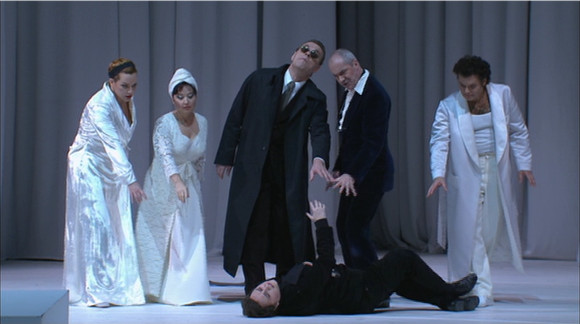
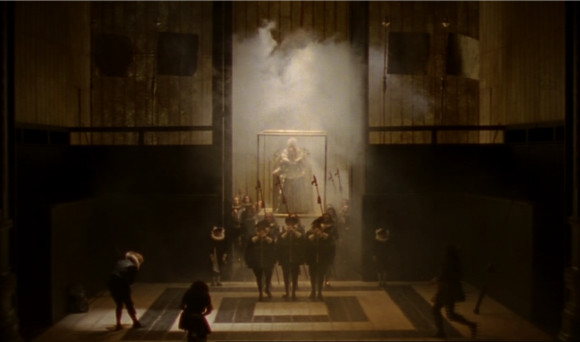
And so, at last to Götterdämmerung. The scene with the Norns is dark, very dark. There’s a rope and not much goes on (at least that is visible) but the singing is good. The “dawn” scene comes off more effectively here than the final scene of Siegfried but it’s still not great. I think the problem is a combination of Manfred Jung’s dry, rather nasal tone and Boulez rather fast tempu. It seems rushed rather than ecstatic and the Rhine Journey doesn’t thrill. I was concerned at this point that I was being unfair to a renowned production so I put on the same scene from Kupfer/Barenboim. It’s much better. Siegfried Jerusalem sounds truly heroic, Anne Evans richer tone blends better than Gwyneth Jones’ (though this could be an artefact of the recording) and, crucially, Barenboim gives the singers room to sing before markedly speeding up for the orchestral music. At least there is no naff attempt to depict a literal Grane in Chéreau’s version. At the conclusion of this scene Brian Large pulls off the first of his artsy effects. During the Rhine music he holds a close up of Brünnhilde for a rather long time before pulling out to a full stage shot which he then shrinks until there is just a tiny square of picture in the middle of a black screen which, when he slowly expands it, has transformed to the Gibichung hall. He does the same thing a couple more times. It seems odd to introduce that kind of thing at such a late stage in the cycle.
Chéreau Ring – Siegfried
Chéreau’s Siegfried is even less obviously “industrial” than his Die Walküre. There’s a forge of course but there rather has to be. Other than that we get workshop, forest and lair pretty much as one might imagine until, of course, we end up back at the ruin where Brünnhilde waits. Brian Large injects lots of smoke at every opportunity.
Finally, some common sense at the Met
Some of that not so common quantity; common sense, seems to have emerged in the negotiating process at the Metropolitan Opera. Following mediation, management and local 802 have agreed to retain an independent financial analyst and have agreed that work will continue while that person does his work and during the negotiations that will follow. So, no lockout for now. Full text of local 802’s press release under the cut.
Chéreau Ring – Die Walküre
The second instalment of Patrice Chéreau’s 1980 Bayreuth Ring cycle is set, like Das Rheingold, in a sort of industrial bourgeois late 19th century. One would almost say steampunk if that were not an anachronism. Actually the “industrial” side is much less evident than in the earlier work. There’s a sort of astrolabe/pendulum thing in Valhalla but that’s about it. Setting aside, the story telling is very straightforward; so much so that it takes a real effort of the imagination to get into a mindset where this production could ever have been considered controversial. It’s quite literal; Brünnhilde has a helmet and breast and back plates (worn over a rather severe grey dress), Wotan has a spear, Siegmund has a sword. There’s not an assault rifle or light sabre to be seen. It is though dramatically effective.
Chéreau Ring – Das Rheingold
So much has been written about Patrice Chéreau’s centenary production of the Ring cycle at Bayreuth that I approached reviewing it with some trepidation. I have decided to write about it “as is”; i.e. to write about what I see on the DVD and leave the undoubted historical significance, perhaps even revolutionary impact of the production, to others. Also, it’s apparent that what’s on the DVD, filmed in an empty house as was contemporary Bayreuth practice, must differ from what was seen on the Green Hill in certain key ways. This is a review of what;s seen and heard on the DVD.
Labour relations more popular than naked soprano
Something rather extraordinary happened around here yesterday. The state of the Met produced a completely unprecedented amount of traffic. This year traffic has been running around 6000-8000 hits/month. It’s been steadily growing since I started in August 2011 but not wildly. Yesterday saw 5916 hits; most of them on the Met piece. It was 17 months before I got that many hits in a month. In less than 24 hours the piece became the most read thing I have posted eclipsing the previous “best seller” which was, oddly enough, a review of the 1992 ROH Salome with Maria Ewing. This has been steadily garnering traffic for two and a half years mostly, it appears, from people who Google variants of “maria ewing nude”. It appears that even a naked Lady Hall can’t compete with labour relations at the Met.
The state of the Met
This is the first time I’ve posted about the current labour negotiations at the metropolitan Opera though I’ve been following the story closely. I have rather a lot of experience of contract and grievance negotiations and I think I can spot bad faith bargaining at some distance. Good faith bargaining typically occurs when both sides want to reach a settlement. The opposite when one side is more interested in ramming home some “point of principle”. This last was often a starting point on the union side in the bad old days ,especially in the UK and Australia but has become much less common. Nowadays bad faith is much more likely to come from the employer’s side, usually when they are bent on some principle like the “right” to hire and fire at will.
Another classic re-release
For the longest time the classic 1995 Glyndebourne recording of Janáček’s Věk Makropulos was the only video option. It’s now been re-released on DVD and Blu-ray in a completely remastered version. I watched the Blu-ray and it’s as well restored as the companion recording of Peter Sellars’ equally classic Theodora. As it’s drawn from a Channel 4 broadcast the picture is 4:3 and it’s presented here formatted for wide screens in what is, apparently, called “pillarbox” mode in the UK. At any event, the picture is excellent; certainly the equal of many more recent recordings, if not quite of the best HD quality. The sound, stereo only, is decent but a bit “boxed in” and the voices often seem to balanced a long way back.
WTF SRSLY!
The latest offering from Loose Tea Theatre is a show called AuroCorrect Operas. Basically it’s Mozart’s Bastien et Bastienne and Stravinsky’s Mavra updated for the internet age. I seem to have seen a lot of internet themed opera recently ranging from cyberbullying to screaming goats. Perhaps it’s a meme? The show runs August 21st to 24th at the Navillus Gallery on Davenport. Loose Tea’s previous effort; La tragédie de Carmen, was well worth seeing so this is probably one to see.
More details and tickets here.
LibLab reading
A few weeks ago I wrote about the Tapestry LibLab; a structured creative collaboration between composers and librettists. Yesterday we got a preview of the results. Twelve works created in this year’s programme were given a run through by the previously announced performers plus singer/dance Eva Tavares. The works will form the basis of this year’s Tapestry Briefs show in November when they will be fully staged.