Requiem come to life?

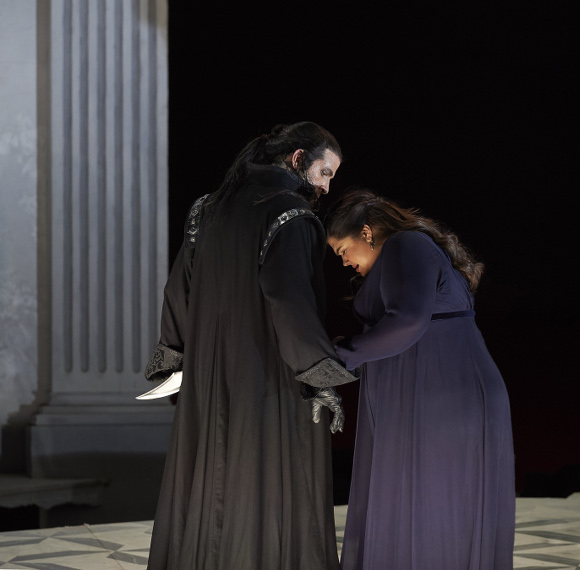
Joel Ivany’s much anticipated “semi-staged” version of Mozart’s Requiem K. 626 finally saw the light yesterday evening at Roy Thomson Hall.  There were some interesting ideas but, ultimately, I didn’t think I came away with any new insight into the piece or life or death or anything really(*).  I’ll go into the reasons but first I should describe how it was performed.  The mass is prefaced by the slow movement from the Clarinet Quintet.  The lights go down.  The five players enter via the aisles in the audience lower level and take their seats (sadly to applause which we had been asked to refrain from).  As the quintet is played (and it was very beautiful) the players are joined by the rest of the orchestra, the choirs, conductor and soloists enter through the audience and from the wings and deposited slips of paper (I think) on two benches at front of stage left and right.  Names of the dead?  Probably and that’s a nice touch though scarcely original.  The quintet concludes.  More unwanted applause.  At this point the orchestra are seated , more or less conventionally, around the conductor with the choirs around them.  There are lots of fancy chairs.  The soloists are more or less in conventional position in front of the audience.  Everyone, except the mezzo and the soprano, are in black.  The very crowded stage is quite dimly lit in bluish tones.  As the mass progresses, the soloists interact in various ways.  The choirs gesture in rather obvious ways; the text says “king” so we pump our fists, the text talks of “writing” so we make scribbly gestures.  At some point the soloists start to rearrange the pieces of paper with the names of the dead in a sort of game of Dearly Departed Patience.  The soloists exit through the orchestra.  The lights go down.  The End.

TSO Mozart Requiem (Malcolm Cook photo)

Continue reading

Où dort la fantaisie

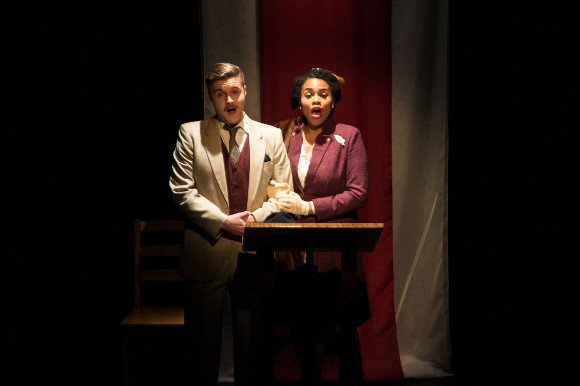
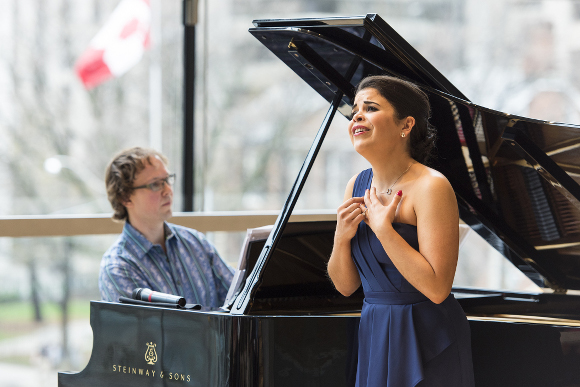
Yesterday’s lunchtime concert in the RBA featured two members of the Ensemble Studio.  Andrew Haji, standing in for an indisposed Charles Sy, and Jennifer Szeto performed Liszt’s Tre Sonetti di Petrarca.  These songs were unfamiliar to me and came as a pleasant surprise.  They are very Italianate and very operatic and have a pretty involved piano part (unsurprisingly).  Haji displayed his uncanny ability to find exactly the right idiom for the music and sang with beauty and expression as well as nailing the three high D flats.  Szeto was a most accomplished accompanist. Great dress too!  New Yorkers can catch these two in the Marilyn Horne Song Celebration at Carnegie Hall on Saturday where they will perform the same music.

Jan19RBA4

Continue reading

Talking with Wallis Giunta

wallis2.jpgGGS and Ensemble Studio graduate Wallis Giunta will be returning to Toronto in early February for Tapestry Opera’s New Opera 101 program and the two concerts of Tapestry Songbook VI.  Basically, she will be working with Jordan de Souza and a group of emerging artists on a three day series of workshops in contemporary opera which will include two concerts open to the public on February 5th and 6th.  I spoke to her via Skype yesterday at her current digs in Leipzig.

Continue reading

Program for Dmitri Hvorostovsky recital

Dmitri-Hvorostovsky-014_0The program for Dmitri Hvorostovsky’s February 21 recital at Koerner Hall has been released.  It is:


Glinka:
To Molly (Do not demand songs from a singer), (text: Kukolnik)
It’s Pleasant to Be with You (text: N.Ryndin)
Say Not That It Grieves the Heart (text: N. Pavlov)
Doubt (text: Kukolnik)
Bolero (text: Kukolnik)

Continue reading

We the sheeple

Calixto Bieito’s production of Mussorgsky’s Boris Godunov recorded at the Bayerische Staatsoper in 2013 is, unsurprisingly, strong stuff.  The central concept is that the political classes “don’t give a fig” for ordinary people and that’s as true , or truer, now than in early modern Russia.  In such a world, where the people are manipulated into acting as their “betters” demand, is it possible for a person like Boris, who has risen to supreme power through manipulation and violence, to have a conscience?

1.placards

Continue reading

Tafelmusik vocal competition

Winner - Kim Leeds

Winner – Kim Leeds

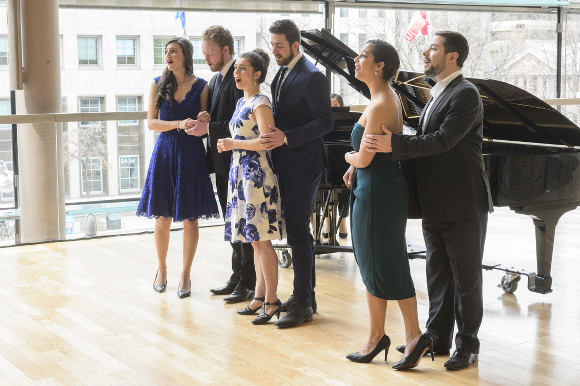
This was a vocal competition with a twist.  The repertoire was all baroque and the prizes were the soloist spots in upcoming performances of Zelenka’s Missa Omnium Sanctorum.  To some extent that dictated the format with three bass-baritones, three tenors and three altos (two mezzos and a countertenor) competing and a prize winner in each triad.  Each singer had to offer the appropriate piece from the Zelenka Mass plus a piece of their choice by each of Bach and Handel.  I did wonder whether I would get through an afternoon of twenty seven baroque vocal pieces but aided by free pizza and cookies I made it.  At least, for once, I was at a singing competition where nobody would be singing Pierrot’s Tanzlied.

Continue reading

Heating up

Faculty_of_Music,_University_of_Toronto_-_from_Philosopher's_Walk_-_DSC09874Next week things get rather busy.  There’s all the Hannigan shenanigans at UoT ; lecturing, masterclassing, concerting, walking on water, details here.  There are a couple of lunchtime concerts in the RBA.  Tuesday sees Gordon Bintner and Charles Sy perform Schumann’s Liederkreis and Britten’s Les Illuminations while on Thursday Jean-Philippe Fortier-Lazure appears with the members of the COC Orchestra Academy and their mentors.

Continue reading

Additions to the COC Ensemble Studio

es1617The COC will add six singers and a pianist to the Ensemble Studio for the 16/17 season.  Unsurprisingly the three prize winners from Centre Stage; mezzo-sopranos Emily D’Angelo and Lauren Eberwein and baritone Bruno Roy, are among the six. They are joined by soprano Samantha Pickett (continuing a tradition of promoting young dramatic sopranos) and mezzo Megan Quick and, best news of all to my mind, soprano Danika Lorèn.  Regular readers will know that I have been increasingly impressed by this young lady over the last twelve months or so and am looking forward to seeing even more of her.  The new pianist is Stéphane Mayer.

Hannigan and more

The amazing Barbara Hannigan is in town next week teaching at the UoT.  There are a number of events open to the public and free.  Here’s a list:

Tues, Jan 19, 10:30 am, Walter Hall
Lecture – Show and Share: Living and Surviving as a Singing Artist

Tues, Jan 19, 12:10 pm, Walter Hall
Master Class with U of T Opera students – featuring excerpts from the contemporary operatic repertoire centering on The Machine Stops, a new opera by the Faculty’s student composer collective.

Wed, Jan 20, 3:10 pm, Room 330 @ 80 Queen’s Park
Interactive session – Dare to Compare: session with composers, pianists and instrumentalists from U of T’s contemporary music ensemble.

Thu, Jan 21, 12:10 pm, Walter Hall
Master Class with U of T Voice students – featuring songs and chamber music of the 20th and 21st centuries.

Fri, Jan 22, 5 pm, Walter Hall
Concert – Performances by Faculty of Music singers and pianists after their training with Barbara, as well as from Barbara herself with pianist Professor Steven Philcox.

ETA: She’s also appearing with the TSO on Jan 27 and 28  singing Correspondances by Henri Dutilleux.  There’s no stopping her!

HanniganBarbara

Continue reading