Creativity and Aging – Confluence Salon

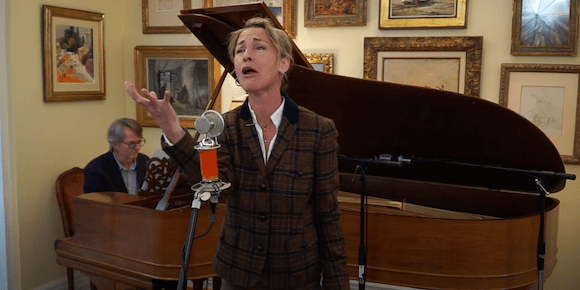
Does creativity follow an arc with age?  Is a period of peak creativity followed by inevitable decline or is there, perhaps, a qualitatively different, kind of creativity in the later years of life?  Linda and Michael Hutcheon; literary scholar and physician, explored this in their book Four Last Songs, which looked at the later works of Verdi, Strauss, Messiaen, and Britten.  Last night they appeared in the Confluence Concerts Salon series to provide further thoughts with reference to the works of Messiaen and Leonard Cohen.  Their thoughts were interwoven with performances of works by Messiaen and Cohen performed by Robert Kortgaard, Patricia O’Callaghan and Larry Beckwith.  There’s no need to read my description of the show.  It’s freely available on Youtube.
kortgaardocallaghan

Minimalist Lohengrin

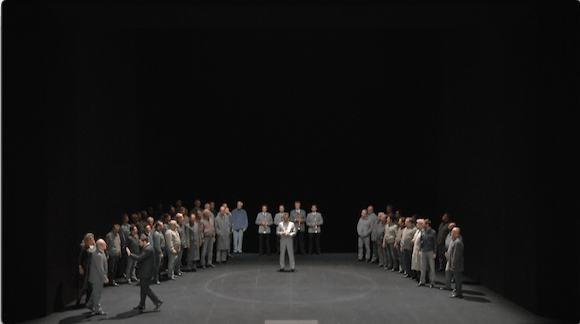
There’s obvious irony in a Hungarian directing Wagner’s Lohengrin; even more so when that director sees in Wagner’s Brabant parallels with Orban’s Hungary.  It’s quite interesting to see how this plays out in Árpád Schilling’s production recorded at Staatsoper Stuttgart in 2018.  The first thing to say is that this is an extremely minimalist production with a circle on stage , a curved back wall and not much else, though a bed appears in Act 3.  It’s very monochrome; the stage and the characters are all more or less in shades of grey until late in the second act when the Vier Edelknaben (here definitely women) and then the chorus appears in colourful but still eclectically modern, casual outfits.  The only real device for telling the story, apart, from the words and music, is the way groups of characters are arranged on stage.

1.Brabantfolk

Continue reading

Managing the Inherited Repertoire – 1/2

Yesterday saw the first part of Opera America’s webinar Managing the Inherited Repertoire.  It consisted of a half hour talk by Bernard Foccroulle, formerly boss at La Monnaie and the Aix Festival and will be followed up by a panel discussion tomorrow at 3pm.  I think you can still view the talk on Opera America’s Youtube channel.

Continue reading

Youtube roundup

New(ish) content you might want to check out:

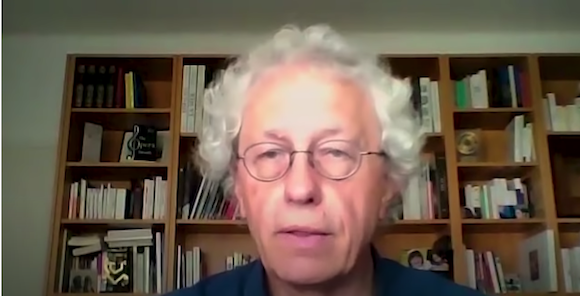
  • AtG’s Youtube channel has a really interesting interview with Peter Sellars and a very nice film presentation of Celia Livingston’s Penelope (after Homer’s Odyssey)
  • Toronto Operetta Theatre is also on Youtube now with excerpts from various shows from the last few years.  technical quAlity is very good.

ivanysellars

And coming up, this year’s Mysterious Barricades event in support of World Suicide Prevention Week is on September 10th. It’s virtual this year, of course, but needed now more than ever. Details on their Facebook page

.

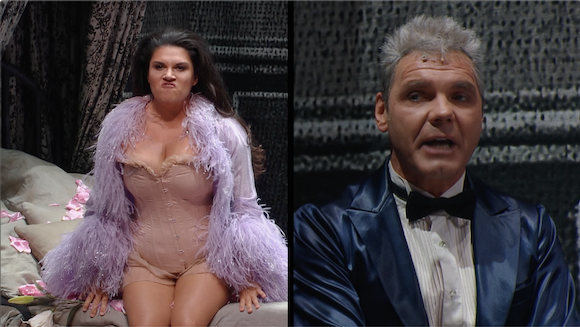
Searing Simon Boccanegra

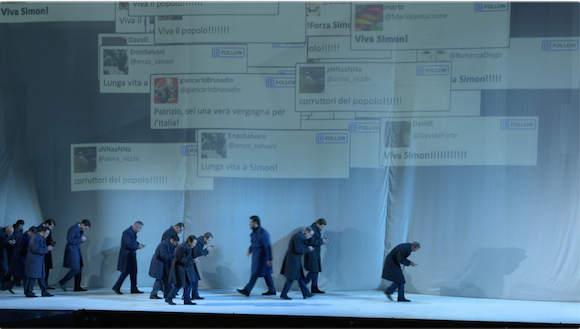
Sometimes a video recording just seems to have it all and I would put the 2019 Salzburg Festival version of Verdi’s Simon Boccanegra in that category.  It’s quite an interesting production but it’s the sheer quality of the music making that puts it in the very top bracket.  It’s also technically very good in all departments.

1.tweets

Continue reading

Orphée à Salzburg

The Salzburg Festival rarely does operetta but in 2019 they decided to commemorate the 200th anniversary of Offenbach’s birth with a new production of Orphée aux enfers by Barrie Kosky.  With Kosky and comedy one sort of knows what to expect but there’s always something very original.  Here, in order to get the (German) dialogue as crisp as possible he takes it away from the singers and gives it to a new character; John Styx, played by actor Max Hopp, who not only speaks all the dialogue in an amazingly wide range of voices but also produces all the sound effects.  The only other character who speaks is Anne Sofie von Otter as L’Opinion publique and even she is doubled by Hopp.  Not that the singers have nothing to do during the dialogues.  They pantomime their words, often in quite an exaggerated fashion and to great effect.

1.euridicestyx

Continue reading

The Anchoress

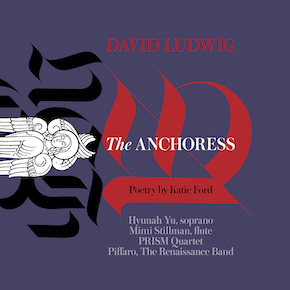
theanchoress_sThe Anchoress is a 2018 work for soprano and instrumental ensemble by David Ludwig setting texts by Katie Ford.  There are eight “scenes” each exploring an aspect of life of the medieval anchoress; a woman who voluntarily secluded herself in a cell attached to a church.  Such women were seen as almost saintly and thought to have great insight which was sought by all ranks of people.  Issues explored in Ford’s poems include faith, alienation, gender and social power as seen through the anchoress’ eyes.
Continue reading

Turandot as symbolism

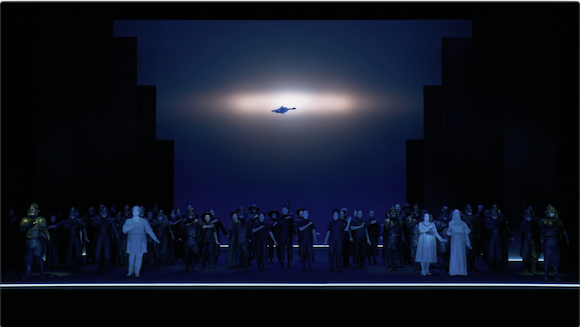
Robert Wilson’s take on Turandot is interesting.  It’s symbolic, even ritualistic and it’s perhaps best seen as a performance of a performance.  It’s certainly not in any way naturalistic.  Throughout the characters are “abstracted” by colour scheme in costume and make up and they move in highly stylized patterns.  This is especially apparent in Act 3 where when Liù dies nothing happens.  She just stands in a pose.  She and Timur then walk back and forth across the stage a few times before slowly processing into the wings.  It’s the same with the final scene with Calaf and Turandot.  They never even touch each other which makes Calaf’s rather lurid description of what he’s going to do to Turandot seem even rapier than usual.  The words and the music (the IMHO overblown Alfano completion) seem at odds but maybe make sense in a ritualistic way.  The approach does make for some very striking stage pictures though.

1.goose

Continue reading