The Killing Flower

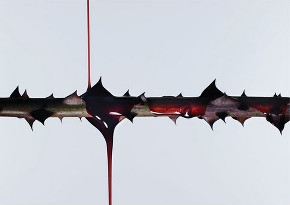
hqdefaultThe Killing Flower is an opera by Salvatore Sciarrino.  Both Italian and English versions exist and it was the latter that was given, in semistaged form, at Walter Hall as part of the Toronto New Music Festival last night.  It’s a very distinctive work and not easy to form a full appreciation of on a single hearing.  The plot is straightforward enough.  There’s a duke and duchess.  She falls in love with a guest.  They are betrayed by a servant.  He kills the guest and then her.  But all this happens in a highly abstracted way (made even more abstract by not being fully staged).  As the composer puts it:

My theatre is ‘post cinema’ theatre, beginning with the way the scenes are laid out – they proceed by dry blocks that ‘subtract’ in order to get the point across.

Got that?  Nor me but what I saw was a succession of scenes in which two characters exchanged fragments of text repeated multiple times.  This was actually quite useful as there were no surtitles and it made it easier to grasp what the (very few) words actually were.

Continue reading

Workshopping The Harvester again

stacie_3005bThis time last year I attended a workshop performance of a work in progress; Aaron Gervais’ The Harvester.  That time it was in piano score but semi staged.  Last night it was presented, at Gallery 345, in concert format but with chamber orchestra.  I’m not going to recap the plot etc because it’s all in last time’s review.  Let’s start by saying it’s coming along and I really look forward to seeing a fully staged version.

So, back to last night.  The concept is of a double bill of Schoenberg’s Erwartung in a chamber reduction followed by The Harvester so last night we started with half the Schoenberg (up to the discovery of her lover’s body).  The chamber reduction (by Aaron Gervais) for piano, three woodwinds, strings, horn and percussion works remarkably well.  The effect is similar (ironically) to Schoenberg’s chamber versions of Mahler’s songs.  Textures are clearer, if less lush, and the singer is less pushed for sheer volume which allows for a bit more subtlety.  It’s different but it works.  On this scale it’s a good fit for Stacie Dunlop; one of those singers who is an excellent musician and interpreter but is not a huge voice.

Continue reading

Traditional Pirates

Toronto Operetta Theatre opened a run of Gilbert and Sullivan’s The Pirates of Penzance at the Jane Mallett Theatre last night.  Bill Siva-Marin’s production is competent and very traditional with some strong performers in the key roles.  It won’t leave you with any new insights into the piece but it’s a well executed production which is lots of fun and very funny in places.  When I say traditional I mean pirates in pantomime pirate dress, maidens in some stereotypically Victorian maiden garb and a Major General in a cod colonial uniform.  Tnere are the traditional mild updatings to the libretto including a couple of rather well crafted verses in the MG’s patter song that reference the Glorious Leader of our neighbour to the south.  There are also a few nice touches.  In the second act the MG spends much of the time clutching a bust of one of his purchased ancestors and the “catlike tread” scene is noisily anything but.  That said, the choreography and blocking are pretty formulaic though there are some deft touches in the Personenregie.  Mabel’s body language in Oh! Is there not one maiden breast? is worth a look.

pirates

Continue reading

Messiah of clarity

Sometimes it takes some time away from home to be able to see things clearly again.  That’s rather how I felt about last night’s Messiah performed by Tafelmusik at Koerner Hall.  In the last few years I’ve seen choreographed and fully staged versions, the Andrew Davis version with sleigh bells and whoopee cushions and Soundstreams eclectic Electric Messiah, all of which helped bring a conventional small scale performance with period instruments into focus.

messiah16

Continue reading

Lineage

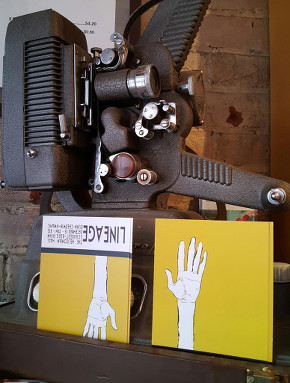
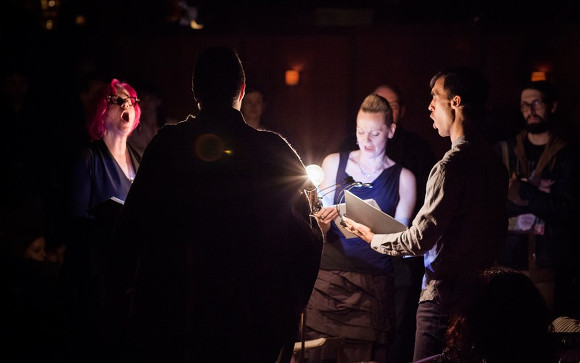
lineageLineage, performed last night at the Heliconian Club, is the latest show from Adanya Dunn, Brad Cherwin and Alice Hwang who brought us Evolving Symmetry in September.  Lineage featured German music from Schubert to Rihm so much more in my sweet spot than the French theme of the earlier show.  It was intriguingly constructed with three sets each of a pieces from Mendelssohn’s Lieder Ohne Worte and a Rihm song setting.  In between we got first Berg and then Webern, Schoenberg and Schubert.  It sounds bizarrely eclectic but the contrast between quite experimental pieces and more obviously accessible fare was very satisfying.  Also the sense that there is both a thematic unity and a tendency to experiment in a lot of German music regardless of period.
Continue reading

Second annual Electric Messiah

Soundstreams’ Electric Messiah, now billed as “annual”, opened last night at a packed Drake Underground.  It’s substantially reworked from last year’s show though structurally it’s similar in that the same arias are sung by the same singers in the same order with similar linking sections.  The differences though are notable.  The space is configured differently with more conventional seating which makes it feel more like a concert than a happening, though there’s still lots of movement and action happening in different parts of the space.  The electro-acoustic orchestra is gone; replaced by keyboards.  John Gzowski and his electric guitar are up on stage rather than tucked away in an alcove.  The linking choral sections have been remixed and the influence of Adam Scime on that is clear.  It’s still a very interesting show and well worth seeing but I enjoyed it rather less than last year.

electricmessiah_harvie_hr-8868-800x500

Continue reading

Comfort

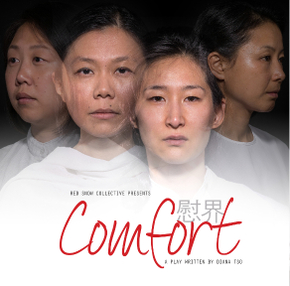
comfortOver 200,000 women from across Asia were conscripted into sexual slavery by the Japanese army in WW2.  They were euphemistically described as “comfort women”.  In 2009 playwright Diana Tso met some of the survivors, heard their stories and wrote a play based on their testimony.  The result was Comfort, currently playing at the Aki Studio in a production directed by William Yong with music by Constantin Caravassilis.

Continue reading

UoT Opera’s Orpheus in the Underworld

brittany-cann-headshot-150x150

Brittany Cann

French operetta is notoriously difficult to get right.  The genre treacherously combines a kind of humour that doesn’t always translate well in time or language, difficult music to sing and a need to be as “naughty” as the original seemed without being crass.  It’s a huge credit to Michael Patrick Albano and his student cast that they pretty much pulled off all of that last night with their new production of Offenbach’s Orpheus in the Underworld.  One could nit pick details (I shall) but overall it was a well paced show with some good singing and acting and it was genuinely funny.  Unsurprisingly the audience lapped it up.  Continue reading

Music of the Rainbow Nation

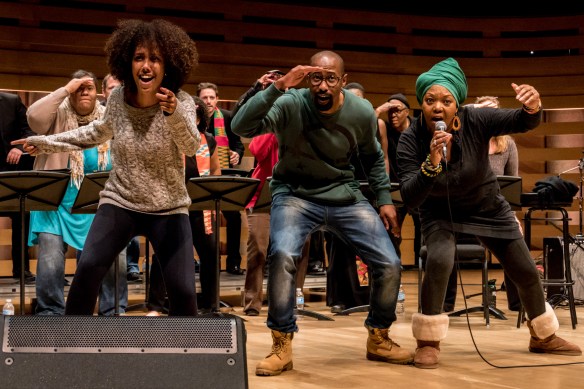
This year’s Soundstreams concert season was supposed to feature a performance by the Nelson Mandela University Choir.  The current student and other social unrest in South Africa led to that tour being cancelled and left Soundstreams with the problem of organising a replacement line up in just four and a half weeks.  I think they should be congratulated for sticking with the South African theme and producing the line up we saw last night subtitled A Tribute to Nelson Mandela’s Dream.

Soundstreams_MusicoftheRainbowNation-181.jpg

Continue reading

LooseTEA’s Carmen

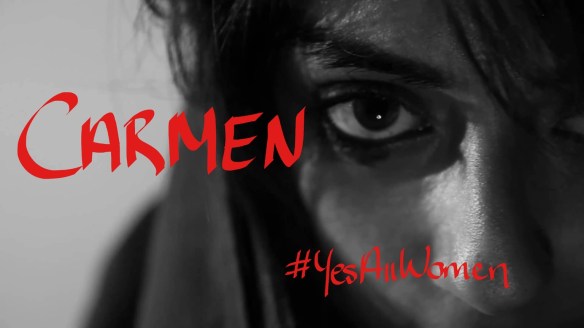
Last night LooseTEA Theatre presented a work-in-progress version of their reimagined Carmen.  Director and librettist Alaina Viau promised a “a radically envisioned” Carmen and she wasn’t kidding.  Apart from the fact that Ricardo (Escamilio) and John Anderson (Don José) are rivals for Carmen’s affections and there’s a woman, Michaela, with a prior attachment to John and, of course, that John kills Carmen there’s not a whole lot left of Mérimée’s story.  We are in Toronto.  John is a vet suffering from PTSD who has left his wife (Michaela) and kids.  Carmen manages a bar but is about to open her own place with the help of investment banker Ricardo.  She comes across as an everyday working girl rather than someone whose life is a serial process of picking up and discarding men.  Episodes that fit the big numbers of the score are quite cleverly crafted together to weave a narrative that works but rather relies on John’s PTSD to explain the two murders.  Woven into the opera are videos by Darren Bryant that contain some of the characters’ back stories.  Music is a mix of a conventional keyboard reduction played by Natasha Fransblow and live electronics from sound artist SlowPitchSound.  The use of electronics brings a grittiness that feels like an essential way of undermining the “prettiness” of the score.  Running around 55 minutes all told it feels a bit episodic and I hope (and expect) that the final version will seem more continuous.  Certainly there’s already more than just the basis for a very interesting piece of music theatre.

c2f553db989ba26456c5d57a9e578e05_original

Continue reading