Let the triumph of love and of beauty be shown

One of the trickiest things about opera productions; baroque opera anyway, is what to do about the dance elements. Time was when opera and ballet were joined at the hip but not so much nowadays beyond sharing premises. In 2009 the Royal Opera House made the bold decision to have choreographer Wayne McGregor direct the combined forces of the Royal Opera and the Royal Ballet in a production of Henry Purcell’s pocket masterpiece Dido and Aeneas. The result was broadcast by the BBC and subsequently released on DVD and Blu-Ray by Opus Arte. It’s a fascinating and rewarding production.

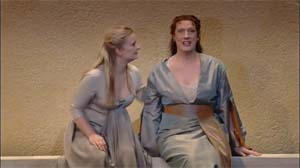
Sets and costumes are very spare. Aeneas and the chorus are in greatcoats and wide trousers. The ladies are in unfussy gowns. The dancers are in singlets and booty shorts (both sexes). Carefully detailed direction of the singers and their gestures, bold choreography and imaginative lighting carry the visual side of the production. The use of top quality dancers and a top notch choreographer allows the dance elements to realise their full potential (and not a castanet in sight!). The result is visually stunning.

Now add a superb singing cast. Lucy Crowe almost steals the show as Belinda. She’s fresh and vivacious and her clean sound is just right for Purcell. But it is “almost” because we have Sarah Connolly’s monumental Dido to set against it.(1) She is one of the great Didos. I have heard Kirkby, Te Kanawa, Ewing and Baker in the role and even Flagstad but none exceed the combination of searing intensity and pathos that Connolly brings to the role. She is superb. Other elements of the singing are also admirable. Lucas Meachem is a hunky Aeneas and manages the tricky low notes better than most. The sorceress and witches; Sara Fulgoni with Eri Nakamura and Pumeza Matshikiza playing Siamese twins, don’t do the camped up distorted thing that is so often inflicted on the role. Fulgoni sings with quite a lot of vibrato which is sufficient to create some musical distance between her and the non infernal characters. The minor roles are all pretty good too. The regular Covent Garden orchestra is replaced by the Orchestra of the Age of Enlightenment under Christopher Hogwood. This is a move that other large houses might think about for earlier repertoire.

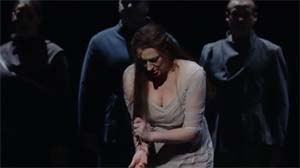
All this goodness builds to a searing climax in which Dido slits her wrists with the “tushes far exceeding those that Venus’ huntsman slew” and dies while a haunting projection of a horse plays back of stage. All in all it’s an hour of magic.

Video direction is much better than average. Close ups are minimised and we get to see the choreography in its broadest sense. The picture is superb 16:9 anamorphic (1080i on the Blu-Ray) and sound options are PCM stereo and DTS 5.1 (PCM 2.0 and PCM 5.1 on Blu-Ray). There are English, French, Spanish, German and Italian subtitle options.

Highly recommended.

(1) I do think the balance of voice types between Belinda and Dido is important. It’s like Carmen and Micaëla. If the voices are too similar much texture is lost. Crowe and Connolly are an ideal combination.

Kupfer’s Der Fliegende Holländer

I was really impressed when I first watched the DVD version of Wagner’s Der Fliegende Holländer recorded at Bayreuth in 1985.  It’s been some time since I last watched it so another look seemed in order.  The production, directed by Harry Kupfer debuted in 1978 to both applause and brickbats.  The concept is that the Dutchman exists only in Senta’s imagination.  She is fixated on the Dutchman as her route out of the repressed bourgeois environment she is trapped.  It’s a tormented, even hysterical, version of Senta that finds a fine interpreter in Lisbeth Baltslev.  Kupfer reinforces this idea of Senta by having her on stage all the time.  During the overture she retreats to a sort of cage at the top of a staircase with her precious picture of the Dutchman which she will hang onto throughout the drama.  She will remain in this cage high to one side of the stage watching the action below her throughout the first act.
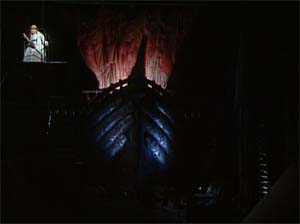
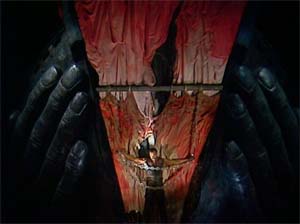
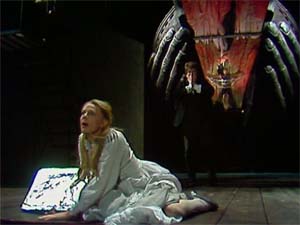
It’s a very strong first act musically and visually  The Dutchman’s ship makes a spectacular entrance and the finger like timbers of the bow open up to show the Dutchman chained in a crucifixion pose.  Simon Estes as the Dutchman is suitably elemental.  His singing and acting have a frightening intensity without ever becoming unmusical.  Matti Salminen’s Dahland is perfectly adequate and conveys the grasping bourgeois rather well.

Act 2, of course, opens in the Spinning Hall.  Anny Schlemm’s Mary exemplifies the dull conventionality of the place.  We are in the world of Strindberg or maybe Babette’s Feast.  The intensity of Balslev’s performance cuts right through this.  Johohoe! Truft ihr das Schiff im Meere an is as eerie as it is powerful.  Against this obsession the rather dull Erik of Robert Schunk is doomed from the start.  Things warm up with the arrival of Dahland and the Dutchman.  Salminen is in very good voice with Mögst du mein Kind, den fremden Mann willkommen heißen.  Senta is pinched looking or frightened almost throughout this scene.  There is great ambiguity while the Dutchman sings Wie aus der Ferne längst versangner Zeiten.  The Dutchman of Senta’s imagination sings from the gorgeous fantasy hold of his ship while the shadowy figure who arrived with Dahland is still on stage.  Senta is slow to buy into what is happening but she finally dissolves into a state that is more madness than delight.
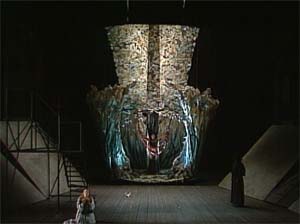
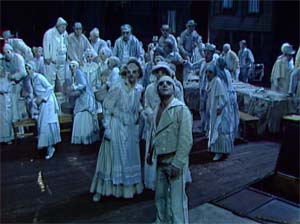
Act 3 opens with Senta watching her own wedding feast from the cage.  The townspeople and Dahland’s crew are almost as unnatural as the Dutchman’s.  It’s quite chilling and sinister all through until the Dutchman’s crew drive everyone off stage leaving Senta alone for her confrontation with Erik.  Then we get the big scene where the Dutchman, chained up again in the infernal version of his ship,  thinks that Senta has betrayed him and leaves her.

This is, obviously, crucial to the plot but it has never really made much sense to me in a normal interpretation.  Here it does.  This obsessed Senta needs to be “faithful unto death” not to have a happy ending.  It’s equally apt that her suicide is just that.  There is no hint of redemption for her or the Dutchman.  It’s the end.  The people turn their backs on her corpse leaving only Erik, in despair, still with her.

So dramatically it works as a piece held together by really intense performances by Balslev and Estes and, lest I forget, Woldemar Nelsson conducts and keeps things moving along briskly.  At times the orchestral playing is quite thrilling and the chorus is excellent too.

A couple of other things about the production are worth pointing out.  Although the booklet sets the scenes out in the conventional three acts it is actually played through (as I understand Wagner intended and as it was played at the COC a couple of years ago).  Scene changes are dynamic and slick.  There’s some real stage craft here.  It’s also very dark, as I recall most 1970s productions being.  This makes on stage detail hard to pick up and, I’m sure, affected the video direction.

This production was directed for video by Brian Large (surprise!) and it seems to have gone straight to video with no TV broadcast.  That said it looks like it was directed for the “small screen” which one might expect in 1985.  This is problematic given the crucial role of the spectating Senta, as most of the time she is out of shot.  Large tries to compensate for this with superpositions, fades and dissolves and is fairly successful.  All in all, I think he gives us as good a picture of what Kupfer put on stage as one could reasonably expect.

Picture quality is a bit soft grained as you might expect for the time and it’s 4:3.  Sound options are PCM stereo or DTS 5.1 which is a post process of the original stereo capture.  It’s very good indeed.  There are English, French, German, Spanish and Chinese subtitle options.  There’s nothing much in the way of bonus material but the booklet has a full track listing and an informative essay by Erich Rappl.

All in all I think this disc can be highly recommended. It’s a landmark production, well executed on stage and captured for DVD remarkably well for its era.

If you want a preview the whole thing is available in ten minute chunks on Youtube but the quality is a bit off putting.

Authentic? Opera Atelier’s Persée on DVD

I’ve been attending performances of Opera Atelier for over twenty years off and on but until viewing this recording of Lully’s Persée I’d never seen them on DVD. I was curious to see how the unique Opera Atelier style would come over on DVD and to what extent watching a recording, which I could compare fairly with other DVD performances, would affect my views of Opera Atelier’s strengths and weaknesses.

Continue reading

Another edition of the Armida and Rinaldo show

I really don’t know how many operas there are more or less based on Tasso’s story of the Christian knight Rinaldo and the Muslim sorceress Armida. Certainly there are versions by Rossini and Lully which I’ve seen. Then there’s Handel’s Rinaldo which I watched in David Alden’s production for the Bayerischer Staatsoper in 2001. Alden at least manages to avoid obvious Monty Python and the Holy Grail references which is more than either the Metropolitan Opera and Opera Atelier managed with the Rossini and the Lully. In fact Alden manages to avoid all the usual cliches of both Handel in general and this piece in particular though at the expense of giving us a version that is quite hard to interpret. The action is moved to maybe the 1950s to judge by the costumes and the Christians are decidedly wimpy and ostentatiously pious (except for the Rinaldo of David Daniels). Crucifixes, surplices and bibles crop up at odd times and in the final scene the Christian army is a line of Jesus statuettes of the kind one can pick up at Honest Ed’s or one’s friendly neighbourhood Catholic tat store. The Muslims are much earthier and in Act 1 Argante (Egilis Silins) seems to terrify the Christian trio of Goffredo (David Walker), Almirena (Deborah York)and Eustazio (Axel Köhler). Also Noëmi Nadelmann’s very sexy Armida is much earthier than Deborah York’s rather etiolated persona. Note that by casting Goffredo as a countertenor we end up with four countertenors which is more than I’ve seen on stage at one time for sure.

Whatever the overall concept, Alden does pretty much what Handel did with the original production; give us a succession of arresting visual images and effects and some very funny moments. There’s probably more flesh on display too than Handel could have got away with in 1711. There is, as the cliche would have it, never a dull moment with giant dolls dropping their pants, an army of aliens, severed limbs and a David Lynch like giant face. It all puts considerable demands on the athletic and acting abilities of the cast and here Nadelmann has the toughest time and does really, really well. Her physical acting and timing are excellent and she’s not at all hard on the eye which helps. Everybody else is pretty good too. David Daniels face, as he gets felt up by both the girls, is a picture.

Musically, the stand out is David Daniels. No surprise really. Here he sings stylishly throughout and delivers a really lovely “cara sposa, amante cara”. Nadelmann gets full marks for being accurate and musical even while acting her head off. She sings “Furie terribili!” with Argante’s head clasped between her thighs! At least for “Lascia ch’io pianga” York is stationary though in quite an awkward pose. I think she sounds a bit over challenged by some of the high passage work in act 1 but she seems to improve as things progress. As the one low voice on show Silins is a good contrast. I’ve heard more agile bass-baritones in Handel but his fairly bluff reading is appropriate to the way the part is portrayed here. Harry Bicket directs the Bavarian State Orchestra and plays continuo. No worries there.

Brian Large directed for the small screen and does his usual thing of giving us lots of close ups which is a shame as there is lots going on that we miss and it’s obvious that Alden and his designer, Paul Steinberg, have put a lot of thought into the overall composition of scenes which is mostly lost on the DVD. The DVD itself is pretty basic. It’s on the Kultur label in North America though it originated as a Euroarts release in Europe. Kultur have stuck the original two DVDs onto a single disc and while they have included the useful documentary essay Handel, the Entertainer it means the only sound option is Dolby 2.0 and the only subtitles are English. The picture (16:9 anamorphic) and sound quality is perfectly OK but not stunning. The only documentation is a chapter listing.

All in all well worth a look

Kinky boots and all

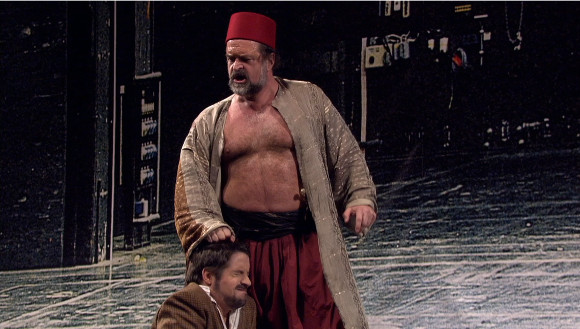
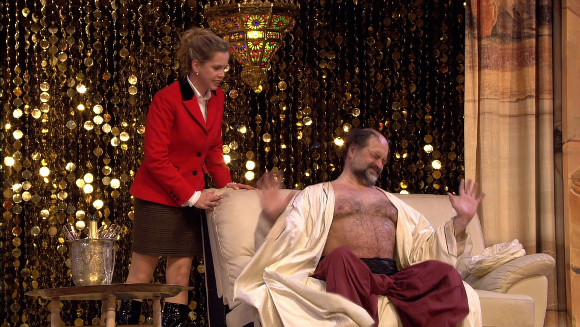
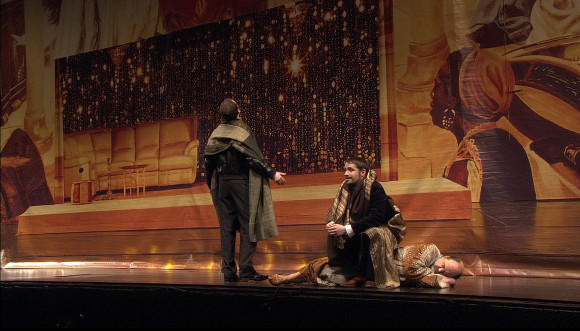
Die Entführung aus dem Serail is probably the major Mozart opera I know least well so I don’t have too many comparators for this performance from Amsterdam by De Nederlandse Opera from 2008. So I can’t say that this is better or worse than other available productions but I can say I enjoyed this one immensely.

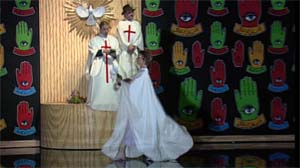
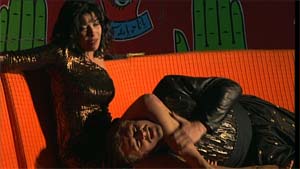
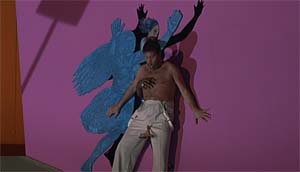
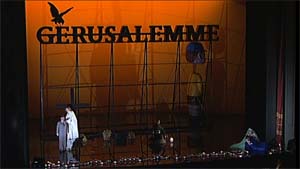
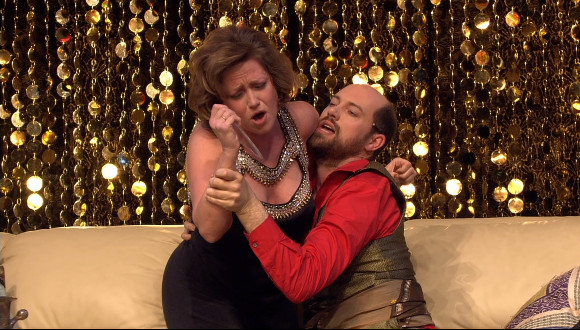
1.osminThe production, directed by Johan Simons, uses fairly uncluttered sets and costumes that switch between pantomime Aladdin and, most of the time, modern dress. The take on the characters is interesting. Osmin is pretty much the classic infatuated old Turk, played brilliantly by Kurt Rydl, but the infatuation is reflected by the distinctly dominatrix like Blonde played by the rather lovely Mojca Erdmann in kinky boots, a tight short skirt and a belt that she’s quite prepared to use on the men in her life. At least in the first two acts there’s plenty of ambiguity in Laura Aikin’s Konstanze. Is she actually at least a little bit in love with Bassa Selim, played very well by Martin van Westmeulen. Certainly she has him twisted around her little finger and in Martern aller Arten seems to be very much “topping from the bottom”. To round the cast out, Michael Smallwood is a cheeky chappy Pedrillo, very much under Blonde’s thumb and Edgaras Montvidas is a suitably sappy Belmonte. It’s mostly fast paced good fun but does strike a more serious note in the final scenes. Funny how that always seems to happen with Mozart “comedies”.

2.bootsMusically it’s pretty good too. Constantinos Carydis conducts a fast paced and nimble reading from the Netherlands Chamber Orchestra. The vocal star is clearly Laura Aikin who has the difficult coloratura parts of Konstanze’s music nailed. This is particularly praiseworthy as she does it while doing some pretty intense physical acting. It can’t be easy to nail Martern aller Arten with Bassa Selim firmly lodged in your cleavage. The men are perfectly adequate. I thought Michael Smallwood was particularly sweet toned. The one weakness, and I hate to say this, was Mojca Erdmann. Her upper register is a bit harsh and shrill. This is surprising as most reviews of Ms. Erdmann praise her beauty of tone. Maybe she was just pushing a little too hard in this performance. The ensemble work was generally first class.

3.maaThe recording is available from Opus Arte on DVD and Blu-Ray. I watched the latter using the Dolby TrueHD 5.0 soundtrack. The picture is 1080i HD 16:9. It looks and sounds great on my system and would doubtless look even better on a more modern TV. Definitely worth a look.

4.boys

How to do Purcell

A while ago I had the misfortune to watch a thoroughly misconceived version of Purcell’s King Arthur. I have now had a chance to watch a version from the 2004 Salzburg Festival and it’s a lot better! This production by Jürgen Flimm takes Purcell and Dryden’s work and treats it respectfully but not solemnly. As originally intended, it’s given as a series of scenes spoken by actors interspersed by songs which are sung by five singers who change role as needed. The dialogue is in German but the singing is in English which seems a bit odd at first to an English speaker but one soon gets used to it. Flimm uses Dryden’s text for the most part but interpolates some scenes, notably where Merlin, disguised as an investment banker’s wife, enters via the auditorium and delivers a diatribe about Regietheater and how Salzburg has gone all to Hell. It’s just like being at a typical COC Opera 101. It’s staged in the appropriately baroque Felsenreitschule and the set mirrored the arcades of the building with a brightly painted wooden arcade structure set behind the stage. The orchestra is in a sunken pit in the middle of the stage so the action takes place all around them. There is clearly some heavy duty projection equipment behind the set because the production uses a wide range of, often spectacular, lighting effects.

1.sacrifice


Continue reading

A blast from the past

One of the first opera DVDs I bought was John Eliot Gardiner’s Le Nozze di Figaro recorded at the Chatelet Theatre in Paris in 1993. This is a pretty early example of period performance of Mozart. Gardiner was in the middle of his run of recordings for DG Archiv and it was only two years after Opera Atelier’s breakthrough Magic Flute which I saw only because one of my clients was sponsoring it and couldn’t shift the free tickets. This Figaro is pretty traditional in design and features “original instruments” and period singing style without going the whole Opera Atelier style baroque route (there are no castanets). Sets are flats plus bits of furniture. Costumes are breeches, crinolines and wigs. Olivier Mille directed but I’m not sure anybody noticed. At one point the Count looks exactly like Prince George in Blackadder the Third. The buffo characters are over made up and over the top. Regie has no place here.

The cast is excellent. 28 year old Bryn Terfel plays Figaro and already sounds on the big side for a period performance of Mozart. Susanna is the sadly under-recorded Alison Hagley; an ideal Susanna both as singer and actor. Rodney Gilfry plays the Count with a perpetual sneer and other Gardiner regulars such as Hillevi Martinpelto, as the Contessa, are prominent. In the future star department we get Sarah Connolly as one of the contadine. Pacing is a bit breath taking. Terfel in particular takes his recitatives so fast it’s hard to tell if he is actually singing. Despite looking rather old fashioned and having a bit of a feel of period performance for the sake of it, the production does come off really well.

The production for DVD is a bit odd. The opera was filmed as 16:9 but it’s hard coded to disk as 4:3 so if you watch it on a widescreen TV it’s letterboxed both ways. The picture is adequate DVD quality. The only sound option is LPCM stereo and there are IT/EN/DE/FR/ES/CHI subtitle options. The documentation includes a long essay on how they decided to order some of the numbers differently from the autograph score. All in all, an interesting artefact as a very early DVD capturing a very decent performance.

This Youtube clip is of abysmal video quality but it does give a fair idea of the production.

Fidelio – Metropolitan Opera 2000

Apparently the 2000 production of Beethoven’s Fidelio at the Met was controversial. It’s very hard to see why. Although Jürgen Flimm has moved the setting to the mid 20th century and some unspecified country that looks vaguely Germanic the storyline is followed to the letter, bar a few changes to dialogue, and there is no risk at all of any dangerous ideas surfacing. It’s actually a very good example of what the Met does when it’s on form; assemble an all star cast, stick them in an inoffensive production and let the music do its thing. Here we have an enviable cast. Leonora/Fidelio is sung by Karita Matila who looks and sounds spectacular (although maybe the fact that she’s the only “male” among the principals with no facial hair should have triggered a little cluefulness). Vocally she is most assured and never seems under any strain at all. She acts well too. Ben Heppner, as Florestan, is also vocally solid and even quite lyrical in the big trio “Euch werde Lohn in besseren Welten”. The acting though is best passed over in discrete silence. René Pape is fascinating as Rocco, the gaoler. I’m used to seeing Pape playing magisterial roles like Boris Gudonov or Sarastro. Here, the big voice is coupled with almost bumbling acting as he plays a morally weak character. It’s most interesting. A young Matthew Polenzani, one of my favourite tenors, sings Jacquino and he sings quite beautifully. Marzellini is Jennifer Welch-Babidge who I had never heard before but was sufficiently impressed to go look her up. It seems she’s busy with four kids in Utah and doesn’t spend much time at all in opera houses these days. It’s rather a pity. Falk Struckmann’s Don Pizarro is appropriately villainish and musically solid like everyone else. James Levine conducts and right from the overture launches us into a very intense, muscular reading of the score backed up by a very high standard orchestra. Musically and dramatically this is very satisfying albeit in a thoroughly conservative way.

The production was recorded for TV broadcast and it shows. The sets are already pretty claustrophobic but Brian Large’s video direction amplifies that. One gets the feeling that this is being directed for a 27 inch screen and it looks a bit lost on anything much larger. That said, the picture is more than decent and the DTS 5.1 soundtrack is top notch (Dolby 5.1 and LPCM stereo are also offered). The English subtitles are a bit odd. For some reason “Gouverneur” is translated as “Colonel” and “König” as “President”. I didn’t check the French, German, Spanish or Chinese subs for similar oddness. Bonus material is minimal but the documentation is fairly decent. All in all it’s a typical Deutsche Grammophon release of its period.

This excerpt from Act 1 (Gut, Söhnchen, gut) is pretty typical.

Umbrellas and underpants

I’m not a huge fan of French baroque opera but I am a huge fan of Robert Carsen which is why I had a look at the DVD recording of his 2003 Paris Garnier production of Rameau’s Les Boréades. I’m still not a huge fan of French baroque but Carsen certainly makes the most of the work on offer.

1.leaves Continue reading

Arma virumque canunt

Berlioz’ Les Troyens is widely considered to be his masterpiece and it does have a lot going for it both dramatically and musically, especially when given the full on star studded treatment that it got at the Chatelet in 2003. That said, it’s dramatically rather odd, it’s very long (well over four hours) and it requires huge forces; twenty soloists, massive chorus, dancers, supers, acrobats, jugglers etc. It also has preludes, ballets and masques on a scale that seem more appropriate to the 17th than the mid 19th century. Act 4 is particularly marked in this respect. It’s perhaps no wonder that it was never played complete in Berlioz’ lifetime. The story is taken from Books two and four of Virgil’s Aeneid; the first dealing with the wooden horse and the fall of Troy (Acts 1 and 2) and the second with the Trojans at Carthage (Acts 3-5). The problem is that there isn’t much connecting them. In the first part the drama centres around Cassandre. By the end of Act 2 she’s dead and we move on to Carthage where Didon makes her first appearance. The Trojan hero Énée links both halves but he’s a pretty minor presence in the first bit.

In Acts 1 and 2 Troy is a sparse stage with a reflector above it projecting much of the action onto a backdrop of an Italianate cityscape of Troy. It’s a good idea as for most of the act there are a lot of people on stage and it’s not easy to take it all in. Occasionally the cityscape dissolves into some kind of symbolic back projection as with the the horse itself which is just a rather grim projection of a horse’s head. It works pretty well. A similar approach is used to introduce the scene where Hector’s ghost tells Énée he’s got to rebuild Troy in Italy. The camera work for the DVD switches between stage and backdrop with the usual close ups and just occasionally pulls back to let us see what the theatre audience is seeing. All in all I think Peter Maniura is giving us as good a look at Yannis Kokkos’ staging as could reasonably be done on DVD.

Vocally, the first part is all about Cassandre, here played by Anna Caterina Antonacci. She’s stunning. She gives a totally committed performance as the prophetess who everyone thinks is mad until it’s all too late. She stands out visually in a simple white dress against the rest of the Trojans who wear greatcoats of mixed military provenance and otherwise look generally scruffy giving an effect somewhere between Colditz and Les Miz. Her singing and acting are both quite mesmerizing. She is well backed up Gregory Kunde’s Énée although he doesn’t have too much to do. He manages to sound like a bel canto singer while upping the heft to cope with some pretty dense orchestration.

Here’s a clip of Antonacci which gives a pretty good idea of the overall idea.

Act 3 involves a total shift of dramatic and aesthetic gear. Now we are in Carthage where Didon (Susan Graham) is presenting the results of the first Five year Plan to what looks like a cross between a Druidic gorsedd and a meeting of the Carthage Soviet of Workers and Peasants. The plan has met its targets but their idyllic existence is threatened by the king of Numidia who wants to marry Didon and is marching on Carthage. Énée appears and offers to save the peace loving Carthaginians (nb these are not the baby burning, general crucifying Carthaginians I remember from history) by doing the fighting for them. This is followed by a longish section where Didon’s sister Anna (the very fetching Renata Pokupić) tries to persuade her that hooking up with Énée would be a smart move. This continues into Act 4 which rather drags. There’s a long, almost Wagnerian, prelude after which Didon enters, obviously head over heels in love. We can tell this from her little interpretative dance and her spending the next half hour looking like a contented hamster watching several ballets complete with jugglers and acrobats.. The entertainmet concludes with singing, dancing Nubians who could have come straight out of National Geographic c. 1950. Finally we get going again and Didon decides that maybe the Énée thing isn’t such a bad idea after all. She and Énée sing the gorgeous duet “Nuit d’ivresse”. Kunde and Graham are very fine indeed in this as you can see below. Both these acts are played out on a brightly lit stage with lots of bright whites and colours.

The act concludes on an ominous note as Mercure reminds Énée of his Italian destiny.

In Act 5 we are back dramatically and aesthetically more or less where we started. It’s dark, Trojans in greatcoats, the reflector. The ghosts of the dead Trojans remind Aeneas of his quest. He decides to obey. Most of the rest of the act is Susan Graham going through a full gamut of emotions; anger, grief, vengeance, resignation. It gets a bit over the top but she is elemental and always musical. Graham steals the show in the final three acts but she is very well supported by Pokupić’s Anna and Laurent Naouri’s Narbal as well as Kunde. Cassandra (or her ghost) get the last word but nobody is going to believe her.

John Eliot Gardiner conducts the Orchestre Révolutionnaire et Romantique. He pushes things along well without sacrificing grandeur at the needed points. The period instruments give some pleasing variation of tone colour. The chorus is the ever excellent Monteverdi Choir. No problems in those departments.

Peter Maniura’s screen direction maintains its high standard through the second half. So what of the disk package? It’s an Opus-Arte production and it was filmed in high definition. The 16:9 anamorphic picture is superb even on DVD (which is what I watched) but it is also available on Blu-Ray which should be even better, especially as the Blu-Ray is cheaper and two discs versus three DVDs. Sound is LPCM stereo or DTS 5.1 (DTS HD on the Blu-Ray). The DTS track is really good with real depth. There is even adequate documentation and an hour long “Making of” documentary. All in all, it’s what an opera DVD/Blu-Ray release ought to be.