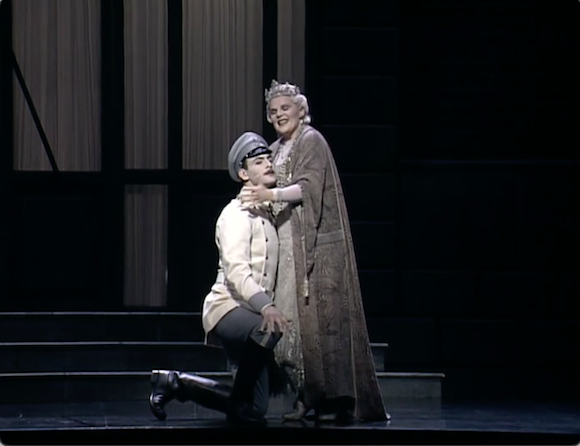
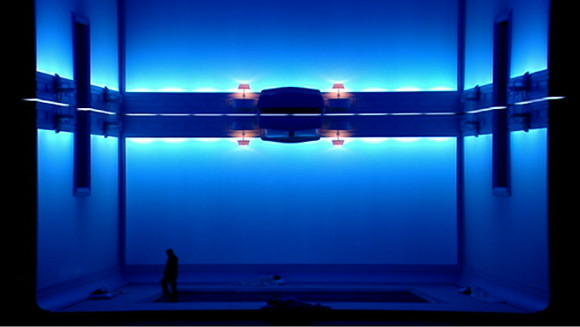
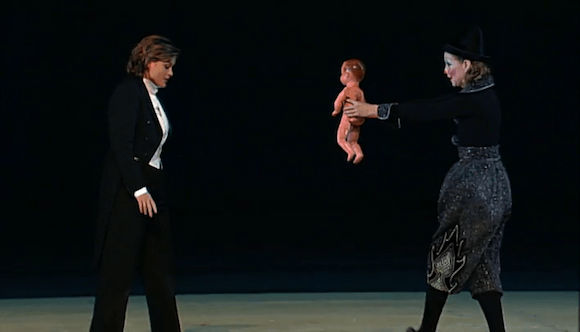
So, continuing my Robert Carsen binge in an especially appropriate manner considering last night’s Iphigénie shindig, I bring you the DVD of Carsen’s 2004 Paris production of Richard Strauss’ Capriccio. This may be even more incoherent than usual as I am reeling a bit, in a good way, from this production.
Category Archives: DVD review
Handel for the Handelians
I think maybe Handel’s Rodelinda is one for the hard-core Handelians. It’s got some lovely music but it’s long (200 minutes), not very dramatic (it’s based on Corneille) and, structurally, is a succession of recitative and da capo arias. There is no chorus and I only recall two numbers that weren’t solos; the concluding quintet and a rather lovely duo between Rodelinda and Bertarido at the end of Act 2. Jean-Marie Villégier’s 1998 production for Glyndebourne rather tends to emphasise the leaning to elegance rather than drama. The basic look and feel is “silent movie era”. Sets and costumes are near monochrome and that tends to be emphasised by the lighting. At least when there is a any. Much of this production is very dark, as was fashionable at the time.

More Carsen genius
I’m a big fan of Robert Carsen. His Orfeo ed Euridice was one of the highlights of last year’s COC season and his Iphigénie en Tauride promises to be one of the events of the upcoming season. So, as you can imagine, I had high expectations for the DVD of his 2002 Paris production of Dvořák’s Rusalka with Renée Fleming in the title role. I wasn’t disappointed. The production is pure magic. It’s almost a mathematician’s production. In Act 1 he gives us symmetry in the horizontal plane. There’s a bedroom reflected horizontally floating above the water sprites’ abode which resolves itself into the bedroom that is the setting for Rusalka’s initial encounter with the prince. In Act 2 we get the same bedroom but in a left right symmetry and the movements of the characters are also mirrored with non singing actors mirroring the singers. The symmetry continues with Rusalka balanced against the foreign princess. It’s very cool. I’m guessing that Carsen is suggesting the distance between the world of the sprites and the human world diminishing then opening up again. In Act 3 we get geometrical chaos as Ježibaba’s hut is presented at crazy angles poised above the stage and all sorts of dissolution goes on before we again get the symmetrical bedroom in which the final tragedy plays out. The general concept is supported by a superb lighting plot (Carsen and Peter van Praet) that brilliantly brings out the moods of the different scenes. And there’s no clutter. Scene follows scene pretty much seamlessly. It’s terrific stagecraft.
Stylish gender bending
I guess Serse gets performed as often as any Handel opera but there only appears to be one DVD version in the original Italian available. It’s a 2000 production from the Dresdner Musikfestspiele. Michael Hampe directs a cast of, then, fairly young singers, few of them familiar to me. Christophe Rousset conducts Les Talens Lyriques and the Ludwigshafener Theaterchor. It’s a really good DVD. The costumes and sets, by Carlo Tommasi, are a sort of mid 19th century European with “exotic” touches. There’s a consistent palette of black, white, grey and silver with a little deep blue and cream intruding. It’s all very elegant. The direction is more than competent. The relationships between characters are explored and Sandrine Piau, as Atalanta gets to exploit her considerable comic talents. To cap it all off we get a few, very apt, pyrotechnic surprises right at the end.
The singing is uniformly excellent. Paula Rasmussen, a mezzo, is cast in the castrato title role. It’s a role where personally I’d prefer a David Daniels or a Lawrence Zazzo but she manages to look and sound masculine enough. The same is true for Ann Hallenberg as “his” brother Arsamene; a genuine mezzo role. Patricia Bardon sings Amastre, Serse’s discarded lover who spends 9/10 of the opera disguised as a man. Ms Bardon manages the difficult feat of acting a woman pretending to be a man convincingly which is obviously quite different from a woman acting a man. I won’t try and describe the singing performances individually because I would just end up using “stylish” way too much. These are all thoroughly idiomatic Handel performances with tasteful decoration, lovely legato and accurate coloratura. The two sisters Romilda and Atalanta are played by sopranos Isobel Bayrakdarian and Sandrine Piau. It was a real pleasure to be reminded of what a fine Handelian Bayrakdarian was right at the start of her career. Her singing is just gorgeous. Piau is great too. She has great comic timing in a role that really needs it and she also gets the most coloratura fireworks which she handles very well indeed. The guys who play guys are Marcello Lippi as girls’ father, Ariodate, and Matteo Peirone as the servant, Elviro. These are both essentially buffo roles and both men are well up to them. I don’t think I’ve heard M.Rousset and his Les Talens Lyriques before but they are as good a Baroque band as I have come across. The chorus doesn’t have much to do but it does fine with what it does have. All in all, it’s very satisfying musically and dramatically.
Direction for TV/DVD is by Philip Behrens and it’s OK. There aren’t too many intrusive close ups though it’s a 4:3 picture so some of that is a bit inevitable. Picture quality is pretty typical of TV to VD productions. Sound options are PCM stereo or Dolby 5.1. The surround version sounded very good. There are no extras on the disk and the documentation is pretty basic. It’s a Euroarts production.
There’s a ten minute trailer up on Youtube that gives a really pretty good idea of what to expect though it’s a bit short on comedy and there’s no Sandrine Piau. Here it is.
And here’s some Sandrine Piau.
An English Ring?
Merlin is an early 20th century collaboration between the English banker Francis Burdett Money-Coutts and his Spanish composer/protege, Isaac Albéniz. It’s an interesting work falling some way short of being a masterpiece but, when given as fine a production and performance as it gets in this Madrid DVD, definitely of interest and worth a look.
Munich Orphée hits 11 on the WTFometer
Back in July I reviewed John Eliot Gardiner’s Paris recording of Gluck’s Orphée et Eurydice which I found musically fine, in good taste (too much so) and ultimately unengaging. Lydia pointed me to a Bayerischen Staatsoper version with Vesselina Kasarova in the title role. It’s the 1859 Berlioz version with a ballet tacked on at the end, more of which below. Musically it’s very good. Chorus and Orchestra under Ivor Bolton are excellent, Kasarova sings and acts very competently and manages an amazing cadenza in her big first act aria. Rosemary Joshua as Eurydice is perfectly adequate if a bit anonymous and Deborah York is an androgynous looking and sounding Amour which works fine for this production.

An everyday story of country folk
If Thomas Hardy had written an opera libretto he might well have come up with something like Janáček’s Jenůfa. It’s a simple rural love story with domestic violence, betrayal, desertion, bastardy and infanticide thrown in. It also has an absolutely gorgeous score mixing folkloric elements, incredible lyricism and some pulsating rhythmic sections. The opera was substantially modified after it’s 1904 Brno premier but in 1989 Glyndebourne put on the original Brno version in a production by Nikolaus Lehnhoff. It’s a three acter and opens with with scenes around a mill owned by Jenůfa’s fiancé, Števa. It’s all a bit cramped and old fashioned looking; probably a function of the small stage in the pre-reno Glyndebourne. Acts 2 and 3 take place inside Jenůfa’s foster-mother’s (Kostelnička) house and here the small stage makes the fairly simple room appropriately claustrophobic. What makes this performance worth seeing though is not the staging but the performances by the three principals; Anja Silja as Kostelnička, Roberta Alexander as Jenůfa and Philip Langridge as Jenůfa’s other suitor, Laca. They are backed up by a superb performance by Andrew Davis and the London Philharmonic. Davis just has an uncanny ability to wring every drop of lyricism out of score without sacrificing drama or forward momentum and he does it here every bit as well as he did in Ariadne at the COC back in May. Other reviews of this DVD that I have read have focussed heavily on Silja’s Kostelnička. I can see why. She is not far short of a force of nature and she drives the drama, especially in the horrific second act and the final scene. I think though that Alexander’s Jenůfa is just as important. She contributes the lyricism in the singing. It’s not that she lacks drama, she doesn’t, but she has a sweet toned voice that carries that element of the music through all three acts. Langridge’s Laca impressed me too. In Act 1 I wasn’t at all sure. He seemed miscast with the role not offering much for his stylish lyrical tenor but he grew on me during the more domestic bits of Acts 2 and 3.

Surrounded by these ghouls; the living and the dead
Britten’s Owen Wingrave is one of very few operas written for television. It’s also the second opera Britten wrote based on a Henry James ghost story. Owen Wingrave comes from a family of soldiers and their portraits and their ghosts dominate the family mansion. Owen is an officer cadet and a brilliant student who, for reasons of conscience, decides to abandon the family line of work. The family, his fiancée, his ancestors and the house are not at all keen on the idea. There is no happy ending.
The version I watched is a 2001 production directed by Margaret Williams for Channel Four. The story has been updated to the 1950s which works fine. Filming is extremely atmospheric mixing location shots with archive footage of troops parading in London. Clever use is made of fades into black and white and a certain ambiguity surrounds the ghost figures. Musically and dramatically it is very strong throughout. The ever reliable Gerald Finley sings the title role brilliantly. He often seems at his best in modern music and this is no exception. He is both powerful and sensitive while always remaining thoroughly musical. The other stand out is Peter Savidge as the military academic Coyle; the one character who makes a real effort to understand Owen. His is a really sensitive, nuanced and finely sung performance. I also enjoyed the rather fetching Swedish mezzo Charlotte Hellekant as Kate, Owen’s girlfriend. The only singer I have reservations about is Josephine Bairstow as Miss Wingrave, Owen’s aunt. She seems a bit shrill to me but maybe that’s intentional. It’s certainly one with the role. All of the singers articulate clearly, sound idiomatic in English and are well recorded. This is more than usually important as there are no subtitles on the disc. Kent Nagano directs the Deutsches Symphonie-Orchester Berlin in a neat, tight reading of the score which is twelve tone influenced with a lot of tuned percussion. There seem, appropriately enough, to be a few references back to the War Requiem buried in there. The choral contribution, which is pretty small, is from the choristers of Westminster Cathedral Choir. All in all this is a very fine realisation of a work I’m glad I have now seen as, up until today, it was one of only a couple of Britten operas that I had neither seen nor heard.
Technically it’s a pretty limited affair. The picture is 16:9 anamorphic and the only sound option is Dolby stereo. As mentioned before there are no subtitles. The disc does include an hour long documentary about Britten called The Hidden Heart. It’s a bit vague and waffly but it does include some interesting archive footage. The disc is available from Kultur in North America and Arthaus in Europe.
Here’s the preview:
Second thoughts (2013) here.
The Most Ghastlie Murther of Mr. Henry Purcell
Purcell’s semi-operas are notoriously difficult to recreate for the stage though it can be done, and brilliantly, as the recent The Fairy Queen at Glyndebourne showed. M. Hervé Niquet and his collaborators (co-perpetrators might be a better term) in Montpellier take the Purcell/Dryden piece King Arthur and provide an object lesson in how not to do it. Starting with a campy explanation of how he couldn’t inflict five hours of John Dryden on us, M. Niquet inflicts upon us a travesty each five minutes of which seem to last longer than five hours of Dryden, or even Racine. The objective, we are told, was to create a narrative to link the Purcell numbers and create something coherent. Except the “plot” (more or less non-existent) which M. Niquet has cooked up with the help of a hitherto unknown to me french comedy duo, Shirley and Dino, doesn’t actually do that. It’s not helped by the fact that no differentiation is made between British and Saxon characters but that’s really minor compared with the overall lameness of it. Most of the linking action is camped up. It’s supposed to be Pythonesque apparently but this lot of Frenchmen are about as convincing as Pythons as the Pythons are as Frenchmen. All the action, except Purcell’s songs, is in French which also seems odd. The Purcell is sung in English, though with the exception of the solid and idiomatic bass, Joao Fernandez, it’s not always obvious. The other singers really aren’t adequate in any department; shrill, forced and unidiomatic to a man/woman, though being forced to camp it up all the time doesn’t help. I couldn’t watch it all. I got half way through Act 2 then fast forwarded to Act 5. I wish I hadn’t. The suffering that is inflicted on that gorgeous song “Fairest Isle, all isles excelling” is just the final straw.
Searching desperately for positives besides Joao Fernandez I would say that the band, Le Concert Spirituel, is very good indeed. Everything else is almost enough to make one forget how good the music Purcell wrote for King Arthur actually is.
Watch if you dare…
The Turn of the Screw
The usual way to do an opera DVD is to film a live stage performance. I guess because this is also the cheapest way. Various alternative ways of committing opera to film have been tried; some using the singers as actors and some using more photogenic actors with the singing dubbed over. In 2004 BBC Wales made a version of Britten’s The Turn of the Screw using the singers as actors. It makes for an interesting film. For example it allows for an appropriately aged girl to play Flora where in the opera house the role has to given to a young adult soprano. It also allows for the interior monologues, which feature a lot in this piece, to be sung with the actor not moving his/her lips. It also allows for some notable location shots by the lake and in the churchyard (Highgate Cemetery was used). Director, Katie Mitchell, makes good use of the options available to her to play with the elements of perception vs reality which are quite hard to communicate on stage.
The singing and playing are excellent and thoroughly idiomatic throughout. Mark Padmore (Prologue/Quint) sounds as if Peter Pears has come to haunt the production. Lisa Milne is thoroughly competent as the troubled governess and the ever dependable Diana Montague is an excellent foil as Mrs. Grose, the housekeeper. Catrin Wyn Davis is a very good Miss Jessel; scary as Hell but just not quite completely demented. The children are excellent. Nicholas Kirby Johnson as Miles and Caroline Wise as Flora look and sound like children. Better, they inhabit the roles of upper class Edwardian children almost uncannily. The tricky score (the vocal scenes are each preceded by a variation on a twelve tone theme) is played really well by the London Sinfonietta under Richard Hickox. All in all this is a really good presentation of one of Britten’s most interesting but problematic works.
The DVD is released by Opus Arte and it’s pretty much up to the standard of their recent offerings. The 16:9 picture is average to good DVD quality. Sound options are LPCM stereo or Dolby 5.1. A range of subtitles are included. English speakers won’t need the subtitles as the diction and articulation throughout are exemplary and the voices are never overwhelmed by the band, and nor should they be when a work is scored for thirteen musicians.
The Opus Arte trailer gives a pretty good idea of what to expect.