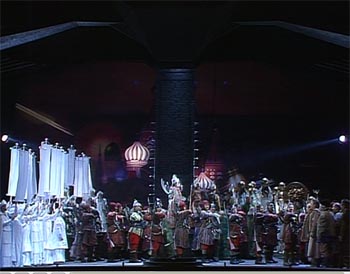
Ariadne auf Dresden

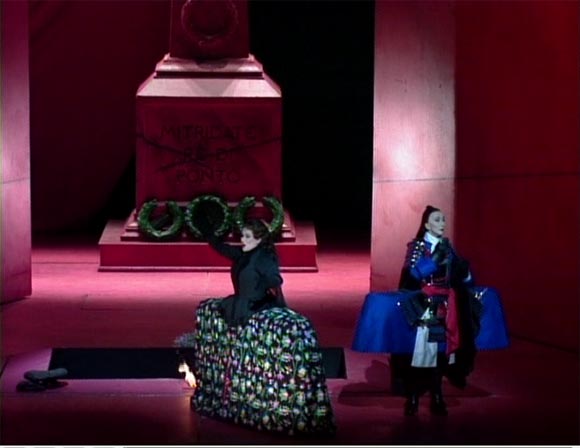
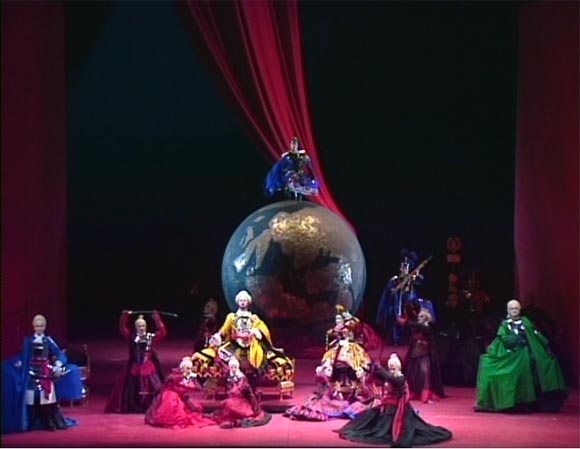
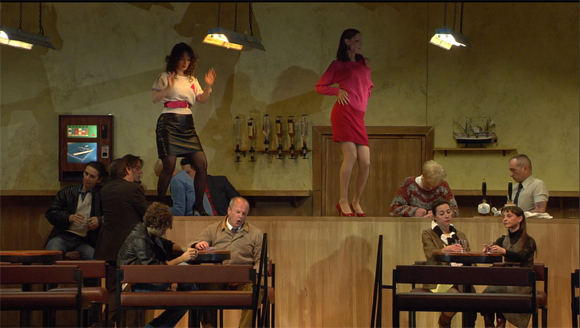
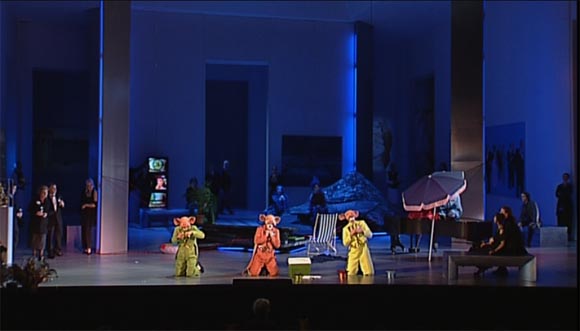
Marco Arturo Marelli’s 2000 production of Richard Strauss’ Ariadne auf Naxos is fascinating and compelling. He sets the work in the present at a very posh, arty party. Throughout there are extras playing party guests all over the place. The “opera” itself takes place in the middle of the main salon where the party is taking place. There are many interesting touches. For example, the Komponist features extensively in Act 2. Obviously smitten with Zerbinetta, he appears to accompany her on piano at the beginning of Groß mächtige Prinzessin and frequently watches from the side of the room as she is drooled over by various male party guests. Only at the end does the staging shift from the party to something that suggests some sort of reality in the relationship between Bacchus and Ariadne before dropping us right back into the party where the guests have completely ignored this piece of transcendence to go and watch the fireworks in the garden. The directorial take on Zerbinetta is interesting too. No flighty airhead here but rather a somewhat cynical and worldly young woman. It works rather well.
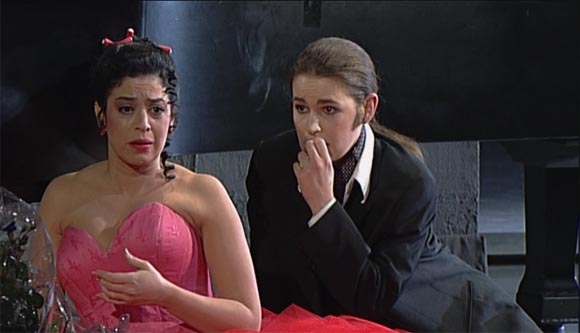
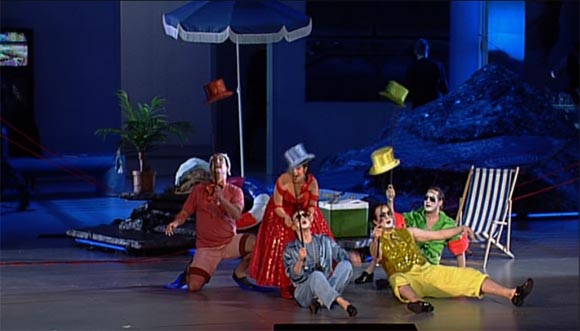
The performances are a bit mixed. The Act 1/Prologue is uniformly strong. Sophie Koch is an excellent Komponist. She sings well and acts very well indeed. Her, non singing, portrayal of the character in the second act as a gauche and geeky young man socially and emotionally out of his depth is really quite funny and touching. Friedrich-Wilhelm Junge is excellent as the Major-Domo. He has just the right touch of disdain. Moving on to the main action it’s a bit of a mixed bag. Iride Martinez’ Zerbinetta is a tour de force. She is completely consistent in her portrayal of the character to the extent of, at times, somewhat suppressing the beauty of the music in favour of dramatic verisimilitude. That’s not to say she sings badly. She sings very well but to a particular purpose. Susan Anthony’s Ariadne didn’t really convince me as much. She’s OK but “OK” isn’t a description I want to use about someone singing Es gibt ein Reich. It should make the hair stand up on the back of one’s neck and Anthony’s doesn’t. To be fair she’s not helped by the recording (see below). Jon Villars’ Bacchus is pretty good and the supporting nymphs and players are more than adequate. The players in particular have a lot of business and they handle it with considerable comic flair. Surprisingly, Sir Colin Davis’ reading of the score seems a bit bland. He doesn’t point the rhythms nearly as incisively as Levine on the Met recording or, even better, as Andrew Davies did in Toronto last year. The orchestra sounds a bit undercooked too. The recording may be a significant part of the problem here too.
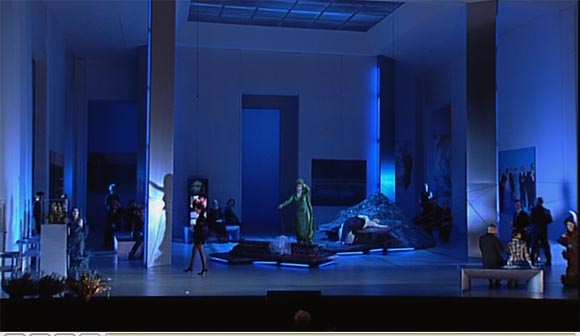
Technically this isn’t too, too bad for a budget Kultur effort. The video direction by Felix Breisach is very good. He shows us the whole stage often enough to appreciate the complexity of the director’s concept and its execution and his close ups aren’t excessively close. It’s a good balance. It’s a pity he’s not better served by the picture quality. It’s fairly good 16:9 (not 4:3 as the box and most on-line references suggest). It works pretty well on close ups but the lack of definition is a bit annoying on the longer shots.  This production would definitely have benefitted from being shot in HD. The sound is Dolby 2.0 and it’s at best OK. There’s no real sense of space and it’s a bit dry. It certainly doesn’t do Susan Anthony or the orchestra any favours. Subtitles are English only and documentation is limited to a track listing.
There aren’t a lot of versions of Ariadne on DVD. There’s a recent Guth production with Emily Magee, which is said to be quite good, an ancient film with Karl Böhm and a 1988 Met version. The Met version is musically far superior to the Dresden offering but features a deadly dull production that looks like it was first given half a century before Ariadne was written. Given that, I think this Dresden version is well worth a look.
Hunger and starvation is increasing everyday

The Royal Opera House’s 2008 production of Humperdinck’s Hänsel und Gretel makes no concessions to the idea that this is a sort of operatic Nutcracker to be staged for the kiddies at Christmas. Patrice Caurier and Moshe Leiser’s production is firmly in the grim, and Grimm, tradition of central European folk tales and it’s sung in German.

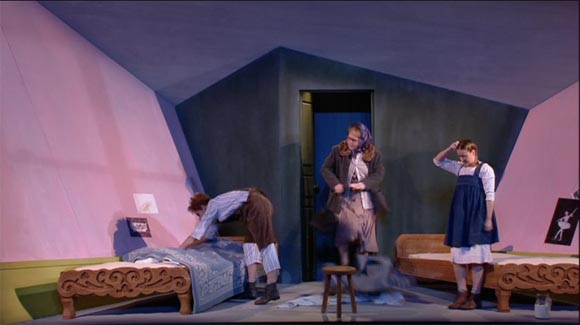
For Act 1, designer Christian Fernouillet has created a claustrophobic bedroom with surfaces at odd angles in which the children (Angelika Kirschlager and Diana Damrau) play out their hunger displacement games until their angry mother (Elizabeth Connell) sends them off to forest to gather berries. The father (Thomas Allen) returns with food and this relief from hunger is played out in a scene heavy with sexual innuendo between mother and father. It’s quite creepy. Finally they realise that the children are missing and set off in search.

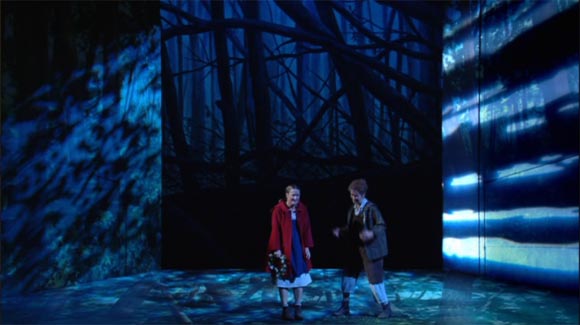
Act 2 starts in a classic fairy tale forest which rapidly darkens into a place of real menace. The sandman (Pumeza Matshikiza) is a strange distorted creature who puts the children to sleep. In the dream sequence the fourteen guardian angels, with animal heads, carry in a bunch of furniture, including a fireplace, to create a fireside scene of bourgeois domesticity. Two of the animal angels reveal themselves as the mother and father and give the children gifts. Inside each elaborate package is a single sandwich which is devoured with rapt concentration.

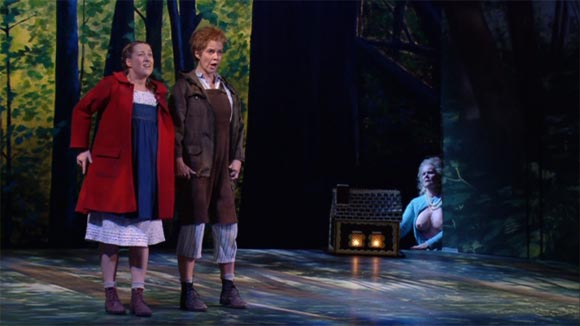
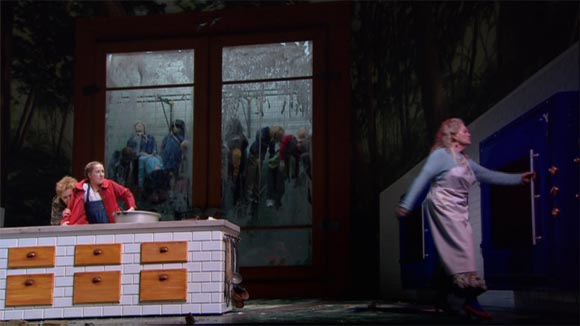
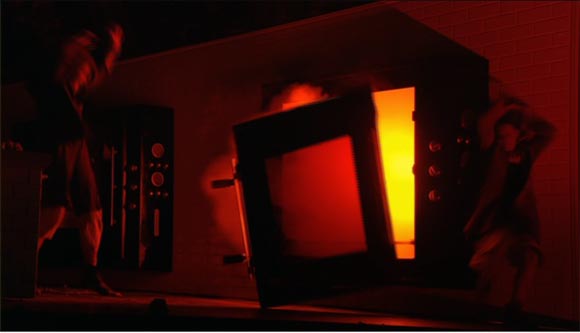
Act 3 opens with the Dew Fairy, here a pink confection played by Anita Watson, waking the children. The witch (Anja Silja), a vicious looking old woman with comedy breasts and a Zimmer frame, leaves a miniature gingerbread house for the children to explore. This transforms to the full size version with dead children hanging in a glass fronted cupboard and industrial scale ovens for the witch’s child based confectionery experiments. There is no concession whatever to comedy. The witch is scary as all hell and the scene in which she is shoved in the oven involves some serious pyrotechnics. The conventional happy ending descends into an orgy of face stuffing as the revived children fall on the cake/corpse of the witch. The production is consistent in its essential seriousness and is supported by fine acting across the board. In line with the concept nobody camps up their part. It’s all in earnest.

Musically it’s a really strong performance. Both Kirschlager and Damrau are quite excellent and work really well together. Kirschlager has quite a rich tone which blends nicely with Damrau’s cleaner sound. Thomas Allen is also really good. He’s quite chilling in the Hexenritt for example. Anja Silja’s Witch is a tour de force. She is every inch the witch/hag of nightmares without descending into cheap vocal trickery. Matshikiza sings very sweetly. Connell and Watson are quite good too but didn’t really register strongly with me. Colin Davis gets a suitably Wagnerian sound out of the orchestra and seems to balance drama and beauty very nicely. He’s well supported by the ROH orchestra, especially the brass and woodwinds, and the Tiffin Boys’ Choir and Children’s Chorus. The sheer beauty of the piece really comes out in the finale with Erlöst, befreit, für alle Zeit which manages to be gorgeous while avoiding dipping into excessive sentimentality.

The video direction of Sue Judd is good. She isn’t fixated with close ups though, since this isn’t a terribly busy production, she brings the camera in when there’s not much else to watch. There aren’t any gimmicks and it’s a good approximation to how one would watch from a decent seat which is what video directors ought to give us. The sound and picture quality are very good. It was shot in 1080i and the DVD picture is generally crisp and clear. The DTS 5.1 soundtrack is absolutely first class; vivid and with spatial depth and everything clearly located. This is also available on Blu-ray.  Audio choices there are LPCM 2.0 and 5.1. Subtitle options are English, French, German, Spanish and Italian. There’s a useful “Making of” documentary, an interview with Colin Davis plus cast and synopsis material on the disks. The package includes an unusually lavish tri-lingual leaflet.

ETA 23 May 2019: I have now had a look at the Blu-ray.  It is, as expected, even better from an AV point of view.  The LPCM 5.1 sound track is especially good with real depth and sense of spaciousness.  The stereo is not bad either but switching it to it from surround the reduction in the width and depth of the sound field is tangible.  Also note that at time of writing this recording is available as part of a three disk set called Fairytale Operas that also contains the Glyndebourne Cunning Little Vixen and Jonathan Dove’s The Adventures of Pinocchio.

I hesitate to compare this Hansel und Gretel with the roughly contemporary Metropolitan Opera version. They are very different but both worthwhile in their own way.

Être ou ne pas être

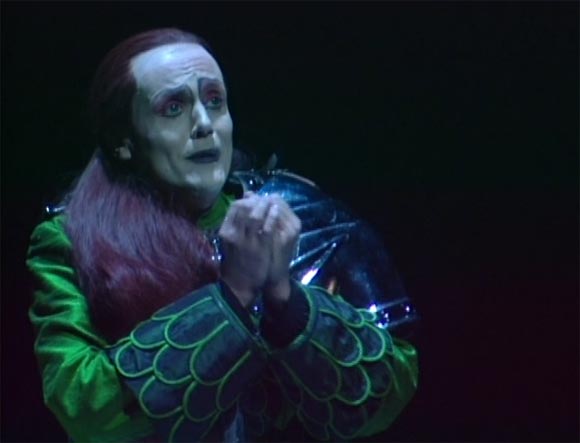
Ambroise Thomas’ Hamlet is a very grand French opera based loosely on various (loose) French adaptations of the play by Shakespeare. If one discards any notion that one is going to see Shakespeare with music and takes the piece on its own terms it’s really pretty good. In recent years it’s been doing the international opera circuit in a production by Patrice Caurier and Moshe Leiser that originated in Geneva in 1996 and was, for example, seen in the Met HD series a year or two ago. Most productions have featured Simon Keenleyside as Hamlet and Natalie Dessay as Ophélie. The available DVD version, recorded at the Liceu in Barcelona in 2003 features both of them.

Really all this opera needs to work is a baritone with exemplary French who can sing with power and lyricism for three hours and really, really act. That, I guess, is why Keenleyside owns the role. He’s superb. He probably peaks in the really quite amazing second act where he does a sort of mad scene as the “play within a play” misfires but he’s superb throughout. The second requirement is someone who can do a compelling mad scene with lots of blood and coloratura. Natalie Dessay seems to have trouble cutting her wrists but is otherwise brilliant and is rewarded with what is probably the longest applause for a single aria ever committed to DVD.

The rest of the cast is mostly very good. Alain Vernhes’ Claudius is very strong, vocally and dramatically; certainly much better than James Morris at the Met. Béatrice Uria-Monzon is occasionally a bit squally as Gertrude but acts really well, especially in the confrontation with Hamlet in Act 3. I didn’t care much for Daniil Shtoda’s Laërte. he sounded too “Italian” and not at all idiomatic. Overall though really great singing backed up by a very crisp performance from the orchestra under Bertrand de Billy. They sounded more lyrical and less bombastic than in the Met version.

The production is not especially exciting. It’s very plain with just a few moving “faux marble” walls. Most of the scenic effects are left to the lighting plot which is effective though hard to film (see below). Costumes are a sort of generic late 19th century with breastplates thrown in in odd places for some reason. It all provides an effective enough backdrop for some carefully directed and well executed acting. There’s no high concept here but the story gets told.

The video direction by Toni Bergallo is pretty good. It’s a tough ask. Often the light levels are low with a really brutal lighting focus on a single character. The Act 2 scene between Hamlet and the ghost is a great example. It’s very hard to make something like that look good on video. The cameras start to lose definition with the low light levels and then the high local contrast sort of blurs out. I found myself watching from quite close up even on a sixty inch screen! The DTS 5.1 sound track is OK but not demonstration quality. There’s not a lot of spatial depth and sometimes the singers sound as if they have been miked too close. The Dolby surround and LPCM stereo mixes aren’t any better. It’s not bad overall technically but it’s not up with the latest from a label like Opus Arte. There are subtitles in English, French, German, Italian, Castilian and Catalan. The only extra is EMI’s standard teaser reel.

Overall, this is well worth seeing. It’s a pretty good little known work, Keenleyside is exceptional and the production for DVD is pretty decent.

Mozart’s Mitridate – ROH 1993

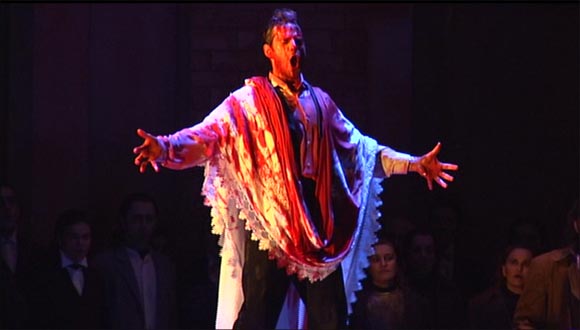
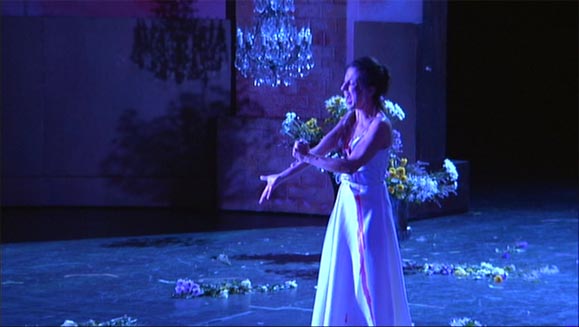
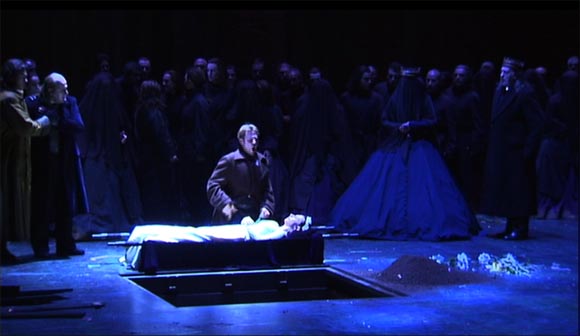
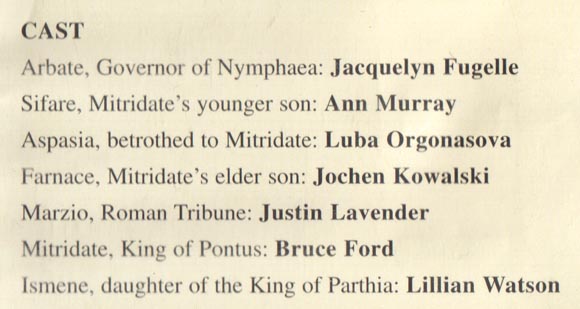
Mitridate, rè di Ponto is a three act opera seria by a fourteen year old kid called Mozart with a libretto based on Racine. Like most operas with a libretto based on Racine, and there are many, it isn’t exactly a barrel load of laughs. While it’s fair to say that the music may well be the best ever composed by a fourteen year old and it is recognisably Mozart it’s still not really quite enough to carry three hours of recitative and da capo arias about the troubled love life and familial relations of a first century BC King of Pontus and his fractious sons. In short, it gets a bit tedious. For a modern audience it’s not improved by the fact that all the male voices are high. Originally the score called for three castrati and two tenors. In the 1993 Royal Opera House production two of the three castrato roles were taken by mezzos and the third, inevitably the baddy, by a countertenor. For the record, here’s the full cast:

The director – Graham Vick, designer – Paul Brown and choreographer – Ron Howell do a pretty good job of injecting some life into the production with fairly extreme use of colour in the costume design, sets and makeup. The choreography and blocking is also quite striking at times but it still ends up being rather a wash of coloratura. The singers too do a worthy job but after a while it all starts to sound the same. Good work too from conductor, Paul Daniel, and the ROH orchestra but ultimately a bit blah.

Video director Derek Bailey does a pretty good job for the period. It’s hard to object to closing in on the singer during a da capo aria and he does pull out when there is stage wide action. He’s not helped by pretty average picture quality that lacks the definition needed to make long shots fully effective. Technically it’s a typical Kultur release of the period. The less than brilliant picture is coupled with so-so Dolby 2.0 sound, hard coded English sub-titles and minimum documentation. It’s also a bit quirky in that the overture comes on, with lead in credits, as soon as the disc is inserted. There’s no “set-up” menu.

One for the Mozart completist.

Joan Sutherland in Toronto

It’s a pet peeve of mine that, alone among state funded TV broadcasters in the industrialised world, CBC doesn’t broadcast opera on TV. There are many other reasons why the CBC is a national embarrassment but this one rankles. That said, there have been a couple of CBC broadcasts over the years and they did make it to DVD. These include a 1981 Canadian Opera Company performance of Bellini’s Norma with Joan Sutherland. It’s a great big pile of steaming whale dreck. The production, by Lotfi Mansouri, looks more like it was done in 1881. The Gauls have helmets with horns on. Sutherland seems to be dressed as the Statue of Liberty and the tenor playing Pollione (Francisco Ortiz) looks like Stephen Fry as the Roman centurion in Black Adder Back and Forth. Add to that it’s pretty much park and bark as far as blocking goes.

Sutherland is on poor form. She has no lower register to speak of and she gets about as much drama out of the music as a doorpost. Whether her powers were in serious decline at this point or she was just having an off night I can’t tell but it’s pretty sad. Ortiz is dreadful. He’s often below the note and seems to be using every trick in the tenor playbook to approximate his music. Bonynge’s conducting is deadly dull. The only part of the music making worthy of note is Tatiana Troyanos as Adalgisa. She’s very good indeed.

Technically the DVD is at least as bad as the performance. It’s recorded in mono (mono, in 1981!) and the sound is muddy and badly balanced. At some points the chorus is completely inaudible. Of course, some of this maybe the lousy O’Keefe Centre acoustics but I think it’s mostly just bad engineering. The picture is very poor quality too. There are hard coded English subtitles. This is one to avoid.

“Thanks” to Lydia at Definitely the Opera for drawing this to my attention!

The Turn of the Screw – Perth 1991

The DVD of Opera Australia’s production of Britten’s The Turn of the Screw is a train wreck. I’m not sure how much of the problem is due to the stage production and how much to the treatment for DVD but the end result is horrible. It’s almost impossible to comment on Neil Armfield’s production because one can’t tell when one is seeing it and when it’s being overlaid or perhaps even replaced by some conceit of the video director. The overall effect is completely incoherent. The barely TV quality picture doesn’t help things.

Musically it’s not good either. The singing is, at best, patchy. The children (Lanneke Jones as Flora and Patrick Littlemore as Miles) do fine and the ghostly pair; Anson Austin and Wendy Dixon, are adequate without being terribly otherworldly. The real problem lies with the Governess of Eilene Hannan and the Mrs. Grose of Margaret Haggart. Both are squally when loud and tending to drop into speech when quieter. Their duets are really hard on the ears. David Stanhope conducts the West Australian Symphony Orchestra. It’s not pretty. This score is hugely rhythmically inventive and the rhythm should drive the thing along. This reading is rhythmic mush. Again, nobody is helped by the recording. The quality of the Dolby 2.0 soundtrack is poor. It’s unfocussed and muddy adding to the overall lack of definition.

If you’ve got this far you probably won’t care that there are no subtitles and the only documentation is a chapter listing. There isn’t even a cast list.

Four decades of Peter Grimes

Having now had a chance to watch and review all seven currently available (as of June 2025 only the Oke and Graham-Hall performances seem to be available) video recordings of Peter Grimes I thought I might do a summary of the strengths and weaknesses of each. All of them have some merit and I doubt that there would be consensus on a “winner”. Anyway, here goes…

BBC film 1969
Grimes – Peter Pears
Conductor – Benjamin Britten
Director – Joan Cross & Brian Large

This is an essential historical document with both composer and the creator of the role involved. The production is straightforward and naturalistic. The sound and video quality is surprisingly good for the period. It does, though, leave one with the feeling that there is more to the role of Grimes than Pears finds.

Royal Opera House 1981
Grimes – Jon Vickers
Conductor – Colin Davis
Director – Elijah Moshinsky

Also a historical landmark being the first major production where Grimes wasn’t sung by Peter Pears. It has the excellent Heather Harper as Ellen Orford. The production is quite dull and very dimly lit. Vickers’ Grimes is controversial. In places he sounds fantastic and in others sorely taxed. His acting is oddly stilted. Norman Bailey fails to convince as Balstrode.  Sound and picture quality are OK.

English National Opera 1994
Grimes – Philip Langridge
Conductor – David Atherton
Director – Tim Albery

This is the production with most sense of the sea as a character brought out through innovative use of video projection. Langridge’s Grimes is intense, convincing and beautifully sung. Alan Opie is a very strong Balstrode. Unfortunately the orchestra and chorus aren’t up to rival versions and all aspects of the DVD; video direction, sound quality and picture quality are rather poor.  This recording was rebroadcast on June 1st 2025 by the BBC with dramatically better sound.  See my thoughts here.

Opernhaus Zürich 2005
Grimes – Christopher Ventris
Conductor – Franz Welser-Möst
Director – David Pountney

This is a very fine and thought provoking production with any number of magical moments. Ventris is a first class Grimes combining power and sensitivity and the supporting performances all have merit, save perhaps for Alfred Muff’s sub-par Balstrode. The orchestra and chorus are quite superb. The performance gets a thoroughly sympathetic treatment on DVD with good video directing backed up by quite excellent sound and picture quality.

Metropolitan Opera 2008
Grimes – Anthony Dean Griffey
Conductor – Donald Runnicles
Director – John Doyle

This is a rather dull and dark production given a very eccentric treatment by the video director. Dean Griffey is a lyrical and sympathetic Grimes well backed up by the supporting cast, especially Anthony Michaels-Moore as Balstrode and Teddy Tahu-Rhodes as Ned Keene. The orchestra and chorus are excellent and Runnicles is fairly convincing though the first act drags a bit. The sound and picture quality is excellent.

La Scala, 2012
2.theboarGrimes: John Graham-Hall
Conductor: Robin Ticciati
Director: Richard Jones

Richard Jones’ production, updated to the 1980s, is quirky. John Graham-Hall is quite lyrical as Grimes but slips into pseudo speech a lot. Susan Gritton fails to convince as Ellen Orford. The supporting cast, the orchestra and the conducting are first rate but the chorus is decidedly sub-par. The Blu-ray sound and picture outclasses all previous versions but, overall, this recording fails to convince.

Peter Grimes on Aldeburgh Beach, 2013
1.prologueGrimes: Allan Oke
Conductor: Steuart Bedford
Director: Tim Albery/Margaret Williams

This film is a record of the unique production staged on Aldeburgh beach by Tim Albery and filmed by Margaret Williams. It’s highly atmospheric and features a brilliant performance by Alan Oke but conditions were not ideal for the singers and musically this cannot match the best available recordings from the theatre.

Grimes goes to Zürich

I guess it’s a sign that work has attained a certain maturity when it is performed outside it’s own “cultural zone”. Peter Grimes has surely reached that point. A quick look at Operabase suggests fifteen productions worldwide in 2010-12 with only two of those in English speaking countries. That said, four of the five video recordings in the catalogue were recorded in Britain or the United States. The fifth, from Opernhaus Zürich is the subject of this review.

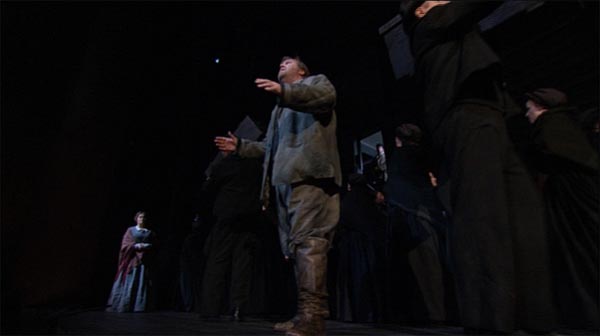
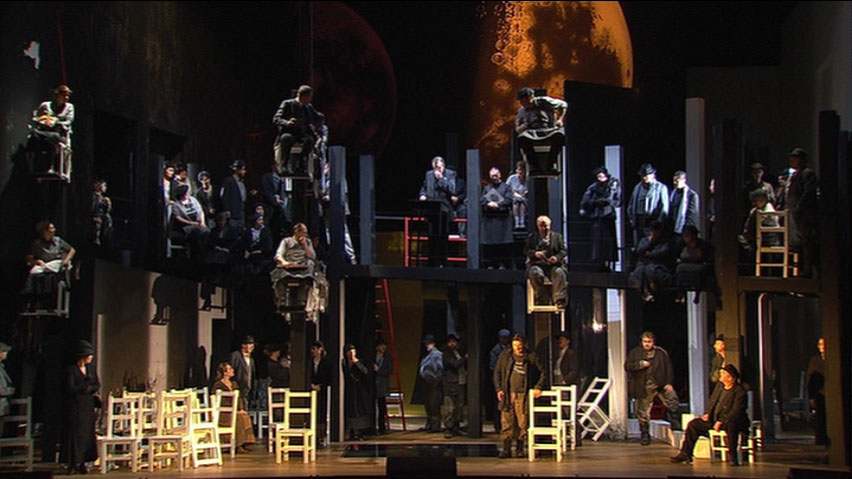
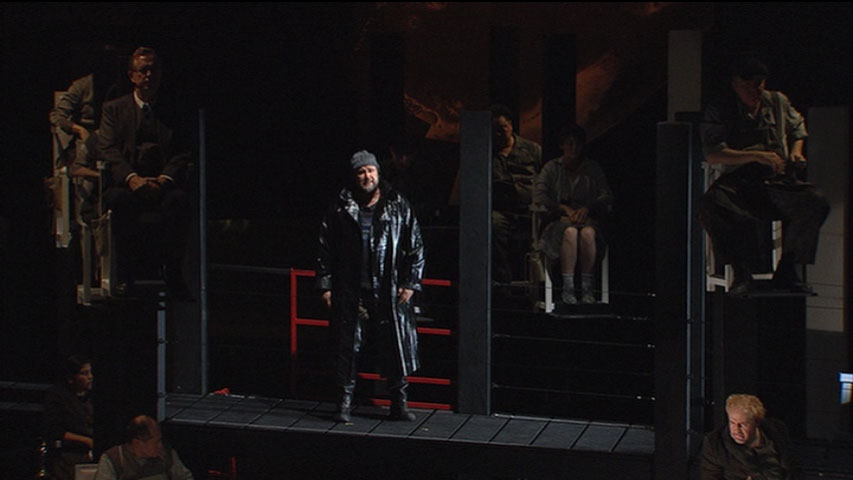
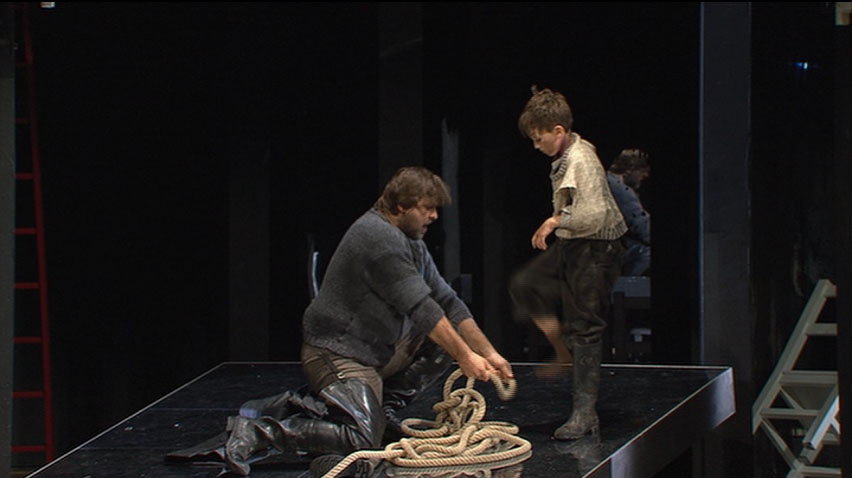
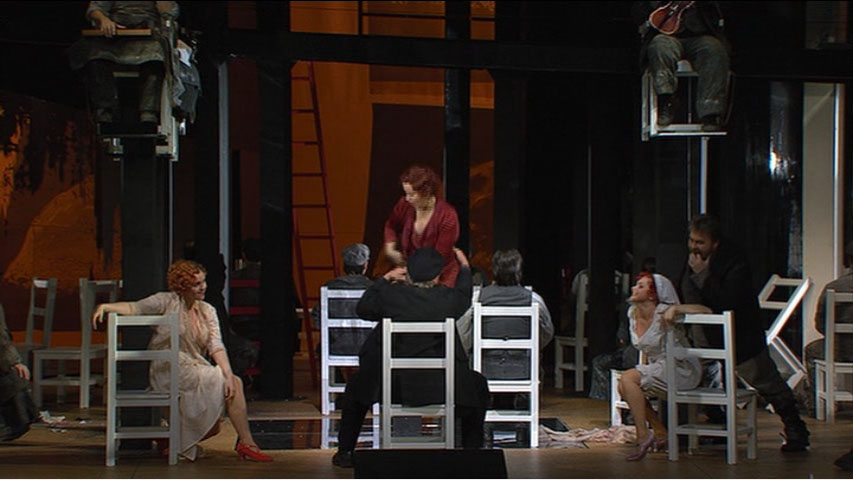
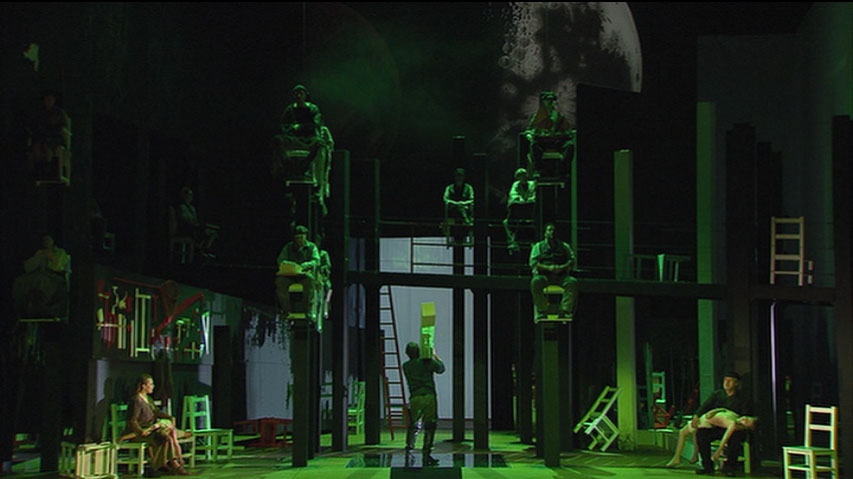
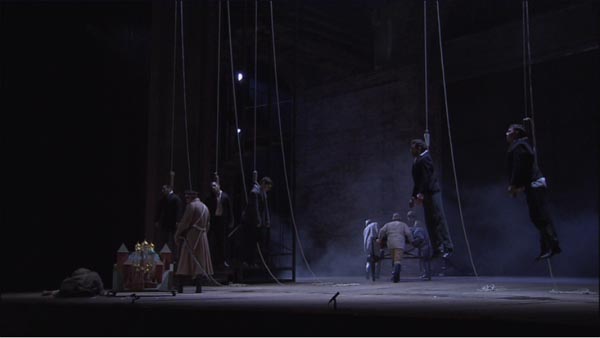
David Pountney’s 2005 production uses a single set, designed by Robert Israel, with gantries at different levels and members of the Borough suspended in chairs above the action. In some ways the concept is similar to the “wall” at the Met but it’s less compartmentalised and not as bleak to look at. It provides a flexible, abstract space which Pountney uses with minor detailing to great effect. Some aspects seem almost Brechtian. The pub scene could be straight out of Mahagonny while “Now is gossip put on trial” takes on quite a militaristic aspect. The set realises it’s potential to greatest impact in the closing scene. Grimes staggers on stage carrying the mast of his boat which he plants on a rocking platform at centre stage. On either side of the stage sit Ellen and Balstrode, each with a dead boy in their lap. As Peter departs to his death, he unships the cruciform mast, shoulders it and walks slowly upstage. It’s stark, beautifully composed and breathtakingly moving.

Pountney is also very careful in his direction of the interpersonal relationships though the Grimes/Balstrode chemistry doesn’t come off as well as in some productions. The Grimes/Ellen relationship is very well delineated. This Ellen is a tough cookie. She stands up to Grimes in the Sunday morning scene and while peter appears desperate and hopeful by turns throughout Act 2 there’s a real finality about Ellen’s “We’ve failed” and it’s followed by a very effective scene with Ellen, Auntie and the Nieces which strongly conveys both “sisters under the skin” and the sense that they, with Grimes, stand outside the tight knit community of the Borough. There are many other deft touches.

The performances are generally strong. Christopher Ventris’ Grimes is wonderful. He’s a full on Heldentenor who can sing a simply gorgeous pianissimo and he can act. It’s a more subtle performance than Vickers and less ethereal than Pears. He’s a Grimes who just doesn’t really get why the Borough hates him. Even when the lynch mob is heading for his hut at the end of Act 2 he’s more puzzled than angry. We never see him maltreat the boy and he doesn’t really hit Ellen either. He’s magnificent in the final scene. Arguably his is the best Grimes currently available on video.

Emily Magee’s Ellen is interesting too. Hers is a more obviously dramatic voice than, say, Heather Harper and not as sweet toned. At times she is a bit squally though at others very lyrical. It fits the interpretation though. As noted above, her Ellen is a tough cookie. I didn’t really care for Alfred Muff’s Balstrode. It’s OK and generally better in the scenes that don’t involve Grimes. He doesn’t achieve the relationship with Grimes though that shines through with Geraint Evans (sadly not recorded) or Anthony Michaels-Moore. Cheyne Davidson makes Ned Keene a more serious and forceful character than his rivals and Richard Angas’ Swallow, is very well characterised indeed, drunk or sober. Liliana Nikiteanu’s Auntie and the Nieces of Liuba Chuchrova and Sandra Trattnigg make a distinctly Continental feeling trio and leave us in little doubt that they are, as the libretto insists, “the chief attractions of the Boar”. Cornelia Kallisch is superb as Mrs. Sedley, maybe even better than Felicity Palmer. She seems to be getting a really creepy sexual pleasure out of her “murder investigation”.

The chorus, orchestra and conductor (Franz Welser-Möst) get absolutely top marks. Welser-Möst directs a consistently incisive, even thrilling, reading of the score and his forces respond magnificently. The chorus is arguably even better than the Met’s and their English diction is almost impeccable.

Video direction is by Felix Breisach and it’s very good indeed. he’s reasonably judicious with his close ups and doesn’t muck about with silly angles. Generally i felt the camera was going pretty much where I would if I were watching in the theatre. In an attempt to do his camerawork justice the screencaps in this post are full sized. Click to get the large version.

The 16:9 anamorphic picture is first class. The sound options are LPCM stereo, Dolby 5.1 and DTS 5.1. The last is clear, detailed and focussed with excellent dynamic range. It’s markedly better than the options. There are English, German, French, Spanish and Italian subtitles. Extras are restricted to some EMI promos which do include some interesting Maria Callas material. Documentation is limited to a short generic essay about the history of Peter Grimes. It’s a shame really. With two DVD9 discs to play with there’s definitely room for a conductor and/or director interview. A chapter listing would be nice too!

Quibbles about the packaging aside, this is a very fine DVD set. For those interested, David Pountney has a rather interesting blog.

The other Khovanshchina

There are only two video recordings of Mussorgsky’s Khovanshchina currently available. The 1989 Vienna recording, which I wrote about yesterday, and a 2007 production from Barcelona’s Gran Teatre del Liceu which I’ve also just had a chance to see.

The two productions make for interesting contrasts on many levels. In Barcelona, music director Michal Boder, while opting to use the Shostakovich orchestration as a basis modifies it in places with elements of the Rimsky-Korsakoff version. He also uses Voronhov’s lower key alternative to the Stravinsky in the final chorus and he makes some cuts; most notably the Susannah scene in Act 3. He also gets quite a different sound from the orchestra. Where Abbado in Vienna is very refined, one might almost say Viennese, Boder is brasher. In places the music almost sounds like Shostakovich with the characteristic braying brass. Admittedly some of this may be due to the quality of the recorded sound. The Vienna recording is rather soft focussed Dolby 2.0 while Barcelona gets very crisp and detailed DTS 5.1 (There’s LPCM stereo too but I didn’t check it out).

Continue reading

Battle of the basses

Mussorgsky’s Khovanshchina may be the most depressing opera ever written. It’s a catalogue of executions, murders, betrayals and mass executions that are no doubt designed to show the extreme purity of the Russian soul. I’m glad I’m not Russian. It’s also a rather beautiful score, though how much that’s due to Mussorgsky who didn’t complete and didn’t orchestrate it is, I suppose, anyone’s guess. In the version I watched; a 1989 performance from the Wiener Staatsoper, the ending is by Stravinsky and the orchestration by Shostakovich. Continue reading