L’opéra du roi

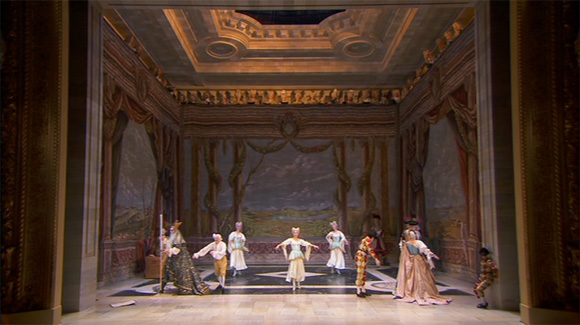
Lully’s Atys was, apparently, Louis XIV’s favourite opera.  It’s not hard to see why.  Within the rigid conventions of its time and place it really is rather fine.  The plot is classical and convoluted.  After an allegorical prologue celebrating Louis’ successful winter campaign in the Low Countries we get the story proper.  The hero Atys loves the nymph Sangaride, daughter of the god of the river Sangar, who returns his affection  She is betrothed to Celenus, king of the Phrygians.  The goddess Cybèle fancies Atys and makes him her high priest.  Atys uses his position to nix the wedding which upsets both Cybèle and Celenus. Cybèle blinds Atys who kills himself but is immortalised by being turned into a tree by Cybèle.  All of this takes over three hours with lots of ballets and other set pieces.  The music is French 17th century court music so it’s a bit unvaried but much of it is very fine indeed.

prologue Continue reading

Full of sound and Furies

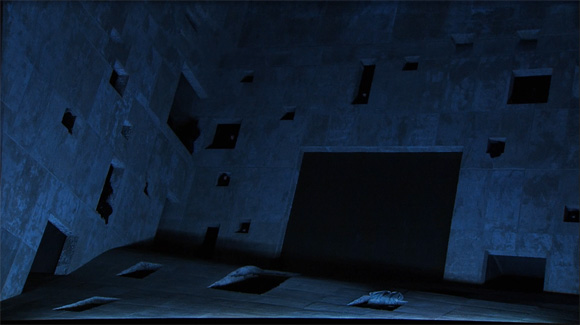
When I first encountered Richard Strauss’ Elektra as a teenager I found the music almost unbearably harsh.  The more I listen to it the more erroneous that judgement seems.  It has its “tough” moments to be sure.  How could an opera about Elektra not?  But it is also full of lush romanticism and there are some really quite lovely passages.  In the 2010 Salzburg Festival recording Daniele Gatti explores both sides of the music in a rather thrilling reading of the score aided and abetted by the Wiener Philharmoniker and a pretty much ideal cast.

set Continue reading

Gerry Finley’s Don Giovanni

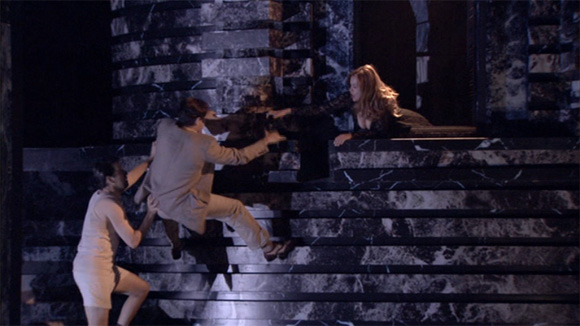
Jonathan Kent’s 2010 Glyndebourne production of Don Giovanni has a great cast and high ambitions but, ultimately, doesn’t really come off, largely because the relationships between the characters too often fall short of anything interesting.  The concept, as explained in the two short bonus segments, is that Don Giovanni is set in a society in transition and that the title character is a sort of harbinger of the new mores.  The “society in transition” chosen by Kent is a sort of hybrid of Fellini’s La Dolce Vita and the last years of Franco’s regime in Spain.  He might have done better to just pick one as the Fellini elements get pretty much reduced to the costumes and the Franco elements really don’t go anywhere.

window Continue reading

We’ll meet again in a better world

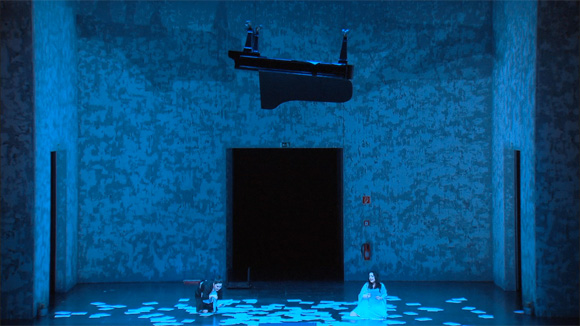
Richard Strauss’ last opera Die Liebe der Danae has a pretty chequered production history.  It was scheduled to premiere at the 1944 Salzburg Festival but that was scuppered when all theatres were closed following the July bomb plot.  A special exception was made for Die Liebe der Danae in that a single, public dress rehearsal was allowed at the conclusion of which Strauss is said to have bid farewell to the Wiener Philharmoniker with the words quoted in the title.  It then remained unperformed until the 1952 festival where it got its true premier followed by productions over the next two years in most major European houses.  After that it pretty much dropped out of the repertoire with occasional performances in Germany but apparently the production recorded at the Deutsche Oper Berlin in 2011 is only the sixteenth production all told.  It’s a bit hard to see why it has been so neglected.  The music is perfectly good Strauss though maybe it lacks a headline aria of the “Es gibt ein Reich” variety.  Maybe the subject matter was just too frivolous for the immediately post-war world; it’s described as “A Joyful Mythology in Three Acts”.  In any event, I was happy to discover it.

Continue reading

It’s the only Iphigénie in town

Claus Guth’s 2001 Zürich production of Gluck’s Iphigénie en Tauride is, rather surprisingly, the only video recording of the work currently available.  Fortunately it’s a very decent production much preferable to the Met’s over-stuffed overly literal version but not, I think, to be preferred over Robert Carsen’s stark and elegant version seen in Toronto, Washington and elsewhere.  The Zürich performance, led by William Christie, is very good but it’s rather let down by the video direction and the production for DVD.

Continue reading

Creepy and claustrophobic Wozzeck

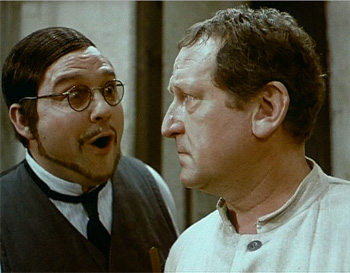
In 1970 Rolf Liebermann took the assembled forces of the Hamburg State Opera down to a castle in South Germany and made a film of Berg’s Wozzeck.  The production is pretty literal.  It’s set in Austria in the late 19th century and everything plays out very literally per the libretto but it’s far from being a routine or dull reading.  A combination of brilliant conducting, slightly over the top acting, pointing up the Expressionist elements in the music and really good cinematography make this a very tense, creepy and claustrophobic experience.  It’s simultaneously rather repellent and hard to watch and deeply engaging.  Continue reading

A gentler Lady Macbeth?

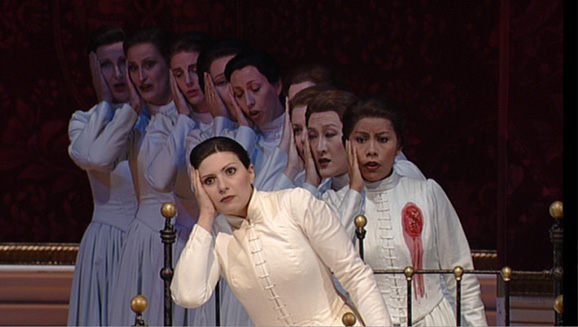
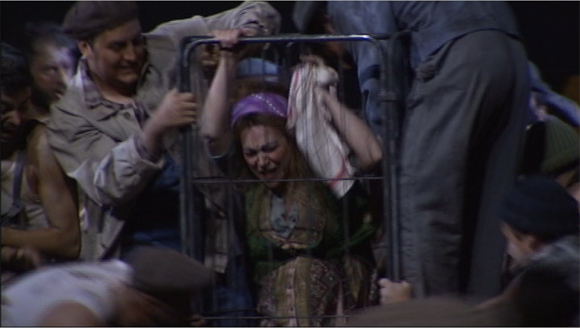
Stein Winge’s 2002 production of Shostakovich’s Lady Macbeth of the Mtsensk District at Barcelona’s Liceu is fairly straightforward in a minimalist sort of way.  The first scene establishes the tone for sets.  There’s a bed and a window and that’s about it.  The succeeding eight scenes are equally stark.  There’s an unusual, and disturbingly creepy, sexual tension between Katerina and Boris Ismailov; played here less boorishly than usual by Anatoli Kotcherga.  The three “difficult” scenes; the rape of Aksinya, the seduction and the death of Katerina are all handled pretty well.  It’s all less “in your face” than Martin Kušej’s Amsterdam production but it’s effective.  There’s also an element of “black slapstick”, especially in the scenes involving the police, that seems to fit the music rather well. Continue reading

Orlando in Craiglockhart

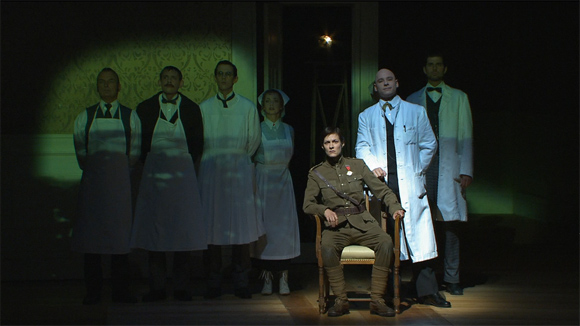
Handel’s Orlando is pretty classic opera seria stuff.  It’s based on an episode in Ariosto’s Orlando Furioso.  Orlando, a great soldier in Charlemagne’s army has lost his ardour for military glory because he has fallen desperately in love with the pagan princess Angelica, who is in turn in love with another man, Medoro. Orlando cannot accept this and he is driven to madness, prevented from causing absolute carnage only by the magician Zoroastro (who eventually restores his sanity).  There’s also a shepherdess, Dorinda, who is also in love with Medoro, but comes to accept her lot.  It’s all a bit daft and screams for a strong production concept.  In his 2008 Zürich production Jens-Daniel Herzog finds one.  He relocates the action to a military psychiatric hospital during, or just after, WW1.  Orlando is suffering from battle fatigue or PTSD and Zoroastro is a psychiatrist.  Angelica is still a princess but Dorinda has become a nurse.  It all works rather well.

Continue reading

Chill out dude

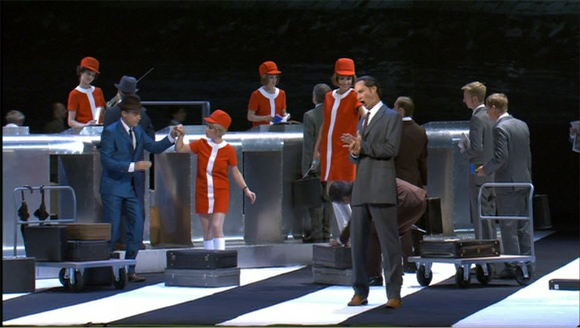
The problem with reviewing Doris Dörrie’s 2002 Berlin production of Così fan tutte is that pretty much everything that can be said about it already has been.  It’s like trying to write about Willy Decker’s “red dress” Traviata.  So I’ll try and be brief and to the point.  On the surface the idea is a bit outlandish.  Mozart and da Ponte’s satire about sexual fidelity is updated to the 1970s though to me, who grew up in the 70s, it seems much more like the 60s.  That said, it works.  It’s lively, funny, musically top notch and the presentation on DVD is very decent.

Continue reading

Almost ideal Idomeneo

The 2006 Salzburg production of Idomeneo seems to me to be just about ideal.  The production is clean and consistently interesting without ever getting too far away from the core story and the pretty much unbeatable cast is backed up by the period sensibilities of Roger Norrington and the Salzburg Camerata and Bachchor.  The only fly in the ointment is the utterly heinous video direction.

Continue reading