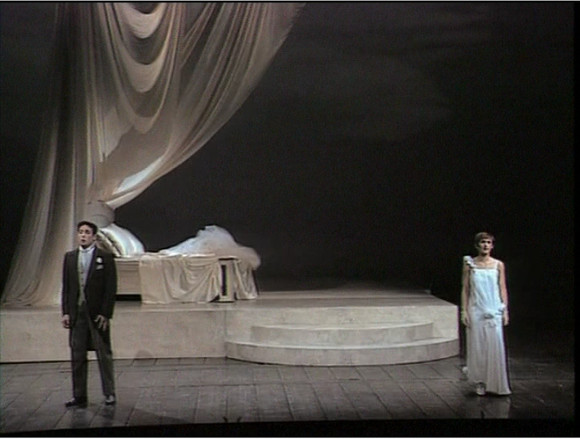
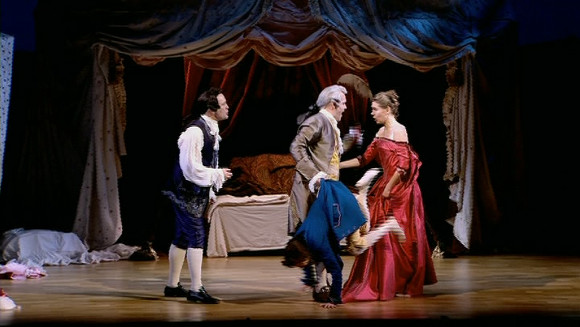
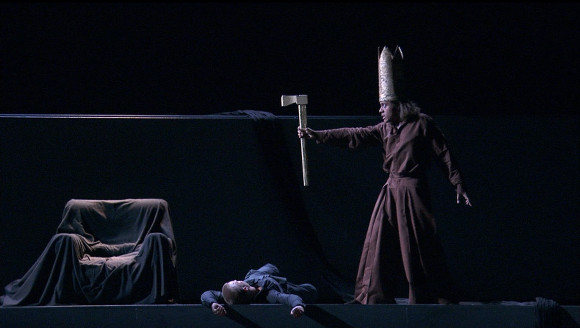
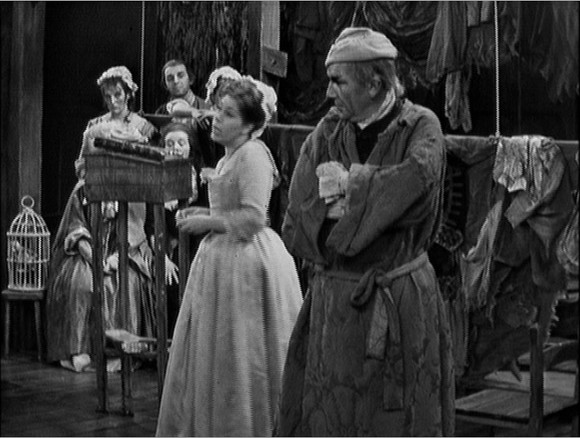
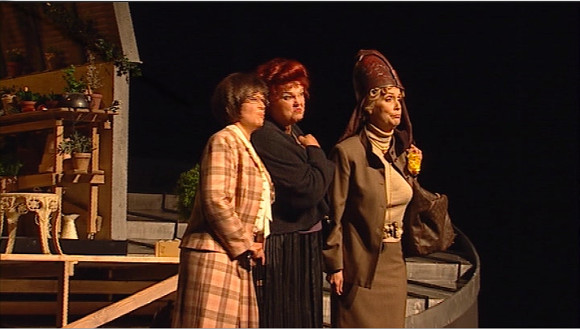
Cilea’s Adriana Lecouvreur isn’t performed very often and, when it is, it’s usually because some great diva of the day wants to do it. That’s the case with the 2010 Covent Garden production which was created by David McVicar for Angela Gheorghiu. Actually I am a bit surprised it’s not done more often. It’s not a great masterpiece but it’s no worse than a great many commonly done pieces and, if the plot is a bit implausible, it’s not as offensive as half of Puccini’s output. I would have thought it would have great appeal to that opera middle ground to which I don’t belong.
Category Archives: DVD review
Bosom stirring
Chabrier’s one act opera Une Éducation Manquée has possibly the most implausible plot in all of opera. It concerns a young aristocratic French couple on their wedding night. The whole plot turns on them having no idea what they are supposed to do. Not only are they French but they rejoice in the names of Gontran de Boismassif and Hélène de la Cerisaie. Titter ye not! Fortunately it only takes them 47 minutes to figure things out because a Wagner work on this theme would be quite intolerable. I’m not sure why anybody would bother with this piece of fluff but it made it onto DVD in a performance recorded in Compiègne in 1994. It’s probably the most amusing thing out of there since someone faked up a video of Hitler dancing in front of a train carriage. Which isn’t saying a lot.
Albert Herring
Britten’s Albert Herring is mysteriously under represented in the DVD catalogue. The work is performed quite often being relatively inexpensive to mount and suitable for smaller venues but the many productions haven’t led to many recordings. I have only been able to find one and that dates back to 1985 when it was recorded at Glyndebourne. That’s appropriate enough as that’s the house the piece premiered in in 1947. At least it’s a fair and effective representation of the work. Peter Hall’s production takes few liberties with the libretto and is a rather literal and effective, if necessarily somewhat caricatured, representation of life in a Suffolk village. The sets and costumes are evocative; especially the hall of Lady Billows’ house which really evokes a 17th century Great Hall and, as the view through the window tells us, is set in or close to the village, not in an isolated park. There’s quite a lot of that kind of attention to detail in this production.
You think this is funny, Beauty?
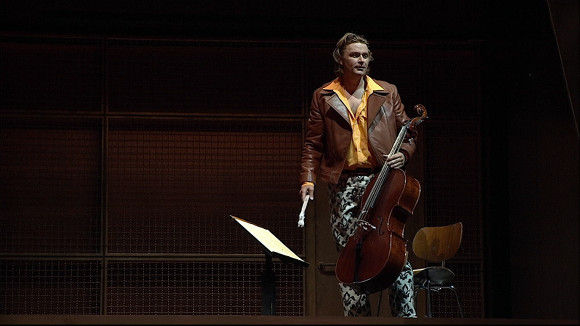
The DVD version of Michael Sturminger’s Giacomo Variations was recorded at the Ronacker Theater in Vienna in 2011. With the exception of Florian Boesch in the baritone role it’s the same line up as the performance in Toronto that I reviewed earlier this year. Watching the DVD didn’t change my views about the piece or the performances materially. It still feels a bit undercooked and schematic. I did like the quote on the DVD box about Malkovich’s singing from the Kürier “closer to Tom Waits than to Fritz Wunderlich”. I wish I’d said that.
A feast of a Belshazzar
Handel’s Belshazzar, written as an oratorio, was staged at the Aix-en-Provence festival in 2008. It works really well as a stage work. The plot is straightforward but dramatic. Impious Babylonian king Belshazzar is being besieged by the virtuous Cyrus of Persia. Babylon is impregnable but a combination of Babylonian impiety and divine intervention on behalf of Cyrus(*) leads to Cyrus’ capture of the city, the death of Belshazzar and, almost incidentally, the liberation of the Jews.
Fear and loathing in Corinth
Cherubini’s 1797 opéra comique Médée was one of the first to use the form for serious drama. Krzysztof Warlikowski’s 2011 production filmed at La Monnaie in Brussels is certainly that. Jason, Medea and the rest are very contemporary characters though we often see them against a backdrop of 1960s style home movies and the chorus too, which tends to remain in the background also seems to be from the same period.The meaning of this juxtaposirtion isn’t clear and there is nothing on the disks or in the documentation to help. We are also told that the libretto was adapted by Warlikowski and dramaturge Christian Longchamp but nothing more than that. This is definitely a production where the director’s notes would be a major plus.
Jealousy, rage, love and fear
It’s a curious thing how some works get over recorded and others are almost entirely neglected. For example, there’s only one video recording of Weill’s Die Dreigroschenoper and that a 1931 film that omits huge chunks of the stage work. It’s inspiration fares little better. There’s only one video recording of The Beggar’s Opera by Johann Pepusch and John Gay. It’s a 1963 BBC TV production of Benjamin Britten’s reworking of the piece for the English Opera Group based on a stage production by Colin Graham. [ETA: There are actually two other versions; a 1953 movie version with Lawrence Olivier and a 1980s version with Roger Daltrey and John Eliot Gardiner].
Can Bayreuth really tackle Meistersinger?
Die Meistersinger is a problematic opera, particularly for Bayreuth. It has rather disturbing elements of German nationalism and a performance tradition at the festival of those being used for ends that most people would rather be able to forget. No surprise then that Katharina Wagner’s production, recorded in 2008, tries to deal with both. It’s a bold effort. Like Robert Carsen’s Tannhäuser it tries to use visual art as a metaphor for music and art in general.
Brünnhilde lives
The concluding instalment of Kasper Holten’s Copenhagen Ring really does wrap it up as Brünnhilde’s story. It’s very effective in so doing too. Holten states that the central problem in interpreting the Ring is the ending and he points out that Wagner struggled with it for years before resorting to what Holten sees as a cop out; the tired, patriarchal device of wrapping things up by having the heroine sacrifice herself for her man. Holten rejects this and instead offers us a living Brünnhilde as a symbol of hope and renewal at the end of a century of terrible strife. I wish I were as optimistic.
Meyerbeer in the museum
Meyerbeer’s L’Africaine was a huge hit in Paris, London and New York when it premiered in 1865. I’m not sure why. It has all of the things that make Meyerbeer seem very dated and not as much of the good stuff as Les Huguenots, or even Dinorah. It’s ostensibly about Vasco de Gama but that’s just a peg to pin a love triangle and a bunch of exoticism on. Are we actually supposed to believe that the Portugese wanted to find a way around the Cape to find out what was there? It would have been a lot easier to get hold of a copy of Herodotus. It’s also long. Even with cuts it runs well over three hours in the version recorded at San Francisco Opera in 1988.