Another classic re-release

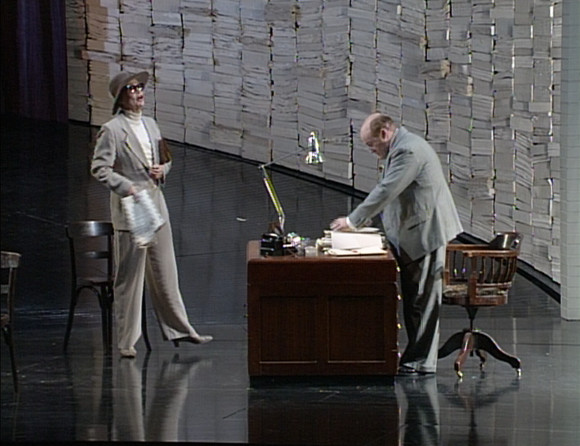
For the longest time the classic 1995 Glyndebourne recording of Janáček’s Věk Makropulos was the only video option.  It’s now been re-released on DVD and Blu-ray in a completely remastered version.  I watched the Blu-ray and it’s as well restored as the companion recording of Peter Sellars’ equally classic Theodora.  As it’s drawn from a Channel 4 broadcast the picture is 4:3 and it’s presented here formatted for wide screens in what is, apparently, called “pillarbox” mode in the UK.  At any event, the picture is excellent; certainly the equal of many more recent recordings, if not quite of the best HD quality.  The sound, stereo only, is decent but  a bit “boxed in” and the voices often seem to balanced a long way back.

1.office Continue reading

Woman on the edge

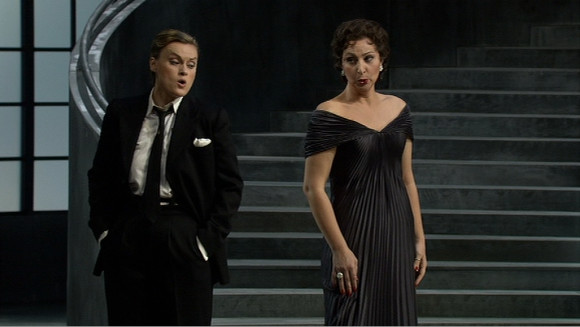
A few weeks ago I reviewed Phillippe Béziat’s documentary traviata et nous, about the making of the 2011 Aix festival La traviata.  I’ve now had a chance to watch the DVD of the finished product and it’s superb.  Forget those Traviatas in which a star soprano simpers vacuously across an overstuffed set, this is compelling drama.  François Sivadier’s production is dark, dangerous and incredibly moving.  Natalie Dessay’s Violetta is a terrifyingly intense portrait of a woman who knows from the beginning she is dying in “this desert which is known to men as Paris”.  There is no further need for heavy symbolism to remind us of the centrality of death to the piece which makes an interesting contrast with Willy Decker’s famous production.

1.natalie Continue reading

Not a mezzo in sight

Leonardo Vinci’s Artaserse is in many ways it’s a classic opera seria. The good guy roles are written for castrati but the baddies here too go to high voices; a castrato and a tenor.  But what sets this apart is that it was written for Rome where it premiered in 1730.  At that time women were not allowed on stage in the Papal States so the two female roles were played by castrati en travesti.  In recreating it in 2012, l’opéra national de Lorraine chose to cast all five castrati roles with countertenors, producing a cast like nothing I’ve ever seen or heard.

1.artabano Continue reading

Christian Chaudet’s Le Rossignol

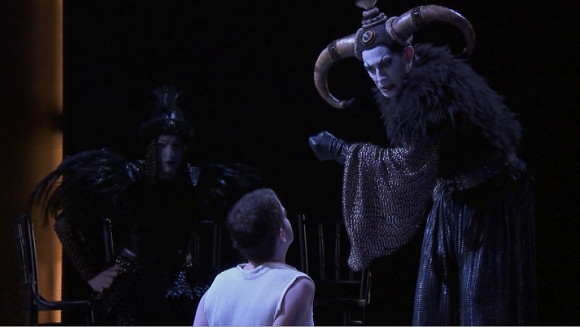
Christian Chaudet’s film of Stravinsky’s Le Rossignol started life as a 1999 studio sound recording of the piece conducted by James Conlon.  Chaudet became somewhat obsessed with the recording and decided to turn it into a film, recruiting the original singers as part of the project.  It’s an ambitious film which mixes live action, animation and a series of special effects to create something really rather weird and wonderful.  It frames the Hans Christian Anderson tale in a modern setting involving a mobile phone, a weird internet cafe and a reality talent show.  He throws in some Gilliamesque animation and a live nightingale for good measure.

1.bird Continue reading

Dessay is a spectacular Zerbinetta

A recording featuring Deb Voigt and Natalie Dessay, both high on my list of singers I’d like to party with, obviously has to be seen.  They feature in a 2003 recording of Ariadne auf Naxos from the Met.  It’s a Moshinsky production, directed for this run by Laurie Feldman.  It’s pretty traditional in most respects though there are some interesting touches in the second act.  We are squarely in the house of the richest man in Vienna c. 1750.  No Konzept here.  In fact, the first act is traditional too in that the acting is broad, going on coarse grained.  Dessay brings a touch of distinction, managing to effectively portray the more vulnerable side of Zerbinetta.  Voigt too is very fine, and very much with the overall mood, as a completely over the top stroppy diva.  She’s definitely playing for laughs.  Susanne Mentzner’s Composer and Wolgang Brendel’s Music Master are both quite competent but suffer a bit from the pantomime acting the director appears to want.

1.house Continue reading

Maria Callas at Covent Garden

There’s not a lot of film footage of Maria Callas performing and most of what there is is of concerts.  What makes this disk special is that it contains the whole of Act 2 of Tosca recorded at the Royal Opera House on 9th February 1964.  It’s a Zeffirelli production and Tito Gobbi sings Scarpia with Renato Cioni as Cavaradossi.  It gives, I think, a pretty good idea of Callas’ appeal as an actress and as a personality.  She is fascinating to watch but in many ways quite hard to listen to.  My partner, who was in the next room, thought I was listening to an atonal modern piece, which is as much as I’m going to say about accuracy of pitch.  I found myself more caught up in thinking about that modern audience segment that wants to go back to “the good old days” because if this is representative I think they are nuts.  It’s not about Callas.  Well directed I think I’d have enjoyed seeing her.  It’s the overly melodramatic, well, everything.  OK, I know it’s Tosca but Gobbi’s eye rolling scenery chewing is like three Bryn Terfels without the self deprecating twinkle in the eye.  One wants to shout “watch out for the crocodile!”  And is he ever loud?  At first I just thought it was a recording balance thing but I don’t think so as he sounds way louder than the other singers.  It’s hard (and probably unfair) to judge a voice on the basis of a rather ropey recording like this but I wouldn’t pay to hear barking like this.

1.Tosca Continue reading

Death, in Venice

If I have a beef with Britten’s Death in Venice it’s that it’s a bit cerebral and bloodless, at least as it has come down in the Aldeburgh-Glyndebourne-ENO performing tradition.  I think it’s fair to say that in its bloodlessness it mirrors the Thomas Mann novella (and indeed a lot of Mann’s other writing) but, for me, it’s a challenge to engage with the piece and, especially, with Gustav von Aschenbach.  So, it was with surprise and growing pleasure that I watched Pier Luigi Pizzi’s production for, appropriately enough, Venice’s La Fenice.  His take is bold and seems to centre less on Aschenbach’s relationshsip with the Polish boy, Tadziu, and more on the conflict between Dionysian and Apollonian ways of thinking and doing and I think it’s clear that Pizzi is a Dionysian.

1.beginning Continue reading

For pity’s sake

I’ve been involved in a lot of on-line discussions about various productions; live and DVD, of La clemenza di Tito.  Oddly perhaps, none of them have ever referenced the 2005 Zürich recording with Jonas Kaufmann in the title role.  Today I think I found out why.  Basically it’s rather dull, except where it’s unintentionally funny.

1.sestovitellia Continue reading

Pelléas for dummies

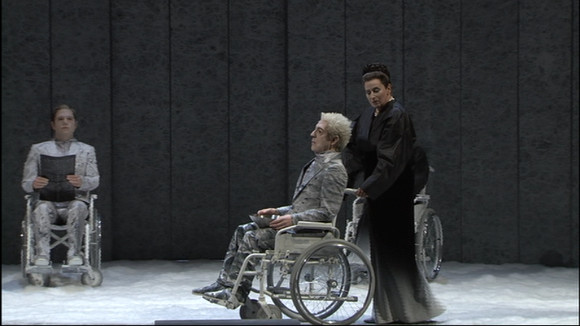
The most obvious feature of Sven-Eric Bechtolf’s Pelléas et Mélisande is the use of dummies to double up the characters.  Much of the time these doubles are lying around or being pushed around the set wheelchairs by the singers.  Most of the time the singers address themselves to one of the dummies even when the “real” version of the person they are addressing is on stage.  I guess it’s designed to create a kind of emotional distancing or dehumanising that does seem in keeping with the piece and, when the convention is broken, ie; characters interact directly, that seems to heighten the drama at that point.

1.wheelchairs Continue reading

Monochrome Poppea

Monteverdi’s L’incoronazione di Poppea was the “shabby, little shocker” of the 17th century.  It’s about lust, obsession, murder and revenge.  So, it’s a bit surprising that all too often it comes off as elegant but deadly dull.  That’s rather the case with Pierre Luigi Pizzi’s production filmed at the Teatro Real in 2010.  Despite having Danielle di Niese, something of a specialist Roman sex kitten, in the title role it’s all rather bloodless.  It starts off OK with the gods and goddesses of the prologue being wheeled about on platforms but after that he gets rather static.  Sets and costumes are almost unrelieved grey/silver tones (including a rather fetching pair of silver lamé booty shorts for Damigella) although Nerone himself seems to be dressed as a giant black chicken in Act1 (know you of such a bird, Baldrick?).  The only real breaks in the (literal) monotony are the bright red robe Ottone borrows from Drusilla for the attempted murder and the sparkly gold outfits  that appear for Nerone and Poppea at the end.  It’s also rather dark most of the time.

1.poppeanerone Continue reading