Equestrian Mozart

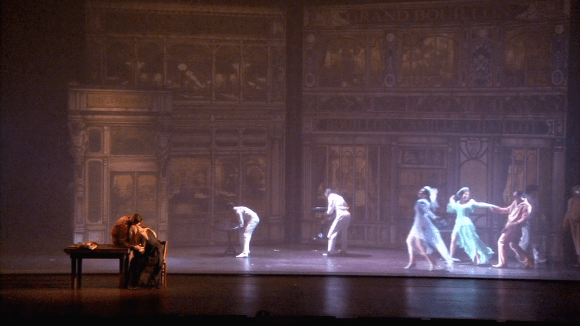
Once in a while one comes across a disk that sounds like it could be interesting but turns out to be a bit of a bust.  That was certainly my experience with the recording of Mozart’s Davide penitente recorded in Salzburg during Mozart Week in 2015.  On the face of it using the Felsenreitschule for something like its original purpose isn’t such a bad idea and the idea of choreographed horse “ballet” to a Mozart cantata is quite intriguing.  On the face of it…

1.bartabas

Continue reading

No sex please, we’re the Met

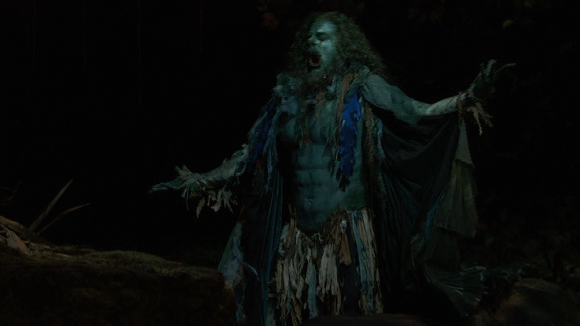
For some reason the Metropolitan opera decided, in 2014, to give an HD broadcast to Otto Schenk’s 1993 version of Dvorák’s Rusalka with revival direction by Laurie Feldman.  This production must have seriously old fashioned even then and actually looks and feels like it was created fifty years before the opera was written.  It’s not just the dark, dreary, over detailed Arthur Rackham like sets and costumes or even the the stock acting and the lame choreography.  The biggest problem is that it completely ignores that Rusalka is essentially about sex and its pathologies.  Does Schenk think that Rusalka wants to hold hands with the Prince at the cinema or take the Foreign Princess to the ball instead of Rusalka?  You would think so from this Disneyfied version.  Has the man even heard of Freud (let’s be clear Dvorák had)?  The result then is stultifyingly dull and actually just rather silly.  I’ve seen panto with more psychological depth.

1.gnome

Continue reading

Dream team casting

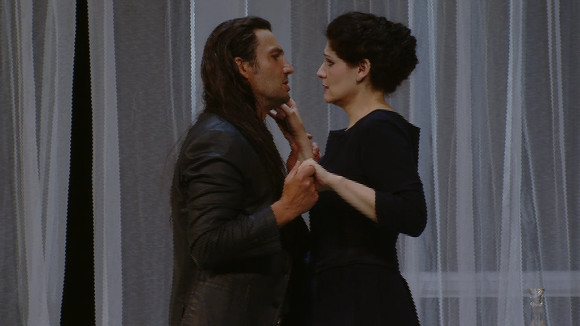
The 2014 recording of Verdi’s La forza del destino from the Bayerischen Staatsoper has the kind of cast one hardly dares dream of.  The elusive Anja Harteros sings Leonora with the almost equally hard to catch Jonas Kaufmann as Alvaro.  Chucking in Ludovic Tézier as Don Carlo and Vitalij Kowaljow doubling the Marchese and Padre Guardiano only improves matters and the rest of the cast is very good indeed.  It was pretty much sure to be a winner and it is.

1.lovers

Continue reading

Routine Manon

Sometimes one comes across a DVD that is perfectly adequate but one really wonders why that particular production/performance was picked for a DVD release.  Such is the 2014 recording of Massenet’s Manon from L’Opéra Royal de Wallonie.  Daniel Barenboim once said that the only reason to do this piece was a s a vehicle for star singers.  I’m not sure I entirely agree but having them helps enormously and when the catalogue already has recordings of Netrebko and Dessay, both with Villazon one wonders how Annick Massis and Alessandro Liberatore can compete.  Bottom line, they can’t really.

manon1

Continue reading

When the going gets weird

the-muppets-statler-and-waldorfA couple of years ago I produced a series of “best of” lists for video recordings, which I’ve updated from time to time.  One can find them on the Index of DVD reviews page.  So, for fun, I thought I’d put together a “weirdest” list.  Mostly this captures operas that are intrinsically weird but I’ve included the odd recording where the director has gone a bit nuts in an attempt to get something out of non too promising material.  So, in alphabetical order by composer, here is the “weird list”.   Continue reading

The other Otello

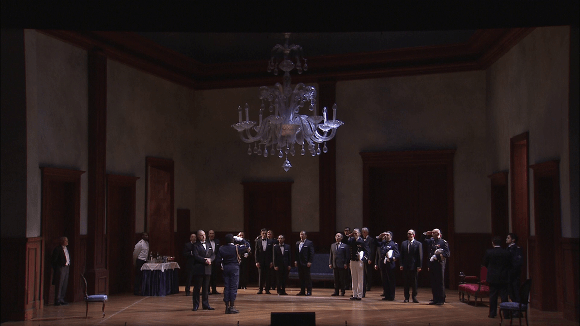
Just as Rossini’s version of Il barbiere di Siviglia completely eclipsed Paisiello’s version, so Verdi’s Otello sounded the death knell for an earlier version; ironically enough by Rossini.  It’s a bit surprising as the Rossini version is not bad at all despite having a rather patchy libretto and being hard to cast.  The first thing one notices is that the story isn’t even close to Shakespeare/Verdi.  This is because the libretto was based on a French play by Jean-François Ducis that was popular in the 18th century.  I don’t know whether the plot’s weaknesses are due to Ducis or the librettist but there are a few.  There’s no Cassio so the motivation for Jago’s plotting is unclear.  All the Venetian notables (bar perhaps the Doge) hate Otello but Jago doesn’t seem to have any special reason for animosity.  Between the end of Act 2 and the beginning of Act 3 Otello is exiled.  There is no explanation.  The finale is abrupt and weak.  Immediately after Otello kills Desdemona the gang of notables burst in to the room and appear to be completely reconciled to Otello and to him marrying Desdemona, despite having spent the rest of the opera chewing chips about this.  In fact one could argue that the happy ending variant (yes, there was one) is the more plausible as it would only take the guys to arrive about ten bars sooner for that to be the logical outcome.  As it is, Otello listens with incredulity to the change of heart and, not unreasonably, kills himself.

1.ballroom

Continue reading

Rossini… with goats

Rossini’s Aureliano in Palmira is a rarity for a whole host of reasons.  There’s no definitive edition.  Many of the extant scores have much easier versions of the main arias for the tenor titular character.  Quite a bit of the music was reused for Il barbiere di Siviglia, often in ways that seem quite odd after hearing it in its original context.  Finally, the plot is a bit thin.  Not that that usually worries bel canto aficianados.

1.temple

Continue reading

Completing the Bechtolf trifecta – Le nozze di Figaro

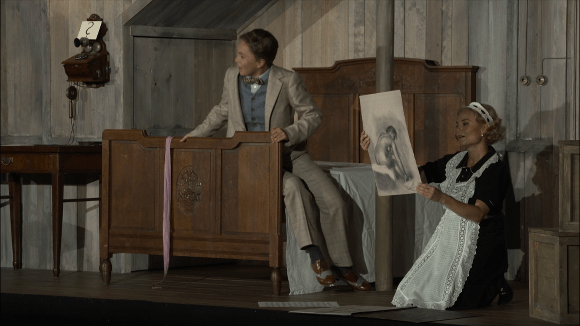
Sven-Eric Bechtolf’s stagings of the Mozart/da Ponte operas in Salzburg concluded in 2015 with Le nozze di Figaro.  I think it’s the most successful of the three.  Bechtolf’s strengths lie in detailed direction of the action rather than bold conceptual statements and Nozze is probably the least in need of, and the least amenable to, the big Konzept.  There aren’t any real dramaturgical problems to solve.  It just works as written.  I don’t think that’s so true for Don Giovanni or Così.

1.sketch

Continue reading

Kaufmann’s Cav and Pag

Jonas Kaufmann made a double role debut as Turiddu and Canio in the classic verismo double bill of Mascagni’s Cavalleria Rusticana and Leoncavallo’s Pagliacci at the Salzburg Easter Festival in 2015,  The productions were directed by Philipp Stölzl and Christian Thielemann conducted with the Staatskapelle Dresden in the pit.

1.church

Continue reading

Bechtolf Round Two – Don Giovanni

Sven-Eric Bechtolf’s second Mozart/daPonte for Salzburg was Don Giovanni which premiered in 2014.  There are some similarities with his Così fan tutte.  He uses a symmetrical unit set again and shows a fondness for creating symmetrical tableaux vivants but there the similarities pretty much end.  I could find a consistent, believable set of humans in Così but not so much in Don Giovanni.  The problem is really the man himself.  Bechtolf, in his notes, seems to be arguing that Don Giovanni can make no sense in an age of pervasive accessibility and exposure to all things sexual.  Da Ponte’s Don requires a climate of sexual repression for his essence; to Bechtolf a kind of Dionysian force (he cites Kierkegaard), to make any sense as a human.  I think I get that but then, I think, the challenge becomes to create a Don Giovanni who does make sense to a 21st century audience as, in their different ways, do Guth and Tcherniakov.  Bechtolf seems to treat the character not so much as a human rather than as a kind of energy focus who exists by igniting aspects of the other characters; whether that’s lust or jealousy or hatred.  He caps off this idea at the end by having Don Giovanni reappear during the final ensemble as a kind of mischievous presence still chasing anything in a skirt, even if it’s, perhaps, from another world.  It’s an idea that I could not really buy into.

1.stab

Continue reading