Carsen productions of Pagliacci and Cavalleria Rusticana

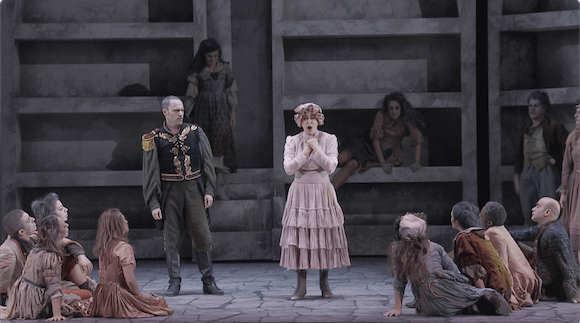
Robert Carsen’s productions of the classic pairing of Leoncavallo’s Pagliacci and Mascagni’s Cavalleria Rusticana, filmed at Dutch National Opera in 2019, are an attempt to extend the meta-theatricality of the former to the latter. To this end he reverses the normal order which allows the prologue of Pagliacci to apply to both works and elements of the Pagliacci to be extended in Cavalleria Rusticana.

1.clowns

Continue reading

A modern take on Gay’s classic

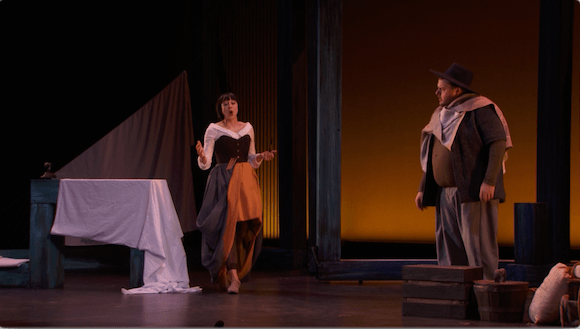
John Gay’s The Beggar’s Opera has been around since 1728 and is revived with some regularity but has never quite made into the opera canon. The latest incarnation is a version heavily rewritten by Robert Carsen and Ian Burton with a musical concept by William Christie. It first saw light at the Théâtre des Bouffes du Nord in 2018 before touring extensively.

1.peachums

Continue reading

McVicar’s Faust revived

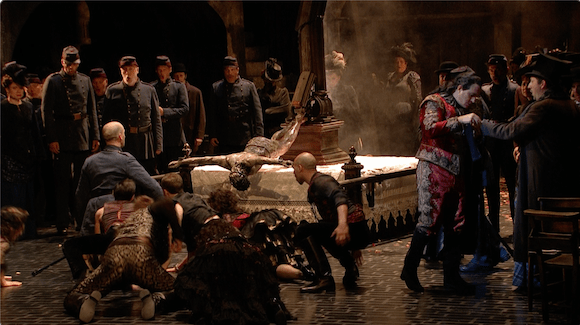
It’s quite unusual for a production to be released twice on video but that’s what has happened with David McVicar’s production of Gounod’s Faust for the Royal Opera House.  It was originally released in 2010 with a cast that included Roberto Alagna, Bryn Terfel and Angela Gheorghiu.  It’s now been released again in a revival directed by Bruno Ravella with a cast headlined by Michael Fabiano, Erwin Schrott and Irina Lungu filmed in 2019.

1.crucifix

Continue reading

Agrippina

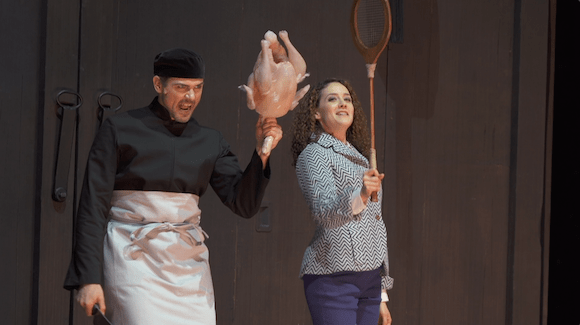
Agrippina is definitely one of the most interesting of Handel’s early operas. It has very good and very varied music including a ravishing love duet in Act 3 which reminds one of Monteverdi; perhaps not surprisingly since Poppea is one of the characters singing it! The libretto, too, has something of L’incoronazione about it. It’s smart, sexy and utterly cynical which I suppose is about par for an 18th century cardinal. It’s said that Grimani based the character of Claudio, here portrayed as an oversexed buffoon (oace Robert Graves), on his arch enemy Clemens XI. s a bonus in Robert Carsen’s version there’s a rather shocking ending in which Nerone, literally, gets the last laugh.

1.desk

Continue reading

Alceste in Munich

I really wonder why Gluck’s Alceste gets as many productions as it does.  The plot is essentially dull (summarised in this review) and I really can’t see an angle that could be used to make it interesting and relevant to today’s audience in the way that one can with such classical stories as Antigone,  Medea or Idomeneo.  The music, bar a handful of numbers, is not very exciting either.

1.people

Continue reading

Cavalli at the court of Louis XIV

Cavalli’s Ercole Amante is an oddity.  It was intended as a wedding present from Cardinal Mazarin to Louis XIV but got hijacked by Lully who inserted a bunch of ballets for the king to dance stretching out the piece to something like six hours.  It wasn’t a great success.  It’s also a very odd story for a piece intended for a royal patron as I explained in reviewing an earlier recording.  It’s also in Italian which may make the only French court work to be performed in that language.

1.allegory

Continue reading

Fidelio 1806

There were, of course, many Beethoven 250 events planned for 2020 and few of them happened.  One, planned for Vienna, was to stage all three versions of Beethoven’s only opera; Leonore (1805), Fidelio (1806) and the final form that modern audiences mostly know, Fidelio (1814).  As far as I know the only one that went ahead was a production of the 1806 version at the Theater an der Wien that was filmed in an empty house and has just got a release on Blu-ray and DVD.  Now, it happens that the 1805 Leonore was staged and recorded by Lafayette Opera in New York the year before.  So we can look at all three versions and the evolution of the piece despite the Vienna cancellations.  For those who want more details on the New York production, it was reviewed by Patrick Dillon in the summer 2020 edition of Opera Canada and there will be a review, by myself, of the recording in a future edition (probably soon).

1.marcellina

Continue reading

Leonore (1805)

Opera Lafayette’s March 2020 production of Beethoven’s 1805 precursor to Fidelio; Leonore, was reviewed by Patrick Dillon in the Summer 2020 edition of Opera Canada. It’s now been released on DVD and Blu-ray. Watching it on video I think tends to highlight further the weaknesses described by Patrick. It can’t seem to make up it’s mind what it is; musically or dramatically. Is it a Singspiel or something grander? The dramatic focus drifts, somewhat bathetically, from the domestic comedy of the Leonore/Marcellina/Jacquino love triangle to the “faithful and virtuous wife” theme to, almost, entering more involved philosophical/political territory before relapsing into a sort of cop out ending. The (very real) strengths of the final version of Fidelio are not much in evidence here.

1.marcellinajaquino Continue reading

Frühlingsstürme

Jaromir Weinberger’s Frühlingstürme has been called “the last operetta of the Weimar Republic”. It premiered in 1933 in Berlin with some success before being banned by the Nazis. The background is sombre enough. We are at the HQ of a Russian Army in Manchuria during the Russo-Japanese war of 1905. Against this backdrop we see two (or perhaps three) love affairs play out. Lydia Pavlovska is a widow exiled from Petersburg because of the Grand Duke Mikhailovitch’s infatuation with her. The commanding Russian general, the elderly and “good natured” Kachalov, is in love with her. She discovers that her old flame, Japanese major Ito, is operating as a spy at Kachalov’s HQ disguised as a Chinese servant. Meanwhile the general’s daughter-from-hell Tatiana has fallen for the scheming reporter from Berlin Roderich Zirbitz, who happens to be the author of a very uncomplimentary article about her father.

1

Continue reading