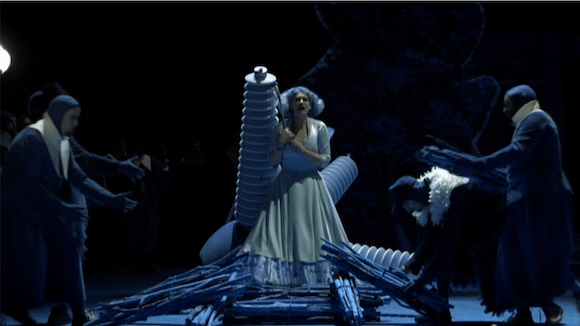
DOB Ring – Siegfried

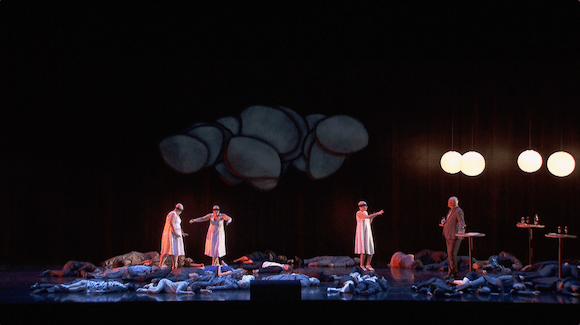
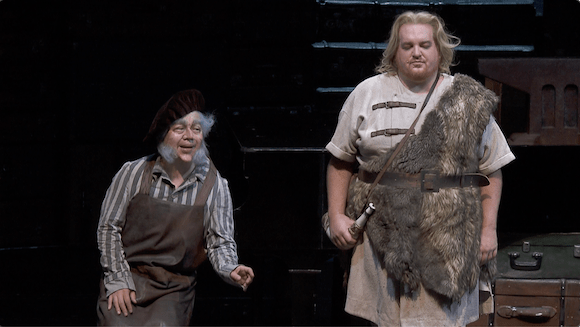
So continuing our look at Wagner’s Ring at the Deutsche Oper Berlin, directed by Stefan Herheim, we move on to Siegfried.  I think it’s fair to say that all the elements referred to in my introductory post are present in Siegfried with some more thrown in for good measure.  Let’s look at it act by act.

1.mimesiegfried

Continue reading

DOB Ring – Die Walküre

The second instalment of Deutsche Oper Berlin’s Ring directed by Stefan Herheim, Die Walküre, carries on with much the same iconography as Das Rheingold.  Once again the set is largely built up of suitcases, a crowd of refugees observes the action, there’s a piano at centre stage and a white sheet in various forms plays a key role in proceedings.  Also, much of the time the characters are working off a score of the piece.

1.twins

Continue reading

DOB Ring – Das Rheingold

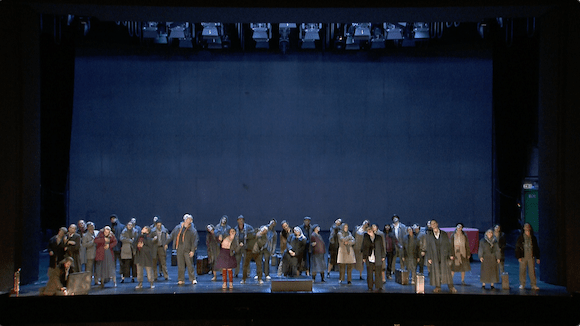
So here we go with the “preliminary evening” of the Deutsche Oper Berlin’s new production of Wagner’s Der Ring des Nibelungen directed by Stefan Herheim.  Das Rheingold opens before the music starts with a crowd of scruffily dressed people with suitcases; presumably refugees, filling a stage which is empty except for a grand piano.  One of them starts to put on clown make up.  We will soon see that this is Alberich.  Another “refugee” sits at the piano and conjures up the first notes of the prelude from the pit.  It takes a bit longer for us to realise that this is Wotan.

1.refugees

Continue reading

Wagner’s Ring at the Deutsche Oper Berlin

There’s a new recording out of Wagner’s Der Ring des Nibelungen recorded at the Deutsche Oper Berlin last year.  Now the DOB claims a special relationship with the music of Wagner (the “Winter Bayreuth”) and it is, of course, in Berlin which adds an unavoidable dimension to the performance history there.  It has also had, for more than twenty years, Götz Friedrich’s famous production in its repertoire.  So, a new Ring at DOB is a big thing.  Given that, what I want to do in terms of engaging with the recording is to bookend reviews of the four videos of the operas in the usual fashion with two general pieces; one laying out my expectations based on the “bonus” material in the boxed set and the booklets, and one as a sort of final conclusion having watched the whole thing.  This post is, of course, the first of those.

DOB

Continue reading

The Golden Ring

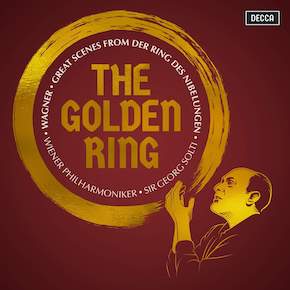
thegoldenringGeorg Solti’s recording of Wagner’s Ring cycle made between 1958 and 1966 has probably had more words written about it than any other classical recording.  They are perhaps best. summed up by Gramophone Magazines comment that it is “The greatest of all the achievements in the history of the gramophone record”.  It’s an amzing cast that no-one could afford to assemble for a studio recording today, it’s the Wiener Philharmoiker and, of course, Solti himself.  But most opera lovers and certainly the audiophile ones will know all this.  So why am I writing about it?
Continue reading

The Dutchman returns

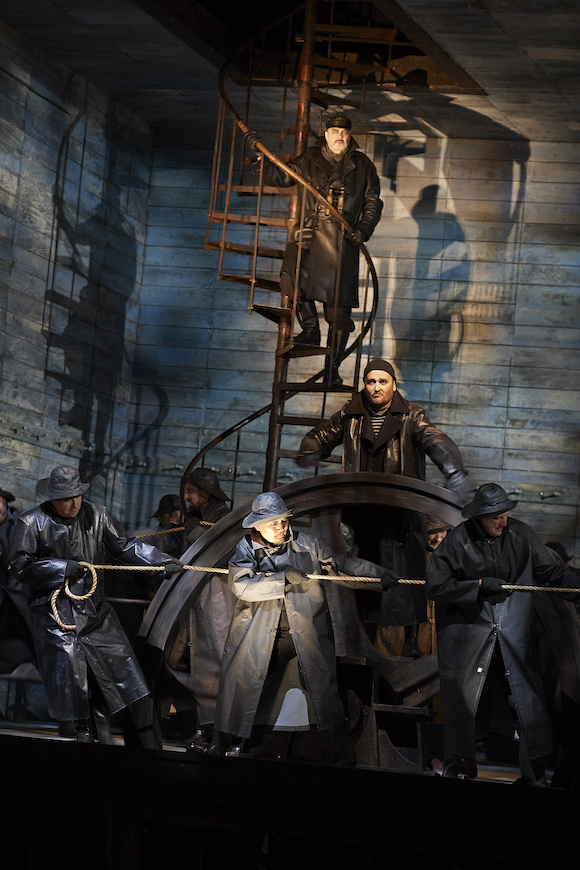
The COC’s 2022/23 season opened last night with a revival of David Alden’s production of Wagner’s Der fliegender Holländer with Marilyn Gronsdal directing.  It’s been eleven years since this production was last seen and, if memory serves, it created some controversy back then, chiefly on account of the Dutchman’s “zombie” crew.  Seeing it again it’s hard to see what the fuss was about.  It’s actually a very straightforward production where sailing ships are sailing ships and spinning sheds feature textile workers.  The only deviation from the libretto that I noticed was Senta’s death.  Here she’s shot by Erik while holding up a picture of the Dutchman.

22-23-01-MC-D-0052-55

Continue reading

Tcherniakov’s Holländer

Dmitri Tcherniakov directed Der fliegende Holländer in Bayreuth in 2021 where it was recorded.  It’s no surprise given (a)Tcherniakov and (b)Bayreuth that it’s not a straightforward production.  I’m not sure I have fully unpacked it and there isn’t anything in the disk package to help (just the usual essay telling the reader what he/she/they already know/s).

1.prologue

Continue reading

Make Brabant Great Again

Yuval Sharon’s Lohengrin in 2018 at the Bayreuth Festival was the first production there by an American director and, perhaps unsurprisingly, there are echoes of contemporary events in the US in the show.  Specifically Sharon’s Brabant is a conformist theocracy in which society has regressed technologically.  Some of the action takes place in and around a prominently placed disused electrical installation of some kind.  The Brabanters are cowardly and subservient, initially to Telramund and then, equally, to Lohengrin.  The advent of a charismatic leader. does not necessarily equate to liberation or full citizenship.  Sharon also claims in his director’s notes that the real dissenter is Ortrud and that it is her actions that liberate Elsa and Gottfried.  Whether the staging supports this is, I think, questionable.

1.elsa_pyre

Continue reading

Ambitious Parsifal

Wagner’s Parsifal both attracts and repels.  It has gorgeous music but a problematic plot that, on the surface, is a weird mash up of Christian symbolism, medieval romance and (more than likely) anti-Semitism.  With reference to the latter it’s no great surprise that an Israeli conductor taking on the work would want to take an approach that deals with that aspect head on.  That’s what Omer Meir Wellber does, with the willing collaboration of director Graham Vick in a production staged and recorded at the Teatro Massimo in Palermo in 2020.

1.amfortasgurnemanzkundry

Continue reading

A metatheatrical Tannhäuser

The more I see of Tobias Kratzer’s work the more impressed I get.  Here we look at his 2019 production of Wagner’s Tannhäuser at Bayreuth.  It’s the kind of production that traditionalists get off on hating and there were boos at curtain call though they were absolutely drowned out by a storm of applause and stomping.  Personally, I found it insightful, at times very funny, and deeply, deeply moving.

1.hut

Continue reading